Stump the Prof: An Activity for Calculus I

After finishing the Product, Quotient, and Chain Rules in my calculus class, I’d tell my class the following: “Next time, we’re going to play Stump the Prof. Anything that you can write on the board in 15 seconds, I will differentiate. Anything. I don’t care how hard it looks, I’ll differentiate it (if it has a derivative). So do your best to stump me.”

At the next lecture, I would devote the last 15-20 minutes of class time to Stump the Prof. Students absolutely loved it… their competitive juices got flowing as they tried to think of the nastiest, hairiest functions that they could write on the board in 15 seconds. And I’d differentiate them all using the rules we’d just covered.. though I never promised that I would simplify the derivatives!

Sometimes the results were quite funny. Every once in a while, a student would write some amazingly awful expression but forgot to include an x anywhere. Since the given function was a constant, the derivative of course was zero.

The worst one I ever got was something like this:

y = \csc^4(\sec^5(\csc^8(\sec^7(\csc^4(\sec^5(x)))))

Differentiating this took a good 3-4 minutes and took maybe 5 lines across the entire length of the chalkboard; I remember that my arm was sore after writing down the derivative. Naturally, some wise guy used his 15 seconds to write y = in front of my answer, asking me to find the second derivative. At that, I waved my white handkerchief and  surrendered.

The point of this exercise is to illustrate to students that differentiation is a science; there are rules to follow, and by carefully following the rules, one can find the derivative of any “standard” function.

Later on, when we hit integration, I’ll draw a contrast: differentiation is a science, but integration is a combination of both science and art.


Mathematics that Swings: The Math Behind Golf

From the YouTube description:

Mathematics is everywhere, and the golf course is no exception. Many aspects of the game of golf can be illuminated or improved through mathematical modeling and analysis. We will discuss a few examples, employing mathematics ranging from simple high school algebra to computational techniques at the frontiers of contemporary research.

Preparation for Industrial Careers in the Mathematical Sciences: Building a Better Filter

The Mathematical Association of America recently published a number of promotional videos showing various mathematics can be used in “the real world.” Here’s the third pair of videos describing how mathematics is used for certain problems in materials science. From the YouTube descriptions:

Dr. Sumanth Swaminathan of W. L. Gore & Associates talks about his career path and the research questions about filtration that he considers. He works to understand the different waste capture mechanisms of filtration devices and to mathematically optimize the microstructure to create better filters.

Prof. Louis Rossi of the Department of Mathematical Sciences of the University of Delaware presents two introductory mathematical models that one can use to understand and characterize filters and the filtration processes.


How I Impressed My Wife: Index

Some husbands try to impress their wives by lifting extremely heavy objects or other extraordinary feats of physical prowess.

That will never happen in the Quintanilla household in a million years.

But she was impressed that I broke an impasse in her research and resolved a discrepancy between Mathematica 4 and Mathematica 8 by finding the following integral by hand in less than an hour:

\displaystyle \int_0^{2\pi} \frac{dx}{\cos^2 x + 2 a \sin x \cos x + (a^2 + b^2) \sin^2 x}

Yes, I married well indeed.

In this post, I collect the posts that I wrote last summer regarding various ways of computing this integral.

Part 1: Introduction
Part 2a, 2b, 2c, 2d, 2e, 2f: Changing the endpoints of integration, multiplying top and bottom by \sec^2 x, and the substitution u = \tan x.
Part 3a, 3b, 3c, 3d, 3e, 3f, 3g, 3h, 3i: Double-angle trig identity, combination into a single trig function, changing the endpoints of integration, and the magic substitution u = \tan \theta/2.
Part 4a, 4b, 4c, 4d, 4e, 4f, 4g, 4h: Double-angle trig identity, combination into a single trig function, changing the endpoints of integration, and contour integration using the unit circle
Part 5a, 5b, 5c, 5d, 5e, 5f, 5g, 5h, 5i, 5j: Independence of the parameter a, the magic substitution u = \tan \theta/2, and partial fractions.
Part 6a, 6b, 6c, 6d, 6e, 6f, 6g:Independence of the parameter a, the magic substitution u = \tan \theta/2, and contour integration using the real line and an expanding semicircle.
Part 7: Concluding thoughts… and ways that should work that I haven’t completely figured out yet.

Thoughts on Infinity (Part 3g)

We have seen in recent posts that

$latex  \displaystyle 1 – \frac{1}{2} + \frac{1}{3} – \frac{1}{4} + \frac{1}{5} – … = \ln 2$

One way of remembering this fact is by using the Taylor series expansion for \ln(1+x):

\ln(1+x) = x - \displaystyle \frac{x^2}{2} + \frac{x^3}{3} - \frac{x^4}{4} + \frac{x^5}{5} \dots

“Therefore,” the first series can be obtained from the second series by substituting x=1.

I placed “therefore” in quotation marks because this reasoning is completely invalid, even though it happens to stumble across the correct answer in this instance. The radius of convergence for the above Taylor series is 1, which can be verified by using the Ratio Test. So the series converges absolutely for |x| < 1 and diverges for |x| > 1. The boundary of |x| = 1, on the other hand, has to be checked separately for convergence.

In other words, plugging in x=1 might be a useful way to remember the formula, but it’s not a proof of the formula and certainly not a technique that I want to encourage students to use!

It’s easy to find examples where just plugging in the boundary point happens to give the correct answer (see above). It’s also easy to find examples where plugging in the boundary point gives an incorrect answer because the series actually diverges: for example, substituting x = -1 into the geometric series

\displaystyle \frac{1}{1-x} = 1 + x + x^2 + x^3 + x^4 + \dots

However, I’ve been scratching my head to think of an example where plugging in the boundary point gives an incorrect answer because the series converges but converges to a different number. I could’ve sworn that I saw an example like this when I was a calculus student, but I can’t see to find an example in reading Apostol’s calculus text.


Thoughts on Infinity (Part 3f)

In recent posts, we’ve seen the curious phenomenon that the commutative and associative laws do not apply to a conditionally convergent series or infinite product: while

\displaystyle 1 - \frac{1}{2} + \frac{1}{3} - \frac{1}{4} + \frac{1}{5} - ... = \ln 2,

a rearranged series can be something completely different:

\displaystyle 1 + \frac{1}{3} - \frac{1}{2} + \frac{1}{5} + \frac{1}{7} - \frac{1}{4} + \frac{1}{9} + \frac{1}{11} - \frac{1}{6} ... = \displaystyle \frac{3}{2} \ln 2.

This very counterintuitive result can be confirmed using commonly used technology — in particular, Microsoft Excel. In the spreadsheet below, I typed:

  • =IF(MOD(ROW(A1),3)=0,ROW(A1)*2/3,IF(MOD(ROW(A1),3)=1,4*(ROW(A1)-1)/3+1,4*(ROW(A1)-2)/3+3)) in cell A1
  • =POWER(-1,A1-1)/A1 in cell B1
  • =B1 in cell C1
  • I copied cell A1 into cell A2
  • =POWER(-1,A2-1)/A2 in cell B2
  • =C1+B2 in cell C2

The unusual command for cell A1 was necessary to get the correct rearrangement of the series.

Then I used the FILL DOWN command to fill in the remaining rows. Using these commands cell C9 shows the sum of all the entries in cells B1 through B9, so that

\displaystyle 1 + \frac{1}{3} - \frac{1}{2} + \frac{1}{5} + \frac{1}{7} - \frac{1}{4} + \frac{1}{9} + \frac{1}{11} - \frac{1}{6} \approx 0.961544012

log2series6

Filling down to additional rows demonstrates that the sum converges to \displaystyle \frac{3}{2}\ln 2 and not to \ln 2. Here’s the sum up to 10,000 terms… the entry in column E is the first few digits in the decimal expansion of \displaystyle \frac{3}{2} \ln 2. log2series7

Clearly the partial sums are not approaching \ln 2 \approx 0.693, and there’s good visual evidence to think that the answer is \displaystyle \frac{3}{2} \ln 2 instead. (Incidentally, the 10,000th partial sum is very close to the limiting value because 10,000 is one more than a multiple of 3.)


Thoughts on Infinity (Part 3e)

In recent posts, we’ve seen the curious phenomenon that the commutative and associative laws do not apply to a conditionally convergent series or infinite product. Here’s another classic example of this fact that’s attributed to Cauchy.

We’ve already seen in this series (pardon the pun) that

\displaystyle 1 - \frac{1}{2} + \frac{1}{3} - \frac{1}{4} + \frac{1}{5} - ... = \ln 2.

Let’s now see what happens if I rearrange the terms of this conditionally convergent series. Let

T = \displaystyle 1 + \frac{1}{3} - \frac{1}{2} + \frac{1}{5} + \frac{1}{7} - \frac{1}{4} + \frac{1}{9} + \frac{11} - \frac{1}{6} \dots,

where two positive numbers alternate with a single negative term. By all rights, this shouldn’t affect anything… right?

Let s_n be the nth partial sum of this series, so that s_{3n} contains 2n positive terms with odd denominators and n negative terms with even denominators:

s_{3n} = \displaystyle \sum_{k=1}^{2n} \frac{1}{2n-1} - \sum_{k=1}^n \frac{1}{2n}.

Let me now add and subtract the “missing” even terms in the first sum:

s_{3n} = \displaystyle \sum_{k=1}^{2n} \frac{1}{2n-1} + \sum_{k=1}^{2n} \frac{1}{2n} - \sum_{k=1}^{2n} \frac{1}{2n} - \sum_{k=1}^n \frac{1}{2n}

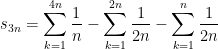
s_{3n} = \displaystyle \sum_{k=1}^{4n} \frac{1}{n} - \sum_{k=1}^{2n} \frac{1}{2n} - \sum_{k=1}^n \frac{1}{2n}

s_{3n} = \displaystyle \sum_{k=1}^{4n} \frac{1}{n} - \frac{1}{2} \sum_{k=1}^{2n} \frac{1}{n} - \frac{1}{2} \sum_{k=1}^n \frac{1}{n}.

For reasons that will become apparent, I’ll now rewrite this as

s_{3n} = \displaystyle \int_1^{4n} \frac{dx}{x} + \left( \sum_{k=1}^{4n} \frac{1}{k} - \displaystyle \int_1^{4n} \frac{dx}{x} \right)

- \displaystyle \frac{1}{2} \int_1^{2n} \frac{dx}{x} - \frac{1}{2} \left( \sum_{k=1}^{2n} \frac{1}{k} - \int_1^{2n} \frac{dx}{x} \right)

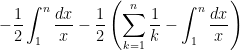
- \displaystyle \frac{1}{2} \int_1^{n} \frac{dx}{x} - \frac{1}{2} \left( \sum_{k=1}^{n} \frac{1}{k} - \int_1^{n} \frac{dx}{x} \right),

or

s_{3n} = \ln(4n) - \ln 1 + \displaystyle \left( \sum_{k=1}^{4n} \frac{1}{k} - [\ln(4n) - \ln 1]\right)

- \displaystyle \frac{1}{2}[\ln (2n) - \ln 1] - \displaystyle \frac{1}{2} \left( \sum_{k=1}^{2n} \frac{1}{k} - [\ln (2n) - \ln 1]\right)

- \displaystyle \frac{1}{2}[\ln n - \ln 1] - \displaystyle \frac{1}{2} \left( \sum_{k=1}^{n} \frac{1}{k} - [\ln n - \ln 1]\right)

Since \ln 1 = 0, \ln(2n) = \ln 2 + \ln n, and \ln(4n) = \ln 4 + \ln n = 2\ln 2 + \ln n, we have

s_{3n} = 2\ln 2 + \ln n + \displaystyle \left( \sum_{k=1}^{4n} \frac{1}{k} - \ln 4n \right)

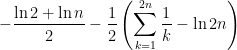
\displaystyle - \frac{\ln 2 + \ln n}{2} - \displaystyle \frac{1}{2} \left( \sum_{k=1}^{2n} \frac{1}{k} - \ln 2n \right)

\displaystyle - \frac{\ln n}{2} - \frac{1}{2} \displaystyle \left( \sum_{k=1}^{n} \frac{1}{k} - \ln n \right),

or

s_{3n}= \displaystyle \frac{3}{2}\ln 2 + \displaystyle \left( \sum_{k=1}^{4n} \frac{1}{k} - \ln 4n \right) - \frac{1}{2}\left( \sum_{k=1}^{2n} \frac{1}{k} - \ln 2n\right) - \frac{1}{2}\left( \sum_{k=1}^{n} \frac{1}{k} - \ln n\right).

I now take the limit as m \to \infty:

\displaystyle \lim_{n \to \infty} s_{3n} = \displaystyle \frac{3}{2}\ln 2 + \lim_{n \to \infty} \left( \sum_{k=1}^{4n} \frac{1}{k} - \ln 4n \right) - \frac{1}{2} \lim_{n \to \infty} \left( \sum_{k=1}^{2n} \frac{1}{k} - \ln 2n\right) - \frac{1}{2} \lim_{n \to \infty} \left( \sum_{k=1}^{n} \frac{1}{k} - \ln n\right).

This step reveals why I added and subtracted the integrals above: those gymnastics were necessary in order to reach a limit that converges.

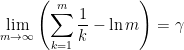
As shown earlier in this series, if

\displaystyle \lim_{m \to \infty} \left( \sum_{k=1}^m \frac{1}{k} - \ln m \right) = \gamma,

the Euler-Mascheroni constant. Therefore, since the limit of any subsequence must converge to the same limit, we have

Applying these above, we conclude

\displaystyle \lim_{m \to \infty} s_{3n} = \displaystyle \frac{3}{2}\ln 2 + \gamma - \frac{1}{2}\gamma - \frac{1}{2} \gamma = \displaystyle \frac{3}{2} \ln 2,

which is different than \ln 2.

Technically, I’ve only shown so far that the limit of partial sums 3, 6, 9, … is \displaystyle\frac{3}{2} \ln 2. For the other partial sums, I note that

\displaystyle \lim_{n \to \infty} t_{3n+1} = \displaystyle \lim_{n \to \infty} \left(s_{3n} + \displaystyle \frac{1}{4n+1} \right) = \displaystyle \frac{3}{2} \ln 2 + 0 = \displaystyle \frac{3}{2} \ln 2

and

\displaystyle \lim_{n \to \infty} t_{3n-1} = \displaystyle \lim_{n \to \infty} \left(s_{3n} - \displaystyle \frac{1}{2n} \right) = \displaystyle \frac{3}{2} \ln 2 - 0 = \displaystyle \frac{3}{2} \ln 2.

Therefore, I can safely conclude that

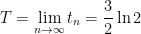
T = \displaystyle \lim_{n \to \infty} t_n = \displaystyle \frac{3}{2} \ln 2,

which is different than the original sum S.