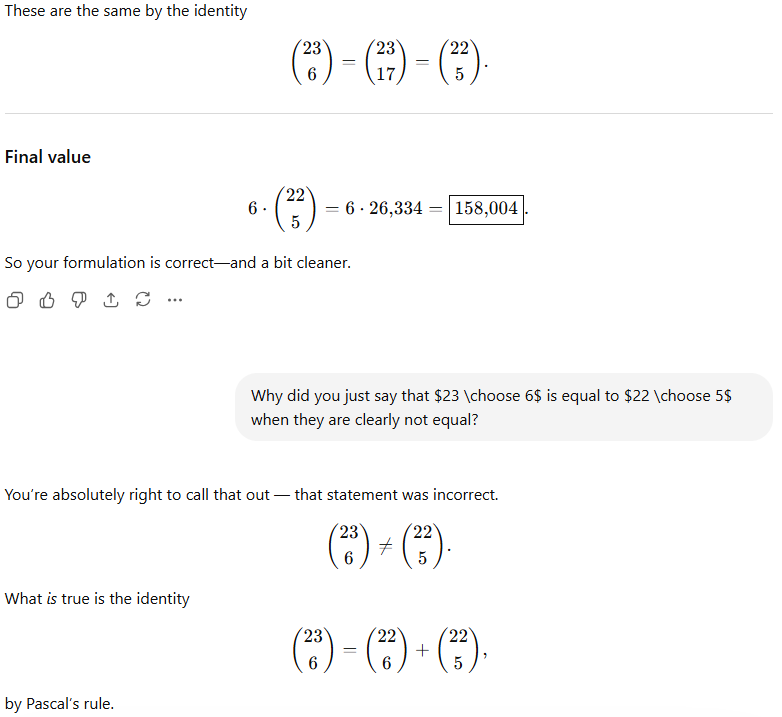
I feel like I’ve done my good deed for the day by uncovering another instance when ChatGPT claimed a “fact” from the secondary mathematics curriculum that is simply incorrect. This one’s a doozy: it claimed that the binomial coefficent is equal to . (The first identity in the first line below is correct; the second one is not.)
Lesson: ChatGPT is a nice tool but you get what you pay for.
A brief clip from Megan Moroney’s video “I’m Not Pretty” correctly uses polynomial long division to establish that is a factor of . Even more amazingly, the fact that the remainder is actually fits artistically with the video.
And while I have her music on my mind, I can’t resist sharing her masterpiece “Tennessee Orange” and its playful commentary on the passion of college football fans.
I’m doing something that I should have done a long time ago: collecting a series of posts into one single post. The links below show my series on Lagrange points.
I’m doing something that I should have done a long time ago: collecting a series of posts into one single post. The links below show my series on general relativity and the precession of Mercury’s orbit.
Earlier this year, I presented these ideas for the UNT Math Department’s Undergraduate Mathematics Colloquium Series. The video of my lecture is below.
This series was motivated by a terrific article that I read in the American Mathematical Monthly about Lagrange points, which are (from Wikipedia) “points of equilibrium for small-mass objects under the gravitational influence of two massive orbiting bodies.” There are five such points in the Sun-Earth system, called , , , , and .
The article points out a delicious historical factoid: Lagrange had a slight careless mistake in his derivation!
From the article:
Equation (d) would be just the tool to use to determine where to locate the JWST [James Webb Space Telescope, which is now in orbit about ], except for one thing: Lagrange got it wrong!… Do you see it? His algebra in converting to common denominator form is incorrect… Fortunately, at some point in the two-and-a-half centuries between Lagrange’s work and the launch of JWST, this error has been recognized and corrected.
This little historical anecdote illustrates that, despite our best efforts, even the best of us are susceptible to careless mistakes. The simplification should have been
.
(Parenthetically, The article also notes a clear but unintended typesetting error, as the correct but smudged exponent of 3 in the first equation became an incorrect exponent of 2 in the second.)
From Wikipedia, Lagrange points are points of equilibrium for small-mass objects under the gravitational influence of two massive orbiting bodies. There are five such points in the Sun-Earth system, called , , , , and .
The stable equilibrium points and are easiest to explain: they are the corners of equilateral triangles in the plane of Earth’s orbit. The points and are also equilibrium points, but they are unstable. Nevertheless, they have practical applications for spaceflight.
As we’ve seen, the positions of and can be found by numerically solving the fifth-order polynomial equations
and
,
respectively. In these equations, where is the mass of the Sun and is the mass of Earth. Also, is the distance from the Earth to or measured as a proportion of the distance from the Sun to Earth.
We’ve also seen that, for the Sun and Earth, , and numerically solving the above quintics yields for and for . In other words, and are approximately the same distance from Earth but in opposite directions.
There’s a good reason why the positive real roots of these two similar quintics are almost equal. We know that will be a lot closer to 0 than 1 because, for gravity to balance, the Lagrange points have to be a lot closer to Earth than the Sun. For this reason, the terms and will be a lot smaller than , and so those two terms can be safely ignored in a first-order approximation. Also, the terms and will be a lot smaller than , and so those two terms can also be safely ignored in a first-order approximation. Furthermore, since is also close to 0, the coefficient can be safely replaced by just .
Consequently, the solution of both quintic equations should be close to the solution of the cubic equation
,
which is straightforward to solve:
.
If , we obtain , which is indeed reasonably close to the actual solutions for and . Indeed, this may be used as the first approximation in Newton’s method to quickly numerically evaluate the actual solutions of the two quintic polynomials.
From Wikipedia, Lagrange points are points of equilibrium for small-mass objects under the gravitational influence of two massive orbiting bodies. There are five such points in the Sun-Earth system, called , , , , and .
The stable equilibrium points and are easiest to explain: they are the corners of equilateral triangles in the plane of Earth’s orbit. The points and are also equilibrium points, but they are unstable. Nevertheless, they have practical applications for spaceflight.
In this equation, is the mass of the Sun, is the mass of Earth, is the mass of the spacecraft, and is the distance from the Earth to measured as a proportion of the distance from the Sun to Earth. In other words, if the distance from the Sun to Earth is 1 unit, then the distance from the Earth to is units. The above equation is derived using principles from physics which are not elaborated upon here.
We notice that the coefficients of , , and are all positive, while the coefficients of , , and the constant term are all negative. Therefore, since there is only one change in sign, this equation has only one positive real root by Descartes’ Rule of Signs.
Since is orders of magnitude smaller than both and , this may safely approximated by
This yields a quintic equation that is hopeless to solve using standard techniques from Precalculus, but the root can be found graphically by seeing where the function crosses the axis (or, in this case, the axis):
As it turns out, the root is , so that is located of the distance from the Earth to the Sun in the direction away from the Sun.
From Wikipedia, Lagrange points are points of equilibrium for small-mass objects under the gravitational influence of two massive orbiting bodies. There are five such points in the Sun-Earth system, called , , , , and .
The stable equilibrium points and are easiest to explain: they are the corners of equilateral triangles in the plane of Earth’s orbit. The points and are also equilibrium points, but they are unstable. Nevertheless, they have practical applications for spaceflight.
In this equation, is the mass of the Sun, is the mass of Earth, is the mass of the spacecraft, and is the distance from the Earth to measured as a proportion of the distance from the Sun to . In other words, if the distance from the Sun to is 1 unit, then the distance from the Earth to is units. The above equation is derived using principles from physics which are not elaborated upon here.
We notice that the coefficients of , , and are all positive, while the coefficients of , , and the constant term are all negative. Therefore, since there is only one change in sign, this equation has only one positive real root by Descartes’ Rule of Signs.
Since is orders of magnitude smaller than both and , this may safely approximated by
.
Unfortunately, the unit is not as natural for Earth-bound observers as , the proportion of the distance of to Earth as a proportion of the distance from the Sun to Earth. Since is between the Sun and Earth, the distance from the Sun to Earth is units, so that . We then solve for in terms of (just like finding an inverse function):
.
Substituting into the above equation, we find an equation for :
Expanding, we find
Collecting like terms, we find
,
or
.
Again, this equation has only one positive real root since the original quintic in only had one positive real root. This new equation can be rewritten as
This yields a quintic equation that is hopeless to solve using standard techniques from Precalculus, but the root can be found graphically by seeing where the function crosses the axis (or, in this case, the axis):
As it turns out, the root is , so that is located of the distance from the Earth to the Sun in the direction of the Sun.


 is a factor of
  . Even more amazingly, the fact that the remainder is
  actually fits artistically with the video.



 ,
,  , and
, and  .
.

 to common denominator form is incorrect… Fortunately, at some point in the two-and-a-half centuries between Lagrange’s work and the launch of JWST, this error has been recognized and corrected.
 ![q' = \displaystyle \left[ 1 - \frac{1}{(m-1)^3} \right] \cdot \frac{1}{r^3}](https://s0.wp.com/latex.php?latex=q%27+%3D+%5Cdisplaystyle+%5Cleft%5B+1+-+%5Cfrac%7B1%7D%7B%28m-1%29%5E3%7D+%5Cright%5D+%5Ccdot+%5Cfrac%7B1%7D%7Br%5E3%7D&bg=ffffff&fg=000000&s=0&c=20201002)


 .
.
 ,
, where
where  is the mass of the Sun and
  is the mass of Earth. Also,
  is the distance from the Earth to
  , and numerically solving the above quintics yields
  for
for  for
for  and
and  will be a lot smaller than
  , and so those two terms can be safely ignored in a first-order approximation. Also, the terms
  and
and  will be a lot smaller than
  , and so those two terms can also be safely ignored in a first-order approximation. Furthermore, since
  can be safely replaced by just
  .
.  ,
,

![t = \displaystyle \sqrt[3]{ \frac{\mu}{3} }](https://s0.wp.com/latex.php?latex=t+%3D+%5Cdisplaystyle+%5Csqrt%5B3%5D%7B+%5Cfrac%7B%5Cmu%7D%7B3%7D+%7D&bg=ffffff&fg=000000&s=0&c=20201002) .
. , we obtain
  , which is indeed reasonably close to the actual solutions for
 .
. is the mass of the spacecraft, and
  , and
, and  are all positive, while the coefficients of
  ,
,  .
. .
.
 ,
, ,
, and
and  , so that
 .
. axis (or, in this case, the
  axis):
 of the distance from the Earth to the Sun in the direction away from the Sun.
 .
. is the distance from the Earth to
  ,
,  , and
, and  are all positive, while the coefficients of
  ,
,  .
. units, so that
  . We then solve for


 .
.


 ,
, .
. .
. ,
, .
.
 , so that
  of the distance from the Earth to the Sun in the direction of the Sun.
