A natural function with discontinuities (Part 3)

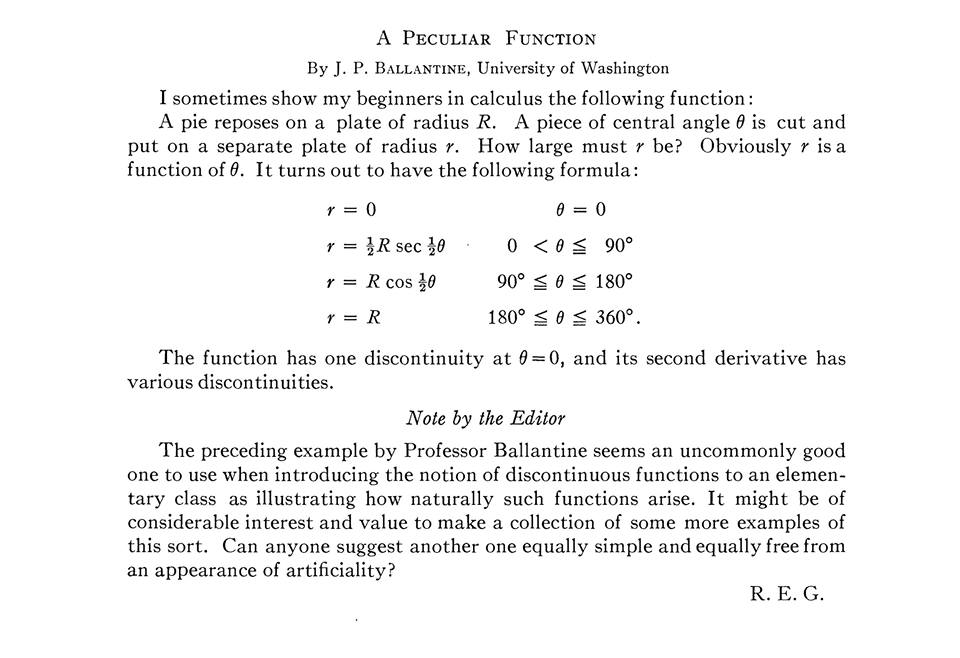
This post concludes this series about a curious function:

discontinuousIn the previous post, I derived three of the four parts of this function. Today, I’ll consider the last part (90^\circ \le \theta \le 180^\circ).

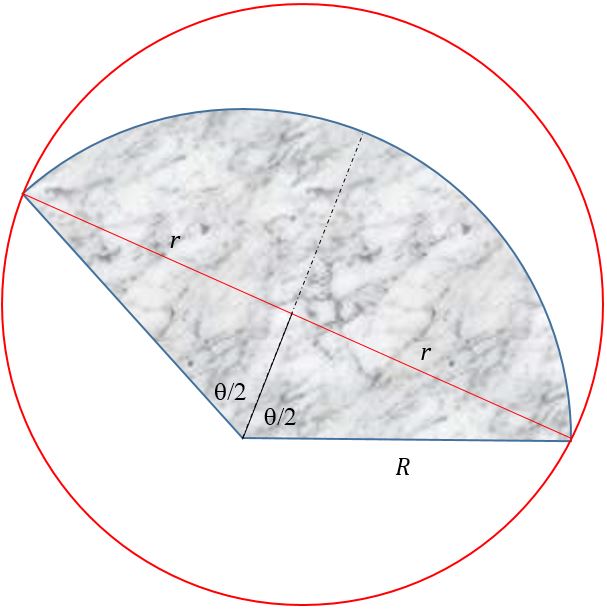
obtuseangleThe circle that encloses the grey region must have the points (R,0) and (R\cos \theta, R \sin \theta) on its circumference; the distance between these points will be 2r, where r is the radius of the enclosing circle. Unlike the case of \theta < 90^\circ, we no longer have to worry about the origin, which will be safely inside the enclosing circle.

Furthermore, this line segment will be perpendicular to the angle bisector (the dashed line above), and the center of the enclosing circle must be on the angle bisector. Using trigonometry,

\sin \displaystyle \frac{\theta}{2} = \frac{r}{R},

or

r = R \sin \displaystyle \frac{\theta}{2}.

We see from this derivation the unfortunate typo in the above Monthly article.

Engaging students: Graphing Sine and Cosine Functions

In my capstone class for future secondary math teachers, I ask my students to come up with ideas for engaging their students with different topics in the secondary mathematics curriculum. In other words, the point of the assignment was not to devise a full-blown lesson plan on this topic. Instead, I asked my students to think about three different ways of getting their students interested in the topic in the first place.

I plan to share some of the best of these ideas on this blog (after asking my students’ permission, of course).

This student submission comes from my former student Emma Sivado. Her topic, from Precalculus: graphing sine and cosine functions.

green line

D.1: What interesting things can you say about the people who contributed to the discovery and/or the development of this topic?

First, I would pose the question “how did the Egyptians build the pyramids without calculators without measuring tapes and without the advanced mathematics we have today?” After a short discussion I would ask them if we want to build a pyramid that is 250 meters high and the base is 360 meters long how long would we need to make the hypotenuse? Already knowing the Pythagorean Theorem the students would be able to answer the question. Then, I would tell them that historians have found Egyptian scribes asking questions such as these in order to build the pyramids, and systems of ropes with knots were used to measure lengths. These relationships in right triangles created the sine and cosine functions we know today. Sine and cosine date back to 1900 BC where they were used to calculate angles in order to track the motion of the planets and stars. However, the definition of sine and cosine in terms of right triangles was not recorded until 1596 AD by Copernicus.

http://www.math.ucdenver.edu/~jloats/Student%20pdfs/40_Trigonometry_Trenkamp.pdf


green line

A.2: How could you as a teacher create an activity or project that involves your topic?

I found a great activity that encompasses all of the aspects of graphing sine and cosine on the University of Arizona website. Depending on how transformations in the linear and quadratic functions were introduced, this activity could follow the same pattern; allowing the students to explore the ideas themselves and having them put the content into their own words. The activity begins by giving an example of a bug walking on an upright loop. The instructor asks the students what the graph would look like of the bug’s distance from the ground vs. time. I would probably use a different, more concrete example because there are plenty of things the students know that go around in circles. The best example I think is a Ferris wheel. So after the students are able to tell you what the graph would look like you relate that to the unit circle and how the sine and cosine functions follow the same pattern of going around the circle counterclockwise. Next, you let the students plot points from the unit circle onto the Cartesian plane showing them that their prediction was correct; the sine and cosine functions make a wave. Now that they have drawn the parent function you let them explore the functions f(x) = asinx or f(x)= acosx, then f(x) = sin(bx) or f(x) = cos(bx), then finally f(x) = sin(x+c) or f(x) = cos(x+c) to let them discover how a, b, and c change the amplitude, period, frequency, and starting point of the graphs.

This is a great activity because the students use multiple examples to see how a, b, and c affect the parent graph of sine and cosine. The activity promotes inquiry based learning and will help deepen the understanding of the graphs of sine and cosine.

http://ime.math.arizona.edu/g-teams/Profiles/JC/Graphing_Sine_and_Cosine_2013.pdf


green line

E.1: How can technology (YouTube, Khan Academy [khanacademy.org], Vi Hart, Geometers Sketchpad, graphing calculators, etc.) be used to effectively engage students with this topic? Note: It’s not enough to say “such-and-such is a great website”; you need to explain in some detail why it’s a great website.

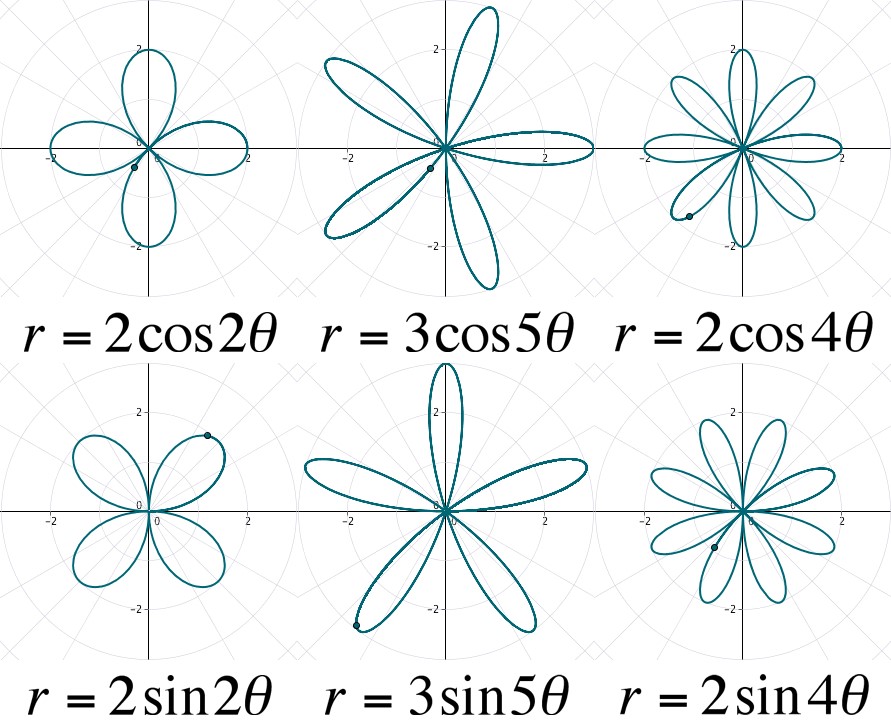
Math can be seen in many forms of art from music to painting. I remember one of my favorite activities from math in high school was creating pictures with sine and cosine functions. We were able to draw flowers, clovers, and hearts simply with only the sine and cosine functions. After the students understand the parent function you can give them an exploration activity on their graphing calculator where they plug in various sine and cosine functions to draw flowers, clovers, and hearts. After that challenge the students to draw their own picture using the patterns they see from the examples. These same ideas can be used in computer graphics and animation to draw similar figures, and a lot of students are interested in computers and especially video games so this should be a fun activity for them.

clovers

ftp://arts.ucsc.edu/pub/ems/DANM%20220-2012/Drawing%20with%20trig.pdf

Engaging students: Defining sine, cosine and tangent in a right triangle

In my capstone class for future secondary math teachers, I ask my students to come up with ideas for engaging their students with different topics in the secondary mathematics curriculum. In other words, the point of the assignment was not to devise a full-blown lesson plan on this topic. Instead, I asked my students to think about three different ways of getting their students interested in the topic in the first place.

I plan to share some of the best of these ideas on this blog (after asking my students’ permission, of course).

This student submission comes from my former student Loc Nguyen. His topic, from Geometry: defining sine, cosine and tangent in a right triangle.

green line

What interesting (i.e., uncontrived) word problems using this topic can your students do now?

There are many real world applications that involve in this topic and I will incorporate some problems in real life to engage the students.  Suppose I have a classroom that has the shape of rectangular prism.  I will begin my lesson by challenging the students to find the height of the classroom and of course I will award them with something cool.  I believe this will ignite students’ curiosity and excitement to participate into the problem.  In the process of finding the height, I will gradually introduce the concept of right triangle trigonometry.  The students will learn the relationship of ratios of the sides in the triangle.  Eventually, the students will realize that they need this concept for finding the height of the classroom.  I will pose some guiding questions to drive them toward the solution.  Such questions could be: what can I measure? Can we measure the angle from our eyes to the opposite corner of the ceiling point?   What formula will help me to find the height?
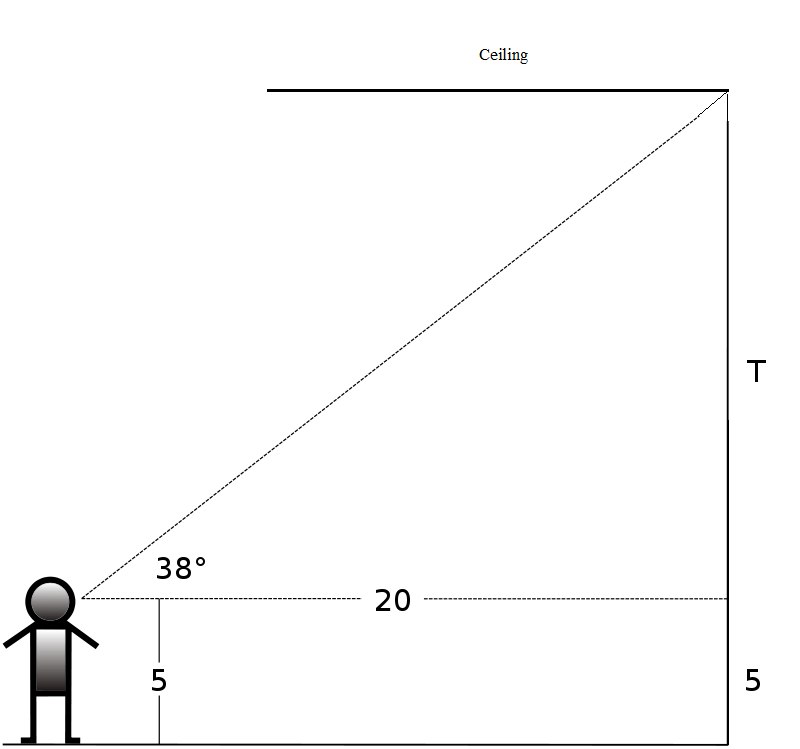
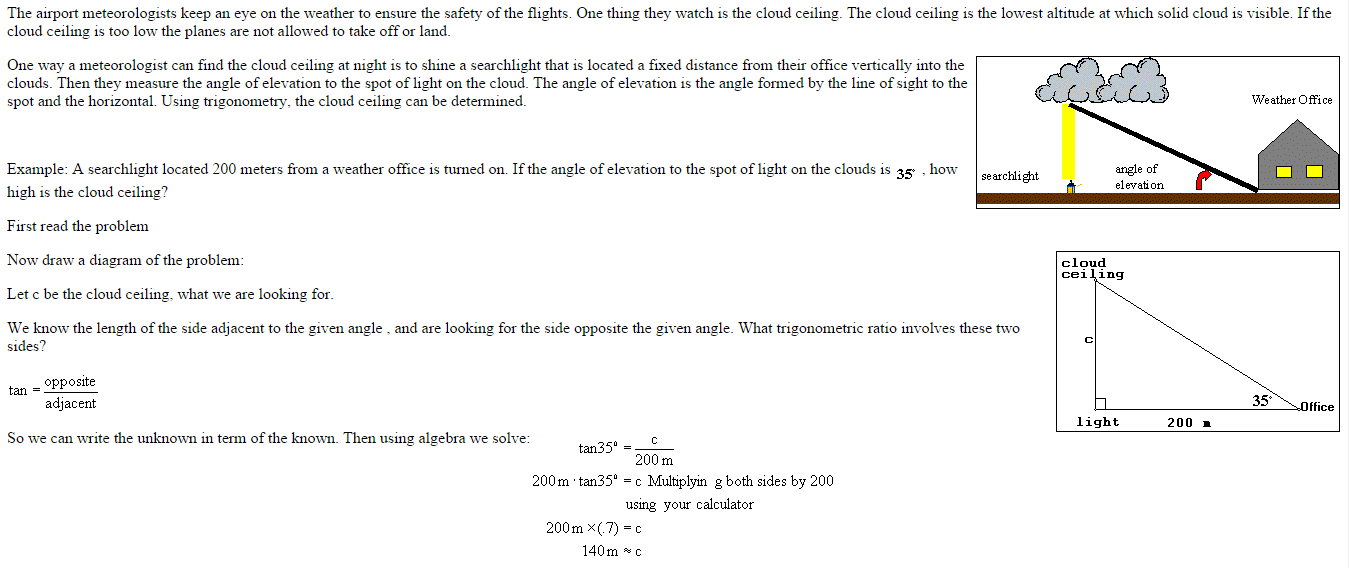
trig1


After this problem I will provide them many different real world problems to practice such as:
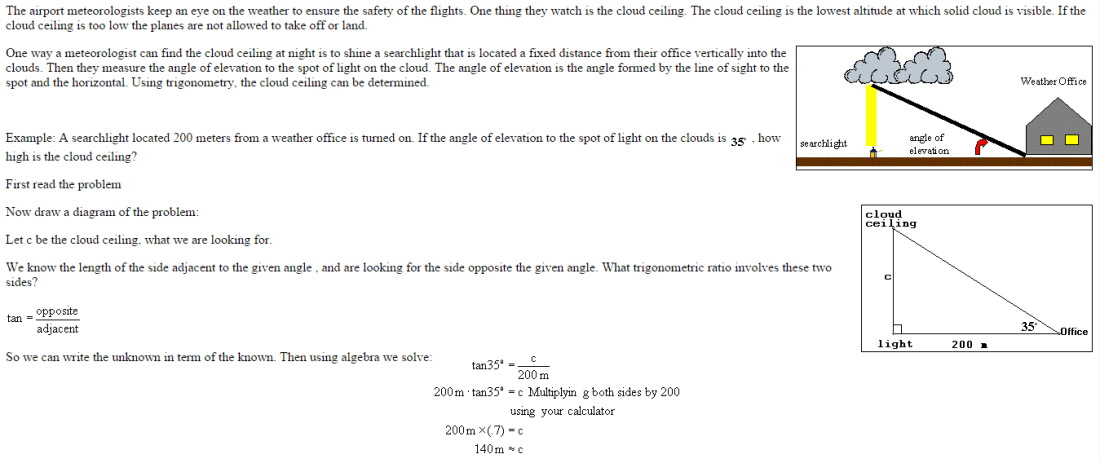
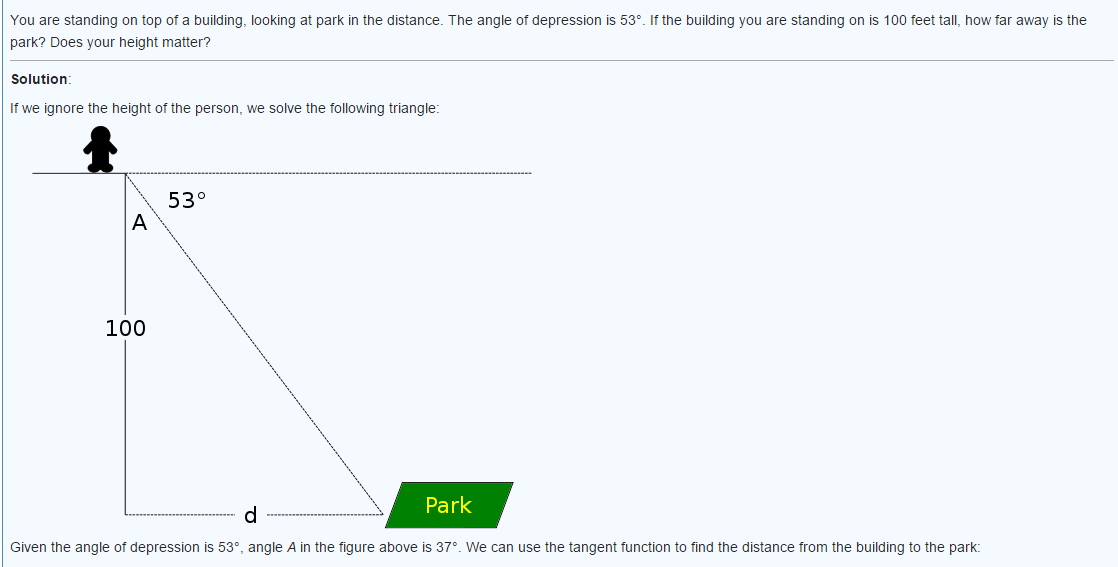
trig2 trig3


green line

How can this topic be used in your students’ future courses in mathematics or science?

Knowing how to compute sine, cosine or tangent in the right triangle will help students a lot when they get to higher level math or other science class, especially Physics.  In higher level math, students will always have the chance to encounter this concept.  For example, in Pre-Calculus, the students will likely learn about polar system.  This requires students to have the strong fundamental understandings of sine, cosine and tangent in a right triangle.  Students will be asked to convert from the Cartesian system to polar system, or vice versa.  If they do not grasp the ideas of this topic, they will eventually encounter huge obstacles in future.  In science, especially physics, the students will learn a lot about the motions of an objects.  This will involve concepts of force, velocity, speed, momentum.  The students will need to understand the how to compute sine, cosine and tangent in the right triangle so that they can easily know how to approach the problems in physics.

green line

How can technology (YouTube, Khan Academy [khanacademy.org], Vi Hart, Geometers Sketchpad, graphing calculators, etc.) be used to effectively engage students with this topic?

This website, https://www.geogebra.org/material/simple/id/48148 , can be a great tool for the students to understand the relationships of the sides in the right triangle.  The website creates an activity for students to explore the ratios of the sides such as AC/BC, AC/AB, and BC/AB.  The students will observe the changes of the ratios based on the changes of theta and side BC which is the hypotenuse.  At this point, the students will be introduced the name of each side of the right triangle which corresponds to theta such as opposite, adjacent and hypotenuse.  This activity allows the students to visualize what happens to the triangle when we change the angle or its side lengths.  The students will then explore the activity to find interesting facts about the side ratios.  I will pose some questions to help the students understand the relationships of side ratios. Such questions could be:  What type of triangle is it?  Tell me how the triangle changes as we change the hypotenuse or angle.  If we know one side length and the angle, how can we find the other side lengths?  Those questions allow me to introduce the terms sine, cosine, and tangent in the right triangle.

trig4

References

https://en.wikibooks.org/wiki/High_School_Trigonometry/Applications_of_Right_Triangle_Trigonometry

https://www.geogebra.org/material/simple/id/48148


SOHCAHTOA

Years ago, when I first taught Precalculus at the college level, I was starting a section on trigonometry by reminding my students of the acronym SOHCAHTOA for keeping the trig functions straight:

\sin \theta = \displaystyle \frac{\hbox{Opposite}}{\hbox{Hypotenuse}},

\cos \theta = \displaystyle \frac{\hbox{Adjacent}}{\hbox{Hypotenuse}},

\tan \theta = \displaystyle \frac{\hbox{Opposite}}{\hbox{Adjacent}}.

At this point, one of my students volunteered that a previous math teacher had taught her an acrostic to keep these straight: Some Old Hippie Caught Another Hippie Tripping On Acid.

Needless to say, I’ve been passing this pearl of wisdom on to my students ever since.

10 Secret Trig Functions Your Math Teachers Never Taught You

Students in trigonometry are usually taught about six functions:

\sin \theta, \cos \theta, \tan \theta, \cot \theta, \sec \theta, \csc \theta

I really enjoyed this article about trigonometric functions that were used in previous generations but are no longer taught today, like \hbox{versin} \theta and \hbox{havercosin} \theta:

http://blogs.scientificamerican.com/roots-of-unity/10-secret-trig-functions-your-math-teachers-never-taught-you/

Naturally, Math With Bad Drawings had a unique take on this by adding a few more suggested functions to the list. My favorites:

Different Ways of Solving a Contest Problem: Index

I’m doing something that I should have done a long time ago: collecting a series of posts into one single post. The following links comprised my series on different ways of solving the contest problem “If 3 \sin \theta = \cos \theta, what is \sin \theta \cos \theta?”

Part 1: Drawing the angle \theta

Part 2: A first attempt using a Pythagorean identity.

Part 3: A second attempt using a Pythagorean identity and the original hypothesis for \theta.


How I Impressed My Wife: Index

Some husbands try to impress their wives by lifting extremely heavy objects or other extraordinary feats of physical prowess.

That will never happen in the Quintanilla household in a million years.

But she was impressed that I broke an impasse in her research and resolved a discrepancy between Mathematica 4 and Mathematica 8 by finding the following integral by hand in less than an hour:

\displaystyle \int_0^{2\pi} \frac{dx}{\cos^2 x + 2 a \sin x \cos x + (a^2 + b^2) \sin^2 x}

Yes, I married well indeed.

In this post, I collect the posts that I wrote last summer regarding various ways of computing this integral.

Part 1: Introduction
Part 2a, 2b, 2c, 2d, 2e, 2f: Changing the endpoints of integration, multiplying top and bottom by \sec^2 x, and the substitution u = \tan x.
Part 3a, 3b, 3c, 3d, 3e, 3f, 3g, 3h, 3i: Double-angle trig identity, combination into a single trig function, changing the endpoints of integration, and the magic substitution u = \tan \theta/2.
Part 4a, 4b, 4c, 4d, 4e, 4f, 4g, 4h: Double-angle trig identity, combination into a single trig function, changing the endpoints of integration, and contour integration using the unit circle
Part 5a, 5b, 5c, 5d, 5e, 5f, 5g, 5h, 5i, 5j: Independence of the parameter a, the magic substitution u = \tan \theta/2, and partial fractions.
Part 6a, 6b, 6c, 6d, 6e, 6f, 6g:Independence of the parameter a, the magic substitution u = \tan \theta/2, and contour integration using the real line and an expanding semicircle.
Part 7: Concluding thoughts… and ways that should work that I haven’t completely figured out yet.