Engaging students: Introducing the number e

In my capstone class for future secondary math teachers, I ask my students to come up with ideas for engaging their students with different topics in the secondary mathematics curriculum. In other words, the point of the assignment was not to devise a full-blown lesson plan on this topic. Instead, I asked my students to think about three different ways of getting their students interested in the topic in the first place.

I plan to share some of the best of these ideas on this blog (after asking my students’ permission, of course).

This student submission comes from my former student Loc Nguyen. His topic, from Precalculus: introducing the number e.

green line

How could you as a teacher create an activity or project that involves your topic?

To be able to understand where the number e is produced in the first place, students need to understand how compound interest is calculated.  Before introducing the number e, I will definitely create an activity for the students to work on so that they can eventually find the formula for compounding interest based on the patterns they produce throughout the process.  The compound interest formula is F=P(1+r/n)nt.  From this formula, I will again provide students a worksheet to work on.  In this worksheet, I will let P=1, r=100%, t=1, then the compound interest formula will be F=(1+1/n)n. Now students will compute the final value from yearly to secondly.

e1

When they do all the computation, they will see all the decimal places of the final value lining up as n gets big.  And finally, they will see that the final value gets to the fixed value as n goes to infinity.  That number is e=2.71828162….,e2


green line

How has this topic appeared in the news?

To help the students realize how important number e is, I would engage them with the real life examples or applications. There were some news that incorporated exponential curves. First, I will show the students the news about how fast deadly disease Ebola will grow through this link http://www.npr.org/sections/goatsandsoda/2014/09/18/349341606/why-the-math-of-the-ebola-epidemic-is-so-scary.  The students will eventually see how exponential curve comes into play. After that I will provide them this link, http://cleantechnica.com/2014/07/22/exponential-growth-global-solar-pv-production-installation/, in this link, the article talked about the global population rate and it provided the scientific evidence that showed the data collected represent the exponential curve.  Up to this point, I will show the students that the population growth model is:

e3

Those examples above was about the growth.  For the next example, I will ask the students that how the scientists figured out the age of the earth.  In this link, http://earthsky.org/earth/how-old-is-the-earth, the students will learn that the scientists used Modern radiometric dating methods to calculate the age of earth.  At this time, I will show them radioactive decay formula and explain to them that this formula is used to determine the lives of the substances such as rocks:e4


green line

How can technology (YouTube, Khan Academy [khanacademy.org], Vi Hart, Geometers Sketchpad, graphing calculators, etc.) be used to effectively engage students with this topic?

To introduce to the students what the number e is, I will engage them with two videos. In the first video, https://www.youtube.com/watch?v=UFgod5tmLYY, the math song “e a magic number” will engage the students why it is a magic number.  While watching this clip, the students will be able to learn the history of e.  Also the students will see many mathematical formulas and expressions that contain e.  This will give them a heads up that they will see these in future when they take higher level math.  It is also pretty humorous of how Dr. Chris Tisdell sang the song.

In the second video, https://www.youtube.com/watch?v=b-MZumdfbt8, it explained why e is everywhere.  The video used probability and exponential function to illustrate the usefulness of e, and showed how e is involving in everything.  It gave many examples of e such as population, finance…  Also the video illustrates the characteristics of the number e and the function that has e in it.  Watching these videos will enhance students’ perception and understanding on the number e, and help them to see how important this number is.

Reference

https://www.youtube.com/watch?v=b-MZumdfbt8

https://www.youtube.com/watch?v=UFgod5tmLYY

http://www.math.unt.edu/~baf0018/courses/handouts/exponentialnotes.pdf

http://cleantechnica.com/2014/07/22/exponential-growth-global-solar-pv-production-installation/

http://www.npr.org/sections/goatsandsoda/2014/09/18/349341606/why-the-math-of-the-ebola-epidemic-is-so-scary

http://earthsky.org/earth/how-old-is-the-earth


Engaging students: Introducing the number e

In my capstone class for future secondary math teachers, I ask my students to come up with ideas for engaging their students with different topics in the secondary mathematics curriculum. In other words, the point of the assignment was not to devise a full-blown lesson plan on this topic. Instead, I asked my students to think about three different ways of getting their students interested in the topic in the first place.

I plan to share some of the best of these ideas on this blog (after asking my students’ permission, of course).

This student submission comes from my former student Nada Al-Ghussain. Her topic, from Precalculus: introducing the number e.

green line

How can this topic be used in your students’ future courses in mathematics or science?


Not every student loves math, but almost all students use math in his or her advanced courses. Students in microbiology will use the number e, to calculate the number of bacteria that will grow on a plate during a specific time. Biology or pharmacology students hoping to go into the health field will be able to find the time it takes a drug to lose one-half of its pharmacologic activity. By knowing this they will be able to know when a drug expires. Students going into business and finance will take math classes that rely greatly on the number e. It will help them understand and be able to calculate continuous compound interest when needed. Students who do love the math will get to explore the relation of logarithms and exponentials and how they interrelate. As students move into calculus, they are introduced to derivatives and integrals. The number e is unique, since when the area of a region bounded by a hyperbola y= 1/x, the x-axis, and the vertical lines x=1 and x= e is 1. So a quick introduction to e in any level of studies, reminds the students that it is there to simplify our life!


green line

What interesting things can you say about the people who contributed to the discovery and/or the development of this topic?


In the late 16th century, a Scottish mathematician named John Napier was a great mind that introduced to the world decimal point and Napier’s bones, which simplified calculating large numbers. Napier by the early 17th century was finishing 20 years of developing logarithm theory and tables with base 1/e and constant 10^7. In doing this, multiplication computational time was cut tremendously in astronomy and navigation. Other mathematicians built on this to make lives easier (at least mathematically speaking!) and help develop the logarithmic system we use today.

Henry Briggs, an English mathematician saw the benefit of using base 10 instead of Napier’s base 1/e. Together Briggs and Napier revised the system to base 10, were Briggs published 30,000 natural numbers to 14 places [those from 1 to 20,000 and from 90,000 to 100,000]! Napier’s became known as the “natural logarithm” and Briggs as the “common logarithm”. This convinced Johann Kepler of the advantages of logarithms, which led him to discovery of the laws of planetary motions. Kepler’s reputation was instrumental in spreading the use of logarithms throughout Europe. Then no other than Isaac Newton used Kepler’s laws in discovering the law of gravity.

In the 18th century Swiss mathematician, Leonhard Euler, figured he would have less distraction after becoming blind. Euler’s interest in e stemmed from the need to calculate compounded interest on a sum of money. The limit for compounding interest is expressed by the constant e. So if you invest $1 at a rate of interest of 100% a year and in interest is compounded continually, then you will have $2.71828… at the end of the year. Euler helped show us many ways e can be used and in return published the constant e. It didn’t stop there but other mathematical symbols we use today like i, f(x), Σ, and the generalized acceptance of π are thanks to Euler.


green line

How can technology be used to effectively engage students with this topic?


Statistics and math used in the same sentence will make most students back hairs stand up! I would engage the students and ask them if they started a new job for one month only, would they rather get 1 million dollars or 1 penny doubled every day for a month? I would give the students a few minutes to contemplate the question, without using any calculators. Then I would take a toll of the number of the students’ choices for each one. I would show them a video regarding the question and idea of compound interest. Students will see how quickly a penny gets transformed into millions of dollars in a short time. Money and short time used in the same sentence will make students fully alert! I would then ask them another question, how many times do you need to fold a newspaper to get to the moon? As a class we would decide that the thickness is 0.001cm and the distance from the Earth to the moon would be given. I would give them some time to formulate a number and then take votes around the class, which should be correct. The video is then played which shows how high folding paper can go! This one helps them see the growth and compare it to the world around them. After the engaged, students are introduced to the number e and its roll in mathematics.


Money: watch until 2:35:

Paper:


References:


http://mathworld.wolfram.com/e.html

http://betterexplained.com/articles/demystifying-the-natural-logarithm-ln/

http://www.math.wichita.edu/history/men/euler.html

http://www.maa.org/publications/periodicals/convergence/john-napier-his-life-his-logs-and-his-bones-introduction

http://math.about.com/library/weekly/blbionapier.htm

http://www.purplemath.com/modules/expofcns5.htm

http://ualr.edu/lasmoller/efacts.html


Different definitions of e: Index

I’m doing something that I should have done a long time ago: collect past series of posts into a single, easy-to-reference post. The following posts formed my series on the different definitions of e that appear in Precalculus and Calculus.

Part 1: Justification for the formula for discrete compound interest

Part 2: Pedagogical thoughts on justifying the discrete compound interest formula for students.

Part 3: Application of the discrete compound interest formula as compounding becomes more frequent.

Part 4: Informal definition of e based on a limit of the compound interest formula.

Part 5: Justification for the formula for continuous compound interest.

Part 6: A second derivation of the formula for continuous compound interest by solving a differential equation.

Part 7: A formal justification of the formula from Part 4 using the definition of a derivative.

Part 8: A formal justification of the formula from Part 4 using L’Hopital’s Rule.

Part 9: A formal justification of the continuous compound interest formula as a limit of the discrete compound interest formula.

Part 10: A second formal justification of the continuous compound interest formula as a limit of the discrete compound interest formula.

Part 11: Numerical computation of e using Riemann sums and the Trapezoid Rule to approximate areas under y = 1/x.

Part 12: Numerical computation of e using \displaystyle \left(1 + \frac{1}{n} \right)^{1/n} and also Taylor series.


Mathematical Christmas gifts

Now that Christmas is over, I can safely share the Christmas gifts that I gave to my family this year thanks to Nausicaa Distribution (https://www.etsy.com/shop/NausicaaDistribution):

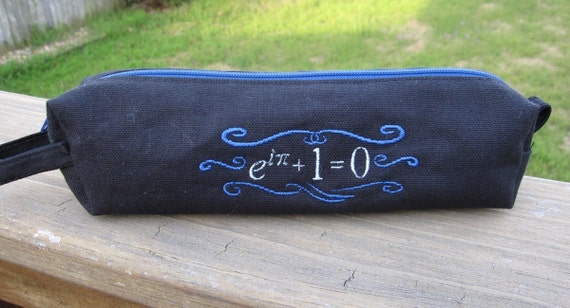
Euler’s equation pencil pouch:

Box-and-whisker snowflakes to hang on our Christmas tree:

And, for me, a wonderfully and subtly punny “Confidence and Power” T-shirt.

Thanks to FiveThirtyEight (see http://fivethirtyeight.com/features/the-fivethirtyeight-2014-holiday-gift-guide/) for pointing me in this direction.

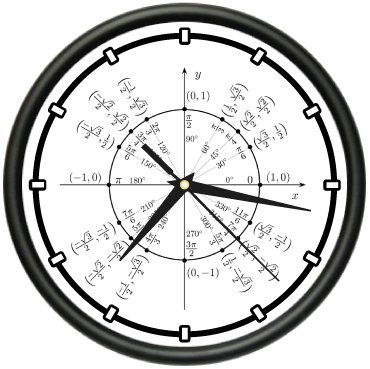
green lineFor the sake of completeness, here are the math-oriented gifts that I received for Christmas:


Engaging students: Introducing the number e

In my capstone class for future secondary math teachers, I ask my students to come up with ideas for engaging their students with different topics in the secondary mathematics curriculum. In other words, the point of the assignment was not to devise a full-blown lesson plan on this topic. Instead, I asked my students to think about three different ways of getting their students interested in the topic in the first place.

I plan to share some of the best of these ideas on this blog (after asking my students’ permission, of course).

This student submission comes from my former student Kenna Kilbride. Her topic, from Precalculus: introducing the number e.

green line

How can this topic be used in your students’ future courses in mathematics or science?


Students will add on to this constant from calculus up to differential equations and even further. In Calculus I students use the number e to solve exponential functions and logarithm function. Calculus II uses the number e when computing integrals. In Complex Numbers you see the number e written as the Taylor series

$latex e^x = \displaystyle \sum_{n=0}^\infty \frac{x^n}{n!}

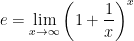
Differential equations utilizes the number e in y(x) = Ce^x. The number e can be utilized in many other areas since it is considered to be a base of the natural logarithm. The number e is also defined as:

e = \displaystyle \lim_{x \to \infty} \left(1 + \frac{1}{x} \right)^x

Also the number e can be seen in the infinite series

$latex e = \sum_{k=0}^\infty \frac{1}{k!}

The number e can be seen in many different areas of mathematics and with many different series and equations. Stirling’s approximation, Pippenger product, and Euler formula are just a few more examples of where you can see the number e.

http://mathworld.wolfram.com/e.html

http://tutorial.math.lamar.edu/Classes/CalcII/ImproperIntegralsCompTest.aspx


green line

What interesting (i.e., uncontrived) word problems using this topic can your students do now? (You may find resources such as http://www.spacemath.nasa.gov to be very helpful in this regard; feel free to suggest others.)


Introducing this constant can be a very hard thing for a teacher to do and using a word problem that involves a satellite that students can comprehend what they do in the sky will help.

A satellite has a radioisotope power supply. The power output in watts is given by the equation

P = 50e^(-t/250)

where t is the time in days and e is the base of natural logarithms.

Then when introducing, e, you can give them problems that they can easily solve without fully understanding what e is. Give them problems such as, how much power will be available in a year. The solution is:

P = 50e^(-365/250)

= 5Oe^(-1.46)

= 50 x 0.232

= 11 .6

Once e has been more formally introduced and the students can then become more familiar (this should only be added on when the students fully understand e) you can add onto this problem by giving them questions such as, what is the half-life of the power supply? Students must use natural log to solve this equation:

25 = 50e^(-t/250)

for t and obtain

– t/250 = ln O.5

= -0.693

t = 250 x 0.693

= 173 days

http://er.jsc.nasa.gov/seh/math49.html

green line

What interesting things can you say about the people who contributed to the discovery and/or the development of this topic? (You might want to consult Math Through The Ages.)


John Napier was born in Scotland around 1550. Napier started attending St. Andrews University at the age of 13. After leaving St. Andrews without a degree he attended Cambridge University. Later he studied abroad, presumably in Paris. In 1614 Napier invented logarithms and later exponential expressions. Along with mathematics, Napier was interested in peace keeping and religion. Napier died on April 4, 1617 of gout.

Euler contributed to e, a mathematical constant. He was born 1707 in the town Basel of Switzerland. By the age of 16 he had earned a Master’s degree and in 1727 he applied for a position as a Physics professor at the University of Basel and was turned down. Due to extreme health problems by 1771 he had lost almost all of his vision. By the time of his death in 1783, the Academy of Sciences in Petersburg had received 500 of his works.


http://www.macs.hw.ac.uk/~greg/calculators/napier/great.html

http://www.pdmi.ras.ru/EIMI/EulerBio.html


Inverse Functions: Logarithms and Complex Numbers (Part 30)

Ordinarily, there are no great difficulties with logarithms as we’ve seen with the inverse trigonometric functions. That’s because the graph of y = a^x satisfies the horizontal line test for any 0 < a < 1 or a > 1. For example,

e^x = 5 \Longrightarrow x = \ln 5,

and we don’t have to worry about “other” solutions.

However, this goes out the window if we consider logarithms with complex numbers. Recall that the trigonometric form of a complex number z = a+bi is

z = r(\cos \theta + i \sin \theta) = r e^{i \theta}

where r = |z| = \sqrt{a^2 + b^2} and \tan \theta = b/a, with \theta in the appropriate quadrant. This is analogous to converting from rectangular coordinates to polar coordinates.

Over the past few posts, we developed the following theorem for computing e^z in the case that z is a complex number.

Definition. Let z = r e^{i \theta} be a complex number so that -\pi < \theta \le \theta. Then we define

\log z = \ln r + i \theta.

Of course, this looks like what the definition ought to be if one formally applies the Laws of Logarithms to r e^{i \theta}. However, this complex logarithm doesn’t always work the way you’d think it work. For example,

\log \left(e^{2 \pi i} \right) = \log (\cos 2\pi + i \sin 2\pi) = \log 1 = \ln 1 = 0 \ne 2\pi i.

This is analogous to another situation when an inverse function is defined using a restricted domain, like

\sqrt{ (-3)^2 } = \sqrt{9} = 3 \ne -3

or

\sin^{-1} (\sin \pi) = \sin^{-1} 0 = 0 \ne \pi.

The Laws of Logarithms also may not work when nonpositive numbers are used. For example,

\log \left[ (-1) \cdot (-1) \right] = \log 1 = 0,

but

\log(-1) + \log(-1) = \log \left( e^{\pi i} \right) + \log \left( e^{\pi i} \right) = \pi i + \pi i = 2\pi i.

green line

This material appeared in my previous series concerning calculators and complex numbers: https://meangreenmath.com/2014/07/09/calculators-and-complex-numbers-part-21/


A probability problem involving two cards: Index

I’m doing something that I should have done a long time ago: collect past series of posts into a single, easy-to-reference post. The following posts formed my series on different ways (correct and incorrect) to solve a two-part probability problem.

Part 1: Two different and correct ways of solving the following problem: “Two cards are dealt from a well-shuffled deck. Find the probability that the first is an ace or the second is a ace.”

Part 2: Two different ways — one correct, one incorrect — of solving the following problem: “Two cards are dealt from a well-shuffled deck. Find the probability that the first is an ace or the second is a jack.”

Part 3: Explaining the incorrect solution, and salvaging the solution to obtain the correct answer.


Exponential growth and decay: Index

I’m doing something that I should have done a long time ago: collect past series of posts into a single, easy-to-reference post. The following posts formed my recently completed series on various applications of exponential growth and decay.

Part 1: Introduction: continuous compound interest and the phrasing of homework questions

Paying off credit-card debt

Part 2: Solution using a differential equation.

Part 3: Teaching basic principles of financial literacy.

Part 4: More on financial literacy.

Part 5: Solution using a difference equation.

Part 6: Comparison of the two solutions (difference equation vs. differential equation).

Part 7: An alternative solution of the difference equation that can be derived by Precalculus students.

Part 8: Verifying the solution of the difference equation using a spreadsheet.

Part 9: Amortization tables.

Half-life

Part 10: Derivation of the formula for exponential decay using a differential equation.

Part 11: Rewriting the solution of the differential equation into the half-life formula.

Newton’s Law of Cooling

Part 12: Derivation of the formula using a differential equation.

Part 13: Classroom demonstrations of Newton’s Law of Cooling.

Logistic Growth Model

Part 14: A simple classroom demonstration of the logistic growth model.

Part 15: The governing differential equation for the logistic growth model.

Part 16: Tips on graphing the logistic growth function.


Exponential growth and decay (Part 16): Logistic growth model

In this series of posts, I provide a deeper look at common applications of exponential functions that arise in an Algebra II or Precalculus class. In the previous posts in this series, I considered financial applications, radioactive decay, and Newton’s Law of Cooling.

Today, I discuss the logistic growth model, which describes how an infection (like a disease, a rumor, or advertise) spreads in a population. In yesterday’s post, I described an in-class demonstration that engages students while also making the following formula believable:

A(t) = \displaystyle \frac{Ly_0}{y_0+ (L-y_0)e^{-rt}}.

I’d like to discuss some observations about this somewhat complicated function that will make producing its graph easier. The first two observations are within reach of Precalculus students.

1. Let’s figure out the y-intercept:

A(0) = \displaystyle \frac{Ly_0}{y_0+ (L-y_0)e^{-r \cdot 0}} = \displaystyle \frac{Ly_0}{y_0+ L-y_0} = y_0.

In other words, the number y_0 represents the initial number of people who have the infection.

2. Let’s figure out the limiting value as t gets large:

\displaystyle \lim_{t \to \infty} A(t) = \displaystyle \frac{Ly_0}{y_0+ (L-y_0) \cdot 0} = \displaystyle \frac{Ly_0}{y_0} = L.

As expected, all L people will get the infection eventually. (Of course, Precalculus students won’t be familiar with the $\displaystyle \lim$ notation, but they should understand that e^{-rt} decays to zero as t gets large.

3. Let’s now figure out the point of inflection. Ordinarily, points of inflection are found by setting the second derivative equal to zero. Though this can be done for the function A(t) above, it would be a somewhat daunting exercise!

The good news is that the points of inflection can be found quite simply using the governing differential equation, which is

A' = r A [ L - A] = r L A - r A^2

Let’s take the derivative of both sides, remembering that r and L are constants:

A'' = r L A' - 2 r A A'

A'' = A' (r L - 2 r A)

So the second derivative is equal to zero when either A' = 0 or else r L - 2 r A = 0. The first case corresponds to the trivial cases A(t) \equiv 0 and A(t) \equiv L; these constants are called the equilibrium solutions. The second case is the more interesting one:

r L - 2 r A = 0

r L = 2 r A

\displaystyle \frac{L}{2} = A

This suggests that, as the infection spreads throughout a population, the curve changes concavity at the time that half of the population becomes infected. In other words, the infection spreads fastest throughout the population at the time when half of the population has been infected.

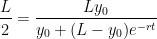
The time at which the point of inflection occurs can be found by setting A(t) = \displaystyle \frac{L}{2} and solving for t:

\displaystyle \frac{L}{2} = \displaystyle \frac{Ly_0}{y_0+ (L-y_0)e^{-rt}}.

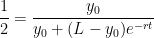
\displaystyle \frac{1}{2} = \displaystyle \frac{y_0}{y_0+ (L-y_0)e^{-rt}}.

y_0 + (L-y_0) e^{-rt} = 2y_0

(L-y_0) e^{-rt} = y_0

e^{-rt} = \displaystyle \frac{y_0}{L-y_0}

-rt = \displaystyle \ln \left( \frac{y_0}{L-y_0} \right)

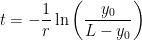
t = \displaystyle - \frac{1}{r} \ln \left( \frac{y_0}{L-y_0} \right)

This technique for finding the points of inflection directly from the differential equation is possible whenever the differential equation is autonomous, which loosely means that the independent variable does not appear on the right-hand side.