What I Learned from Reading “Gamma: Exploring Euler’s Constant” by Julian Havil: Part 3

At the time of this writing, it is unknown if there are infinitely many twin primes, which are prime numbers that differ by 2 (like 3 and 5, 5 and 7, 11 and 13, 17 and 19, etc.) However, significant progress has been made in recent years. However, it is known (Gamma, page 30) the sum of the reciprocals of the twin primes converges:

\displaystyle \left( \frac{1}{3} + \frac{1}{5} \right) + \left( \frac{1}{5} + \frac{1}{7} \right) + \left( \frac{1}{11} + \frac{1}{13} \right) + \left( \frac{1}{17} + \frac{1}{19} \right) = 1.9021605824\dots.

This constant is known as Brun’s constant (see also Mathworld). In the process of computing this number, the infamous 1994 Pentium bug was found.

Although this sum is finite, it’s still unknown if there are infinitely many twin primes since it’s possible for an infinite sum to converge (like a geometric series).

green line

When I researching for my series of posts on conditional convergence, especially examples related to the constant \gamma, the reference Gamma: Exploring Euler’s Constant by Julian Havil kept popping up. Finally, I decided to splurge for the book, expecting a decent popular account of this number. After all, I’m a professional mathematician, and I took a graduate level class in analytic number theory. In short, I don’t expect to learn a whole lot when reading a popular science book other than perhaps some new pedagogical insights.

Boy, was I wrong. As I turned every page, it seemed I hit a new factoid that I had not known before.

In this series, I’d like to compile some of my favorites — while giving the book a very high recommendation.

What I Learned from Reading “Gamma: Exploring Euler’s Constant” by Julian Havil: Part 2

Let’s define partial sums of the harmonic series as follows:

H(m,n) = \displaystyle \frac{1}{m} + \frac{1}{m+1} + \frac{1}{m+2} + \dots + \frac{1}{n-1} + \frac{1}{n},

where m < n are positive integers. Here are a couple of facts that I didn’t know before reading Gamma (pages 24-25):

  • H(m,n) is never equal to an integer.
  • The only values of n for which H(1,n) is an integer are n = 2 and n=6.

green line

When I researching for my series of posts on conditional convergence, especially examples related to the constant \gamma, the reference Gamma: Exploring Euler’s Constant by Julian Havil kept popping up. Finally, I decided to splurge for the book, expecting a decent popular account of this number. After all, I’m a professional mathematician, and I took a graduate level class in analytic number theory. In short, I don’t expect to learn a whole lot when reading a popular science book other than perhaps some new pedagogical insights.

Boy, was I wrong. As I turned every page, it seemed I hit a new factoid that I had not known before.

In this series, I’d like to compile some of my favorites — while giving the book a very high recommendation.

What I Learned from Reading “Gamma: Exploring Euler’s Constant” by Julian Havil: Part 1

When I researching for my series of posts on conditional convergence, especially examples related to the constant \gamma, the reference Gamma: Exploring Euler’s Constant by Julian Havil kept popping up. Finally, I decided to splurge for the book, expecting a decent popular account of this number. After all, I’m a professional mathematician, and I took a graduate level class in analytic number theory. In short, I don’t expect to learn a whole lot when reading a popular science book other than perhaps some new pedagogical insights.

Boy, was I wrong. As I turned every page, it seemed I hit a new factoid that I had not known before.

In this series, I’d like to compile some of my favorites — while giving the book a very high recommendation.

green lineIt is well known the harmonic series diverges:

\displaystyle 1 + \frac{1}{2} + \frac{1}{3} + \frac{1}{4} + \dots = \infty.

This means that, no matter what number N you choose, I can find a number n so that

\displaystyle 1 + \frac{1}{2} + \frac{1}{3} + \frac{1}{4} + \dots + \frac{1}{n} > N.

What I didn’t know (p. 23 of Gamma) is that, in 1968, somebody actually figured out the precise number of terms that are needed for the sum on the left hand side to exceed 100. Here’s the answer:

15,092,688,622,113,788,323,693,563,264,538,101,449,859,497.

With one fewer term, the sum is a little less than 100.

Another Poorly Written Word Problem: Index

I’m doing something that I should have done a long time ago: collecting a series of posts into one single post. The following links comprised my series poorly written word problem, taken directly from textbooks and other materials from textbook publishers.

Part 1: Addition and estimation.

Part 2: Estimation and rounding.

Part 3: Probability.

Part 4: Subtraction and estimation.

Part 5: Algebra and inequality.

Part 6: Domain and range of a function.

Part 7: Algebra and inequality.

Part 8: Algebra and inequality.

Part 9: Geometric series.


Predicate Logic and Popular Culture: Index

I’m doing something that I should have done a long time ago: collecting a series of posts into one single post. The following links comprised my series on using examples from popular culture to illustrate principles of predicate logic. My experiences teaching these ideas to my discrete mathematics students led to my recent publication (John Quintanilla, “Name That Tune: Teaching Predicate Logic with Popular Culture,” MAA Focus, Vol. 36, No. 4, pp. 27-28, August/September 2016).

Unlike other series that I’ve made, this series didn’t have a natural chronological order. So I’ll list these by concept illustrated from popular logic.

green lineLogical and \land:

  • Part 1: “You Belong To Me,” by Taylor Swift
  • Part 21: “Do You Hear What I Hear,” covered by Whitney Houston
  • Part 31: The Godfather (1972)
  • Part 45: The Blues Brothers (1980)
  • Part 53: “What Does The Fox Say,” by Ylvis
  • Part 54: “Billie Jean,” by Michael Jackson

Logical or \lor:

  • Part 1: Shawshank Redemption (1994)

Logical negation \lnot:

  • Part 1: Richard Nixon
  • Part 32: “Satisfaction!”, by the Rolling Stones
  • Part 39: “We Are Never Ever Getting Back Together,” by Taylor Swift

Logical implication \Rightarrow:

  • Part 1: Field of Dreams (1989), and also “Roam,” by the B-52s
  • Part 2: “Word Crimes,” by Weird Al Yankovic
  • Part 7: “I’ll Be There For You,” by The Rembrandts (Theme Song from Friends)
  • Part 43: “Kiss,” by Prince
  • Part 50: “I’m Still A Guy,” by Brad Paisley
  • Part 76: “You’re Never Fully Dressed Without A Smile,” from Annie.

For all \forall:

  • Part 3: Casablanca (1942)
  • Part 4: A Streetcar Named Desire (1951)
  • Part 34: “California Girls,” by The Beach Boys
  • Part 37: Fellowship of the Ring, by J. R. R. Tolkien
  • Part 49: “Buy Me A Boat,” by Chris Janson
  • Part 57: “Let It Go,” by Idina Menzel and from Frozen (2013)
  • Part 65: “Stars and Stripes Forever,” by John Philip Sousa.
  • Part 68: “Love Yourself,” by Justin Bieber.
  • Part 69: “I Will Always Love You,” by Whitney Houston.
  • Part 74: “Faithfully,” by Journey.
  • Part 79: “We’re Not Gonna Take It Anymore,” by Twisted Sister.
  • Part 87: “Hungry Heart,” by Bruce Springsteen.

For all and implication:

  • Part 8 and Part 9: “What Makes You Beautiful,” by One Direction
  • Part 13: “Safety Dance,” by Men Without Hats
  • Part 16: The Fellowship of the Ring, by J. R. R. Tolkien
  • Part 24 : “The Chipmunk Song,” by The Chipmunks
  • Part 55: The Quiet Man (1952)
  • Part 62: “All My Exes Live In Texas,” by George Strait.
  • Part 70: “Wannabe,” by the Spice Girls.
  • Part 72: “You Shook Me All Night Long,” by AC/DC.
  • Part 81: “Ascot Gavotte,” from My Fair Lady
  • Part 82: “Sharp Dressed Man,” by ZZ Top.
  • Part 86: “I Could Have Danced All Night,” from My Fair Lady.

There exists \exists:

  • Part 10: “Unanswered Prayers,” by Garth Brooks
  • Part 15: “Stand by Your Man,” by Tammy Wynette (also from The Blues Brothers)
  • Part 36: Hamlet, by William Shakespeare
  • Part 57: “Let It Go,” by Idina Menzel and from Frozen (2013)

Existence and uniqueness:

  • Part 14: “Girls Just Want To Have Fun,” by Cyndi Lauper
  • Part 20: “All I Want for Christmas Is You,” by Mariah Carey
  • Part 23: “All I Want for Christmas Is My Two Front Teeth,” covered by The Chipmunks
  • Part 29: “You’re The One That I Want,” from Grease
  • Part 30: “Only You,” by The Platters
  • Part 35: “Hound Dog,” by Elvis Presley
  • Part 73: “Dust In The Wind,” by Kansas.
  • Part 75: “Happy Together,” by The Turtles.
  • Part 77: “All She Wants To Do Is Dance,” by Don Henley.
  • Part 90: “All You Need Is Love,” by The Beatles.

DeMorgan’s Laws:

  • Part 5: “Never Gonna Give You Up,” by Rick Astley
  • Part 28: “We’re Breaking Free,” from High School Musical (2006)

Simple nested predicates:

  • Part 6: “Everybody Loves Somebody Sometime,” by Dean Martin
  • Part 25: “Every Valley Shall Be Exalted,” from Handel’s Messiah
  • Part 33: “Heartache Tonight,” by The Eagles
  • Part 38: “Everybody Needs Somebody To Love,” by Wilson Pickett and covered in The Blues Brothers (1980)
  • Part 46: “Mean,” by Taylor Swift
  • Part 56: “Turn! Turn! Turn!” by The Byrds
  • Part 63: P. T. Barnum.
  • Part 64: Abraham Lincoln.
  • Part 66: “Somewhere,” from West Side Story.
  • Part 71: “Hold On,” by Wilson Philips.
  • Part 80: Liverpool FC.
  • Part 84: “If You Leave,” by OMD.

Maximum or minimum of a function:

  • Part 12: “For the First Time in Forever,” by Kristen Bell and Idina Menzel and from Frozen (2013)
  • Part 19: “Tennessee Christmas,” by Amy Grant
  • Part 22: “The Most Wonderful Time of the Year,” by Andy Williams
  • Part 48: “I Got The Boy,” by Jana Kramer
  • Part 60: “I Loved Her First,” by Heartland
  • Part 92: “Anything You Can Do,” from Annie Get Your Gun.

Somewhat complicated examples:

  • Part 11 : “Friends in Low Places,” by Garth Brooks
  • Part 27 : “There is a Castle on a Cloud,” from Les Miserables
  • Part 41: Winston Churchill
  • Part 44: Casablanca (1942)
  • Part 51: “Everybody Wants to Rule the World,” by Tears For Fears
  • Part 58: “Fifteen,” by Taylor Swift
  • Part 59: “We Are Never Ever Getting Back Together,” by Taylor Swift
  • Part 61: “Style,” by Taylor Swift
  • Part 67: “When I Think Of You,” by Janet Jackson.
  • Part 78: “Nothing’s Gonna Stop Us Now,” by Starship.
  • Part 89: “No One Is Alone,” from Into The Woods.

Fairly complicated examples:

  • Part 17 : Richard Nixon
  • Part 47: “Homegrown,” by Zac Brown Band
  • Part 52: “If Ever You’re In My Arms Again,” by Peabo Bryson
  • Part 83: “Something Good,” from The Sound of Music.
  • Part 85: “Joy To The World,” by Three Dog Night.
  • Part 88: “Like A Rolling Stone,” by Bob Dylan.
  • Part 91: “Into the Fire,” from The Scarlet Pimpernel.

Really complicated examples:

  • Part 18: “Sleigh Ride,” covered by Pentatonix
  • Part 26: “All the Gold in California,” by the Gatlin Brothers
  • Part 40: “One of These Things Is Not Like the Others,” from Sesame Street
  • Part 42: “Take It Easy,” by The Eagles

Combinatorics and Jason’s Deli (Part 2)

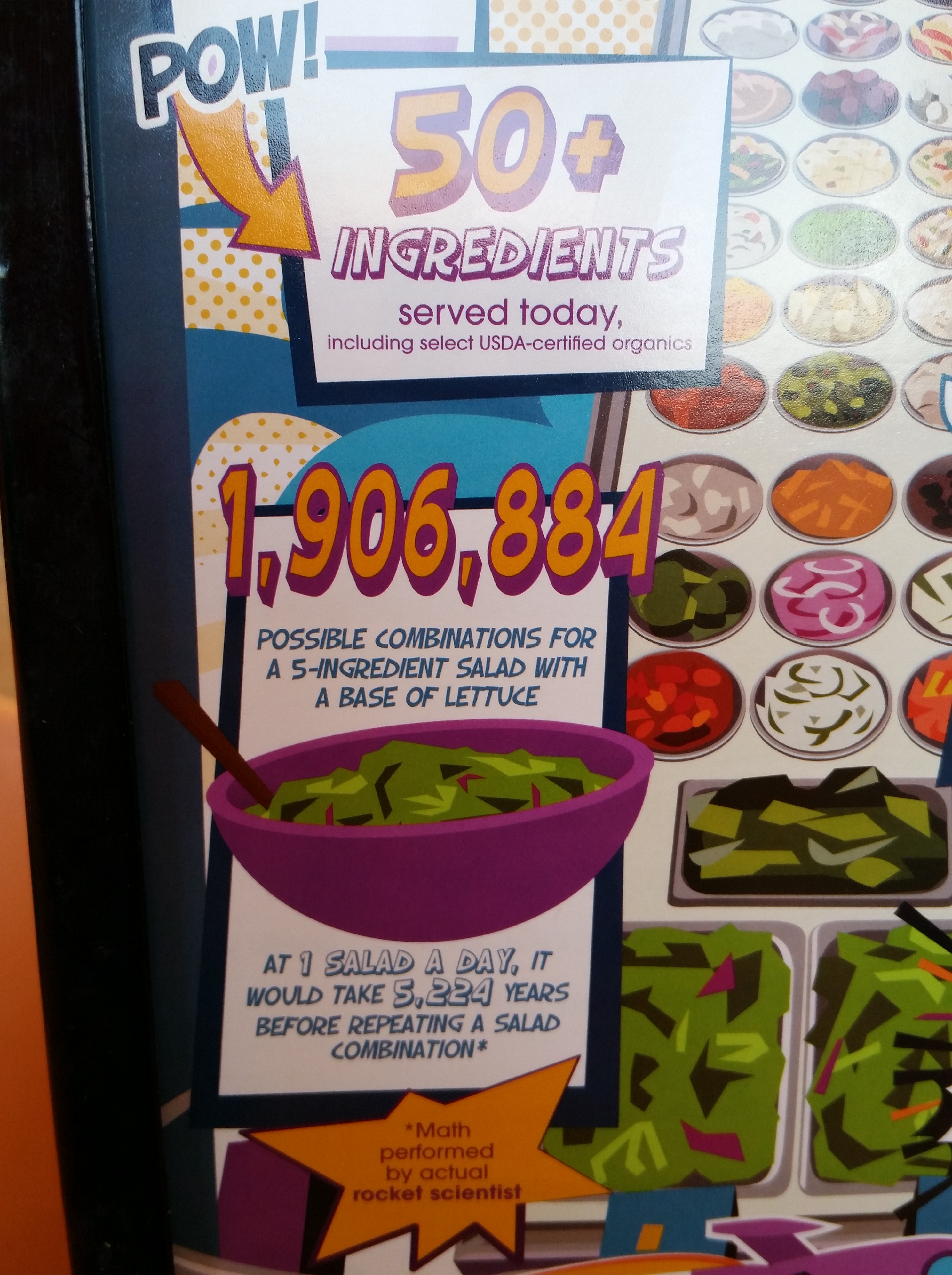
Jason’s Deli is one of my family’s favorite places for an inexpensive meal. Recently, I saw the following placard at our table advertising their salad bar:

fb_img_1470352586255.jpg

The small print says “Math performed by actual rocket scientist”; let’s see how the rocket scientist actually did this calculation.

The advertisement says that there are 50+ possible ingredients; however, to actually get a single number of combinations, let’s say there are exactly 50 ingredients. Lettuce will serve as the base, and so the 5 ingredients that go on top of the lettuce will need to be chosen from the other 49 ingredients.

Also, order is not important for this problem… for example, it doesn’t matter if the tomatoes go on first or last if tomatoes are selected for the salad.

Therefore, the number of possible ingredients is

\displaystyle {49 \choose 5},

or the number in the 5th column of the 49th row of Pascal’s triangle. Rather than actually finding the 49th row of Pascal’s triangle by direct addition, it’s simpler to use factorials:

\displaystyle {49 \choose 5} = \displaystyle \frac{49!}{5! \times 44!} = \displaystyle \frac{49 \times 48 \times 47 \times 46 \times 45 \times 44!}{5 \times 4 \times 3 \times 2 \times 1 \times 44!}

= \displaystyle \frac{49 \times 48 \times 47 \times 46 \times 45}{5 \times 4 \times 3 \times 2 \times 1}

= 49 \times 12 \times 47 \times 23 \times 3

= 1,906,884.

Under the assumption that there are exactly 50 ingredients, the rocket scientist actually got this right.

Lessons from teaching gifted elementary students (Part 8g)

Every so often, I’ll informally teach a class of gifted elementary-school students. I greatly enjoy interacting with them, and I especially enjoy the questions they pose. Often these children pose questions that no one else will think about, and answering these questions requires a surprisingly depth of mathematical knowledge.

Here’s a question I once received, in the students’ original handwriting. They wanted me to add adjacent numbers on the bottom row to produce the number on the next row, building upward until I reached the apex of the triangle. Then, after I reached the top number, they wanted me to take the square root of that number. (Originally, they wanted me to first multiply by 80 before taking the square root, but evidently they decided to take it easy on me.)

And, just to see if I could do it, they wanted me to do all of this without using a calculator. But they were nice and allowed me to use pencil and paper.

PascalProblem

So far, I’ve used Pascal’s triangle to obtain

y = \displaystyle \sum_{k=0}^{11} (k+1)^2 {11 \choose k}

= \displaystyle \sum_{k=2}^{11} k(k-1) {11 \choose k} +  \sum_{k=1}^{11} 3k {11 \choose k} + \sum_{k=0}^{11} {11 \choose k}.

= \displaystyle \sum_{k=2}^{11} k(k-1) \left( \frac{11!}{k!(11-k)!} \right) +  \sum_{k=1}^{11} 3k \left( \frac{11!}{k!(11-k)!} \right) + \sum_{k=0}^{11} \left( \frac{11!}{k!(11-k)!} \right).

= \displaystyle \sum_{k=2}^{11}  \frac{11!}{(k-2)!(11-k)!}  +  3 \sum_{k=1}^{11}  \frac{11!}{(k-1)!(11-k)!}  + \sum_{k=0}^{11}  \frac{11!}{k!(11-k)!} .

= \displaystyle \sum_{i=0}^{9} \frac{11!}{i!(9-i)!}  +  3 \sum_{j=0}^{10}  \frac{11!}{j!(10-j)!}  + \sum_{k=0}^{11}  \frac{11!}{k!(11-k)!} .

= \displaystyle \sum_{i=0}^{9} 11 \times 10 \frac{9!}{i!(9-i)!}  +  3 \sum_{j=0}^{10}  11 \frac{10!}{j!(10-j)!}  + \sum_{k=0}^{11}  \frac{11!}{k!(11-k)!}

= \displaystyle 110 \sum_{i=0}^{9} {9 \choose i}  +  33 \sum_{j=0}^{10} {10 \choose j} + \sum_{k=0}^{11}  {11 \choose k}

= 110 \times 2^9 + 33 \times 2^{10} + 2^{11}

= 92,160.

I’m almost done… except my students wanted me to find the square root of this number without using a calculator.

There are a couple ways to do this; the method I chose was directly extracting the square root by hand… a skill that was taught to children in previous generations but has fallen out of pedagogical disfavor with the advent of handheld calculators. I lost my original work, but it would have looked something like this (see the above website for details on why this works):

squareroot

And so I gave my students their answer: x \approx 303.578\dots