Engaging students: Reducing fractions to lowest terms

In my capstone class for future secondary math teachers, I ask my students to come up with ideas for engaging their students with different topics in the secondary mathematics curriculum. In other words, the point of the assignment was not to devise a full-blown lesson plan on this topic. Instead, I asked my students to think about three different ways of getting their students interested in the topic in the first place.

I plan to share some of the best of these ideas on this blog (after asking my students’ permission, of course).

This student submission comes from my former student Madison duPont. Her topic, from Pre-Algebra: reducing fractions to lowest terms.

green line

How can this topic be used in your students’ future courses in mathematics or science?

Reducing fractions to lowest terms can be applied to future mathematics topics such as ratios and proportions, and scientific topics such as chemistry or physics. Ratios can be represented as fractions and are not typically reduced to lowest terms because they represent relationships of two subjects using numbers. Being able to reduce these ratios can help students better identify the underlying relationship and apply this relationship to other aspects of the math problem, such as problems using unit price or map scales. Proportions relate to the concept of reducing fractions to lowest terms when using cross-multiplication. Having both sides of the proportion reduced to lowest terms makes the cross-multiplication much easier to compute and derive a final reduced answer. Chemistry uses fractions reduced to lowest terms with topics, like stoichiometry, that use potentially small and large numbers in several ratios that are multiplied together to obtain a final converted and reduced answer. Physics often uses ratio-like formulas and problems that are applied to real-world scenarios, which typically require fractions reduced to lowest terms because answers like miles per one hour are the goal. All of these topics use concepts of reducing fractions to lowest terms to more easily accomplish problems using a series of fractional computations, or to get an answer that is in terms of a single unit or most reduced so that it makes sense to real-world application.


green line

How does this topic extend what your students should have learned in previous courses?

This topic extends previously learned topics such as concepts of unique prime factorizations, greatest common divisor, manipulating fractions, and multiplication facts. The concept of unique prime factorizations greatly aids students in finding the greatest common divisor, which is used to find the greatest factor of the value of both the numerator and denominator. Next, manipulation of fractions is used to properly divide the numerator and denominator by the greatest common divisor. This process of dividing both parts of the fraction utilizes multiplication facts as well to determine what the answer to the division problem on both the top and bottom of the fraction would be. These previously learned concepts are all subtle and important applications when reducing fractions to lowest terms.


green line

How can technology (YouTube, Khan Academy [khanacademy.org], Vi Hart, Geometers Sketchpad, graphing calculators, etc.) be used to effectively engage students with this topic? Note: It’s not enough to say “such-and-such is a great website”; you need to explain in some detail why it’s a great website.


This video reminded me of many students that I have tutored or encountered in classrooms that were determined that a calculator was all they needed when doing math. Applied to reducing fractions to lowest terms, this video is extremely relevant in displaying that technology cannot be the only source of intelligence when thinking mathematically. Reducing fractions with extremely large numbers or numbers that do not have well-known factors can seem exhausting or impossible. Punching several factors of the numerator and denominator into a calculator attempting to reduce numbers with each common factor, and then not being sure of whether the fraction appearing on their screen is truly in the most reduced form surely indicates the technology is not the only way of solving the problem. Many students hop on a procedural escalator when beginning varying types of problems (in addition to reducing fractions to lowest terms) using memorized steps, punching calculator buttons, feeling comfortable, until suddenly—there is a horribly unattractive fraction halting their progress. This is when using mathematical problem solving skills such as reducing the numerator and denominator by the greatest common divisor or checking to see that the numerator and denominator are relatively prime becomes pertinent. Using these conceptual skills can save someone that is stuck waiting for a calculator to do the work for them, or that has given up on finishing a problem because it seems impossible or difficult, from thinking they are incapable of working out a problem efficiently and successfully. This video highlights the importance of being capable of knowing when it is time to take the effort to climb the stairs to reach your destination.


References:

“Stuck on an Escalator” Video link:

https://www.youtube.com/watch?v=VrSUe_m19FY

found via Google video search


Lessons from teaching gifted elementary school students: Index (updated)

I’m doing something that I should have done a long time ago: collect past series of posts into a single, easy-to-reference post. The following posts formed my series on various lessons I’ve learned while trying to answer the questions posed by gifted elementary school students. (This is updated from my previous index.)

Part 1: A surprising pattern in some consecutive perfect squares.

Part 2: Calculating 2 to a very large exponent.

Part 3a: Calculating 2 to an even larger exponent.

Part 3b: An analysis of just how large this number actually is.

Part 4a: The chance of winning at BINGO in only four turns.

Part 4b: Pedagogical thoughts on one step of the calculation.

Part 4c: A complicated follow-up question.

Part 5a: Exponentiation is multiplication as multiplication is to addition. So, multiplication is to addition as addition is to what? (I offered the answer of incrementation, but it was rejected: addition requires two inputs, while incrementation only requires one.)

Part 5b: Why there is no binary operation that completes the above analogy.

Part 5c: Knuth’s up-arrow notation for writing very big numbers.

Part 5d: Graham’s number, reputed to be the largest number ever to appear in a mathematical proof.

Part 6a: Calculating $(255/256)^x$.

Part 6b: Solving $(255/256)^x = 1/2$ without a calculator.

Part 7a: Estimating the size of a 1000-pound hailstone.

Part 7b: Estimating the size a 1000-pound hailstone.

Part 8a: Statement of an usually triangle summing problem.

Part 8b: Solution using binomial coefficients.

Part 8c: Rearranging the series.

Part 8d: Reindexing to further rearrange the series.

Part 8e: Rewriting using binomial coefficients again.

Part 8f: Finally obtaining the numerical answer.

Part 8g: Extracting the square root of the answer by hand.

Thoughts on the Accidental Fraction Brainbuster

I really enjoyed reading a recent article on Math With Bad Drawings centered on solving the following problem without a calculator:

I won’t repeat the whole post here, but it’s an excellent exercise in numeracy, or developing intuitive understanding of numbers without necessarily doing a ton of computations. It’s also a fun exercise to see how much we can figure out without resorting to plugging into a calculator. I highly recommend reading it.

When I saw this problem, my first reflex wasn’t the technique used in the post. Instead, I thought to try the logic that follows. I don’t claim that this is a better way of solving the problem than the original solution linked above. But I do think that this alternative solution, in its own way, also encourages numeracy as well as what we can quickly determine without using a calculator.

Let’s get a common denominator for the two fractions:

\displaystyle \frac{3997 \times 5001}{4001 \times 5001} \qquad and \displaystyle \qquad \frac{4001 \times 4996}{4001 \times 5001}.

Since the denominators are the same, there is no need to actually compute 4001 \times 5001. Instead, the larger fraction can be determined by figuring out which numerator is largest. At first glance, that looks like a lot of work without a calculator! However, the numerators can both be expanded by cleverly using the distributive law:

3997 \times 5001 = (4000-3)(5000+1) = 4000\times 5000 + 4000 - 3 \times 5000 - 3,

4001 \times 4996 = (4000+1)(5000-4) = 4000\times 5000 - 4 \times 4000 + 5000 - 4.

We can figure out which one is bigger without a calculator — or even directly figuring out each product.

  • Each contains 4000 \times 5000, so we can ignore this common term in both expressions.
  • Also, 4000 - 3\times 5000 and 5000 - 4 \times 4000 are both equal to -11,000, and so we can ignore the middle two terms of both expressions.
  • The only difference is that there’s a -3 on the top line and a -4 on the bottom line.

Therefore, the first numerator is the larger one, and so \displaystyle \frac{3997}{4001} is the larger fraction.

Once again, I really like the original question as a creative question that initially looks intractable that is nevertheless within the grasp of middle-school students. Also, I reiterate that I don’t claim that the above is a superior method, as I really like the method suggested in the original post. Instead, I humbly offer this alternate solution that encourages the development of numeracy.

Lessons from teaching gifted elementary school students: Index (updated)

I’m doing something that I should have done a long time ago: collect past series of posts into a single, easy-to-reference post. The following posts formed my series on various lessons I’ve learned while trying to answer the questions posed by gifted elementary school students. (This is updated from my previous index.)

Part 1: A surprising pattern in some consecutive perfect squares.

Part 2: Calculating 2 to a very large exponent.

Part 3a: Calculating 2 to an even larger exponent.

Part 3b: An analysis of just how large this number actually is.

Part 4a: The chance of winning at BINGO in only four turns.

Part 4b: Pedagogical thoughts on one step of the calculation.

Part 4c: A complicated follow-up question.

Part 5a: Exponentiation is multiplication as multiplication is to addition. So, multiplication is to addition as addition is to what? (I offered the answer of incrementation, but it was rejected: addition requires two inputs, while incrementation only requires one.)

Part 5b: Why there is no binary operation that completes the above analogy.

Part 5c: Knuth’s up-arrow notation for writing very big numbers.

Part 5d: Graham’s number, reputed to be the largest number ever to appear in a mathematical proof.

Lessons from teaching gifted elementary school students: Index

I’m doing something that I should have done a long time ago: collect past series of posts into a single, easy-to-reference post. The following posts formed my series on various lessons I’ve learned while trying to answer the questions posed by gifted elementary school students.

Part 1: A surprising pattern in some consecutive perfect squares.

Part 2: Calculating 2 to a very large exponent.

Part 3a: Calculating 2 to an even larger exponent.

Part 3b: An analysis of just how large this number actually is.

Part 4a: The chance of winning at BINGO in only four turns.

Part 4b: Pedagogical thoughts on one step of the calculation.

Part 4c: A complicated follow-up question.

Thoughts on 1/7 and Other Rational Numbers: Index

I’m using the Twelve Days of Christmas (and perhaps a few extra days besides) to do something that I should have done a long time ago: collect past series of posts into a single, easy-to-reference post. The following posts formed my series the decimal expansions of rational numbers.

Part 1: A way to remember the decimal expansion of \displaystyle \frac{1}{7}.

Part 2: Long division and knowing for certain that digits will start repeating.

Part 3: Converting a repeating decimal into a fraction, using algebra.

Part 4: Converting a repeating decimal into a fraction, using infinite series.

Part 5: Quickly converting fractions of the form \displaystyle \frac{M}{10^t}, \displaystyle \frac{M}{10^k-1}, and \displaystyle \frac{M}{10^t (10^k-1)} into decimals without using a calculator.

Part 6: Converting any rational number into one of the above three forms, and then converting into a decimal.

Part 7: Same as above, except using a binary (base-2) expansion instead of a decimal expansion.

Part 8: Why group theory relates to the length of the repeating block in a decimal expansion.

Part 9: A summary of the above ideas to find the full decimal expansion of \displaystyle \frac{8}{17}, which has a repeating block longer than the capacity of most calculators.

Part 10: More thoughts on \displaystyle \frac{8}{17}.


Lessons from teaching gifted elementary school students (Part 4c)

Every so often, I’ll informally teach a class of gifted elementary-school students. I greatly enjoy interacting with them, and I especially enjoy the questions they pose. Often these children pose questions that no one else will think about, and answering these questions requires a surprisingly depth of mathematical knowledge.

Here’s a question I once received:

What is the chance of winning a game of BINGO after only four turns?

When my class posed this question, I was a little concerned that the getting the answer might be beyond the current abilities of a gifted elementary student. As discussed over the past couple of posts, for a non-standard BINGO game with 44 numbers, the answer is

\displaystyle 4 \times \frac{4}{44} \times \frac{3}{43} \times \frac{2}{42} \times \frac{1}{41} = \displaystyle \frac{4}{135,751}

After we got the answer, I then was asked the question that I had fully anticipated but utterly dreaded:

What’s that in decimal?

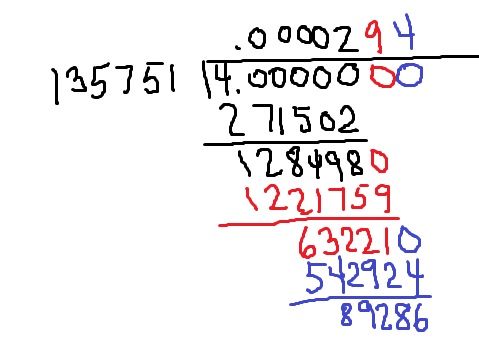
With these gifted students, I encourage thinking as much as possible without a calculator… and they wanted me to provide the answer to this one in like fashion. For my class, this actually did serve a purpose by illustrating a really complicated long division problem so they could reminded about the number of leading zeroes in such a problem.

Gritting my teeth, I started on the answer:

biglongdivisionAt this point, I was asked the other question that I had anticipated but utterly dreaded… motivated by child-like curiosity mixed perhaps with a touch of sadism:

How long do we have before the digits start repeating?

My stomach immediately started churning.

I told the class that I’d have to figure this one later. But I told them that the answer would definitely be less than 135,751 times. My class was surprised that I could even provide this level of (extremely) modest upper limit on the answer. After some prompting, my class saw the reasoning for this answer: there are only 135,751 possible remainders after performing the subtraction step in the division algorithm, and so a remainder has to be repeated after 135,751 steps. Therefore, the digits will start repeating in 135,751 steps or less.

What I knew — but probably couldn’t explain to these elementary-school students, and so I had to work this out for myself and then get back to them with the answer — is that the length of the repeating block n is the least integer so that

135751 \mid 10^n - 1

which is another way of saying that we’ve used the division algorithm enough times so that a remainder repeats. Written in the language of group theory, n is the least integer that satisfies

10^n \equiv 1 \mod 135751

(A caveat:this rule works because neither 2 nor 5 is a factor of 135,751… otherwise, those factors would have to be taken out first.)

Some elementary group theory can now be used to guess the value of n. Let G be the multiplicative group of integers modulo 135,751 which are relatively prime which. The order of this group is denoted by \phi(135751), called the Euler totient function. In general, if m = p_1^{a_1} p_2^{a_2} \dots p_r^{a_r} is the prime factorization of m, then

\phi(m) = n \left( \displaystyle 1 - \frac{1}{p_1} \right) \left( \displaystyle 1 - \frac{1}{p_2} \right) \dots \left( \displaystyle 1 - \frac{1}{p_r} \right)

For the case at hand, the prime factorization of 135,751 can be recovered by examining the product of the fractions near the top of this post:

135751 = 7 \times 11 \times 41 \times 43

Therefore,

\phi(135,751) = 6 \times 10 \times 40 \times 42 = 100,800

Next, there’s a theorem from group theory that says that the order n of an element of a group must be a factor of the order of the group. In other words, the number n that we’re seeking must be a factor of 100,800. This is easy to factor:

100,800 = 2^6 \times 3^2 \times 5^2 \times 7

Therefore, the number n has the form

n = 2^a 3^b 5^c 7^d,

where 0 \le a \le 6, 0 \le b \le 2, 0 \le c \le 2, and 0 \le d \le 1 are integers.

So, to summarize, we can say definitively that n is at most 100,800, and that were have narrowed down the possible values of n to only 7 \times 3 \times 3 \times 2 = 126 possibilities (the product of one more than all of the exponents). So that’s a definite improvement and reduction from my original answer of 135,751 possibilities.

At this point, there’s nothing left to do except test all 126 possibilities. Unfortunately, there’s no shortcut to this; it has to be done by trial and error. Thankfully, this can be done with Mathematica:

biglongdivision2The final line shows that the least such value of n is 210. Therefore, the decimal will repeat after 210 digits. So here are the first 210 digits of \displaystyle \frac{4}{135,751} (courtesy of Mathematica):

0.000029465712959757202525211600651192256410634175807176374391348866675015285338597874048809953517837805983013016478699972744215512224587664\
179269397647162820163387378361853688002298325610861061796966504850792996…

For more on this, see https://meangreenmath.com/2013/08/23/thoughts-on-17-and-other-rational-numbers-part-6/ and https://meangreenmath.com/2013/08/25/thoughts-on-17-and-other-rational-numbers-part-8/.

Lessons from teaching gifted elementary school students (Part 4b)

Every so often, I’ll informally teach a class of gifted elementary-school students. I greatly enjoy interacting with them, and I especially enjoy the questions they pose. Often these children pose questions that no one else will think about, and answering these questions requires a surprisingly depth of mathematical knowledge.

Here’s a question I once received:

What is the chance of winning a game of BINGO after only four turns?

When my class posed this question, I was a little concerned that the getting the answer might be beyond the current abilities of a gifted elementary student.  Still, what I love about this question is that it gave me a way to teach my class some techniques of probabilistic reasoning that probably would not occur in a traditional elementary school setting.

As discussed yesterday, for a non-standard BINGO game with 44 numbers, the answer is

\displaystyle 4 \times \frac{4}{44} \times \frac{3}{43} \times \frac{2}{42} \times \frac{1}{41}

For a standard BINGO board with 75 numbers, the denominators are instead 75, 74, 73, and 72.

Now, for the next challenge: getting my students to simplify this product. I’m always mystified when college students blindly multiply numerators and denominators together without bothering to attempt to cancel common factors. Fortunately, this class already understands how to simplify fractions, and so the next step was easy:

\displaystyle 4 \times \frac{1}{11} \times \frac{3}{43} \times \frac{1}{21} \times \frac{1}{41}

 So I was ready for the next step: cancelling 3 from the numerator and denominator. To my surprise, this was a major stumbling block. I tried probing around to prod them to perform this cancellation, but no luck. Eventually, I guessed the issue that my class was facing: they were familiar with the mechanics of both adding and multiplying fractions and also with writing fractions in lowest terms, but they weren’t yet comfortable enough with fractions to cancel 3 from the numerator of one fraction and the denominator of a different fraction.

So, toward this end, I asked my class if it was OK to shuffle a couple of the numerators and rewrite this product as

\displaystyle 4 \times \frac{1}{11} \times \frac{1}{43} \times \frac{3}{21} \times \frac{1}{41}

It took a moment, but then they agreed that this was OK because the order of multiplication doesn’t matter, even volunteering the word commutative to explain their reasoning. (I’m going to try to remember this technique for future reference as a way to get students new to fractions more comfortable with similar cancellations.) Once they got past this conceptual barrier, it was straightforward to continue the simplification:

\displaystyle 4 \times \frac{1}{11} \times \frac{1}{43} \times \frac{1}{7} \times \frac{1}{41}

= \displaystyle \frac{4}{135,751}

So I explained that if a game of BINGO took one minute, we could play round the clock for 135,751 minutes (about 96 days) and expect to win in the minimal number of turns only four times. Not very likely at all. (Though I didn’t discuss this with my class, the answer is even smaller with a standard BINGO game with 75 numbers: you’d expect to win only once every 211 days.)