AI and Proving Theorems

Paul Erdős famously said that mathematicians are machines that turn coffee into theorems. A couple of recent articles in the Wall Street Journal revealed the current state-of-the-art for AI to do the same.

In July, Ben Cohen published the article The High-Schoolers Who Just Beat the World’s Smartest AI Models. The focus of the article was the 2025 International Mathematical Olympiad, the pinnacle of the calendar for high school mathematics competitions. In the United States, the pathway to the IMO is first excellng at a sequence of increasing difficult exams: the AMC->12 (or possibly AMC->10), then the American Invitational Mathematics Exam (AIME), and then USA Mathematical Olympiad (USAMO) or USA Junior Mathematical Olympiad (USJAMO). The top USAMO and USJAMO participants then get invited to a special camp from which the participants in that year’s IMO are selected.

My personal story: back in high school, my score on the AMC->12 (then called the AHSME) qualified me for the AIME my sophomore and junior years, where my run in the competition ended with a resounding thud. My senior year, I caught lightning in a bottle and somehow qualified for the USAMO; I’m not sure what the cut-off is these days, but back then only 150 or so high school students qualified for the USAMO each year. My excitement at qualifying for the USAMO gave way to utter humiliation after I actually attempted the exam (to say that I “took” the exam is probably a misuse of the work “took”.) All this to say: I never came close to sniffing the IMO. From the Wall Street Journal article:

The famously grueling IMO exam is held over two days and gives students three increasingly difficult problems a day and more than four hours to solve them. The questions span algebra, geometry, number theory and combinatorics—and you can forget about answering them if you’re not a math whiz. You’ll give your brain a workout just trying to understand them. 

Because those problems are both complex and unconventional, the annual math test has become a useful benchmark for measuring AI progress from one year to the next. In this age of rapid development, the leading research labs dreamed of a day their systems would be powerful enough to meet the standard for an IMO gold medal, which became the AI equivalent of a four-minute mile. 

But nobody knew when they would reach that milestone or if they ever would—until now. 

The unthinkable occurred earlier this month when an AI model from Google DeepMind earned a gold-medal score at IMO by perfectly solving five of the six problems. In another dramatic twist, OpenAI also claimed gold despite not participating in the official event. The companies described their feats as giant leaps toward the future—even if they’re not quite there yet. 

In fact, the most remarkable part of this memorable event is that 26 students got higher scores on the IMO exam than the AI systems. 

A second article by Ben Cohen, The Math Legend Who Just Left Academic — for an AI Startup Run by a 24-Year-Old, might be a precursor of things to come. One of the two starts of the article is number theorist Dr. Ken Ono. From the article:

In recent years, Ono began tracking AI’s remarkable progress as it rapidly improved. He was intrigued, though not intimidated. AI was astonishing at cognitive tasks and solving problems it had already seen, but it struggled with the creative elements of his field, which require intuition and abstract thinking.

That creativity is so fundamental to pure mathematics that Ono figured his job would be safe for decades.

But last spring, he was one of 30 mathematicians invited to curate research-level problems as a test of the AI models. He left the symposium profoundly shaken by what he’d seen.

“The lead I had on the models was shrinking,” he said. “And in areas of mathematics that were not in my wheelhouse, I felt like the models were already blowing me away.”

For months afterward, Ono felt like he was grieving his identity. He didn’t know what to do next, knowing that AI models would only get smarter.

“Then I had an epiphany,” he said. “I realized what the models were offering was a different way of doing math.”

Dr. Ono is now taking an extended leave from the University of Virginia to join a new AI startup company called Axiom. From Tech Funding News:

Led by Carina Hong, Axiom Math is developing an AI system that not only solves complex math problems but also generates new mathematical knowledge by proposing conjectures: mathematical statements that have yet to be proven.

The model produces rigorous, step-by-step proofs that can be independently verified using proof assistants such as Lean and Coq. This approach aims to transform English-language math from textbooks and research papers into code, enabling the AI to create and validate new problems that push the boundaries of existing knowledge…

Currently, Axiom is working on models that can discover and solve new math problems. The researchers also hope to apply their work in areas like finance, aircraft design, chip design, and quantitative trading.

Beyond pure mathematics, Axiom’s AI tool is being tested for practical applications in fields requiring rigorous computational precision, including finance, aircraft and chip design, and quantitative trading.

Time will tell if the intersection of AI with mathematics can generate a profitable company. What I don’t doubt is that the previously unthinkable — original mathematical work by AI — will eventually happen, given enough time.

High School Students Finding New Proofs of Old Theorems (Part 2): Pythagorean theorem

This is a new favorite story to share with students: two high school students recently figured out multiple new proofs of the Pythagorean theorem.

Professional article in the American Mathematical Monthly (requires a subscription): https://maa.tandfonline.com/doi/full/10.1080/00029890.2024.2370240

Video describing one of their five ideas:

Interview in MAA Focus: http://digitaleditions.walsworthprintgroup.com/publication/?i=836749&p=14&view=issueViewer

Interview by 60 Minutes:

https://www.youtube.com/watch?v=VHeWndnHuQs

Praise from Michelle Obama: https://www.facebook.com/michelleobama/posts/i-just-love-this-story-about-two-high-school-students-calcea-johnson-and-nekiya-/750580956432311/

High School Students Finding New Proofs of Old Theorems (Part 1): Dividing a line segment with straightedge and compass

This is one of my all-time favorite stories to share with students: how a couple of ninth graders in 1995 played with Geometer’s Sketchpad and stumbled upon a brand-new way of using only a straightedge and compass to divide a line segment into any number of equal-sized parts. This article was published in 1997 and made quite a media sensation at the time.

Predicate Logic and Popular Culture: Index

I’m doing something that I should have done a long time ago: collecting a series of posts into one single post. The following links comprised my series on using examples from popular culture to illustrate principles of predicate logic. My experiences teaching these ideas to my discrete mathematics students led to my recent publication (John Quintanilla, “Name That Tune: Teaching Predicate Logic with Popular Culture,” MAA Focus, Vol. 36, No. 4, pp. 27-28, August/September 2016).

Unlike other series that I’ve made, this series didn’t have a natural chronological order. So I’ll list these by concept illustrated from popular logic. The vast majority of these examples were suggested by my students.

green lineLogical and \land:

  • Part 1: “You Belong To Me,” by Taylor Swift
  • Part 21: “Do You Hear What I Hear,” covered by Whitney Houston
  • Part 31: The Godfather (1972)
  • Part 45: The Blues Brothers (1980)
  • Part 53: “What Does The Fox Say,” by Ylvis
  • Part 54: “Billie Jean,” by Michael Jackson
  • Part 98: “Call Me Maybe,” by Carly Rae Jepsen.
  • Part 137: “Pen Pineapple Apple Pen,” by Pikotaro.
  • Part 142: “Galway Girl,” by Ed Sheeran.
  • Part 183: A memorable line from Avengers: Age of Ultron.
  • Part 184: A memorable line from Star Wars Episode I: The Phantom Menace.
  • Part 197: “That’s Life,” by Frank Sinatra.
  • Part 209: A line from The Office.
  • Part 242: A line from The Fellowship of the Ring.
  • Part 249: “We Didn’t Start the Fire,” by Billy Joel.
  • Part 252: A line from The Two Towers.
  • Part 253: “I’m Gonna Miss Her,” by Brad Paisley.
  • Part 261: A line from Spiderman 2.

Logical or \lor:

  • Part 1: Shawshank Redemption (1994)

Logical negation \lnot:

  • Part 1: Richard Nixon
  • Part 32: “Satisfaction!”, by the Rolling Stones
  • Part 39: “We Are Never Ever Getting Back Together,” by Taylor Swift
  • Part 129: “Blue Ain’t Your Color,” by Keith Urban.
  • Part 143: “Ain’t Worth The Whiskey,” by Cole Swindell.
  • Part 247: A line from The Fellowship of the Ring.

Logical implication \Rightarrow:

  • Part 1: Field of Dreams (1989), and also “Roam,” by the B-52s
  • Part 2: “Word Crimes,” by Weird Al Yankovic
  • Part 7: “I’ll Be There For You,” by The Rembrandts (Theme Song from Friends)
  • Part 43: “Kiss,” by Prince
  • Part 50: “I’m Still A Guy,” by Brad Paisley
  • Part 76: “You’re Never Fully Dressed Without A Smile,” from Annie.
  • Part 109: “Dancing in the Dark,” by Bruce Springsteen.
  • Part 122: “Keep Yourself Alive,” by Queen.
  • Part 140: “It Don’t Mean A Thing If It Ain’t Got That Swing,” by Ella Fitzgerald.
  • Part 174: A famous line from Rocky IV.
  • Part 176: A famous line from Game of Thrones.
  • Part 185: A line from Westworld.
  • Part 188: A line from Talladega Nights.
  • Part 195: “If We Were a Movie,” from the Hannah Montana series.
  • Part 207: A line from Name of the Wind, by Patrick Rothfuss.
  • Part 222: A line from The Notebook.
  • Part 234: “Battle Symphony,” by Linkin Park.
  • Part 235: A line from Suits.
  • Part 259: “Out There,” from “The Hunchback of Notre Dame.”
  • Part 269: “Dear Theodosia,” from Hamilton.

For all \forall:

  • Part 3: Casablanca (1942)
  • Part 4: A Streetcar Named Desire (1951)
  • Part 34: “California Girls,” by The Beach Boys
  • Part 37: Fellowship of the Ring, by J. R. R. Tolkien
  • Part 49: “Buy Me A Boat,” by Chris Janson
  • Part 57: “Let It Go,” by Idina Menzel and from Frozen (2013)
  • Part 65: “Stars and Stripes Forever,” by John Philip Sousa.
  • Part 68: “Love Yourself,” by Justin Bieber.
  • Part 69: “I Will Always Love You,” by Dolly Parton (covered by Whitney Houston).
  • Part 74: “Faithfully,” by Journey.
  • Part 79: “We’re Not Gonna Take It Anymore,” by Twisted Sister.
  • Part 87: “Hungry Heart,” by Bruce Springsteen.
  • Part 99: “It’s the End of the World,” by R.E.M.
  • Part 100: “Hold the Line,” by Toto.
  • Part 101: “Break My Stride,” by Matthew Wilder.
  • Part 102: “Try Everything,” by Shakira.
  • Part 108: “BO$$,” by Fifth Harmony.
  • Part 113: “Sweet Caroline,” by Neil Diamond.
  • Part 114: “You Know Nothing, Jon Snow,” from Game of Thrones.
  • Part 118: “The Lazy Song,” by Bruno Mars.
  • Part 120: “Cold,” by Crossfade.
  • Part 123: “Always on My Mind,” by Willie Nelson.
  • Part 127: Motif from Hamilton.
  • Part 131: Abraham Lincoln’s Second Inaugural Address.
  • Part 132: A famous line from The Fellowship of the Ring.
  • Part 133: A famous line from Braveheart.
  • Part 136: “I Don’t Wanna Live Forever,” by ZAYN and Taylor Swift.
  • Part 138: “Bohemian Rhapsody,” by Queen.
  • Part 144: “The Anchor,” by Bastille.
  • Part 146: A line from the video game series “Fallout”
  • Part 147: “Nobody’s Perfect,” from the Hannah Montana series.
  • Part 150: “Roar,” by Katy Perry.
  • Part 167: “Look What You Made Me Do,” by Taylor Swift.
  • Part 180: “Bohemian Rhapsody,” by Queen.
  • Part 181: “We Don’t Talk Anymore,” by Charlie Puth and Selena Gomez.
  • Part 189: “Tengo Muchas Alas / I Have Many Wings,” by Mana.
  • Part 190: “Eastside,” by Benny Blanco, Halsey, and Khalid.
  • Part 191: “I’m a Mess,” by Bebe Rexha.
  • Part 193: “Forever and Ever, Amen,” by Randy Travis.
  • Part 202: “Everything Is Awesome!!!,” from The Lego Movie.
  • Part 204: “She’s Always A Woman,” by Billy Joel.
  • Part 208: A line by Naruto in Masashi Kishimoto’s anime.
  • Part 211: “Everyone Lies To Me,” by Knuckle Puck.
  • Part 214: “Aeroplane,” by Björk.
  • Part 216: “Hound Dog,” by Elvis Presley.
  • Part 227: One Fish, Two Fish, Red Fish, Blue Fish, by Dr. Seuss.
  • Part 230: “Be Alright,” by Dean Lewis.
  • Part 231: “Everyone Wants To Be A Cat,” from The Aristocats.
  • Part 232: “Behind Blue Eyes,” by Limp Bizkit.
  • Part 236: A line from Dirty Dancing.
  • Part 243: “Better,” by Khalid.
  • Part 246: “Unfaithful,” by Rihanna.
  • Part 260: A line from Ratatouille.
  • Part 263: A line from Shakespeare’s As You Like It.
  • Part 264: “Bet On It,” from High School Musical 2.
  • Part 271: A line from Pirates of the Caribbean: The Curse of the Black Pearl.
  • Part 273: “Gaston,” from Beauty and the Beast.

For all and implication:

  • Part 8 and Part 9: “What Makes You Beautiful,” by One Direction
  • Part 13: “Safety Dance,” by Men Without Hats
  • Part 16: The Fellowship of the Ring, by J. R. R. Tolkien
  • Part 24 : “The Chipmunk Song,” by The Chipmunks
  • Part 55: The Quiet Man (1952)
  • Part 62: “All My Exes Live In Texas,” by George Strait.
  • Part 70: “Wannabe,” by the Spice Girls.
  • Part 72: “You Shook Me All Night Long,” by AC/DC.
  • Part 81: “Ascot Gavotte,” from My Fair Lady
  • Part 82: “Sharp Dressed Man,” by ZZ Top.
  • Part 86: “I Could Have Danced All Night,” from My Fair Lady.
  • Part 95: “Every Breath You Take,” by The Police.
  • Part 96: “Only the Lonely,” by Roy Orbison.
  • Part 97: “I Still Haven’t Found What I’m Looking For,” by U2.
  • Part 105: “Every Rose Has Its Thorn,” by Poison.
  • Part 107: “Party in the U.S.A.,” by Miley Cyrus.
  • Part 112: “Winners Aren’t Losers,” by Donald J. Trump and Jimmy Kimmel.
  • Part 115: “Every Time We Touch,” by Cascada.
  • Part 117: “Stronger,” by Kelly Clarkson.
  • Part 125: “Do Wot You Do,” by INXS.
  • Part 130: “Think of You,” by Chris Young and Cassadee Pope.
  • Part 135: “Can’t Feel My Face,” by The Weeknd.
  • Part 145: A line from Black Dynamite.
  • Part 152: “You Haven’t Done Nothin’,” by Stevie Wonder.
  • Part 155: “All The Lazy Boyfriends,” by They Might Be Giants.
  • Part 165: A famous quote by Eleanor Roosevelt.
  • Part 166: “Perfect,” by Ed Sheeran.
  • Part 172: “Twas the Night Before Christmas,” by Clement Clarke Moore.
  • Part 182: “How Far I’ll Go,” from Moana.
  • Part 192: A line from the videogame “Overwatch.”
  • Part 194: A line from the Dragon Ball franchise.
  • Part 196: “ME!,” by Taylor Swift.
  • Part 200: A line from the 1990s Spider-Man cartoons.
  • Part 201: “It’s Quiet Uptown,” from Hamilton.
  • Part 205: “Three Little Birds,” by Bob Marley.
  • Part 206: “Mudfootball,” by Jack Johnson.
  • Part 210: “On My Way,” by Alan Walker, Sabrina Carpenter, and Farruko.
  • Part 215: “Aging Rockers,” by Tim Hawkins.
  • Part 218: “Happy Together,” by The Turtles.
  • Part 223: “Too Deep to Turn Back,” by Daniel Caesar.
  • Part 224: “Nothing Gold Can Stay,” by Robert Frost.
  • Part 225: “He Stopped Loving Her Today,” by George Jones.
  • Part 229: A line from Mean Girls.
  • Part 233: “Emperor’s New Clothes,” by Panic! At The Disco.
  • Part 240: “For Those About To Rock (We Salute You),” by AC/DC.
  • Part 244: A famous line from Spiderman.
  • Part 248: The poem “All That Is Gold Does Not Glitter,” from The Fellowship of the Ring.
  • Part 251: “Survey Ladies,” from Animaniacs.
  • Part 265: “Every Time You Go Away,” by Paul Young.
  • Part 268: “Sweet Dreams,” by Eurhymics.
  • Part 270: A line from the anime “Naruto Shippuden.”
  • Part 272: “Be Our Guest,” from Beauty and the Beast.
  • Part 274: “He Stopped Loving Her Today,” by George Jones.

There exists \exists:

  • Part 10: “Unanswered Prayers,” by Garth Brooks
  • Part 15: “Stand by Your Man,” by Tammy Wynette (also from The Blues Brothers)
  • Part 36: Hamlet, by William Shakespeare
  • Part 57: “Let It Go,” by Idina Menzel and from Frozen (2013)
  • Part 93: “There’s No Business Like Show Business,” from Annie Get Your Gun (1946).
  • Part 94: “Not While I’m Around,” from Sweeney Todd (1979).
  • Part 104: “Wild Blue Yonder” (US Air Force)
  • Part 106: “No One,” by Alicia Keys.
  • Part 116: “Ocean Front Property,” by George Strait.
  • Part 139: “Someone in the Crowd,” from La La Land.
  • Part 149: “Someone Like You,” by Adele.
  • Part 151: “E-MO-TION,” by Carly Rae Jepsen.
  • Part 154: “I Wanna Dance With Somebody,” by Whitney Houston.
  • Part 162: “Think of You,” by Chris Young and Cassadee Pope.
  • Part 168: “Sorry,” by Halsey.
  • Part 175: “Someday We’ll Be Together,” by Diana Ross and the Supremes.
  • Part 177: “Try Everything,” by Shakira.
  • Part 186: “Someday,” by Nickelback.
  • Part 226: “The Wizard and I,” from Wicked.
  • Part 238: A line from the video game “Among Us.”
  • Part 250: “Ain’t No Mountain High Enough,” by Marvin Gaye.

Existence and uniqueness:

  • Part 14: “Girls Just Want To Have Fun,” by Cyndi Lauper
  • Part 20: “All I Want for Christmas Is You,” by Mariah Carey
  • Part 23: “All I Want for Christmas Is My Two Front Teeth,” covered by The Chipmunks
  • Part 29: “You’re The One That I Want,” from Grease
  • Part 30: “Only You,” by The Platters
  • Part 35: “Hound Dog,” by Elvis Presley
  • Part 73: “Dust In The Wind,” by Kansas.
  • Part 75: “Happy Together,” by The Turtles.
  • Part 77: “All She Wants To Do Is Dance,” by Don Henley.
  • Part 90: “All You Need Is Love,” by The Beatles.
  • Part 169: “Marry Me,” by Thomas Rhett.
  • Part 179: A line from “Harry Potter and the Sorcerer’s Stone.”
  • Part 245: An advertising line for Gibson guitars.
  • Part 258: “Nobody Knows,” by Kevin Sharp.
  • Part 262: “Dust in the Wind,” by Kansas.

DeMorgan’s Laws:

  • Part 5: “Never Gonna Give You Up,” by Rick Astley
  • Part 28: “We’re Breaking Free,” from High School Musical (2006)
  • Part 255: A line from “The Nightmare Before Christmas.”
  • Part 257: A line from “The Wizard of Oz.”

Simple nested predicates:

  • Part 6: “Everybody Loves Somebody Sometime,” by Dean Martin
  • Part 25: “Every Valley Shall Be Exalted,” from Handel’s Messiah
  • Part 33: “Heartache Tonight,” by The Eagles
  • Part 38: “Everybody Needs Somebody To Love,” by Wilson Pickett and covered in The Blues Brothers (1980)
  • Part 46: “Mean,” by Taylor Swift
  • Part 56: “Turn! Turn! Turn!” by The Byrds
  • Part 63: P. T. Barnum.
  • Part 64: Abraham Lincoln.
  • Part 66: “Somewhere,” from West Side Story.
  • Part 71: “Hold On,” by Wilson Philips.
  • Part 80: Liverpool FC.
  • Part 84: “If You Leave,” by OMD.
  • Part 103: “The Caisson Song” (US Army).
  • Part 111: “Always Something There To Remind Me,” by Naked Eyes.
  • Part 121: “All the Right Moves,” by OneRepublic.
  • Part 126: Motif from Hamilton.
  • Part 157: “Whenever, Wherever,” by Shakira.
  • Part 158: “Church Bells,” by Carrie Underwood.
  • Part 163: A famous line from The Princess Bride.
  • Part 170: “Everywhere,” by Tim McGraw.
  • Part 173: “If I Ain’t Got You,” by Alicia Keys.
  • Part 187: “Always Something There To Remind Me,” by Naked Eyes.
  • Part 198: “All Star,” by Smash Mouth.
  • Part 203: “Lean On Me,” by Bill Withers.
  • Part 217: A line in the video game Valorant.
  • Part 219: “Señorita,” by Shawn Mendes and Camila Cabello.
  • Part 220: “How to Love,” by Cash Cash.
  • Part 221: A line from Monk.
  • Part 237: A line from Psycho.
  • Part 254: “You Can’t Always Get What You Want,” by the Rolling Stones.
  • Part 256: “Irgendwie, Irgendwo, Irgendwann” by Nena.
  • Part 266: “Kokomo,” by the Beach Boys.

Maximum or minimum of a function:

  • Part 12: “For the First Time in Forever,” by Kristen Bell and Idina Menzel and from Frozen (2013)
  • Part 19: “Tennessee Christmas,” by Amy Grant
  • Part 22: “The Most Wonderful Time of the Year,” by Andy Williams
  • Part 48: “I Got The Boy,” by Jana Kramer
  • Part 60: “I Loved Her First,” by Heartland
  • Part 92: “Anything You Can Do,” from Annie Get Your Gun.
  • Part 119: “Uptown Girl,” by Billy Joel.
  • Part 124: “All I Want To Do Is Be With You,” from High School Musical 3.
  • Part 160: “God, Your Mama, and Me,” by Florida Georgia Line and the Backstreet Boys.
  • Part 178: “Ex Factor,” by Lauryn Hill.

Somewhat complicated examples:

  • Part 11 : “Friends in Low Places,” by Garth Brooks
  • Part 27 : “There is a Castle on a Cloud,” from Les Miserables
  • Part 41: Winston Churchill
  • Part 44: Casablanca (1942)
  • Part 51: “Everybody Wants to Rule the World,” by Tears For Fears
  • Part 58: “Fifteen,” by Taylor Swift
  • Part 59: “We Are Never Ever Getting Back Together,” by Taylor Swift
  • Part 61: “Style,” by Taylor Swift
  • Part 67: “When I Think Of You,” by Janet Jackson.
  • Part 78: “Nothing’s Gonna Stop Us Now,” by Starship.
  • Part 89: “No One Is Alone,” from Into The Woods.
  • Part 110: “Everybody Loves My Baby,” by Louis Armstrong.
  • Part 134: A famous line from Braveheart.
  • Part 141: “How Far I’ll Go,” from Moana.
  • Part 148: “The Climb,” by Miley Cyrus.
  • Part 153: “I Can’t Tell You Why,” by The Eagles.
  • Part 161: “For What It’s Worth,” by Buffalo Springfield.
  • Part 164: “When The Sun Goes Down,” by Kenny Chesney.
  • Part 199: “Never Say Never,” by Justin Bieber.
  • Part 213: “Sign of the Times,” by Harry Styles.
  • Part 241: “Dreams,” by Fleetwood Mac.
  • Part 267: A line from The Hound of the Baskervilles.

Fairly complicated examples:

  • Part 17 : Richard Nixon
  • Part 47: “Homegrown,” by Zac Brown Band
  • Part 52: “If Ever You’re In My Arms Again,” by Peabo Bryson
  • Part 83: “Something Good,” from The Sound of Music.
  • Part 85: “Joy To The World,” by Three Dog Night.
  • Part 88: “Like A Rolling Stone,” by Bob Dylan.
  • Part 91: “Into the Fire,” from The Scarlet Pimpernel.
  • Part 128: “A Puzzlement,” from The King and I.
  • Part 156: “Everybody Loves a Lover,” by Doris Day.
  • Part 159: “Fastest Girl in Town,” by Miranda Lambert.
  • Part 171: “Everybody’s Got Somebody But Me,” by Hunter Hayes.

Really complicated examples:

  • Part 18: “Sleigh Ride,” covered by Pentatonix
  • Part 26: “All the Gold in California,” by the Gatlin Brothers
  • Part 40: “One of These Things Is Not Like the Others,” from Sesame Street
  • Part 42: “Take It Easy,” by The Eagles

Mathematical Allusions in Shantaram (Part 3)

I recently finished the novel Shantaram, by Gregory David Roberts. As I’m not a professional book reviewer, let me instead quote from the Amazon review:

Crime and punishment, passion and loyalty, betrayal and redemption are only a few of the ingredients in Shantaram, a massive, over-the-top, mostly autobiographical novel. Shantaram is the name given Mr. Lindsay, or Linbaba, the larger-than-life hero. It means “man of God’s peace,” which is what the Indian people know of Lin. What they do not know is that prior to his arrival in Bombay he escaped from an Australian prison where he had begun serving a 19-year sentence. He served two years and leaped over the wall. He was imprisoned for a string of armed robberies performed to support his heroin addiction, which started when his marriage fell apart and he lost custody of his daughter. All of that is enough for several lifetimes, but for Greg Roberts, that’s only the beginning.

He arrives in Bombay with little money, an assumed name, false papers, an untellable past, and no plans for the future. Fortunately, he meets Prabaker right away, a sweet, smiling man who is a street guide. He takes to Lin immediately, eventually introducing him to his home village, where they end up living for six months. When they return to Bombay, they take up residence in a sprawling illegal slum of 25,000 people and Linbaba becomes the resident “doctor.” With a prison knowledge of first aid and whatever medicines he can cadge from doing trades with the local Mafia, he sets up a practice and is regarded as heaven-sent by these poor people who have nothing but illness, rat bites, dysentery, and anemia. He also meets Karla, an enigmatic Swiss-American woman, with whom he falls in love. Theirs is a complicated relationship, and Karla’s connections are murky from the outset.

While it was a cracking good read, what struck me particularly were the surprising mathematical allusions that the author used throughout the novel. In this mini-series, I’d like to explore the ones that I found.

In this third installment, the narrator a sudden realization that he had.

I put all of my focus on the beating of my heart, trying by force of will to slow its too-rapid pace. It worked, after a time. I closed around a single, still thought. That thought was of [a mafia don], and the formula he’d made me repeat so often: “The wrong thing, for the right reasons.” And I knew, as I repeated the words in the fearing dark, that the fight with [another mafia don], the war, the struggle for power, was always the same, everywhere, and it was always wrong.

[My mafia don], no less than [other mafia dons] and all the rest of them, were pretending that their little kingdoms made them kings; that their power struggles made them powerful. And they didn’t. They couldn’t. I saw that then so clearly that it was like understanding a mathematical theorem for the first time. The only kingdom that makes any man a king is the kingdom of his own soul. The only power that has any real meaning is the power to better the world. And only men like [my noble friends, not in the mafia] were such kings and had such power.

Shantaram, Chapter 41

The author’s choice of language is music to my ears: “I saw that then so clearly that it was like understanding a mathematical theorem for the first time.” There have been many, many times throughout my education and career that I struggled to understand some theorem. But the moment that I figured it out, I couldn’t believe what had taken me so long to finally get it. That’s the type of epiphany that the author seems to be describing.

I again quote at length from Richard P. Feynman, who did a far better job of explaining the emotions of such a sudden realization after being stuck in a rut than I ever could:

Then I had another thought: Physics disgusts me a little bit now, but I used to enjoy doing physics. Why did I enjoy it? I used to play with it. I used to do whatever I felt like doing–it didn’t have to do with whether it was important for the development of nuclear physics, but whether it was interesting and amusing for me to play with. When I was in high school, I’d see water running out of a faucet growing narrower, and wonder if I could figure out what determines that curve. I found it was rather easy to do. I didn’t have to do it; it wasn’t important for the future of science; somebody else had already done it. That didn’t make any difference: I’d invent things and play with things for my own entertainment.

So I got this new attitude. Now that I am burned out and I’ll never accomplish anything, I’ve got this nice position at the university teaching classes which I rather enjoy, and just like I read the Arabian Nights for pleasure, I’m going to play with physics, whenever I want to, without worrying about any importance whatsoever.

Within a week I was in the cafeteria and some guy, fooling around, throws a plate in the air. As the plate went up in the air I saw it wobble, and I noticed the red medallion of Cornell on the plate going around. It was pretty obvious to me that the medallion went around faster than the wobbling.

I had nothing to do, so I start to figure out the motion of the rotating plate. I discover that when the angle is very slight, the medallion rotates twice as fast as the wobble rate–two to one. It came out of a complicated equation! Then I thought, “Is there some way I can see in a more fundamental way, by looking at the forces or the dynamics, why it’s two to one?”

I don’t remember how I did it, but I ultimately worked out what the motion of the mass particles is, and how all the accelerations balance to make it come out two to one.

I still remember going to Hans Bethe and saying, “Hey, Hans! I noticed something interesting. Here the plate goes around so, and the reason it’s two to one is . . .” and I showed him the accelerations.

He says, “Feynman, that’s pretty interesting, but what’s the importance of it? Why are you doing it?”

“Hah!” I say. “There’s no importance whatsoever. I’m just doing it for the fun of it.” His reaction didn’t discourage me; I had made up my mind I was going to enjoy physics and do whatever I liked.

I went on to work out equations of wobbles. Then I thought about how electron orbits start to move in relativity. Then there’s the Dirac Equation in electrodynamics. And then quantum electrodynamics. And before I knew it (it was a very short time) I was “playing”–working, really — with the same old problem that I loved so much, that I had stopped working on when I went to Los Alamos: my thesis-type problems; all those old-fashioned, wonderful things.

It was effortless. It was easy to play with these things. It was like uncorking a bottle: Everything flowed out effortlessly. I almost tried to resist it! There was no importance to what I was doing, but ultimately there was. The diagrams and the whole business that I got the Nobel Prize for came from that piddling around with the wobbling plate.

Richard P. Feynman, “The Dignified Professor,” from Surely You’re Joking, Mr. Feynman!

Mathematical Allusions in Shantaram (Part 2)

I recently finished the novel Shantaram, by Gregory David Roberts. As I’m not a professional book reviewer, let me instead quote from the Amazon review:

Crime and punishment, passion and loyalty, betrayal and redemption are only a few of the ingredients in Shantaram, a massive, over-the-top, mostly autobiographical novel. Shantaram is the name given Mr. Lindsay, or Linbaba, the larger-than-life hero. It means “man of God’s peace,” which is what the Indian people know of Lin. What they do not know is that prior to his arrival in Bombay he escaped from an Australian prison where he had begun serving a 19-year sentence. He served two years and leaped over the wall. He was imprisoned for a string of armed robberies performed to support his heroin addiction, which started when his marriage fell apart and he lost custody of his daughter. All of that is enough for several lifetimes, but for Greg Roberts, that’s only the beginning.

He arrives in Bombay with little money, an assumed name, false papers, an untellable past, and no plans for the future. Fortunately, he meets Prabaker right away, a sweet, smiling man who is a street guide. He takes to Lin immediately, eventually introducing him to his home village, where they end up living for six months. When they return to Bombay, they take up residence in a sprawling illegal slum of 25,000 people and Linbaba becomes the resident “doctor.” With a prison knowledge of first aid and whatever medicines he can cadge from doing trades with the local Mafia, he sets up a practice and is regarded as heaven-sent by these poor people who have nothing but illness, rat bites, dysentery, and anemia. He also meets Karla, an enigmatic Swiss-American woman, with whom he falls in love. Theirs is a complicated relationship, and Karla’s connections are murky from the outset.

While it was a cracking good read, what struck me particularly were the surprising mathematical allusions that the author used throughout the novel. In this mini-series, I’d like to explore the ones that I found.

In this second installment, the narrator describes a conversation with a new acquaintance.

“My father was a teacher of chemistry and mathematics… My father was a stubborn man — it is a kind of stubbornness that permits one to become a mathematician, isn’t it? Perhaps mathematics is itself a kind of stubbornness, do you think?”

“Maybe,” I replied, smiling. “I never thought about it that way, but maybe you’re right.”

Shantaram, Chapter 26

When I think of stubbornness, I think of the determination of a marathon runner to push through fatigue to keep running hour after hour to complete all 26.2 miles of the course. I don’t usually think of a mathematician.

Nevertheless, the author certainly hit on something with this allusion. Mathematicians certainly need a healthy dose of stubbornness when staring a conjecture and trying to figure out its proof; it’s normal for that frustration to last for weeks, months, or even years. That said, I wouldn’t say that this is unique to mathematicians — researchers in just about any field of study need to be persistent to discover something that nobody else has figure out before.

Nobel Prize laureate Richard P. Feynman had a couple of vivid descriptions about the frustration of getting stuck on a research project and the stubbornness that was necessary to break out of that rut.

I don’t believe I can really do without teaching. The reason is, I have to have something so that when I don’t have any ideas and I’m not getting anywhere I can say to myself, “At least I’m living; at least I’m doing something; I’m making some contribution”–it’s just psychological.

When I was at Princeton in the 1940s I could see what happened to those great minds at the Institute for Advanced Study, who had been specially selected for their tremendous brains and were now given this opportunity to sit in this lovely house by the woods there, with no classes to teach, with no obligations whatsoever. These poor bastards could now sit and think clearly all by themselves, OK? So they don’t get any ideas for a while: They have every opportunity to do something, and they’re not getting any ideas. I believe that in a situation like this a kind of guilt or depression worms inside of you, and you begin to worry about not getting any ideas. And nothing happens. Still no ideas come.

Nothing happens because there’s not enough real activity and challenge: You’re not in contact with the experimental guys. You don’t have to think how to answer questions from the students. Nothing!

In any thinking process there are moments when everything is going good and you’ve got wonderful ideas. Teaching is an interruption, and so it’s the greatest pain in the neck in the world. And then there are the longer periods of time when not much is coming to you. You’re not getting any ideas, and if you’re doing nothing at all, it drives you nuts! You can’t even say “I’m teaching my class.”

Richard P. Feynman, “The Dignified Professor,” from Surely You’re Joking, Mr. Feynman!

Also from Feynman:

The problem was to find the right laws of beta decay. There appeared to be two particles, which were called a tan and a theta. They seemed to have almost exactly the same mass, but one disintegrated into two pions, and the other into three pions. Not only did they seem to have the same mass, but they also had the same lifetime, which is a funny coincidence. So everybody was concerned about this…

At that particular time I was not really quite up to things: I was always a little behind. Everybody seemed to be smart, and I didn’t feel I was keeping up…

Anyway, the discovery of parity law violation was made, experimentally, by Wu, and this opened up a whole bunch of new possibilities for beta decay theory, It also unleashed a whole host of experiments immediately after that. Some showed electrons coming out of the nuclei spun to the left, and some to the right, and there were all kinds of experiments, all kinds of interesting discoveries about parity. But the data were so confusing that nobody could put things together.

At one point there was a meeting in Rochester–the yearly Rochester Conference. I was still always behind, and Lee was giving his paper on the violation of parity. He and Yang had come to the conclusion that parity was violated, and flow he was giving the theory for it.

During the conference I was staying with my sister in Syracuse. I brought the paper home and said to her, “I can’t understand these things that Lee and Yang are saying. It’s all so complicated.”

“No,” she said, “what you mean is not that you can’t understand it, but that you didn’t invent it. You didn’t figure it out your own way, from hearing the clue. What you should do is imagine you’re a student again, and take this paper upstairs, read every line of it, and check the equations. Then you’ll understand it very easily.”

I took her advice, and checked through the whole thing, and found it to be very obvious and simple. I had been afraid to read it, thinking it was too difficult.

Richard P. Feynman, “The 7 Percent Solution,” from Surely You’re Joking, Mr. Feynman!

An algebra and trigonometry–based proof of Kepler’s First Law

The proofs of Kepler’s Three Laws are usually included in textbooks for multivariable calculus. So I was very intrigued when I saw, in the Media Reviews of College Mathematics Journal, that somebody had published a proof of Kepler’s First Law that only uses algebra and trigonometry. Let me quote from the review:

Kepler’s first law states that bounded planetary orbits are elliptical. This law is presented in introductory textbooks, but the proof typically requires intricate integrals or vector analysis involving an accidental degeneracy. Simha offers an elementary proof of Kepler’s first law using algebra and trigonometry at the high school level.

https://doi.org/10.1080/07468342.2022.2026089

Once upon a time, I taught Precalculus for precocious high school students. I wish I had known of this result back then, as it would have been a wonderful capstone to their studies of trigonometry and the conic sections.

The preprint of this result can be found on arXiv. (The proof only addresses Kepler’s First Law and not the Second and Third Laws.) The actual article, for those with institutional access, was published in American Journal of Physics Vol. 89 No. 11 (2021): 1009-1011.

Wonderful quote from College Mathematics Journal

As a member of the Mathematical Association of America, one of the journals that I subscribe to is College Mathematics Journal. Of late, there has been a pleasant uptick in the number of articles that have been co-written by undergraduate researchers under the mentorship of faculty advisers, which is a terrific development for the field.

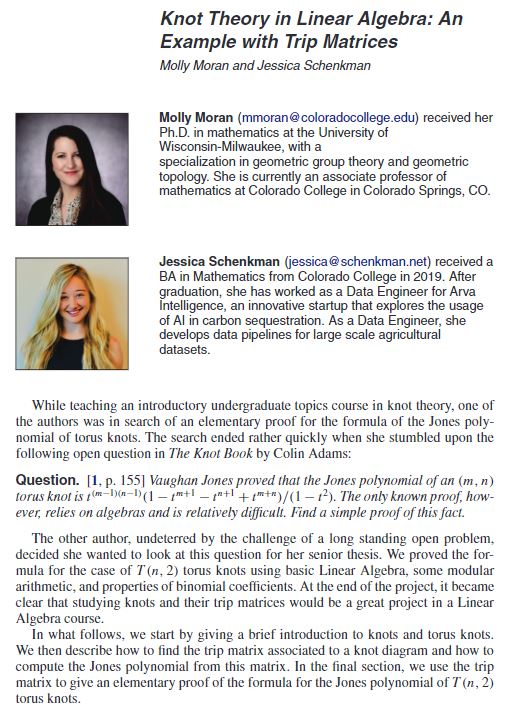
In the latest issue, one such article on knot theory appeared. Truth in advertising: I know next to nothing about knot theory, I do not know the authors, and I’ve only driven through Colorado College while on a recent vacation to Colorado Springs. With all that said, I love the opening paragraphs of their recent article, which are shown below.

The first sentence of the second paragraph grabbed my attention:

The other author, undeterred by the challenge of a long standing open problem, decided she wanted to look at this question for her senior thesis.

I absolutely love the moxie behind this sentiment. For the little it’s worth, I offer my congratulations to both authors.

More truth in advertising: usually, when I see a journal article that’s outside my realm of expertise, I’ll make a half-hearted stab at scanning it; with rare exceptions, I then give up and move on to the next article. For this article, however, given this wonderful introduction, I’ll do my best to read and (try to) understand the full article.

Parabolas from String Art (Part 10)

Recently, I announced that my paper Parabolic Properties from Pieces of String had been published in the magazine Math Horizons. The article had multiple aims; in chronological order of when I first started thinking about them:

  • Prove that string art from two line segments traces a parabola.
  • Prove that a quadratic polynomial satisfies the focus-directrix property of a parabola, which is the reverse of the usual logic when students learn conic sections.
  • Prove the reflective property of parabolas.
  • Accomplish all of the above without using calculus.

While I’m generally pleased with the final form of the article, the necessity of publication constraints somewhat abbreviated the original goal of this project: determining a pedagogically sound way of convincing a bright Algebra I student that string art unexpectedly produces a parabola. In this series of posts, I’d wanted to expand on the article with some pedagogical thoughts about connecting string art to parabolas for algebra students. After all, most mathematical studies of string art curves — formally known as “envelopes” — rely on differential equations or at least limits and calculus.

However, string art is simple enough for a young child to construct, and so this study was inspired by the quest of explaining this phenomenon using only simple mathematical tools.

The article linked above has further thoughts on this problem, including a calculus-free way of deriving the reflective property of parabolas. However, I think the article pretty much has all of my thoughts on this matter, and so I don’t think I need to elaborate upon them here.

This series of posts is dedicated to an inspired and inspiring Algebra I student who wanted to understand string art curves using tools that she could understand… even though she progressed much further into the mathematics curriculum by the time my article was published and this series of posts appeared on my blog.