Mathematical Allusions in Shantaram (Part 2)

I recently finished the novel Shantaram, by Gregory David Roberts. As I’m not a professional book reviewer, let me instead quote from the Amazon review:

Crime and punishment, passion and loyalty, betrayal and redemption are only a few of the ingredients in Shantaram, a massive, over-the-top, mostly autobiographical novel. Shantaram is the name given Mr. Lindsay, or Linbaba, the larger-than-life hero. It means “man of God’s peace,” which is what the Indian people know of Lin. What they do not know is that prior to his arrival in Bombay he escaped from an Australian prison where he had begun serving a 19-year sentence. He served two years and leaped over the wall. He was imprisoned for a string of armed robberies performed to support his heroin addiction, which started when his marriage fell apart and he lost custody of his daughter. All of that is enough for several lifetimes, but for Greg Roberts, that’s only the beginning.

He arrives in Bombay with little money, an assumed name, false papers, an untellable past, and no plans for the future. Fortunately, he meets Prabaker right away, a sweet, smiling man who is a street guide. He takes to Lin immediately, eventually introducing him to his home village, where they end up living for six months. When they return to Bombay, they take up residence in a sprawling illegal slum of 25,000 people and Linbaba becomes the resident “doctor.” With a prison knowledge of first aid and whatever medicines he can cadge from doing trades with the local Mafia, he sets up a practice and is regarded as heaven-sent by these poor people who have nothing but illness, rat bites, dysentery, and anemia. He also meets Karla, an enigmatic Swiss-American woman, with whom he falls in love. Theirs is a complicated relationship, and Karla’s connections are murky from the outset.

While it was a cracking good read, what struck me particularly were the surprising mathematical allusions that the author used throughout the novel. In this mini-series, I’d like to explore the ones that I found.

In this second installment, the narrator describes a conversation with a new acquaintance.

“My father was a teacher of chemistry and mathematics… My father was a stubborn man — it is a kind of stubbornness that permits one to become a mathematician, isn’t it? Perhaps mathematics is itself a kind of stubbornness, do you think?”

“Maybe,” I replied, smiling. “I never thought about it that way, but maybe you’re right.”

Shantaram, Chapter 26

When I think of stubbornness, I think of the determination of a marathon runner to push through fatigue to keep running hour after hour to complete all 26.2 miles of the course. I don’t usually think of a mathematician.

Nevertheless, the author certainly hit on something with this allusion. Mathematicians certainly need a healthy dose of stubbornness when staring a conjecture and trying to figure out its proof; it’s normal for that frustration to last for weeks, months, or even years. That said, I wouldn’t say that this is unique to mathematicians — researchers in just about any field of study need to be persistent to discover something that nobody else has figure out before.

Nobel Prize laureate Richard P. Feynman had a couple of vivid descriptions about the frustration of getting stuck on a research project and the stubbornness that was necessary to break out of that rut.

I don’t believe I can really do without teaching. The reason is, I have to have something so that when I don’t have any ideas and I’m not getting anywhere I can say to myself, “At least I’m living; at least I’m doing something; I’m making some contribution”–it’s just psychological.

When I was at Princeton in the 1940s I could see what happened to those great minds at the Institute for Advanced Study, who had been specially selected for their tremendous brains and were now given this opportunity to sit in this lovely house by the woods there, with no classes to teach, with no obligations whatsoever. These poor bastards could now sit and think clearly all by themselves, OK? So they don’t get any ideas for a while: They have every opportunity to do something, and they’re not getting any ideas. I believe that in a situation like this a kind of guilt or depression worms inside of you, and you begin to worry about not getting any ideas. And nothing happens. Still no ideas come.

Nothing happens because there’s not enough real activity and challenge: You’re not in contact with the experimental guys. You don’t have to think how to answer questions from the students. Nothing!

In any thinking process there are moments when everything is going good and you’ve got wonderful ideas. Teaching is an interruption, and so it’s the greatest pain in the neck in the world. And then there are the longer periods of time when not much is coming to you. You’re not getting any ideas, and if you’re doing nothing at all, it drives you nuts! You can’t even say “I’m teaching my class.”

Richard P. Feynman, “The Dignified Professor,” from Surely You’re Joking, Mr. Feynman!

Also from Feynman:

The problem was to find the right laws of beta decay. There appeared to be two particles, which were called a tan and a theta. They seemed to have almost exactly the same mass, but one disintegrated into two pions, and the other into three pions. Not only did they seem to have the same mass, but they also had the same lifetime, which is a funny coincidence. So everybody was concerned about this…

At that particular time I was not really quite up to things: I was always a little behind. Everybody seemed to be smart, and I didn’t feel I was keeping up…

Anyway, the discovery of parity law violation was made, experimentally, by Wu, and this opened up a whole bunch of new possibilities for beta decay theory, It also unleashed a whole host of experiments immediately after that. Some showed electrons coming out of the nuclei spun to the left, and some to the right, and there were all kinds of experiments, all kinds of interesting discoveries about parity. But the data were so confusing that nobody could put things together.

At one point there was a meeting in Rochester–the yearly Rochester Conference. I was still always behind, and Lee was giving his paper on the violation of parity. He and Yang had come to the conclusion that parity was violated, and flow he was giving the theory for it.

During the conference I was staying with my sister in Syracuse. I brought the paper home and said to her, “I can’t understand these things that Lee and Yang are saying. It’s all so complicated.”

“No,” she said, “what you mean is not that you can’t understand it, but that you didn’t invent it. You didn’t figure it out your own way, from hearing the clue. What you should do is imagine you’re a student again, and take this paper upstairs, read every line of it, and check the equations. Then you’ll understand it very easily.”

I took her advice, and checked through the whole thing, and found it to be very obvious and simple. I had been afraid to read it, thinking it was too difficult.

Richard P. Feynman, “The 7 Percent Solution,” from Surely You’re Joking, Mr. Feynman!
An algebra and trigonometry–based proof of Kepler’s First Law

The proofs of Kepler’s Three Laws are usually included in textbooks for multivariable calculus. So I was very intrigued when I saw, in the Media Reviews of College Mathematics Journal, that somebody had published a proof of Kepler’s First Law that only uses algebra and trigonometry. Let me quote from the review:

Kepler’s first law states that bounded planetary orbits are elliptical. This law is presented in introductory textbooks, but the proof typically requires intricate integrals or vector analysis involving an accidental degeneracy. Simha offers an elementary proof of Kepler’s first law using algebra and trigonometry at the high school level.

https://doi.org/10.1080/07468342.2022.2026089

Once upon a time, I taught Precalculus for precocious high school students. I wish I had known of this result back then, as it would have been a wonderful capstone to their studies of trigonometry and the conic sections.

The preprint of this result can be found on arXiv. (The proof only addresses Kepler’s First Law and not the Second and Third Laws.) The actual article, for those with institutional access, was published in American Journal of Physics Vol. 89 No. 11 (2021): 1009-1011.

Wonderful quote from College Mathematics Journal

As a member of the Mathematical Association of America, one of the journals that I subscribe to is College Mathematics Journal. Of late, there has been a pleasant uptick in the number of articles that have been co-written by undergraduate researchers under the mentorship of faculty advisers, which is a terrific development for the field.

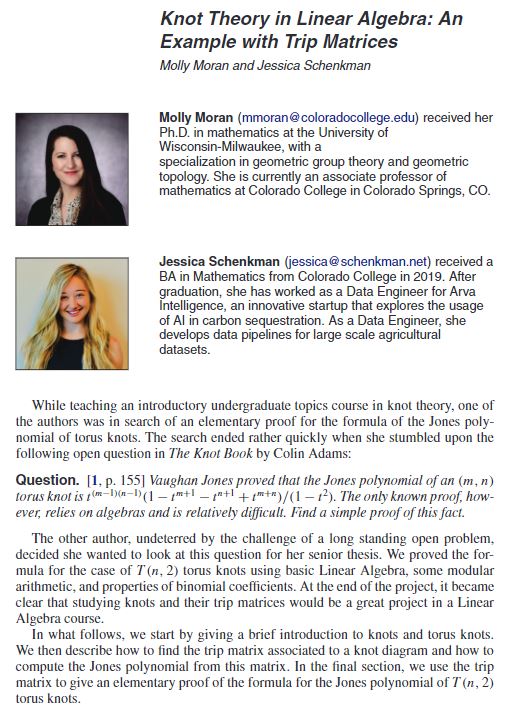
In the latest issue, one such article on knot theory appeared. Truth in advertising: I know next to nothing about knot theory, I do not know the authors, and I’ve only driven through Colorado College while on a recent vacation to Colorado Springs. With all that said, I love the opening paragraphs of their recent article, which are shown below.

The first sentence of the second paragraph grabbed my attention:

The other author, undeterred by the challenge of a long standing open problem, decided she wanted to look at this question for her senior thesis.

I absolutely love the moxie behind this sentiment. For the little it’s worth, I offer my congratulations to both authors.

More truth in advertising: usually, when I see a journal article that’s outside my realm of expertise, I’ll make a half-hearted stab at scanning it; with rare exceptions, I then give up and move on to the next article. For this article, however, given this wonderful introduction, I’ll do my best to read and (try to) understand the full article.

Parabolas from String Art (Part 10)

Recently, I announced that my paper Parabolic Properties from Pieces of String had been published in the magazine Math Horizons. The article had multiple aims; in chronological order of when I first started thinking about them:

  • Prove that string art from two line segments traces a parabola.
  • Prove that a quadratic polynomial satisfies the focus-directrix property of a parabola, which is the reverse of the usual logic when students learn conic sections.
  • Prove the reflective property of parabolas.
  • Accomplish all of the above without using calculus.

While I’m generally pleased with the final form of the article, the necessity of publication constraints somewhat abbreviated the original goal of this project: determining a pedagogically sound way of convincing a bright Algebra I student that string art unexpectedly produces a parabola. In this series of posts, I’d wanted to expand on the article with some pedagogical thoughts about connecting string art to parabolas for algebra students. After all, most mathematical studies of string art curves — formally known as “envelopes” — rely on differential equations or at least limits and calculus.

However, string art is simple enough for a young child to construct, and so this study was inspired by the quest of explaining this phenomenon using only simple mathematical tools.

The article linked above has further thoughts on this problem, including a calculus-free way of deriving the reflective property of parabolas. However, I think the article pretty much has all of my thoughts on this matter, and so I don’t think I need to elaborate upon them here.

This series of posts is dedicated to an inspired and inspiring Algebra I student who wanted to understand string art curves using tools that she could understand… even though she progressed much further into the mathematics curriculum by the time my article was published and this series of posts appeared on my blog.

Parabolas from String Art (Part 9)

Recently, I announced that my paper Parabolic Properties from Pieces of String had been published in the magazine Math Horizons. The article had multiple aims; in chronological order of when I first started thinking about them:

  • Prove that string art from two line segments traces a parabola.
  • Prove that a quadratic polynomial satisfies the focus-directrix property of a parabola, which is the reverse of the usual logic when students learn conic sections.
  • Prove the reflective property of parabolas.
  • Accomplish all of the above without using calculus.

While I’m generally pleased with the final form of the article, the necessity of publication constraints somewhat abbreviated the original goal of this project: determining a pedagogically sound way of convincing a bright Algebra I student that string art unexpectedly produces a parabola. While all the necessary mathematics is in the article, I think the article is somewhat lacking on how to sell the idea to students. So, in this series of posts, I’d like to expand on the article with some pedagogical thoughts about connecting string art to parabolas.

We have shown in the last couple of posts that if the three points that generate the Our explorations of string art led us to consider an arbitrary string \overline{PQ} depicted below. For brevity, this string will be called “string s,” matching the (possibly non-integer) x-coordinate of its left endpoint P. Since P is s units to the right of A, the right endpoint Q must correspondingly be s units to the right of B. Therefore, the x-coordinate of Q is s + 8.

Previously, we established that the equation for string s is

y = -\displaystyle \frac{s^2}{4} + \frac{xs}{4} - x + 8.

We also obtained a bonus result that we obtained using only algebra: string s is tangent to the parabola y = \displaystyle \frac{x^2}{16} - x + 8, which is traced by the strings, when x=2s. Of course, tangent lines are usually obtained using calculus, and so calculus should be able to confirm this result. The derivative of this function is

y' = \displaystyle \frac{x}{8} - 1,

so that the slope of the tangent line when x=2s is m = \displaystyle \frac{s}{4} - 1 = \frac{s-4}{4}. We observe that this matches the slope of line segment \overline{PQ} in the above picture:

slope = \displaystyle \frac{s - (s-8)}{(s+8) - 8} = \frac{2s-8}{8} = \frac{s-4}{4}.

Therefore, to show that \overline{PQ} is the tangent line, it suffices to show that either P or Q is on the tangent line.

At x = 2s, the y-coordinate of where the tangent line intersects the curve is

y = \displaystyle \frac{(2s)^2}{16} - 2s + 8 = \frac{s^2}{4} - 2s + 8.

Using the point-slope formula for a line, the equation of the tangent line is thus

y-y_1 = m(x-x_1)

y-\displaystyle \left( \frac{s^2}{4} - 2s + 8 \right) = \frac{s-4}{4} (x-2s)

y = \displaystyle \frac{s-4}{4} (x-2s) +  \frac{s^2}{4} - 2s + 8.

We now check to see if P(s,8-s) is on the tangent line. Substituting x =s, we find

y = \displaystyle \frac{s-4}{4} (s-2s) +  \frac{s^2}{4} - 2s + 8

= \displaystyle \frac{s-4}{4} (-s) +  \frac{s^2}{4} - 2s + 8

= \displaystyle \frac{(s-4)(-s) + s^2}{4} - 2s + 8

= \displaystyle \frac{-s^2+4s + s^2}{4} - 2s + 8

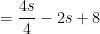
= \displaystyle \frac{4s}{4} - 2s + 8

= s - 2s + 8

= -s + 8

Therefore, the point (s,8-s) is on the tangent line, thus confirming that P is on the tangent line and that \overline{PQ} is the tangent line.

Parabolas from String Art (Part 8)

Recently, I announced that my paper Parabolic Properties from Pieces of String had been published in the magazine Math Horizons. The article had multiple aims; in chronological order of when I first started thinking about them:

  • Prove that string art from two line segments traces a parabola.
  • Prove that a quadratic polynomial satisfies the focus-directrix property of a parabola, which is the reverse of the usual logic when students learn conic sections.
  • Prove the reflective property of parabolas.
  • Accomplish all of the above without using calculus.

While I’m generally pleased with the final form of the article, the necessity of publication constraints somewhat abbreviated the original goal of this project: determining a pedagogically sound way of convincing a bright Algebra I student that string art unexpectedly produces a parabola. While all the necessary mathematics is in the article, I think the article is somewhat lacking on how to sell the idea to students. So, in this series of posts, I’d like to expand on the article with some pedagogical thoughts about connecting string art to parabolas.

We have shown in the last couple of posts that if the three points that generate the Our explorations of string art led us to consider an arbitrary string \overline{PQ} depicted below. For brevity, this string will be called “string s,” matching the (possibly non-integer) x-coordinate of its left endpoint P. Since P is s units to the right of A, the right endpoint Q must correspondingly be s units to the right of B. Therefore, the x-coordinate of Q is s + 8.

Previously, we established that the equation for string s is

y = -\displaystyle \frac{s^2}{4} + \frac{xs}{4} - x + 8.

Finding the curve traced by the strings is a two-step process:

  • For a fixed value of x, find the value of s that maximizes y.
  • Find this optimal value of y.

Previously, we showed using only algebra that the optimal value of s is s = \displaystyle \frac{x}{2}, corresponding to an optimal value of y of y = \displaystyle \frac{x^2}{16} - x + 8.

For a student who knows calculus, the optimal value of s can be found by instead solving the equation \displaystyle \frac{dy}{ds} = 0 (or, more accurately, \displaystyle \frac{\partial y}{\partial s} = 0):

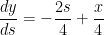
\displaystyle \frac{dy}{ds} = -\frac{2s}{4} + \frac{x}{4}

0 = \displaystyle \frac{-2s+x}{4}

0 = -2s + x

2s = x

s = \displaystyle \frac{x}{2},

matching the result that we found by using only algebra.

Parabolas from String Art (Part 7)

Recently, I announced that my paper Parabolic Properties from Pieces of String had been published in the magazine Math Horizons. The article had multiple aims; in chronological order of when I first started thinking about them:

  • Prove that string art from two line segments traces a parabola.
  • Prove that a quadratic polynomial satisfies the focus-directrix property of a parabola, which is the reverse of the usual logic when students learn conic sections.
  • Prove the reflective property of parabolas.
  • Accomplish all of the above without using calculus.

While I’m generally pleased with the final form of the article, the necessity of publication constraints somewhat abbreviated the original goal of this project: determining a pedagogically sound way of convincing a bright Algebra I student that string art unexpectedly produces a parabola. While all the necessary mathematics is in the article, I think the article is somewhat lacking on how to sell the idea to students. So, in this series of posts, I’d like to expand on the article with some pedagogical thoughts about connecting string art to parabolas.

Our explorations of string art led us to consider an arbitrary string \overline{PQ} depicted below. For brevity, this string will be called “string s,” matching the (possibly non-integer) x-coordinate of its left endpoint P. Since P is s units to the right of A, the right endpoint Q must correspondingly be s units to the right of B. Therefore, the x-coordinate of Q is s + 8.

In the previous post, we established that the equation for string s is

y = -\displaystyle \frac{s^2}{4} + \frac{xs}{4} - x + 8

This has the appearance of a quadratic equation, but it’s actually a linear equation in x for a fixed value of s. For example, if s = 5, we find that the equation of string 5 is

y = -\displaystyle \frac{25}{4} + \frac{5x}{4} - x +8 = 0.25x+1.75,

matching the equation of the blue string we found in a previous post in this series.

To prove that the strings trace a parabola, we now determine which string s maximizes the value of y = -\displaystyle \frac{1}{4}s^2 + \frac{x}{4}s - x + 8 for a given value of x. Algebra students can determine this maximum by recalling that a quadratic function y = as^2 + bs + c is maximized (for negative a) when s = \displaystyle -\frac{b}{2a}. Therefore, the string with largest y-coordinate for a given value of x is

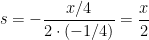
s = \displaystyle -\frac{x/4}{2 \cdot (-1/4)} = \frac{x}{2}.

For example, if x = 4, then string s = 4 / 2 = 2 has the largest y-coordinate, matching our previous observations.
To complete the proof that the strings above trace a parabola, we substitute s = \displaystyle \frac{x}{2} into y = -\displaystyle \frac{s^2}{4} + \frac{xs}{4} - x + 8 to find the value of this largest y-coordinate:

y = -\displaystyle \frac{(x/2)^2}{4} + \frac{x(x/2)}{4} - x + 8

= -\displaystyle \frac{x^2}{16} + \frac{x^2}{8} - x + 8

= \displaystyle \frac{x^2}{16} - x + 8,

matching the result that we found earlier in this series.

There’s also a bonus result. We further note that, for every x, there is only one string s = \frac{x}{2} that intersects the parabola y = \displaystyle \frac{x^2}{16} - x + 8. Since each x is associated with a unique string s and vice versa, we conclude that each string intersects the parabola at exactly one point. In other words, string s is tangent to the parabola y = \displaystyle \frac{x^2}{16} - x + 8 when x=2s.

We note that all of the above calculations were entirely elementary, in the sense that calculus was not used and that only techniques from algebra were employed. That said, the word “elementary” in mathematics can be a bit loaded — this means that it is based on simple ideas that are perhaps used in a profound and surprising way. Perhaps my favorite quote along these lines was this understated gem from the book Three Pearls of Number Theory after the conclusion of a very complicated multi-page proof in Chapter 1:

You see how complicated an entirely elementary construction can sometimes be. And yet this is not an extreme case; in the next chapter you will encounter just as elementary a construction which is considerably more complicated.

In the next post, we take a second look at this derivation using techniques from calculus.

Parabolas from String Art (Part 6)

Recently, I announced that my paper Parabolic Properties from Pieces of String had been published in the magazine Math Horizons. The article had multiple aims; in chronological order of when I first started thinking about them:

  • Prove that string art from two line segments traces a parabola.
  • Prove that a quadratic polynomial satisfies the focus-directrix property of a parabola, which is the reverse of the usual logic when students learn conic sections.
  • Prove the reflective property of parabolas.
  • Accomplish all of the above without using calculus.

While I’m generally pleased with the final form of the article, the necessity of publication constraints somewhat abbreviated the original goal of this project: determining a pedagogically sound way of convincing a bright Algebra I student that string art unexpectedly produces a parabola. While all the necessary mathematics is in the article, I think the article is somewhat lacking on how to sell the idea to students. So, in this series of posts, I’d like to expand on the article with some pedagogical thoughts about connecting string art to parabolas.

As discussed previous posts, we begin our explorations with string art connecting evenly spaced points on line segments \overline{AB} and \overline{BC} with endpoints A(0,8), B(8,0), and C(16,8). We will call these colored line segments “strings.” We then found the string with the largest y-coordinate at x = 2, 4, 6, \dots, 14, resulting in the following picture:

In previous posts, we discussed three different ways of establishing that the colored points lie on the parabola y = \displaystyle \frac{x^2}{16} - x + 8.

Unfortunately, checking that a statement is true for a few points (in our case, x= 0, 2, 4, \dots, 14, 16) does not constitute a complete proof for all points. Furthermore, it’s conceivable that “fuller” string art with additional strings, like the picture below, may identify a new string with a higher y-coordinate than a colored point.

To prove that the string art indeed traces a parabola, we study an arbitrary string \overline{PQ} depicted below. For brevity, this string will be called “string s,” matching the (possibly non-integer) x-coordinate of its left endpoint P. Since P is s units to the right of A, the right endpoint Q must correspondingly be s units to the right of B. Therefore, the x-coordinate of Q is s + 8.

Since the equations of \overline{AB} and \overline{BC} are y=-x+8 and y=x-8, respectively, the y-coordinates of P and Q are -s+8 and (s+8)-8 = s, respectively. For example, if s = 5, the coordinates of P are (s,8-s)=(5,3) and the coordinates of Q are (s + 8, s) = (13, 5), matching the endpoints of the blue string in the first figure.

We now use standard algebraic techniques to find the equation of string s. Its slope is

m = \displaystyle \frac{ s - (8-s)}{(s+8)-s} = \frac{2s-8}{8} = \frac{s-4}{4}.

The coordinates of either P or Q can now be used to find the equation of string s via the point-slope formula. As it turns out, the coordinates of P are simpler to use:

y-y_1 = m(x-x_1)

y-(8-s) = \displaystyle \frac{s-4}{4}(x-s)

y = \displaystyle \frac{(s-4)(x-s)}{4} + (8-s)

y = \displaystyle \frac{xs-s^2-4x+4s}{4} + 8-s

y = \displaystyle \frac{xs}{4} - \frac{s^2}{4} - x + s + 8 - s

to finally arrive at the equation of string s:

y = -\displaystyle \frac{s^2}{4} + \frac{xs}{4} - x + 8

This has the appearance of a quadratic equation, but it’s actually a linear equation in x for a fixed value of s. For example, if s = 5, we find that the equation of string 5 is

y = -\displaystyle \frac{25}{4} + \frac{5x}{4} - x +8 = 0.25x+1.75,

matching the equation of the blue string we found in a previous post in this series.

We are now almost in position to prove that the string art traces a parabola. We demonstrate this in the next post.

Parabolas from String Art (Part 5)

Recently, I announced that my paper Parabolic Properties from Pieces of String had been published in the magazine Math Horizons. The article had multiple aims; in chronological order of when I first started thinking about them:

  • Prove that string art from two line segments traces a parabola.
  • Prove that a quadratic polynomial satisfies the focus-directrix property of a parabola, which is the reverse of the usual logic when students learn conic sections.
  • Prove the reflective property of parabolas.
  • Accomplish all of the above without using calculus.

While I’m generally pleased with the final form of the article, the necessity of publication constraints somewhat abbreviated the original goal of this project: determining a pedagogically sound way of convincing a bright Algebra I student that string art unexpectedly produces a parabola. While all the necessary mathematics is in the article, I think the article is somewhat lacking on how to sell the idea to students. So, in this series of posts, I’d like to expand on the article with some pedagogical thoughts about connecting string art to parabolas.

As discussed previous posts, we begin our explorations with string art connecting evenly spaced points on line segments \overline{AB} and \overline{BC} with endpoints A(0,8), B(8,0), and C(16,8). We will call these colored line segments “strings.” We then found the string with the largest y-coordinate at x = 2, 4, 6, \dots, 14, resulting in the following picture:

However, perhaps it’s clearer to plot these points on a separate graph, without the clutter of the strings:

These points are definitely following some kind of curve. In the previous posts, we established algebraically that the curve is the parabola y = \displaystyle \frac{x^2}{16} - x + 8.

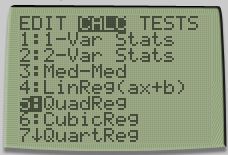
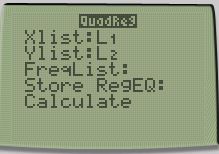
A more modern way of convincing students that the points lie on a parabola is by using technology: specifically, quadratic regression. First, we can input the nine points into a scientific calculator.

Then we ask the calculator to perform quadratic regression on the data.

The calculator then returns the result:

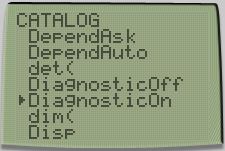
The best quadratic fit to the data is y = 0.0625x^2 - x + 8, or y = \displaystyle \frac{x^2}{16} - x + 8 as before. The line R^2 = 1 indicates a correlation coefficient of 1, meaning that the points lie perfectly on this parabola. A parenthetical note: If the R^2 line does not appear using a TI-83 or TI-84, this can be toggled by using DiagnosticOn:
I’ve presented three different ways that algebra students can convince themselves that the nine points generated by the above string art indeed lie on a parabola. I don’t suggest that all three methods should be used for any given student; as always, if one technique doesn’t appear to work pedagogically, then perhaps a different explanation might work.

However, our explorations aren’t done yet. Any of these three techniques may convince algebra students that the strings above trace a parabola. Unfortunately, checking that a statement is true for a few points (in our case, x= 0, 2, 4, \dots, 14, 16) does not constitute a complete proof for all points. Furthermore, it’s conceivable that “fuller” string art with additional strings, like the picture below, may identify a new string with a higher y-coordinate than a colored point.

So we have more work to do to prove our assertion that string art traces a parabola. We begin this next phase of our investigations in the next post.