Engaging students: Adding and subtracting polynomials

In my capstone class for future secondary math teachers, I ask my students to come up with ideas for engaging their students with different topics in the secondary mathematics curriculum. In other words, the point of the assignment was not to devise a full-blown lesson plan on this topic. Instead, I asked my students to think about three different ways of getting their students interested in the topic in the first place.

I plan to share some of the best of these ideas on this blog (after asking my students’ permission, of course).

This student submission again comes from my former student Kelly Bui. Her topic, from Algebra: multiplying polynomials.

green line

A2. How could you as a teacher create an activity or project that involves your topic?
The main idea of the activity will be finding an expression to represent the area of the border given the dimensions of the outer rectangle and the inner rectangle. The students will need to know how to multiply binomials and add or subtract polynomials. Therefore, this activity would be towards the end of the unit. Students will be asked to roam around the classroom or the hallway in search of items that already have dimensions labeled. For example, in the hallway there may be a bulletin board with the dimensions (2x² – 7) for the length and (3x – 4) for the width. Inside of the bulletin board, there will be the dimensions of a smaller rectangle. The question will be asked: What expression will represent the area I want to cover if I want to cover the only the border with paper?
Students may work in partners or groups to put minds together to solve this problem. Every object labeled with dimensions will be in the shape of a rectangle and the math involved will require students to multiply binomials and subtract polynomials.


green lineB2. How does this topic extend what your students should have learned in previous courses?
Before students learn to add and subtract polynomials, they learn how to combine like terms such as 3x and 5x. When we add and subtract polynomials, it is very similar to combining like terms in algebraic expressions. Students will need be familiar with the concept of combing like terms before they add or subtract polynomials. To introduce the topic of combining polynomials, it can be set up horizontally.

Such as: (3x² – 5x + 6) – (6x² – 4x + 9)

By setting it up this way, students can determine which terms can be combined and which terms need to be left alone. Additionally, students will build on the concept of combining like terms as it applies to this process as well. Setting it up horizontally will also increase the chance of preventing the mistake of forgetting to distribute the negative sign throughout the second polynomial. Once students are comfortable doing it this way, the addition and subtraction can be set up as a vertical problem where students must now take the step to align the like terms together in order to add or subtract. By taking the step to set up the polynomials horizontally before vertically, it will give the students a deeper understanding of what concept is actually behind adding and subtracting polynomials.


green line

E1. How can technology be used to effectively engage students with this topic?

The website http://www.quia.com provides a multitude of activities relating to different subjects. The game I chose to correlate adding and subtracting polynomials is identical to the actual game Battleship. The game can be played by anyone with access to the internet and Adobe. This game is interactive because you won’t have to perform math on every single shot fired at the enemy. If the student does hit one of the vessels, in order to actually “hit” the enemy’s ship, the student must successfully add or subtract two polynomials. If a student hits a vessel but is unable to solve the polynomial correctly, the game will highlight the hit area so that the student can try again. This game can either engage the students to see who can sink all of the enemy’s ships first, or it can be assigned as a homework assignment that requires showing work and screenshotting the end result of the game. Lastly, you can choose the level of difficulty of the game. For example, on the hard level, you must determine the missing addend or minuend to the expression, or add or subtract polynomials of different degrees.
The website also offers an option to create your own activities, so if Battleship isn’t panning out as desired, it is possible to create your own game for your students.
Game: https://www.quia.com/ba/28820.html

References:

Area of the Border: https://www.sophia.org/concepts/adding-and-subtracting-polynomials-in-the-real-world

Combining Like Terms: https://courses.lumenlearning.com/boundless-algebra/chapter/introduction-to-polynomials/

Battleship: https://www.quia.com/ba/28820.html
Engaging students: Using the point-slope equation of a line

In my capstone class for future secondary math teachers, I ask my students to come up with ideas for engaging their students with different topics in the secondary mathematics curriculum. In other words, the point of the assignment was not to devise a full-blown lesson plan on this topic. Instead, I asked my students to think about three different ways of getting their students interested in the topic in the first place.

I plan to share some of the best of these ideas on this blog (after asking my students’ permission, of course).

This student submission again comes from my former student Rachel Delflache. Her topic, from Algebra: using the point-slope equation of a line.

green line


A2: How could you as a teacher create an activity that involves the topic?

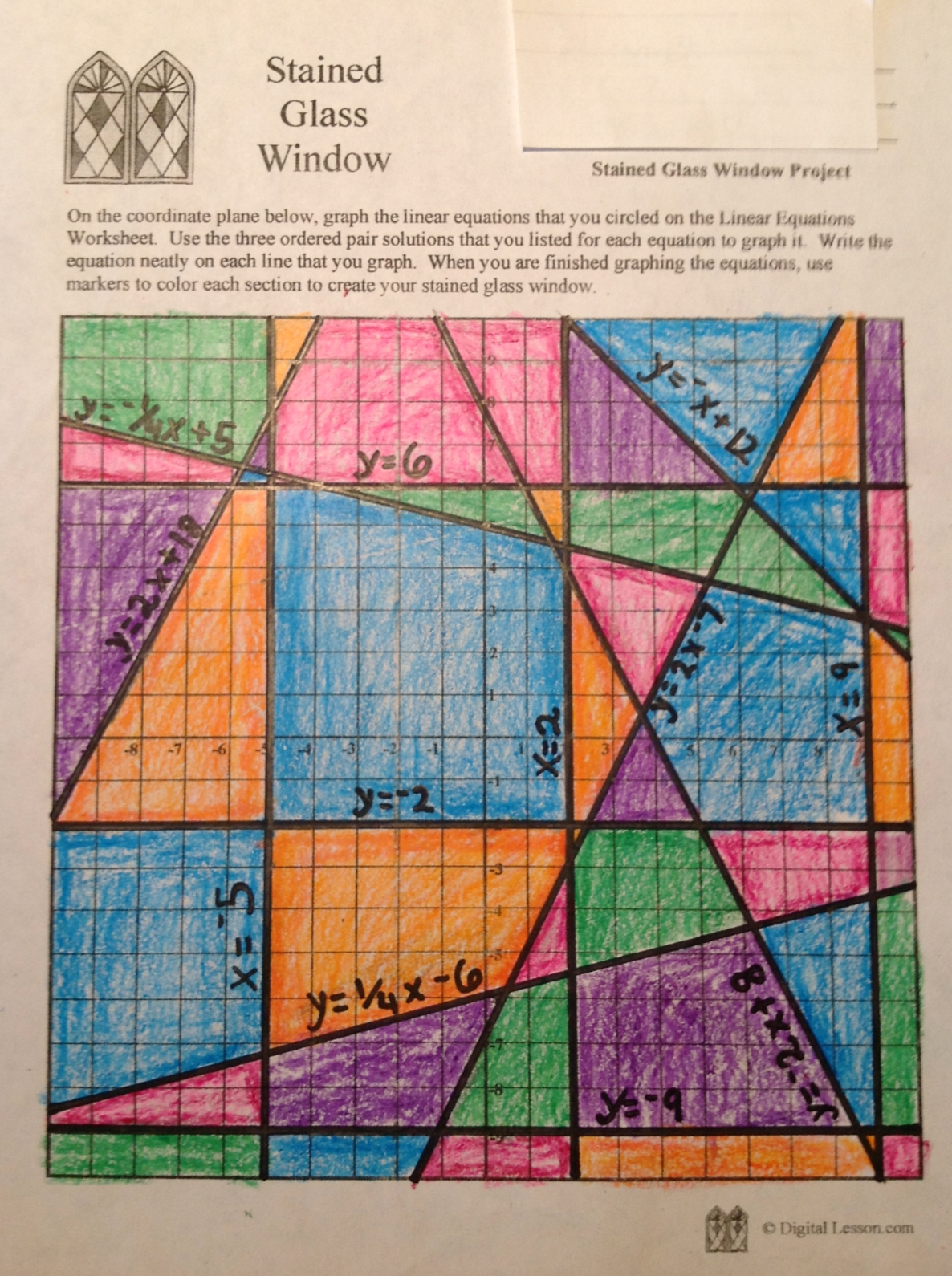
An adaptation of the stained-glass window project could be used to practice the point-slope formula (picture beside). Start by giving the students a piece of graph paper that is shaped like a traditional stained-glass window and then let they students create a window of their choosing using straight lines only. Once they are done creating their window, ask them to solve for and label the equations of the lines used in their design. While this project involves the point slope formula in a rather obvious way, giving the students the freedom to create a stained-glass window that they like helps to engage the students more than a normal worksheet. Also, by having them solve for the equations of the lines they created it is very probable that the numbers they must use for the equation will not be “pretty numbers” which would add an addition level of difficulty to the assignment.

green line

B2: How does this topic extend what your students should have learned in previous courses?

The point-slope formula extends from the students’ knowledge of the slope formula

m = (y2-y1)/(x2-x1)
(x2-x1)m = y2-y1
y-y1 = m(x-x1).

This means that the students could solve for the point-slope formula given the proper information and prompts. By allowing students to solve for the point-slope formula given the previous knowledge of the formula for slope, it gives the students a deeper understanding of how and why the point-slope formula works the way it does. Allowing the students to solve for the point-slope formula also increases the retention rate among the students.


green line

C1&3: How has this topic appeared in pop culture and the news?

Graphs are everywhere in the news, like the first graph below. While they are often time line charts, each section of the line has its own equation that could be solved for given the information found on the graph. One of the simplest way to solve for each section of the line graph would be to use point slope formula. The benefit of using point slope formula to solve for the equations of these graphs is that there is very minimal information needed—assuming that two coordinates can be located on the graph, the linear equation can be solved for. Another place where graphs appear is in pop culture. It is becoming more common to find graphs like the second one below. These graphs are often time linear equation for which the formula could be solved for using the point slope formula. These kinds of graphs could be used to create an activity where the students use the point slope formula to solve to the equations shown in either the real world or comical graph.


References:

Stained glass window-

Stained Glass Window Graphing Project

iPhone sales-
https://www.usatoday.com/story/tech/news/2017/06/28/iphones-smartphone-revolution-4-graphs/103216746/

Halloween graph-
https://www.buzzfeed.com/agh/halloween-charts-and-graphs?utm_term=.hpXrNWPm9#.qpvwGmxp0


Engaging students: Finding x- and y-intercepts

In my capstone class for future secondary math teachers, I ask my students to come up with ideas for engaging their students with different topics in the secondary mathematics curriculum. In other words, the point of the assignment was not to devise a full-blown lesson plan on this topic. Instead, I asked my students to think about three different ways of getting their students interested in the topic in the first place.

I plan to share some of the best of these ideas on this blog (after asking my students’ permission, of course).

This student submission again comes from my former student Deetria Bowser. Her topic, from Algebra: finding x- and y-intercepts. Unlike most student submissions, Maranda’s idea answers three different questions at once.

green line


E1. How can technology (YouTube, Khan Academy [khanacademy.org], Vi Hart, Geometers Sketchpad, graphing calculators, etc.) be used to effectively engage students with this topic? Note: It’s not enough to say “such-and-such is a great website”; you need to explain in some detail why it’s a great website.

One example of an engaging form of technology that involves finding x- and y-intercepts of lines is mangahigh.com. Under the algebra section, there is a tab for finding x and y intercepts which once clicked provides an option to start a game (“Algebra.”). In this game, the student is expected to look at lines and quickly decipher what is known about the x and y intercepts of the line in question. Before the game begins, the student is able to choose the difficulty of the game as well as the number of questions. After the game is completed students are able to review their answers. Implementing this website into the classroom will help students gain quickness in identifying x and y intercepts. Additionally, this game is also a quick and fun way to evaluate students understanding of x and y intercepts, without forcing them to take a quiz.

green lineD1. What interesting things can you say about the people who contributed to the discovery and/or the development of this topic? (You might want to consult Math Through The Ages.)

The topic of x and y intercepts falls under a much broader topic called analytical geometry.The article “Analytic geometry” defines analytical geometry as “[a] mathematical subject in which algebraic symbolism and methods are used to represent and solve problems in geometry” (D’Souza). One of the people who discovered this topic was René Descartes. René Descartes was actually a french modern philosopher who also made discoveries in the realms of science as well as mathematics. Descartes “dismissed apparent knowledge derived from authority,” meaning that he made his discoveries based on what he thought rather than taking ideas from scientists, philosophers and mathematicians (Watson). He discovered analytical mathematics (along with Fermat) in the 1630s (D’Souza). He also “he stressed the need to consider general algebraic curves—graphs of polynomial equations in x and y of all degrees” (D’Souza). Mentioning Descartes in class, and explaining his accomplishments in Mathematics as well as modern philosophy and science, will encourage students to realize that they can succeed in more than one subject . Also, Descartes can be used as an influence in the building of ideas in the classroom, since he did not just accept ideas already created.

green line

C1. How has this topic appeared in pop culture (movies, TV, current music, video games, etc.)?

The topic of x and y intercepts appeared on a “pop culture blog” called the comeback.com. In an article posted in November 2016, a former UCLA and current Cleveland Indians baseball player named Trevor Bauer helped one of his fans with her math homework (Blazer). This article describes a girl asking Bauer for help determining the slope of a line and the y – intercepts via Twitter. Her specific question involves the equation 2y=x (Blazer). He then explains that “for every 1 unit on the x axis go 2 units on the y axis. y intercept is where it crosses the y axis. Make y 0 and figure x” (Blazer). Since Bauer is a professional baseball player, he already has a great influence over people. Showing students this article about Bauer will show students that even people who play baseball for a living still have the knowledge of Algebra.


References
“Algebra.” Mangahigh.com – Algebra,
http://www.mangahigh.com/en-us/math_games/algebra/straight_line_graphs/find_the_x_and_y_intercepts_of_lines. Accessed 15 Sept. 2017.

Blazer, Sam, et al. “Trevor Bauer helped a fan do their math homework on Twitter.” The
Comeback, 13 Nov. 2016,
thecomeback.com/mlb/trevor-bauer-twitter-math-homework.html. Accessed 15 Sept.
2017.

D’Souza, Harry Joseph, and Robert Alan Bix. “Analytic geometry.” Encyclopædia Britannica,
Encyclopædia Britannica, inc., 6 June 2016,
http://www.britannica.com/topic/analytic-geometry. Accessed 15 Sept. 2017.

Watson, Richard A. “René Descartes.” Encyclopædia Britannica, Encyclopædia Britannica, inc.,
27 Jan. 2017, http://www.britannica.com/biography/Rene-Descartes. Accessed 15 Sept. 2017.

Engaging students: Factoring polynomials

In my capstone class for future secondary math teachers, I ask my students to come up with ideas for engaging their students with different topics in the secondary mathematics curriculum. In other words, the point of the assignment was not to devise a full-blown lesson plan on this topic. Instead, I asked my students to think about three different ways of getting their students interested in the topic in the first place.

I plan to share some of the best of these ideas on this blog (after asking my students’ permission, of course).

This student submission again comes from my former student Brittnee Lein. Her topic, from Algebra: factoring polynomials.

green line

1. How can technology be used to effectively engage students with this topic?

There are many great websites that can help to provide students a conceptual framework for factoring polynomials in lieu of simple lecture. This website lets students explore polynomial equations with online algebra tiles.

https://illuminations.nctm.org/activity.aspx?id=3482

Algebra tiles are effective in teaching factoring because they provide a visual representation of abstract concepts and allow students to understand that the symbol “=” in an equation really means equivalence (i.e. what you do to one side of the equation, you must do to the other side). I also think algebra tiles are very beneficial in teaching students about zero pairs. There are other websites –such as wolfram alpha– that are especially great supplements to go alongside topics such as factoring polynomials because students can see the graphical meaning of the roots of a quadratic equation. When combined, these websites can aid students in gaining a both conceptual and procedural understanding of the topic.


green line

How could you as a teacher create an activity or project that involves your topic?

There is an activity called “Factor Draft” where students set up a ‘playing field’ of cards. In this field, there are factor cards such as (x+2), (x-12), etc. sum (5x), (12x), etc., and product cards (1), (42), and so on. The goal of the game is to draw a winning hand of two factor cards and a corresponding sum and product card. Each card is color coded to their type. Each turn a player draws one card from the field of face up cards. The player must pay mind to not only his/her own cards but also those of their opponent’s –as the first person to get two factor cards and their corresponding sum and product card wins. This activity is beneficial in furthering student understanding between the relationships between each term in a quadratic polynomial. For example (x+4)(x-3) = x^2 + 1x - 12 and the corresponding factor cards would be (x+4) and (x-3) the sum card would be (1x) and the product card would be (-12). This activity allows students to intuitively get a sense of the process of factoring and gives them practice multiplying out polynomials.


green line

2. How can this topic be used in your students’ future courses in mathematics or science?
• Factoring polynomials is used in many important future science and mathematics concepts. When a quadratic equation cannot be factored simply, teachers must introduce the quadratic formula. This slides into the introduction of complex roots of an equation and complex numbers. When factoring polynomials of higher degree than 2, synthetic division (another topic in high school mathematics) is useful in finding the roots of the equation. If a student is able to understand the meaning of the roots of an equation, that will aid in solving many interesting physics and mathematics problems. Factoring is used quite often to find the domain of a rational equation such as f(x) = (x+2)/ (x^2+ 4x+3). A student must also have a strong basis in factoring polynomials to learn concepts such as completing the square.
References

• National Library of Virtual Manipulatives, nlvm.usu.edu/en/nav/vlibrary.html.

• Cleveland, James. “The Factor Draft.” The Roots of the Equation, 23 May 2014, rootsoftheequation.wordpress.com/2014/05/22/the-factor-draft/.

Engaging students: Solving one-step algebra problems

In my capstone class for future secondary math teachers, I ask my students to come up with ideas for engaging their students with different topics in the secondary mathematics curriculum. In other words, the point of the assignment was not to devise a full-blown lesson plan on this topic. Instead, I asked my students to think about three different ways of getting their students interested in the topic in the first place.

I plan to share some of the best of these ideas on this blog (after asking my students’ permission, of course).

This student submission again comes from my former student Deetria Bowser. Her topic, from Algebra: solving one-step algebra problems.

green line

What interesting (i.e., uncontrived) word problems using this topic can your students do now? (You may find resources such as http://www.spacemath.nasa.gov to be very helpful in this regard; feel free to suggest others.)

To create a successful word problem that would both interest, and engage students, the teacher must “know his class.” Knowing one’s class involves knowing the many different students your students have. For example, if one knows that there are a lot of baseball players in the classroom, then creating word problems that involve baseball would be engaging for these students.

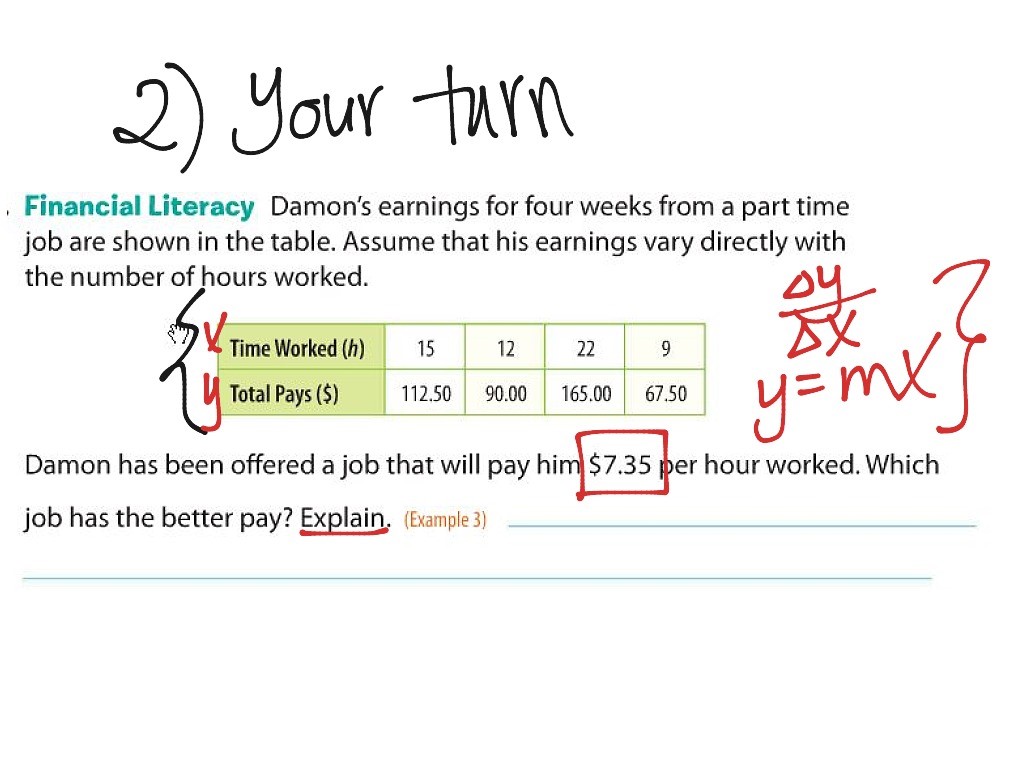
Additionally, to benefit all students you could do problems that involve finances. Including more “finance problems” will help students realize the importance of math, and how they can apply it in everyday life. An example of such problem would be “Damon’s earnings for four weeks from a part time are shown in the table. Assume his earnings vary directly with the number of hours worked. Damon has been offered a job that will pay him $7.35 per hour worked. Which job is better pay (Tucker, A.)? Including word problems that students can relate to now or in the future can help students stay engaged while learning, and answer the question that is most commonly asked by students: “When will I ever use this in real life?”

green line

How could you as a teacher create an activity or project that involves your topic?

As a teacher, creating engaging activities and/or projects can prove to be quite difficult for word problems that are one- or two-step algebra problems, due to the fact that most students completely shut down once a word problem is presented to them. To combat this I have found that making it into a cooperative game can help soothe the anxiety caused by word problems. One game that is great to play with one or two step algebra problems is called rally coach. In this game, students are paired off. Student A is expected to work on solving the problem, while Student B is expected to watch, listen, check, and praise just as a coach would. Once the students think they have the correct answer, they will raise their hand so that the teacher may check it. If they get the answer correct, then the teacher will give them another problem (this time Student A and Student B switch roles). If the answer is incorrect, they must continue working on the problem. The end goal of the game is to answer as many questions as possible before time runs out. By playing this game students are able to help each other solve one or two step word problems.


green line

How can this topic be used in your students’ future courses in mathematics or science?

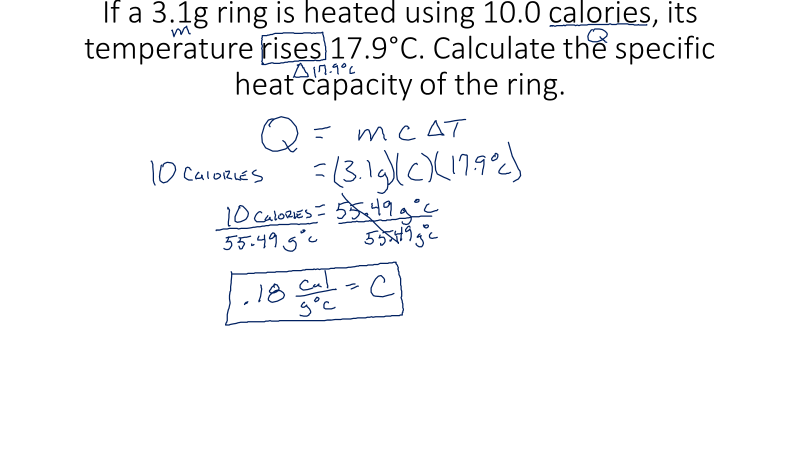
In future courses many problems will involve one or two step algebra problems. For instance, in science courses like chemistry and physics, one will need to know how to solve for different variables of equations. For example, if one is in a chemistry course and is given a word problem (i.e If a 3.1g ring is heated using 10.0 calories, its temperature rises 17.9°C. Calculate the specific heat capacity of the ring) that provides heat energy (Q) mass of a substance (m) and change in temperature (deltaT), but is asked to solve for the specific heat, students will need to know how to solve for the specific heat either by isolating the variable in the beginning (Cp=Q/mdeltaT) or plugging in the givens and isolating the variable (Daniell, B).

References

Daniell, B. (n.d.). Energy Slides 3 [Powerpoint that contains Specific Heat problem].

Tucker, A. (2016). Direct Variation. Retrieved September 01, 2017, from

http://www.showme.com/sh/?h=PQvPbm4


Engaging students: Negative and zero exponents

In my capstone class for future secondary math teachers, I ask my students to come up with ideas for engaging their students with different topics in the secondary mathematics curriculum. In other words, the point of the assignment was not to devise a full-blown lesson plan on this topic. Instead, I asked my students to think about three different ways of getting their students interested in the topic in the first place.

I plan to share some of the best of these ideas on this blog (after asking my students’ permission, of course).

This student submission again comes from my former student Austin DeLoach. His topic, from Algebra: negative and zero exponents.

green line

B1. How can this topic be used in your students’ future courses in mathematics or science?

The topic of negative and zero exponents is very important when or if the students get to calculus. Although that will be several years down the line, having a solid fundamental grasp on the idea of negative and zero exponents will help them understand derivatives a lot better. Because derivatives of “simple” functions just multiply the coefficient by the exponent and then subtract one from the exponent, it is important for the students to have a good understanding of what negative and zero exponents are. If they do not understand already, they will be confused about why, for example, the derivative of 3x is just 3. It also greatly simplifies derivatives of things like 4/x2, as the students will simply be able to recognize that that is the same thing as 4x-2 and follow standard rules instead of needing to think about the quotient rule and waste time with that. It will also help them in the more near future when they work with simplifying expressions with the exponents written in different terms (i.e. with a positive exponent or with a negative exponent in the denominator), as it will help them recognize what simplifications mean the same thing. Explaining that understanding negative exponents will thoroughly help them in the future may be enough for some students to want to solidify their grasp on the topic.

green line

D2. How was this topic adopted by the mathematical community?

Although this is not about the early adoption of negative and zero exponents in the mathematical community, Geoffrey D. Dietz points out more recent bias for or against the use of negative exponents in textbooks in his Journal of Humanistic Mathematics (linked at the bottom of this answer). Dietz brings up the idea of what is considered “simplified” when it comes to negative exponents vs exponents in denominators. He rated over 20 mathematics textbooks from 1825 to 2012 from “very tolerant” of negative denominators in simplified answers to “very intolerant”. Interestingly, his first encounter with an “intolerant” textbook was not until the 20th century, and textbooks began getting more polarized as very tolerant or very intolerant closer to the end of the 20th century and getting closer to today. This is interesting when it comes to adoption by the mathematical community, as there is a significant inconsistency, even today, about whether negative exponents can be considered “simplified” or not. It will be important to point this out to your students so they can be prepared for their future teachers who may have different preferences on simplification from you, as that will help them understand the polarity in the mathematical community on this topic, as well as hopefully make them want to understand what negative exponents really mean. Dietz recommends giving your students practice with not only converting negative exponents to positive exponents, but also from positive to negative, in order to make sure they are prepared for whatever preferences come up as well as solidifying their understanding of what negative exponents mean.

http://scholarship.claremont.edu/cgi/viewcontent.cgi?article=1110&context=jhm

green line

E1. How can technology be used to effectively engage students with this topic?
This video from Khan Academy does a good job at explaining why negative and zero exponents are what they are. Although Khan Academy videos will likely not be the most engaging for all students, this video is short enough to maintain the attention of the class, and it the logic in it is helpful for the students who don’t understand how the definition of negative and zero exponents was decided on. The presenter does well explaining the idea of “going backwards” and dividing by the number when you decrease the exponent. It’s a good way to explain the “why” for students who ask about it, and it also is a good way to change up the pace for students, as playing videos during class could prevent it from becoming stale for the students, keeping them engaged for longer.

https://www.khanacademy.org/math/pre-algebra/pre-algebra-exponents-radicals/pre-algebra-negative-exponents/v/negative-exponent-intuition


My Favorite One-Liners: Index

I’m doing something that I should have done a long time ago: collecting a series of posts into one single post. The links below show my series on my favorite one-liners.

Mathematical Wisecracks for Almost Any Occasion: Part 2Part 7, Part 8, Part 12, Part 21, Part 28, Part 29, Part 41, Part 46, Part 53, Part 60, Part 63, Part 65, Part 71, Part 79, Part 84, Part 85, Part 100, Part 101Part 108

All-Purpose Anecdotes: Part 38, Part 50, Part 64, Part 70, Part 92, Part 94

Addressing Misconceptions: Part 3Part 4Part 11, Part 14, Part 15, Part 18, Part 30, Part 32, Part 33, Part 37, Part 45, Part 59

Tricky Steps in a Calculation: Part 5, Part 6

Greek alphabet and choice of variables: Part 40, Part 43, Part 56

Homework and exams: Part 39Part 47, Part 55, Part 57, Part 58, Part 66, Part 77, Part 78, Part 91, Part 96, Part 97, Part 107

Inequalities: Part 99

Simplification: Part 10, Part 102, Part 103

Polynomials: Part 19, Part 48, Part 49, Part 81, Part 90

Inverses: Part 16

Exponential and Logarithmic Functions: Part 1, Part 42, Part 68, Part 80

Trigonometry: Part 9, Part 69, Part 76, Part 106

Complex numbers: Part 54, Part 67, Part 86

Sequences and Series: Part 20, Part 35

Combinatorics: Part 27

Statistics: Part 22, Part 23, Part 36, Part 51, Part 52, Part 61, Part 95

Probability: Part 26, Part 31, Part 62, Part 93

Calculus: Part 24, Part 25, Part 72, Part 73, Part 74, Part 75, Part 83, Part 87, Part 88, Part 104

Logic and Proofs: Part 13, Part 17Part 34, Part 44, Part 89, Part 98

Differential Equations: Part 82, Part 105


My Favorite One-Liners: Part 108

In this series, I’m compiling some of the quips and one-liners that I’ll use with my students to hopefully make my lessons more memorable for them.

Today’s post marks the final entry in this series. When I first came up with the idea of listing some of favorite classroom quips, I thought that this series might last a couple dozen posts. To my surprise, it instead lasted for more than 100 posts. I guess that, in my 21-year teaching career, I’ve slowly developed my own unique lexicon for communicating mathematical ideas, and perhaps this parallels (on a decidedly smaller scale) what a radio talk show host (like local legend Randy Galloway, who was a sports reporter/commentator in the Dallas/Fort Worth area for many years before retiring) does to build rapport with his/her audience.

I’ll use this final one-liner near the end of the semester when it’s time for students complete their evaluations of my teaching. Back in days of yore, professors would take 10-15 minutes to pass out paper copies of these evaluations, students would complete them, and that would be the end of it. In modern times, however, paper evaluations have switched to electronic evaluations, which are perhaps better for the environment but tend to have a decidedly lower response rate than the old paper evaluations. Still, I value my students’ feedback. So I’ll tell them:

Please fill out the student evaluation; the size of my raise depends on this.

After the laughter settles down, I’ll tell them, “Who’s joking?” I can’t say this happens everywhere, but I can honestly say that my department’s executive committee does consider student evaluations of teaching when deciding on the quality of my teaching, and that partially determines the size of my annual merit raise. (The committee also considers other indicators of good teaching other than student evaluations.)

It’s important to note that I don’t tell my students to give me a good evaluation; I just ask them to fill it out and to be honest with their feedback. I also tell them, forgetting my raise, I also want to hear from them about how the semester went. If it went great, I want to know that. If it sucked, I also want to know that. However, if they think the class sucked, just writing “This class sucked” doesn’t give me a lot of information about how to fix things for the next time that I teach the course. So, if they have a criticism, I ask them to give me specific feedback so that I can consider their critiques.

A couple years ago, I served on my university’s committee for reconsidering the way that we conduct student evaluations of teaching. To my surprise, when I interviewed students in focus groups, there was a general consensus that students believed that their evaluations were a waste of time that didn’t actually contribute anything to the university — or if they did contribute something, they had no idea what it was. Ever since then, I’ve made a point of telling my students that their evaluations really do matter and can make a difference in future offerings of my courses.