
I’m a few months late with this, but my colleague Jason Ermer at Collaborative Mathematics has published Challenge 12 on his website: http://www.collaborativemathematics.org/
Category: Precalculus
A little trigonometry humor
Courtesy Math with Bad Drawings: https://wordpress.com/read/post/id/48254001/2942/
The Fundamental Theorem of Algebra: A Visual Approach
A former student forwarded to me the following article concerning a visual way of understanding the Fundamental Theorem of Algebra, which dictates that every nonconstant polynomial has at least one complex root: http://www.cs.amherst.edu/~djv/FTAp.pdf. The paper uses a very clever idea, from the opening paragraphs:
[I]f we want to use pictures to display the behavior of polynomials defined on the complex numbers, we are immediately faced with a difficulty: the complex numbers are two-dimensional, so it appears that a graph of a complex-valued function on the complex numbers will require four dimensions. Our solution to this problem will be to use color to represent some dimensions. We begin by assigning a color to every number in the complex plane… so a complex number can be uniquely specified by giving its color.
We can now use this color scheme to draw a picture of a function
as follows: we simply color each point
in the complex plane with the color corresponding to the value of
. From such a picture, we can read off the value of
The article is engagingly written; I recommend it highly.
Inverse Functions: Index
I’m doing something that I should have done a long time ago: collect past series of posts into a single, easy-to-reference post. The following posts formed my series on the different definitions on inverse functions that appear in Precalculus and Calculus.
Square Roots, nth Roots, and Rational Exponents
Part 1: Simplifying

Part 2: The difference between 

Part 3: Definition of an inverse function and the horizontal line test
Part 4: Why extraneous solutions may occur when solving algebra problems involving a square root
Part 5: Defining
Part 6: Consequences of the definition of 
Part 7: Defining ![\sqrt[n]{x}](https://s0.wp.com/latex.php?latex=%5Csqrt%5Bn%5D%7Bx%7D&bg=ffffff&fg=000000&s=0&c=20201002)

Part 8: Rational exponents if the denominator of the exponent is odd or even
Arcsine
Part 9: There are infinitely many solutions to

Part 10: Defining arcsine with domain
![[-\pi/2,\pi/2]](https://s0.wp.com/latex.php?latex=%5B-%5Cpi%2F2%2C%5Cpi%2F2%5D&bg=ffffff&fg=000000&s=0&c=20201002)
Part 11: Pedagogical thoughts on teaching arcsine.
Part 12: Solving SSA triangles: impossible case
Part 13: Solving SSA triangles: one way of getting a unique solution
Part 14: Solving SSA triangles: another way of getting a unique solution
Part 15: Solving SSA triangles: continuation of Part 14
Part 16: Solving SSA triangles: ambiguous case of two solutions
Part 17: Summary of rules for solving SSA triangles
Arccosine
Part 18: Definition for arccosine with domain
![[0,\pi]](https://s0.wp.com/latex.php?latex=%5B0%2C%5Cpi%5D&bg=ffffff&fg=000000&s=0&c=20201002)
Part 19: The Law of Cosines and solving SSS triangles
Part 20: Identifying impossible triangles with the Law of Cosines
Part 21: The Law of Cosines provides an unambiguous angle, unlike the Law of Sines
Part 22: Finding the angle between two vectors
Part 23: A proof for why the formula in Part 22 works
Arctangent
Part 18: Definition for arctangent with domain

Part 24: Finding the angle between two lines
Part 25: A proof for why the formula in Part 24 works.
Arcsecant
Part 26: Defining arcsecant using
![[0,\pi/2) \cup (\pi/2,\pi]](https://s0.wp.com/latex.php?latex=%5B0%2C%5Cpi%2F2%29+%5Ccup+%28%5Cpi%2F2%2C%5Cpi%5D&bg=ffffff&fg=000000&s=0&c=20201002)
Part 27: Issues that arise in calculus using the domain
Part 28: More issues that arise in calculus using the domain
Part 29: Defining arcsecant using

Logarithm
Part 30: Logarithms and complex numbers
Influences of Teaching Approaches and Class Size on Undergraduate Mathematical Learning
Every so often, I’ll publicize through this blog an interesting article that I’ve found in the mathematics or mathematics education literature that can be freely distributed to the general public. Today, I’d like to highlight Jo Clay Olson , Sandy Cooper & Tom Lougheed (2011) Influences of Teaching Approaches and Class Size on Undergraduate Mathematical Learning, PRIMUS: Problems, Resources, and Issues in Mathematics Undergraduate Studies, 21:8, 732-751, DOI: 10.1080/10511971003699694
Here’s the abstract:
An issue for many mathematics departments is the success rate of precalculus students. In an effort to increase the success rate, this quantitative study investigated how class size and teaching approach influenced student achievement and students’ attitudes towards learning mathematics. Students’ achievement and their attitudes toward learning mathematics were compared across four treatments of a precalculus course. The four treatments were (a) traditional lecture-based structure, (b) traditional lecture-based structure with a reduced class size, (c) instruction that engaged students in problem solving, and (d) instruction that included opportunities for small collaborative groups. The achievement of students engaged in problem-based learning (PBL) was significantly higher than the other treatments. These findings suggest that undergraduates benefit from instruction that encourages reflection on prior knowledge while developing new ideas through problem solving. Surprisingly, students in the PBE treatment did not continue to outperform students in the other treatments in calculus. These findings suggest the need for longitudinal studies that investigate the long-term effect of teaching approach and small class size on student learning and student success in advanced mathematics courses.
The full article can be found here: http://dx.doi.org/10.1080/10511971003699694
All You Need Is…

Different definitions of e: Index
I’m doing something that I should have done a long time ago: collect past series of posts into a single, easy-to-reference post. The following posts formed my series on the different definitions of 
Part 1: Justification for the formula for discrete compound interest
Part 2: Pedagogical thoughts on justifying the discrete compound interest formula for students.
Part 3: Application of the discrete compound interest formula as compounding becomes more frequent.
Part 4: Informal definition of
Part 5: Justification for the formula for continuous compound interest.
Part 6: A second derivation of the formula for continuous compound interest by solving a differential equation.
Part 7: A formal justification of the formula from Part 4 using the definition of a derivative.
Part 8: A formal justification of the formula from Part 4 using L’Hopital’s Rule.
Part 9: A formal justification of the continuous compound interest formula as a limit of the discrete compound interest formula.
Part 10: A second formal justification of the continuous compound interest formula as a limit of the discrete compound interest formula.
Part 11: Numerical computation of 
Part 12: Numerical computation of 
Different definitions of logarithm: Index
I’m doing something that I should have done a long time ago: collect past series of posts into a single, easy-to-reference post. The following posts formed my series on how the different definitions of logarithm are in fact equivalent.
Part 1: Introduction to the two definitions: an antiderivative and an inverse function.
Part 2: The main theorem: four statements only satisfied by the logarithmic function.
Part 3: Case 1 of the proof: positive integers.
Part 4: Case 2 of the proof: positive rational numbers.
Part 5: Case 3 of the proof: negative rational numbers.
Part 6: Case 4 of the proof: irrational numbers.
Part 7: Showing that the function 
Part 8: Computation of standard integrals and derivatives involving logarithmic and exponential functions.
Engaging students: Graphing the sine and cosine functions
In my capstone class for future secondary math teachers, I ask my students to come up with ideas for engaging their students with different topics in the secondary mathematics curriculum. In other words, the point of the assignment was not to devise a full-blown lesson plan on this topic. Instead, I asked my students to think about three different ways of getting their students interested in the topic in the first place.
I plan to share some of the best of these ideas on this blog (after asking my students’ permission, of course).
This student submission comes from my former student Jessica Trevizo. Her topic, from Precalculus: graphing the sine and cosine functions.
 How could you as a teacher create an activity or project that involves your topic?
For this activity students can either work with a partner or work individually. I enjoyed this activity because students are able to derive the sine and cosine functions on their own using fun materials other than the original paper and pencil. The knowledge that students should gain from this activity is the relationship between the unit circle and the sine/cosine function. Along with this activity, students will be practicing previous concepts learned such as converting degrees to radians, finding the domain/rage, and finding the x-intercepts and y-intercepts. Also, amplitude, period, and wavelength are important vocabulary words that can be introduced and applied to the parent functions. To complete the activity assign the students to write a paragraph comparing and contrasting both functions. In their paragraph make sure students include a discussion of the intercepts, maxima, minimum, and period. It is essential for the students to know how to graph the parent functions of sine and cosine and where they come from before teaching the students about the transformations of the functions.
http://illuminations.nctm.org/Lesson.aspx?id=2870
A.1 What interesting word problems using this topic can your students do now?
Real life word problems that involve the sine and cosine function can be used to keep the students engaged in the topic. Both of the functions can used to model situations that occur in real life in a daily basis such as; recording the path of the electric currents, musical tones, radio waves, tides, and weather patterns. Here is an example of a word problem, “Throughout the day, the depth of the water at the end of a dock in Bar Harbor, Maine varies with tides. The table shows the depths (in feet) at various times during the morning.” With the data provided the students are able to do several things such as: be able to use a trigonometric function to model the data and find the depth of the water at any specific time. Also, if a boat needs at least 10 feet of water to moor at the dock, the students should be able to figure out safe dock times for the boat.

How can technology be used to effectively engage students with this topic?
Most of the students are familiar with sound waves. As an engage go to www.onlinemictest.com and have the students observe the sound waves that appear on the screen as you speak. Many students will recognize the various sine and cosine functions on the screen. With the online mic test students are also able to make relationships between the sound and the wave. Download several different tones and play them so the sound waves of the tones appear on the screen. Have the students sketch the graph of a soft high note, soft low note, loud high note, and a loud low note. The following graphs should look similar to the figure below. Once all of the students have recorded their own observations have the students work with a partner to compare their graphs. Also give the students a minute or two so they can compare and contrast the 4 different graphs by using the new vocabulary that they learned such as amplitude and period. Students are able to remember the new vocabulary when they have opportunities to have discussions that require them to use them.

Engaging students: Compound interest
In my capstone class for future secondary math teachers, I ask my students to come up with ideas for engaging their students with different topics in the secondary mathematics curriculum. In other words, the point of the assignment was not to devise a full-blown lesson plan on this topic. Instead, I asked my students to think about three different ways of getting their students interested in the topic in the first place.
I plan to share some of the best of these ideas on this blog (after asking my students’ permission, of course).
This student submission comes from my former student Daniel Littleton. His topic, from Precalculus: compound interest.
How has this topic appeared in the news?
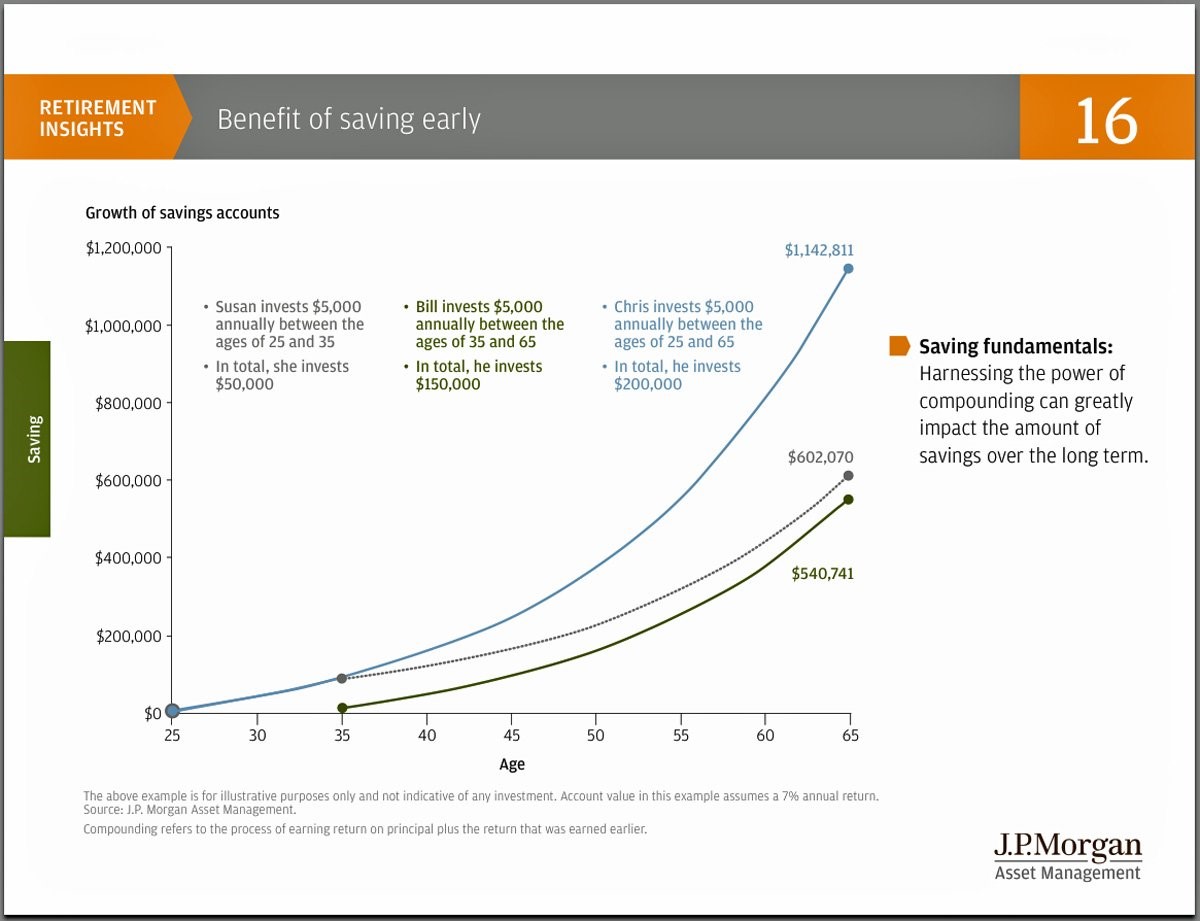
In a publication entitled Business Insider, Sam Ro published an article entitled “Every 25 Year Old In America Should See This Chart” on March 21, 2014. In this article Ro stated that in past times companies would offer pension plans to long term employees in order to support them in retirement. He goes on to state that in modern times employees need to contribute to retirement plans such as a 401K or an IRA in order to save for retirement. These plans function by the mathematical principle of compound interest. While the mechanics of compound interest are not presented in the article an illustration is shown how individuals who save their money through this formula accumulate a greater amount of money over time. He even presents a situation in which one individual can save money for a less amount of time than another and still accrue a greater total amount of savings because of compound interest. This illustration, presented below, can be a useful tool in engaging students in the possibilities that compound interest could have in their own futures.
This information was collected from the following web page on Friday, April 04, 2014; http://www.businessinsider.com/compound-interest-retirement-funds-2014-3.
How can this topic be used in your students’ future courses in mathematics or science?
Compound interest is introduced at the Pre-Calculus level of secondary education. At the Post-Secondary Education level compound interest is a concept that is included in several areas of study. For example, students that wish to study business will need to have a mastery of compound interest. Additionally, those studying finance or economics will constantly use the principle of compound interest in their computations. Not only does this formula come into play in the mathematics of monetary systems, but also in the workings of political science as well. Those that wish to pursue political aspirations will need a firm understanding of economics and the means by which funds can be grown over time. As is evident, compound interest is a mathematical formula, but like many realms of mathematics it affects multiple realms of interest and practice in a real world environment.
What interesting word problems using this topic can your students do now?
There are an innumerable amount of problems that can be presented to students involving compound interest. One could deal with the monetary worth of valuable or precious items. For instance, “A necklace is appraised at $7200. If the value of the necklace has increased at an annual rate of 7.2%, how much was it worth 15 years ago?” This question is asking the student to solve for the original principle of the necklace, rather than the accrued value which is given. Another problem could be “A sum of $7000 is invested at an interest rate of 7% per year. Find the time required for the money to double if the interest is compounded quarterly.” This problem requires the student to determine the amount of time necessary for the investment to yield the desired amount. These are only two problems that I have presented that will allow the students to practice the concept of compound interest. There are undoubtedly multiple others that could be written with the same effect.
 Mean Green Math