My Favorite One-Liners: Part 8

In this series, I’m compiling some of the quips and one-liners that I’ll use with my students to hopefully make my lessons more memorable for them.

At many layers of the mathematics curriculum, students learn about that various functions can essentially commute with each other. In other words, the order in which the operations is performed doesn’t affect the final answer. Here’s a partial list off the top of my head:

  1. Arithmetic/Algebra: a \cdot (b + c) = a \cdot b + a \cdot c. This of course is commonly called the distributive property (and not the commutative property), but the essential idea is that the same answer is obtained whether the multiplications are performed first or if the addition is performed first.
  2. Algebra: If a,b > 0, then \sqrt{ab} = \sqrt{a} \sqrt{b}.
  3. Algebra: If a,b > 0 and x is any real number, then (ab)^x = a^x b^x.
  4. Precalculus: \displaystyle \sum_{i=1}^n (a_i+b_i) = \displaystyle \sum_{i=1}^n a_i + \sum_{i=1}^n b_i.
  5. Precalculus: \displaystyle \sum_{i=1}^n c a_i = c \displaystyle \sum_{i=1}^n a_i.
  6. Calculus: If f is continuous at an interior point c, then \displaystyle \lim_{x \to c} f(x) = f(c).
  7. Calculus: If f and g are differentiable, then (f+g)' = f' + g'.
  8. Calculus: If f is differentiable and c is a constant, then (cf)' = cf'.
  9. Calculus: If f and g are integrable, then \int (f+g) = \int f + \int g.
  10. Calculus: If f is integrable and c is a constant, then \int cf = c \int f.
  11. Calculus: If f: \mathbb{R}^2 \to \mathbb{R} is integrable, \iint f(x,y) dx dy = \iint f(x,y) dy dx.
  12. Calculus: For most differentiable function f: \mathbb{R}^2 \to \mathbb{R} that arise in practice, \displaystyle \frac{\partial^2 f}{\partial x \partial y} = \displaystyle \frac{\partial^2 f}{\partial y \partial x}.
  13. Probability: If X and Y are random variables, then E(X+Y) = E(X) + E(Y).
  14. Probability: If X is a random variable and c is a constant, then E(cX) = c E(X).
  15. Probability: If X and Y are independent random variables, then E(XY) = E(X) E(Y).
  16. Probability: If X and Y are independent random variables, then \hbox{Var}(X+Y) = \hbox{Var}(X) + \hbox{Var}(Y).
  17. Set theory: If A, B, and C are sets, then A \cup (B \cap C) = (A \cup B) \cap (A \cup C).
  18. Set theory: If A, B, and C are sets, then A \cap (B \cup C) = (A \cap B) \cup (A \cap C).

However, there are plenty of instances when two functions do not commute. Most of these, of course, are common mistakes that students make when they first encounter these concepts. Here’s a partial list off the top of my head. (For all of these, the inequality sign means that the two sides do not have to be equal… though there may be special cases when equality happens to happen.)

  1. Algebra: (a+b)^x \ne a^x + b^x if x \ne 1. Important special cases are x = 2, x = 1/2, and x = -1.
  2. Algebra/Precalculus: \log_b(x+y) = \log_b x + \log_b y. I call this the third classic blunder.
  3. Precalculus: (f \circ g)(x) \ne (g \circ f)(x).
  4. Precalculus: \sin(x+y) \ne \sin x + \sin y, \cos(x+y) \ne \cos x + \cos y, etc.
  5. Precalculus: \displaystyle \sum_{i=1}^n (a_i b_i) \ne \displaystyle \left(\sum_{i=1}^n a_i \right) \left( \sum_{i=1}^n b_i \right).
  6. Calculus: (fg)' \ne f' \cdot g'.
  7. Calculus \left( \displaystyle \frac{f}{g} \right)' \ne \displaystyle \frac{f'}{g'}
  8. Calculus: \int fg \ne \left( \int f \right) \left( \int g \right).
  9. Probability: If X and Y are dependent random variables, then E(XY) \ne E(X) E(Y).
  10. Probability: If X and Y are dependent random variables, then \hbox{Var}(X+Y) \ne \hbox{Var}(X) + \hbox{Var}(Y).

All this to say, it’s a big deal when two functions commute, because this doesn’t happen all the time.

green lineI wish I could remember the speaker’s name, but I heard the following one-liner at a state mathematics conference many years ago, and I’ve used it to great effect in my classes ever since. Whenever I present a property where two functions commute, I’ll say, “In other words, the order of operations does not matter. This is a big deal, because, in real life, the order of operations usually is important. For example, this morning, you probably got dressed and then went outside. The order was important.”


My Favorite One Liners: Part 2

In this series, I’m compiling some of the quips and one-liners that I’ll use with my students to hopefully make my lessons more memorable for them.

When doing a large computation, I’ll often leave plenty of blank space on the board to fill it later. For example, when proving by mathematical induction that

1 + 3 + 5 + \dots + (2n-1) = n^2,

the inductive step looks something like

1 + 3 + 5 \dots + (2k-1) + (2[k+1]-1) =

~

~

~

~

~

~

= (k+1)^2

So I explained that, to complete the proof by induction, all we had to do was convert the top line into the bottom line.

As my class swallowed hard as they thought about how to perform this task, I told them, “Yes, this looks really intimidating. Indeed, to quote the great philosopher, ‘You might think that I’m insane. But I’ve got a blank space, baby… so let’s write what remains.’ “

And, just in case you’ve been buried under a rock, here’s the source material for the one-liner (which, at the time of this writing, is the fifth-most watched video on YouTube):

My Favorite One-Liners: Part 1

In this series, I’m compiling some of the quips and one-liners that I’ll use with my students to hopefully make my lessons more memorable for them.

One of the most common student mistakes with logarithms is thinking that

\log_b(x+y) = \log_b x + \log_b y.

Whenever students make this mistake, I call it the Third Classic Blunder. The first classic blunder, of course, is getting into a major land war in Asia. The second classic blunder is getting into a battle of wits with a Sicilian when death is on the line. And the third classic blunder is thinking that \log_b(x+y) somehow simplfies as \log_b x + \log_b y.

Sadly, as the years pass, fewer and fewer students immediately get the cultural reference. On the bright side, it’s also an opportunity to introduce a new generation to one of the great cinematic masterpieces of all time.

One of my colleagues calls this mistake the Universal Distributive Law, where the \log_b distributes just as if x+y was being multiplied by a constant. Other mistakes in this vein include  \sqrt{x+y} = \sqrt{x} + \sqrt{y}  and  (x+y)^2 = x^2 + y^2.

Along the same lines, other classic blunders are thinking that

\left(\log_b x\right)^n  simplifies as  \log_b \left(x^n \right)

and that

\displaystyle \frac{\log_b x}{\log_b y}  simplifies as  \log_b \left( \frac{x}{y} \right).

I’m continually amazed at the number of good students who intellectually know that the above equations are false but panic and use them when solving a problem.

Engaging students: Dividing polynomials

In my capstone class for future secondary math teachers, I ask my students to come up with ideas for engaging their students with different topics in the secondary mathematics curriculum. In other words, the point of the assignment was not to devise a full-blown lesson plan on this topic. Instead, I asked my students to think about three different ways of getting their students interested in the topic in the first place.

I plan to share some of the best of these ideas on this blog (after asking my students’ permission, of course).

This student submission again comes from my former student Sarah Asmar. Her topic, from Algebra/Precalculus: dividing polynomials.

green line

How could you as a teacher create an activity or project that involves your topic?

Many high school students are introduced to Polynomials in Algebra I. They are taught how to factor and to even graph Polynomials. In Algebra II, students are asked to add, subtract, multiply and divide Polynomials. Dividing Polynomials is challenging for many students because they are not only dividing numbers, but now they have added letters to the mix. There are two ways to divide Polynomials: Long Division and Synthetic Division. Since this is a topic that most students find difficult to grasp, I would split the students into groups of about 3 or 4 and provide each group with Algebra tiles. I would then provide each group with an index card with a specific Polynomial for them to divide. The index card will have a dividend and divisor for the students to use in order for them to create find the answer using the Algebra tiles. First, they will need to create a frame. Then, the dividend should be formed inside the frame while the divisor is formed on the left hand side outside of the frame. The answer will be shown with the tiles on the top line outside the frame. I will do an example with them first and then have them do the problem provided on their index card with their group. This activity will provide the students with a visual representation on how dividing polynomials would look like in order for it to be easier for them on paper.

green line

How can this topic be used in your students’ future courses in mathematics or science?

Students are introduced to dividing Polynomials in Algebra II. Most would never like to see this topic again, but unfortunately that is not the case. Dividing Polynomials is revisited in a Pre-Calculus class. However, it is taught at a much deeper level. Students are required to divide using long and synthetic division. Synthetic division is taught as a short cut for dividing Polynomials, but it doesn’t always work and students would have to divide using long division. Synthetic substitution is taught as well to find the solution of the Polynomial given. Synthetic substitution is as easy as just plugging in the given number for the variable provided in the Polynomial. Dividing Polynomials is also used in Binomial Expansion in Pre-Calculus. Along with all of these topics in Pre-Calculus, dividing Polynomials appears in all future basic Math courses such as Calculus. A real life example that uses Polynomials is aerospace science. These equations are used for object in motion, projectiles and air resistance.

green line

How can technology be used to effectively engage students with this topic?


I was searching the Internet and I came across this video. I thought that this video would be an amazing tool to help the students understand how to divide polynomials without me just lecturing to them. It is sung to the tune of “We Are Young” which is a very popular song in the pop music culture. Using something like this would show a visual representation, but it will also drill the steps in their head. Our brains can easily remember songs even after listening to a song just once. The fact that dividing polynomials is put into a song makes it more likely for a student to remember the steps they need to take in order to perform the indicated operation.


References:


http://www.doe.virginia.gov/testing/solsearch/sol/math/A/m_ess_a-2b_1.pdf


http://polynomialsinourlives.weebly.com/polynomials-in-the-real-world.html


Engaging students: Adding, subtracting, and multiplying matrices

In my capstone class for future secondary math teachers, I ask my students to come up with ideas for engaging their students with different topics in the secondary mathematics curriculum. In other words, the point of the assignment was not to devise a full-blown lesson plan on this topic. Instead, I asked my students to think about three different ways of getting their students interested in the topic in the first place.

I plan to share some of the best of these ideas on this blog (after asking my students’ permission, of course).

This student submission again comes from my former student Perla Perez. Her topic, from Algebra: adding, subtracting, and multiplying matrices.

green line

How could you as a teacher create an activity or project that involves your topic?


“Cryptography is the study of encoding and decoding messages. Cryptography was first developed to send secret messages in written form.” Cryptography also uses matrices to code and decode these messages by multiplication and the inverse of them. This, however, can be done by using any operations. By using the worksheet below as a foundation for an activity, teachers can have students act like hackers to engage students in computing different operations with matrices. In this activity, prepare the classroom by dividing it into four sections each with one of the phrases separated on the worksheet. Display the message (numerically) that is to be coded. Display the alphabet with corresponding number somewhere visible for students to have references throughout the activity. The instructions given are:

  1. Students are to get into four groups (more groups can be added for larger classrooms by making the phrase longer).
  2. Students are given an index card with the matrix [2, 7; 13, 5]
  3. Students are to add the matrix on each station to the the matrix on the card.
  4. When completed students must go change the message on the broad with the code.

When the students finish coding the message they can continue developing their skills by having them do this in the beginning of class throughout the lesson plan period. As the lesson progresses the teacher can change the phrase and require different operations to be made to either code or decode or even come up with their own message. With this activity the teacher gets the opportunity to see how the students choose to add the matrices together.

Click to access using_matrices_in_cryptography_intro.pdf

green line

How can technology (YouTube, Khan Academy [khanacademy.org], Vi Hart, Geometers Sketchpad, graphing calculators, etc.) be used to effectively engage students with this topic? Note: It’s not enough to say “such-and-such is a great website”; you need to explain in some detail why it’s a great website.

In today’s society we have access to a plethora of technology that can aid us in our everyday lives. There are so many ways one can learn something with different methods and from different people. The best part about the technology that we have access to is we can be manipulative to fit the needs of our students. When students get to the topic of adding, subtracting and soon multiplying matrices, they should be familiar with what a matrix is, the dimensions of one, and how to solve linear system with them. At this point it is a good a time to bring in a game into play like this one:

http://www.intmath.com/matrices-determinants/matrix-addition-multiplication-applet.php.

In this game the player chooses an operation such as adding, subtracting, multiplying by another matrix or scaler, and its dimensions. When a certain operation is chosen such as multiplication, it only allows the player to choose any size matrix but then spits out one with specific number of rows to multiply it with. The teacher can play this game with their students in any way they sit. The purpose is to get students thinking why and how the operations are working. From there the teacher can introduce the new topic.


Resources:


green line

How has this topic appeared in high culture (art, classical music, theatre, etc.)?


So many times students don’t understand that what they learn in class is used in everyday life, but teachers can give students the resources and knowledge to see applications of their work. In the video below, it shows different ways matrices can be applied. For instances the operations of matrices are used in a wide variety of way in our culture.

The main one can be in computer programming and computer coding, but they are also seen in another places such as dance and architecture. “In contra dancing, the dancers form groups of four (two couples), and these groups of four line up to produce a long, two-person-wide column” and where each square that is created is a formed by two pairs. Like the video had said, matrices can be used to analyze contra dancing. This can be done by having squares and multiplying them creating different types of configurations. By creating different groups and formations, essentially it is using different operations to create different matrices to.

Resources:


References:

“Common Topics Covered in Standard Algebra II Textbooks.” Space Math @ NASA. NASA, n.d. Web. 18 Sept. 2015.

Knill, Oliver. “When Was Matrix Multiplication Invented?” When Was Matrix Multiplication Invented?  Harvard, 24 July 2014. Web. 18 Sept. 2015.

Smoller, Laura. “The History of Matrices.” The History of Matrices. University of Arkansas at Little Rock, Apr. 2001. Web. 18 Sept. 2015.


Engaging students: Adding, subtracting, multiplying, and dividing complex numbers

In my capstone class for future secondary math teachers, I ask my students to come up with ideas for engaging their students with different topics in the secondary mathematics curriculum. In other words, the point of the assignment was not to devise a full-blown lesson plan on this topic. Instead, I asked my students to think about three different ways of getting their students interested in the topic in the first place.

I plan to share some of the best of these ideas on this blog (after asking my students’ permission, of course).

This student submission again comes from my former student Daniel Adkins. His topic, from Algebra: adding, subtracting, multiplying, and dividing complex numbers.

green line

How has this topic appeared in pop culture?

Robot chicken aired a television episode in which students were being taught about the imaginary number. Upon the instructor’s completion of his definition of the imaginary number, one student, who understands the definition, immediately has his head explode. One student turns to him and says, “I don’t get it. No wait now I-“, and then his head also explodes.

This video can be used as a humorous introduction that only takes a few seconds. It conveys that these concepts can be difficult in a more light-hearted sense. At the same time it satirically exaggerates the difficulty, and therefore might challenge the students. All the while the video provides the definition as well.


green line

How did people’s conception of this topic change over time?

The first point of contact with imaginary numbers is attributed to Heron of Alexandria around the year 50 A.D. He was attempting to solve the section of a pyramid. The equation he eventually deemed impossible was the sqrt(81-114). Attempts to find a solution for a negative square root wouldn’t reignite till the discovery of negative numbers, and even this would lead to the belief that it was impossible. In the early fifteenth century speculations would rise again as higher degree polynomial equations were being worked out, but for the most part negative square roots would just be avoided. In 1545 Girolamo Cardono writes a book titled Ars Magna. He solves an equation with an imaginary number, but he says, “[imaginary numbers] are as subtle as they would be useless.” About them, and most others agreed with him until 1637. Rene Descartes set a standard form for complex numbers, but he still wasn’t too fond of them. He assumed, “that if they were involved, you couldn’t solve the problem.” And individuals like Isaac Newton agreed with him.

Rafael Bombelli strongly supported the concept of complex numbers, but since he wasn’t able to supply them with a purpose, he went mostly unheard. That is until he came up with the concept of using complex numbers to find real solutions. Over the years, individuals eventually began to hear him out.

One of the major ways that helped aid with people eventually come to terms with imaginary numbers was the concept of placing them on a Cartesian graph as the Y-axis. This concept was first introduced in 1685 by John Wallis, but he was largely ignored. A century later, Caspar Wessel published a paper over the concept, but was also ignored. Euler himself labeled the square root of negative 1 as i, which did help in modernizing the concept. Throughout the 19th century, countless mathematicians aided to the growing concept of complex numbers, until Augustin Louis Cauchy and Niels Henrik Able make a general theory of complex numbers.

This is relevant to students because it shows that mathematicians once found these things impossible, then they found them unbelievable, then they found them trivial, until finally, they found a purpose. It encourages students to work hard even if there doesn’t seem to be a reason behind it just yet, and even if it seems like your head is about to blow.


green line

How has this topic appeared in high culture?

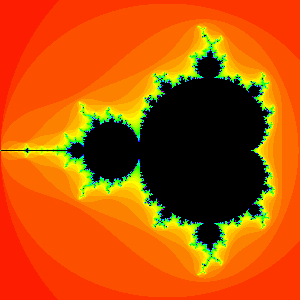
The Mandelbrot set is a beautiful fractal set with highly complex math hidden behind it. However it is extremely complicated, and as Otto von Bismarck put it, “laws are like sausages. Better not to see them being made.”

Like most fractals, the Mandelbrot set begins with a seed to start an iteration. In this case we begin with x2 + c, where c is some real number. This creates an eccentric pattern that grows and grows.

For students, this can show how mathematics can create beautiful patterns that would interest their more artistic senses. Not only would this generate interest in complex numbers, but it might convince students to investigate recurring patterns.

Sources:

https://www.youtube.com/watch?v=oENQ2jlHpfo

History of imaginary numbers:

http://rossroessler.tripod.com/


Mendelbrot sets:

https://plus.maths.org/content/unveiling-mandelbrot-set


Engaging students: Parabolas

In my capstone class for future secondary math teachers, I ask my students to come up with ideas for engaging their students with different topics in the secondary mathematics curriculum. In other words, the point of the assignment was not to devise a full-blown lesson plan on this topic. Instead, I asked my students to think about three different ways of getting their students interested in the topic in the first place.

I plan to share some of the best of these ideas on this blog (after asking my students’ permission, of course).

This student submission comes from my former student Lisa Sun. Her topic, from Algebra II: parabolas.

green line

How has this topic appeared in high culture?

Parabola is a special curve, shaped like an arch. Any point on a parabola is at an equal distance from a fixed point (the focus) and a fixed straight line (the directrix). Today, I will be presenting the parabolas’ unique shape to the class. Parabolas are everywhere in our society today. Students just don’t know it yet because no one has informed them. Parabolic structures can be seen in buildings, mosaic art, bridges, and many more. One that I’m going to share with the class is going to be roller coasters. Similar to this image below:

rollercoaster

This specific roller coaster is The Behemoth. It is a steel coaster located in Canada’s Wonderland in Vaughan, Ontario, Canada. I will first present this photo to the class and ask the following:

  • What do you notice that’s repeating in this roller coaster?
  • Do you think you’ve seen this similar structure anywhere else? Where?

–Present definition of Parabola–

  • Does this roller coaster have any parabolic structure? Where?

With these guiding questions, I want the students to be familiar with how a parabola looks like and that we can see them in our real world other than school.

green line

How has this topic appeared in the news?

https://www.sciencedaily.com/releases/2016/07/160713143146.htm

This link above is a recent article from Science News on how an engineer from the University of Warwick discovered how to build bridges and buildings to enhance the safety and long durability without the need for repair or restructuring by the use of inverted parabolas. Using inverted parabolas and a design process called “form finding”, engineers will be able to take away the main points of weakness in structures. I believe this is a remarkable discovery that must be shared with students. Math is truly used in our everyday life and can definitely benefit the society today by how fast our technology is advancing.

green line

How can technology be used to effectively engage students with this topic?

Prezi favors visual learning and works similar to a graphic organizer or a mind map. It helps students to explore a canvas of small ideas then turning it into a bigger picture or vice versa. Prezi is a great tool to maintain an interactive classroom and creates stunning visual impact on students keeping them engaged in the lecture.

http://www.bbcactive.com/BBCActiveIdeasandResources/UsingPreziInEducation.aspx

Above is a link of a Prezi presentation of parabolas in roller coasters. This is a great example as to what I would create for my students to provide them the information of a parabola.


http://www.rollercoasterking.com/article/behemoth/

https://www.mathsisfun.com/definitions/parabola.html

https://www.sciencedaily.com/releases/2016/07/160713143146.htm

https://prezi.com/pwkzfddbu4bu/parabolas-in-roller-coasters/

http://www.bbcactive.com/BBCActiveIdeasandResources/UsingPreziInEducation.aspx


What I Learned by Reading “Gamma: Exploring Euler’s Constant” by Julian Havil: Index

I’m doing something that I should have done a long time ago: collecting a series of posts into one single post.

When I was researching for my series of posts on conditional convergence, especially examples related to the constant \gamma, the reference Gamma: Exploring Euler’s Constant by Julian Havil kept popping up. Finally, I decided to splurge for the book, expecting a decent popular account of this number. After all, I’m a professional mathematician, and I took a graduate level class in analytic number theory. In short, I don’t expect to learn a whole lot when reading a popular science book other than perhaps some new pedagogical insights.

Boy, was I wrong. As I turned every page, it seemed I hit a new factoid that I had not known before.

In this series, I’d like to compile some of my favorites along with the page numbers in the book — while giving the book a very high recommendation.

Part 1: The smallest value of n so that 1 + \frac{1}{2} + \dots + \frac{1}{n} > 100 (page 23).

Part 2: Except for a couple select values of m<n, the sum \frac{1}{m} + \frac{1}{m+1} + \dots + \frac{1}{n} is never an integer (pages 24-25).

Part 3: The sum of the reciprocals of the twin primes converges (page 30).

Part 4: Euler somehow calculated \zeta(26) without a calculator (page 41).

Part 5: The integral called the Sophomore’s Dream (page 44).

Part 6: St. Augustine’s thoughts on mathematicians — in context, astrologers (page 65).

Part 7: The probability that two randomly selected integers have no common factors is 6/\pi^2 (page 68).

Part 8: The series for quickly computing \gamma to high precision (page 89).

Part 9: An observation about the formulas for 1^k + 2^k + \dots + n^k (page 81).

Part 10: A lower bound for the gap between successive primes (page 115).

Part 11: Two generalizations of \gamma (page 117).

Part 12: Relating the harmonic series to meteorological records (page 125).

Part 13: The crossing-the-desert problem (page 127).

Part 14: The worm-on-a-rope problem (page 133).

Part 15: An amazingly nasty formula for the nth prime number (page 168).

Part 16: A heuristic argument for the form of the prime number theorem (page 172).

Part 17: Oops.

Part 18: The Riemann Hypothesis can be stated in a form that can be understood by high school students (page 207).


Lessons from teaching gifted elementary school students: Index (updated)

I’m doing something that I should have done a long time ago: collect past series of posts into a single, easy-to-reference post. The following posts formed my series on various lessons I’ve learned while trying to answer the questions posed by gifted elementary school students. (This is updated from my previous index.)

Part 1: A surprising pattern in some consecutive perfect squares.

Part 2: Calculating 2 to a very large exponent.

Part 3a: Calculating 2 to an even larger exponent.

Part 3b: An analysis of just how large this number actually is.

Part 4a: The chance of winning at BINGO in only four turns.

Part 4b: Pedagogical thoughts on one step of the calculation.

Part 4c: A complicated follow-up question.

Part 5a: Exponentiation is multiplication as multiplication is to addition. So, multiplication is to addition as addition is to what? (I offered the answer of incrementation, but it was rejected: addition requires two inputs, while incrementation only requires one.)

Part 5b: Why there is no binary operation that completes the above analogy.

Part 5c: Knuth’s up-arrow notation for writing very big numbers.

Part 5d: Graham’s number, reputed to be the largest number ever to appear in a mathematical proof.

Part 6a: Calculating $(255/256)^x$.

Part 6b: Solving $(255/256)^x = 1/2$ without a calculator.

Part 7a: Estimating the size of a 1000-pound hailstone.

Part 7b: Estimating the size a 1000-pound hailstone.

Part 8a: Statement of an usually triangle summing problem.

Part 8b: Solution using binomial coefficients.

Part 8c: Rearranging the series.

Part 8d: Reindexing to further rearrange the series.

Part 8e: Rewriting using binomial coefficients again.

Part 8f: Finally obtaining the numerical answer.

Part 8g: Extracting the square root of the answer by hand.

A Natural Function with Discontinuities: Index

I’m doing something that I should have done a long time ago: collecting a series of posts into one single post. The following links comprised my series on a natural function that nevertheless has discontinuities.

Part 1: Introduction

Part 2: Derivation of this piecewise function, beginning.

Part 3: Derivation of the piecewise function, ending.