

Source: http://www.xkcd.com/759/
In the same vein, see also the explanation for why 25 divided by 5 is 14.
Source: http://www.xkcd.com/759/
In the same vein, see also the explanation for why 25 divided by 5 is 14.
I took a statistics course at MIT. I would go study and do problems, and have high confidence that I understood the material. Then I’d go to the lecture, and be more confused than I was when I entered the classroom. Thus, I discovered that some teachers were capable of conveying negative knowledge, so that after listening to them, I knew less than I did before.
It was also clear that knowledge varies considerably in quantity among people, and this convinced me that real knowledge varies over a very wide range.
Then I encountered people who either did not know what they were talking about, or were clearly convinced of things that were wrong, and so I learned that there was imaginary knowledge.
Once I understood that there was both real and imaginary knowledge, I concluded that knowledge is truly complex.
– Hillel J. Chiel, Case Western Reserve University
Source: American Mathematical Monthly, Vol. 120, No. 10, p. 923 (December 2013)
In my capstone class for future secondary math teachers, I ask my students to come up with ideas for engaging their students with different topics in the secondary mathematics curriculum. In other words, the point of the assignment was not to devise a full-blown lesson plan on this topic. Instead, I asked my students to think about three different ways of getting their students interested in the topic in the first place.
I plan to share some of the best of these ideas on this blog (after asking my students’ permission, of course).
This student submission comes from my former student Derek Skipworth. His topic, from Pre-Algebra: finding points in the coordinate plane.

A. Applications – How could you as a teacher create an activity or project that involves your topic?
When I think of the coordinate plane, one of the first things that come to mind is mapping. When I think of my teenage years, I think of how I always wanted more money. By using these two ideas together, an activity could easily be created to get the students involved in the lesson: a treasure map!
The first part of the activity would be providing the students with a larger grid. Then provide them with a list of landmarks/items at different locations (i.e. skull cave at 


 Courtesy of paleochick.blogspot.com
B. Curriculum: How can this topic be used in your students’ future courses in mathematics or science?
One of the good things about the exercise above is that it integrates several different ideas into one. A big one that stands out to me is following procedures. This is vital once you get into high school sciences. By building the map step-by-step, which each one building off the previous step, you cannot find the treasure without replicating the map exactly if you miss/misinterpret a step along the way.
As far as the coordinate plane, finding locations on the plane is important when graphing functions. Being able to find the intercepts and any asymptotes gives you starting points to work with. From there you generally only need a few more points to create a line of the function based off plotted points. This also has applications in science/math when creating bar graphs/line graphs and similar graphs.
D. How was this topic adopted by the mathematical community?
As discussed in my Geometry class this semester (Krueger), the Cartesian plane opened up a lot of doors in the world of Geometry. Euclid had already established a great working knowledge of a vast amount of Geometric ideas and figures. One thing he did not establish was length. In his teachings, there were relative terms such as “smaller than” or “larger than”. No values were ever assigned to his figures though. By introducing the Cartesian plane (and in effect, being able to plot points on said plane), we were able to actually assign values to these figures and advance our mathematical knowledge. The Cartesian plane acts as a bridge between Algebra and Geometry that did not exist before. Because of this, we can know solve problems based in Geometry without ever even needing to draw the figure in the first place (example: Pythagorean Theorem).
Over the summer, I occasionally teach a small summer math class for my daughter and her friends around my dining room table. Mostly to preserve the memory for future years… and to provide a resource to my friends who wonder what their children are learning… I’ll write up the best of these lesson plans in full detail.
In this lesson, the students practiced their skills with multiplication and division to create modular multiplication tables. Though this is a concept ordinarily first encountered in an undergraduate class in number theory or abstract algebra, there’s absolutely no reason why elementary students who’ve mastered multiplication can’t do this exercise. This exercise strengthens the notion of dividing with a remainder and leads to a fun application with encrypting and decrypting secret messages. Indeed, this activity made be viewed as a child-appropriate version of the RSA encryption algorithm that’s used every time we use our credit cards. This was mentioned in two past posts: https://meangreenmath.com/2013/10/17/engaging-students-finding-prime-factorizations and https://meangreenmath.com/2013/07/11/cryptography-as-a-teaching-tool
This lesson plan is written in a 5E format — engage, explore, explain, elaborate, evaluate — which promotes inquiry-based learning and fosters student engagement.
Lesson Plan: Kid RSA Lesson
Other Documents:
Modular Multiplication Assessment
Modular Multiplcation Practice
Over the summer, I occasionally teach a small summer math class for my daughter and her friends around my dining room table. Mostly to preserve the memory for future years… and to provide a resource to my friends who wonder what their children are learning… I’ll write up the best of these lesson plans in full detail.
This was a fun activity that took a couple of hours: designing a model Solar System. I chose the scale so that most of the planets would fit on a straight section of sidewalk near my house; of course, the scale could be changed to fit the available space.
For my particular audience of students, I also worked through the basics of the metric system as well as decimals.
This lesson plan is written in a 5E format — engage, explore, explain, elaborate, evaluate — which promotes inquiry-based learning and fosters student engagement.
P.S. For what it’s worth, the world’s largest model solar system can be found in Sweden.
In this series, I discuss some ways of convincing students that 
Method #5. This is a proof by contradiction; however, I think it should be convincing to a middle-school student who’s comfortable with decimal representations. Also, perhaps unlike Methods #1-4, this argument really gets to the heart of the matter: there can’t be a number in between 

In the proof below, I’m deliberating avoiding the explicit use of algebra (say, letting
Suppose that 
Similarly, the midpoint is strictly less than
(For the sake of convincing middle-school students, a number line with three tick marks — for
So what is the decimal representation of the midpoint? Since the midpoint is less than 

midpoint =
midpoint =
midpoint =
midpoint =
midpoint =
midpoint =
midpoint =
midpoint =
midpoint =
In any event,
In this series, I discuss some ways of convincing students that
Method #4. This is a direct method using the formula for an infinite geometric series… and hence will only be convincing to students if they’re comfortable with using this formula. By definition,
This is an infinite geometric series. Its first term is 

In this series, I discuss some ways of convincing students that
Methods #2 and #3 are indirect methods. We start with a decimal representation that we know and end with
Method #2. This technique should be accessible to any student who can do long division. With long division, we know full well that
Multiply both sides by 
Though not logically necessary, this method could be reinforced for students by also considering
Method #3. With long division, we know full well that

Add them together:
Though not logically necessary, this method could be reinforced for students by also considering any (or all) of the following:
Let’s now consider the decimal representation of 
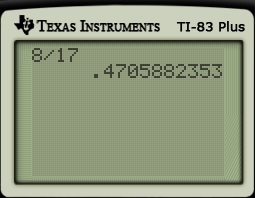
There’s no obvious repeating pattern. But we know that, since 17 has neither 2 nor 5 as a factor, that there has to be a repeating decimal pattern.
So… what is it?
When I ask this question to my students, I can see their stomachs churning a slow dance of death. They figure that the calculator didn’t give the answer, and so they have to settle for long division by hand.
That’s partially correct.
However, using the ideas presented below, we can perform the long division extracting multiple digits at once. Through clever use of the calculator, we can quickly obtain the full decimal representation even though the calculator can only give ten digits at a time.
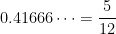
Let’s now return to where this series began… the decimal representation of 

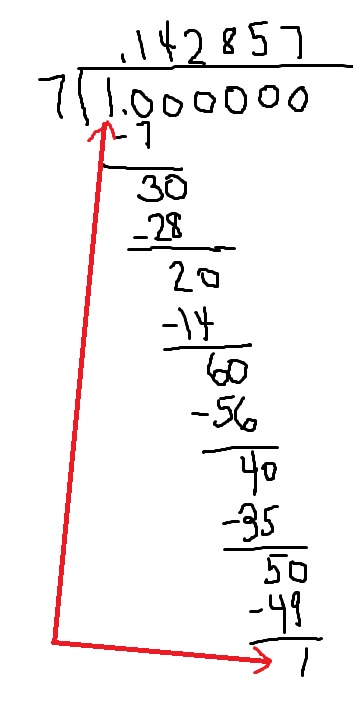
Because we arrived at a repeated remainder, we know that we have found the repeating block. So we can conclude that 
Students are taught long division in elementary school and are so familiar with the procedure that not much thought is given to the logic behind the procedure. The underlying theorem behind long division is typically called the division algorithm. From Wikipedia:
Given two integers
and
, with
, there exist unique integers
and
such that
and $0 \le r < |b|$, where
denotes the absolute value of
The number
Repeated application of this theorem is the basis for long division. For the example above:
Step 1.


Step 2.


Returning to the end of Step 1, we see that
Step 3.


Returning to the end of Step 2, we see that
And so on.
By adding an extra zero and using the division algorithm, the digits in the decimal representation are found one at a time. That said, it is possible (with a calculator) to find multiple digits in a single step by adding extra zeroes. For example:
Alternate Step 1.

Alternate Step 2.


Returning to the end of Alternate Step 1, we see that
So, with these two alternate steps, we arrive at a remainder of
The big catch is that, if 


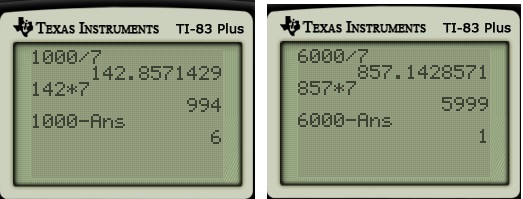
At first blush, it seems silly to use a calculator to find these values of 
Let’s now return to the question posed at the top of this post: finding the decimal representation of 


Here’s the result of the calculator again:
We clearly see from the calculator that the repeating block doesn’t have a length less than or equal to
Now we perform the division algorithm to obtain these digits, as before. This can be done in two steps by multiplying by 
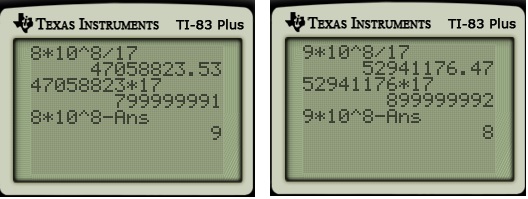
So, by the same logic used above, we can conclude that
In other words, through clever use of the calculator, the full decimal representation can be quickly found even if the calculator itself returns only ten digits at a time… and had rounded the final 
In Part 3 of this series, I considered the conversion of a repeating decimal expansion into a fraction. This was accomplished by an indirect technique which was pulled out of the patented Bag of Tricks. For example, if 

As mentioned in Part 3, most students are a little bit skeptical that this actually works, and often need to type the final fraction into a calculator to be reassured that the method actually works. Most students are also a little frustrated with this technique because it does come from the Bag of Tricks. After all, the first two steps (setting the decimal equal to
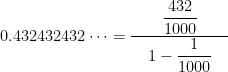
In this post, I’d like to discuss a more direct way of converting a repeating decimal into a fraction. In my experience, this approach presents a different conceptual barrier to students. This is a more direct approach, and so students are more immediately willing to accept its validity. However, the technique uses the formula for an infinite geometric series, which (unfortunately) most senior math majors cannot instantly recall. They’ve surely seen the formula before, but they’ve probably forgotten it because a few years have passed since they’ve had to extensively use the formula.
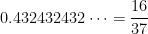
Anyway, here’s the method applied to 
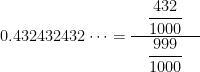
Combining fractions three at a time (matching the length of the repeating block), we get
This is an infinite geometric series whose first term is 

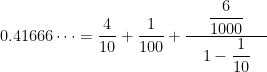
For what it’s worth, the decimal representation could have been simplified by using three separate geometric series. Some students find this to be more intuitive, combining the unlike fractions at the final step as opposed to the initial step.
Finally, this direct technique also works for repeating decimals with a delay, like 
































 Mean Green Math