

Tag: periodic trig identities
My Favorite One-Liners: Part 76
In this series, I’m compiling some of the quips and one-liners that I’ll use with my students to hopefully make my lessons more memorable for them.
Here’s a problem that might arise in trigonometry:
Compute
.
To begin, we observe that 

We then remember that 





Said another way, 


In mathematics, there’s a technical term for this idea; it’s called
How I Impressed My Wife: Index
Some husbands try to impress their wives by lifting extremely heavy objects or other extraordinary feats of physical prowess.
That will never happen in the Quintanilla household in a million years.
But she was impressed that I broke an impasse in her research and resolved a discrepancy between Mathematica 4 and Mathematica 8 by finding the following integral by hand in less than an hour:

Yes, I married well indeed.
In this post, I collect the posts that I wrote last summer regarding various ways of computing this integral.
Part 1: Introduction
Part 2a, 2b, 2c, 2d, 2e, 2f: Changing the endpoints of integration, multiplying top and bottom by  , and the substitution
  .
.
, and the substitution .Part 3a, 3b, 3c, 3d, 3e, 3f, 3g, 3h, 3i: Double-angle trig identity, combination into a single trig function, changing the endpoints of integration, and the magic substitution  .
.
.Part 4a, 4b, 4c, 4d, 4e, 4f, 4g, 4h: Double-angle trig identity, combination into a single trig function, changing the endpoints of integration, and contour integration using the unit circle
Part 5a, 5b, 5c, 5d, 5e, 5f, 5g, 5h, 5i, 5j: Independence of the parameter  , the magic substitution , and partial fractions.
, the magic substitution , and partial fractions.Part 6a, 6b, 6c, 6d, 6e, 6f, 6g:Independence of the parameter , the magic substitution , and contour integration using the real line and an expanding semicircle.
, the magic substitution , and contour integration using the real line and an expanding semicircle.Part 7: Concluding thoughts… and ways that should work that I haven’t completely figured out yet.
How I Impressed My Wife: Part 5c
Earlier in this series, I gave three different methods of showing that

Using the fact that  is independent of , I’ll now give a fourth method.
 Since is independent of , I can substitute any convenient value of that I want without changing the value of . For example, let me substitute
  :
:
is independent of , I’ll now give a fourth method. Since is independent of , I can substitute any convenient value of that I want without changing the value of . For example, let me substitute :



So that I can employ the magic substitution 



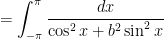
I’ll continue with this fourth evaluation of the integral in tomorrow’s post.
How I Impressed My Wife: Part 3e
Previously in this series, I showed that
My wife had asked me to compute this integral by hand because Mathematica 4 and Mathematica 8 gave different answers. At the time, I eventually obtained the solution by multiplying the top and bottom of the integrand by and then employing the substitution (after using trig identities to adjust the limits of integration).
and then employing the substitution (after using trig identities to adjust the limits of integration).But this wasn’t the only method I tried. Indeed, I tried two or three different methods before deciding they were too messy and trying something different. So, for the rest of this series, I’d like to explore different ways that the above integral can be computed.
So far, I have shown that


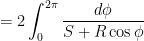
where 


I now write 


For 


Next, I employ the trigonometric identity 

where I have changed the dummy variable from 

Therefore, 


Once again, the fact that the integrand is over an interval of length
I’ll continue this different method of evaluating this integral in tomorrow’s post.
How I Impressed My Wife: Part 3d
Previously in this series, I showed that
My wife had asked me to compute this integral by hand because Mathematica 4 and Mathematica 8 gave different answers. At the time, I eventually obtained the solution by multiplying the top and bottom of the integrand by and then employing the substitution (after using trig identities to adjust the limits of integration).
and then employing the substitution (after using trig identities to adjust the limits of integration).But this wasn’t the only method I tried. Indeed, I tried two or three different methods before deciding they were too messy and trying something different. So, for the rest of this series, I’d like to explore different ways that the above integral can be computed.
So far, I have shown that

where
I now write 


For 



Next, I employ the trigonometric identity 

where I have changed the dummy variable from 
Therefore, 


Next, I employ the substitution 


Almost by magic, the mysterious angle
I’ll continue this different method of evaluating this integral in tomorrow’s post.
How I Impressed My Wife: Part 2a
Some husbands try to impress their wives by lifting extremely heavy objects or other extraordinary feats of physical prowess.
That will never happen in the Quintanilla household in a million years.
But she was impressed that I broke an impasse in her research and resolved a discrepancy between Mathematica 4 and Mathematica 8 by finding the following integral by hand in less than an hour:
In this series, I’ll explore different ways of evaluating this integral.I begin by adjusting the range of integration:
I begin by adjusting the range of integration:

where



I’ll begin with 



Next, we use the periodic property for both sine and cosine — 


Changing the dummy variable from 

Therefore, we can combined 



Next, we work on the middle integral 





Next, we use the trigonometric identities


so that the last integral becomes



On the line above, I again replaced the dummy variable of integration from 


I’ll continue with the evaluation of this integral in tomorrow’s post.
 Mean Green Math