Confirming Einstein’s Theory of General Relativity With Calculus, Part 9: Pedagogical Thoughts

At long last, we have reached the end of this series of posts.

The derivation is elementary; I’m confident that I could have understood this derivation had I seen it when I was in high school. That said, the word “elementary” in mathematics can be a bit loaded — this means that it is based on simple ideas that are perhaps used in a profound and surprising way. Perhaps my favorite quote along these lines was this understated gem from the book Three Pearls of Number Theory after the conclusion of a very complicated proof in Chapter 1:

You see how complicated an entirely elementary construction can sometimes be. And yet this is not an extreme case; in the next chapter you will encounter just as elementary a construction which is considerably more complicated.

Here are the elementary ideas from calculus, precalculus, and high school physics that were used in this series:

  • Physics
    • Conservation of angular momentum
    • Newton’s Second Law
    • Newton’s Law of Gravitation
  • Precalculus
    • Completing the square
    • Quadratic formula
    • Factoring polynomials
    • Complex roots of polynomials
    • Bounds on \cos \theta and \sin \theta
    • Period of \cos \theta and \sin \theta
    • Zeroes of \cos \theta and \sin \theta
    • Trigonometric identities (Pythagorean, sum and difference, double-angle)
    • Conic sections
    • Graphing in polar coordinates
    • Two-dimensional vectors
    • Dot products of two-dimensional vectors (especially perpendicular vectors)
    • Euler’s equation
  • Calculus
    • The Chain Rule
    • Derivatives of \cos \theta and \sin \theta
    • Linearizations of \cos x, \sin x, and 1/(1-x) near x \approx 0 (or, more generally, their Taylor series approximations)
    • Derivative of e^x
    • Solving initial-value problems
    • Integration by u-substitution

While these ideas from calculus are elementary, they were certainly used in clever and unusual ways throughout the derivation.

I should add that although the derivation was elementary, certain parts of the derivation could be made easier by appealing to standard concepts from differential equations.

One more thought. While this series of post was inspired by a calculation that appeared in an undergraduate physics textbook, I had thought that this series might be worthy of publication in a mathematical journal as an historical example of an important problem that can be solved by elementary tools. Unfortunately for me, Hieu D. Nguyen’s terrific article Rearing Its Ugly Head: The Cosmological Constant and Newton’s Greatest Blunder in The American Mathematical Monthly is already in the record.

Confirming Einstein’s Theory of General Relativity With Calculus, Part 6i: Rationale for Method of Undetermined Coefficients VI

In this series, I’m discussing how ideas from calculus and precalculus (with a touch of differential equations) can predict the precession in Mercury’s orbit and thus confirm Einstein’s theory of general relativity. The origins of this series came from a class project that I assigned to my Differential Equations students maybe 20 years ago.

In the last few posts, I’ve used a standard technique from differential equations: to solve the nth order homogeneous differential equation with constant coefficients

a_n y^{(n)} + \dots + a_3 y''' + a_2 y'' + a_1 y' + a_0 y = 0,

we first solve the characteristic equation

a_n r^n + \dots + a_3 r^3 + a_2 r^2 + a_1 r + a_0 = 0

using techniques from Precalculus. The form of the roots r determines the solutions of the differential equation.

While this is a standard technique from differential equations, the perspective I’m taking in this series is scaffolding the techniques used to predict the precession in a planet’s orbit using only techniques from Calculus and Precalculus. So let me discuss why the above technique works, assuming that the characteristic equation does not have repeated roots. (The repeated roots case is a little more complicated but is not needed for the present series of posts.)

We begin by guessing that the above differential equation has a solution of the form y = e^{rt}. Differentiating, we find y' = re^{rt}, y'' = r^2 e^{rt}, etc. Therefore, the differential equation becomes

a_n r^n e^{rt} + \dots + a_3 r^3 e^{rt} + a_2 r^2 e^{rt} + a_1 r e^{rt} + a_0 e^{rt} = 0

e^{rt} \left(a_n r^n  + \dots + a_3 r^3 + a_2 r^2 + a_1 r  + a_0 \right) = 0

a_n r^n  + \dots + a_3 r^3 + a_2 r^2 + a_1 r  + a_0 = 0

The last step does not “lose” any possible solutions for r since e^{rt} can never be equal to 0. Therefore, solving the differential equation reduces to finding the roots of this polynomial, which can be done using standard techniques from Precalculus.

For example, one of the differential equations that we’ve encountered is y''+y=0. The characteristic equation is r^2+1=0, which has roots r=\pm i. Therefore, two solutions to the differential equation are e^{it} and e^{-it}, so that the general solution is

y = c_1 e^{it} + c_2 e^{-it}.

To write this in a more conventional way, we use Euler’s formula e^{ix} = \cos x + i \sin x, so that

y = c_1 (\cos t + i \sin t) + c_2 (\cos (-t) + i \sin (-t))

= c_1 \cos t + i c_1 \sin t + c_2 \cos t - i c_2 \sin t

= (c_1 + c_2) \cos t + (ic_1 - ic_2) \sin t

= C_1 \cos t + C_2 \sin t.

Likewise, in the previous post, we encountered the fourth-order differential equation y^{(4)}+5y''+4y = 0. To find the roots of the characteristic equation, we factor:

r^4 + 5r^2 + 4r = 0

(r^2+1)(r^2+4) = 0

r^2 +1 = 0 \qquad \hbox{or} \qquad \hbox{or} r^2 + 4 = 0

r = \pm i \qquad \hbox{or} \qquad r = \pm 2i.

Therefore, four solutions of this differential equation are e^{it}, e^{-it}, e^{2it}, and e^{-2it}, so that the general solution is

y = c_1 e^{it} + c_2 e^{-it} + c_3 e^{2it} + c_4 e{-2it}.

Using Euler’s formula as before, this can be rewritten as

y = C_1 \cos t + C_2 \sin t + C_3 \cos 2t + C_4 \sin 2t.

How I Impressed My Wife: Part 6a

This series was inspired by a question that my wife asked me: calculate

Q = \displaystyle \int_0^{2\pi} \frac{dx}{\cos^2 x + 2 a \sin x \cos x + (a^2 + b^2) \sin^2 x}

Originally, I multiplied the top and bottom of the integrand by \tan^2 x and performed a substitution. However, as I’ve discussed in this series, there are four different ways that this integral can be evaluated.
Starting with today’s post, I’ll begin a fifth method. I really like this integral, as it illustrates so many different techniques of integration as well as the trigonometric tricks necessary for computing some integrals.
green lineSince Q is independent of a, I can substitute any convenient value of a that I want without changing the value of Q. As shown in previous posts, substituting a =0 yields the following simplification:
Q = \displaystyle \int_0^{2\pi} \frac{dx}{\cos^2 x + 2 a \sin x \cos x + (a^2 + b^2) \sin^2 x}

= \displaystyle \int_{0}^{2\pi} \frac{dx}{\cos^2 x + 2 \cdot 0 \cdot \sin x \cos x + (0^2 + b^2) \sin^2 x}

= \displaystyle \int_{0}^{2\pi} \frac{dx}{\cos^2 x + b^2 \sin^2 x}

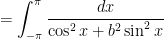
= \displaystyle \int_{-\pi}^{\pi} \frac{dx}{\cos^2 x + b^2 \sin^2 x}

= \displaystyle \int_{-\infty}^{\infty} \frac{ 2(1+u^2) du}{u^4 + (4 b^2 - 2) u^2 + 1}

Earlier, I evaluated this last integral using partial fractions, separating into the cases |b| = 1, |b| > 1, and |b| < 1. Now, I’ll calculate this same integral using contour integration. (See Wikipedia and Mathworld for more details.)

It turns out that Q can be rewritten as

Q = \displaystyle \lim_{R \to \infty} \oint_{C_R} \frac{ 2(1+z^2) dz}{z^4 + (4 b^2 - 2) z^2 + 1},

where C_R is the contour in the complex plane shown above (graphic courtesy of Mathworld). That’s because

\displaystyle \lim_{R \to \infty} \oint_{C_R} \frac{ 2(1+z^2) dz}{z^4 + (4 b^2 - 2) z^2 + 1}

= \displaystyle \lim_{R \to \infty} \int_{-R}^R \frac{ 2(1+z^2) dz}{z^4 + (4 b^2 - 2) z^2 + 1} + \lim_{R \to \infty} \int_{\gamma_R} \frac{ 2(1+z^2) dz}{z^4 + (4 b^2 - 2) z^2 + 1}

= \displaystyle \int_{-\infty}^{\infty} \frac{ 2(1+z^2) dz}{z^4 + (4 b^2 - 2) z^2 + 1} + \lim_{R \to \infty} \int_{\gamma_R} \frac{ 2(1+z^2) du}{z^4 + (4 b^2 - 2) z^2 + 1}

= Q + \displaystyle \lim_{R \to \infty} \int_{\gamma_R} \frac{ 2(1+z^2) dz}{z^4 + (4 b^2 - 2) z^2 + 1}

To show that the limit of the last integral is equal to 0, I use the parameterization z = R e^{i \theta}, so that dz = i R e^{i \theta}:

\displaystyle \lim_{R \to \infty} \left| \int_{\gamma_R} \frac{ 2(1+z^2) dz}{z^4 + (4 b^2 - 2) z^2 + 1} \right|

= \displaystyle \lim_{R \to \infty} \left| \int_0^{\pi} \frac{ 2R(1+R^2 e^{2i\theta}) d\theta}{R^4 e^{4 i\theta} + (4 b^2 - 2) R^2 e^{2i\theta} + 1} \right|

\le \displaystyle \lim_{R \to \infty} \pi \max_{0 \le \theta \le \pi} \left| \frac{ 2R(1+R^2 e^{2i\theta})}{R^4 e^{4 i\theta} + (4 b^2 - 2) R^2 e^{2i\theta} + 1} \right|

= \displaystyle \pi \max_{0 \le \theta \le \pi} \lim_{R \to \infty} \left| \frac{ 2R(1+R^2 e^{2i\theta})}{R^4 e^{4 i\theta} + (4 b^2 - 2) R^2 e^{2i\theta} + 1} \right|

= \displaystyle \pi \max_{0 \le \theta \le \pi} 0

= 0.

The above limit is equal to zero because the numerator grows like R^3 while the denominator grows like R^4. (This can be more laboriously established using L’Hopital’s rule).

Therefore, I have shown that

Q = \displaystyle \lim_{R \to \infty} \oint_{C_R} \frac{ 2(1+z^2) dz}{z^4 + (4 b^2 - 2) z^2 + 1},

and this contour integral can be computed using residues.

green line

I’ll continue with this fifth evaluation of the integral, starting with the case |b| = 1, in tomorrow’s post.

How I Impressed My Wife: Part 4b

Previously in this series, I have used two different techniques to show that

Q = \displaystyle \int_0^{2\pi} \frac{dx}{\cos^2 x + 2 a \sin x \cos x + (a^2 + b^2) \sin^2 x} = \displaystyle \frac{2\pi}{|b|}.

Originally, my wife had asked me to compute this integral by hand because Mathematica 4 and Mathematica 8 gave different answers. At the time, I eventually obtained the solution by multiplying the top and bottom of the integrand by \sec^2 x and then employing the substitution u = \tan x (after using trig identities to adjust the limits of integration).

But this wasn’t the only method I tried. Indeed, I tried two or three different methods before deciding they were too messy and trying something different. So, for the rest of this series, I’d like to explore different ways that the above integral can be computed.
green lineLet me backtrack to a point in the middle of the previous solution:

Q = \displaystyle \int_0^{2\pi} \frac{dx}{\cos^2 x + 2 a \sin x \cos x + (a^2 + b^2) \sin^2 x}

= \displaystyle \int_0^{2\pi} \frac{2 \, dx}{1+\cos 2x + 2 a \sin 2x + (a^2 + b^2)(1-\cos 2x)}

= 2 \displaystyle \int_0^{2\pi} \frac{d\theta}{(1+a^2+b^2) + 2 a \sin \theta + (1 - a^2 - b^2) \cos \theta}

= 2 \displaystyle \int_{0}^{2\pi} \frac{d\theta}{S + R \cos (\theta - \alpha)}

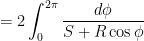
= 2 \displaystyle \int_{0}^{2\pi} \frac{d\phi}{S + R \cos \phi},

where R = \sqrt{(2a)^2 + (1-a^2-b^2)^2} and S = 1 + a^2 + b^2 (and \alpha is a certain angle that is now irrelevant at this point in the calculation).

Earlier in this series, I used the magic substitution u = \tan \displaystyle \frac{\phi}{2} to evaluate this last integral. Now, I’ll instead use contour integration; see Wikipedia for more details. I will use Euler’s formula as a substitution (see here and here for more details):

z = e^{i \phi} = \cos \phi + i \sin \phi,

so that the integral Q is transformed to a contour integral in the complex plane. Under this substitution, as discussed in yesterday’s post,

\cos \phi = \displaystyle \frac{1}{2} \left[z + \displaystyle \frac{1}{z} \right]

and

d\phi = \displaystyle -\frac{i}{z} dz

Employing this substitution, the region of integration changes from 0 \le \phi \le 2\pi to a the unit circle C, a closed counterclockwise contour in the complex plane:

Q = 2 \displaystyle \oint_C \frac{\displaystyle -\frac{i}{z} dz}{S + \displaystyle \frac{R}{2} \left[z + \displaystyle \frac{1}{z} \right]}

= -4i \displaystyle \oint_C \frac{dz}{Rz^2 + 2Sz + R}

= \displaystyle -\frac{4i}{R} \oint_C \frac{dz}{z^2 + 2\frac{S}{R}z + 1}

green lineWhile this looks integral in the complex plane looks a lot more complicated than a regular integral, it’s actually a lot easier to compute using residues. I’ll discuss the computation of this contour integral in tomorrow’s post.

How I Impressed My Wife: Part 4a

Previously in this series, I have used two different techniques to show that

Q = \displaystyle \int_0^{2\pi} \frac{dx}{\cos^2 x + 2 a \sin x \cos x + (a^2 + b^2) \sin^2 x} = \displaystyle \frac{2\pi}{|b|}.

Originally, my wife had asked me to compute this integral by hand because Mathematica 4 and Mathematica 8 gave different answers. At the time, I eventually obtained the solution by multiplying the top and bottom of the integrand by \sec^2 x and then employing the substitution u = \tan x (after using trig identities to adjust the limits of integration).
But this wasn’t the only method I tried. Indeed, I tried two or three different methods before deciding they were too messy and trying something different. So, for the rest of this series, I’d like to explore different ways that the above integral can be computed.
green lineLet me backtrack to a point in the middle of the previous solution:

Q = \displaystyle \int_0^{2\pi} \frac{dx}{\cos^2 x + 2 a \sin x \cos x + (a^2 + b^2) \sin^2 x}

= \displaystyle \int_0^{2\pi} \frac{2 \, dx}{1+\cos 2x + 2 a \sin 2x + (a^2 + b^2)(1-\cos 2x)}

= 2 \displaystyle \int_0^{2\pi} \frac{d\theta}{(1+a^2+b^2) + 2 a \sin \theta + (1 - a^2 - b^2) \cos \theta}

= 2 \displaystyle \int_{0}^{2\pi} \frac{d\theta}{S + R \cos (\theta - \alpha)}

= 2 \displaystyle \int_{0}^{2\pi} \frac{d\phi}{S + R \cos \phi},

where R = \sqrt{(2a)^2 + (1-a^2-b^2)^2} and S = 1 + a^2 + b^2 (and \alpha is a certain angle that is now irrelevant at this point in the calculation).

In the previous solution, I used the “magic substitution” u = \tan \displaystyle \frac{\phi}{2} to convert the last integrand to a simple rational function. Starting today, I’ll use a completely different technique to compute this last integral.

The technique that I’ll use is contour integration; see Wikipedia for more details. I will use Euler’s formula as a substitution (see here and here for more details):

z = e^{i \phi} = \cos \phi + i \sin \phi,

so that the integral Q is transformed to a contour integral in the complex plane.

Under this substitution,

\displaystyle \frac{1}{z} = e^{-i\phi} = \cos(-\phi) + i \sin(-\phi) = \cos \phi - i \sin \phi

Using these last two equations, I can solve for \cos \phi and \sin \phi in terms of z and \displaystyle \frac{1}{z}. I’ll begin with \cos \phi:

z + \displaystyle \frac{1}{z} = \cos \phi + i \sin \phi + \cos \phi - i \sin \phi

z + \displaystyle \frac{1}{z} = 2 \cos \phi

\displaystyle \frac{1}{2} \left[z + \displaystyle \frac{1}{z} \right] = \cos \phi

Though not necessary for this particular, let me solve for \sin \phi for completeness:

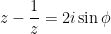
z - \displaystyle \frac{1}{z} = \cos \phi + i \sin \phi - [ \cos \phi - i \sin \phi]

z - \displaystyle \frac{1}{z} = 2i \sin \phi

\displaystyle \frac{1}{2i} \left[z - \displaystyle \frac{1}{z} \right] = \sin\phi

 Finally, let me solve for the differential d\phi:

z = e^{i \phi}

dz = i e^{i \phi} d\phi

\displaystyle \frac{1}{i} e^{-i \phi} dz = d\phi

-i e^{-i \phi} dz = d\phi

\displaystyle -\frac{i}{z} dz = d\phi

green line I’ll continue with this different method of evaluating this integral in tomorrow’s post.

Full lesson plan: Modular multiplication and encryption

Over the summer, I occasionally teach a small summer math class for my daughter and her friends around my dining room table. Mostly to preserve the memory for future years… and to provide a resource to my friends who wonder what their children are learning… I’ll write up the best of these lesson plans in full detail.

In this lesson, the students practiced their skills with multiplication and division to create modular multiplication tables. Though this is a concept ordinarily first encountered in an undergraduate class in number theory or abstract algebra, there’s absolutely no reason why elementary students who’ve mastered multiplication can’t do this exercise. This exercise strengthens the notion of dividing with a remainder and leads to a fun application with encrypting and decrypting secret messages. Indeed, this activity made be viewed as a child-appropriate version of the RSA encryption algorithm that’s used every time we use our credit cards. This was mentioned in two past posts: https://meangreenmath.com/2013/10/17/engaging-students-finding-prime-factorizations and https://meangreenmath.com/2013/07/11/cryptography-as-a-teaching-tool

This lesson plan is written in a 5E format — engage, explore, explain, elaborate, evaluate — which promotes inquiry-based learning and fosters student engagement.

Lesson Plan: Kid RSA Lesson

Other Documents:

Vocabulary Sheet

Three Letter Words

RSA Numbers

 Modular Multiplication Tables

Modular Multiplication Assessment

Modular Multiplcation Practice

Kid RSA

Full lesson plan: Platonic solids

Over the summer, I occasionally teach a small summer math class for my daughter and her friends around my dining room table. Mostly to preserve the memory for future years… and to provide a resource to my friends who wonder what their children are learning… I’ll write up the best of these lesson plans in full detail.

This was the first lesson that I taught to this audience: constructing the five regular polyhedra and inductively deriving Euler’s formula. This lesson plan is written in a 5E format — engage, explore, explain, elaborate, evaluate — which promotes inquiry-based learning and fosters student engagement.

Platonic Solids Lesson

Post Assessment 1

Post Assessment 2

V-E-F Chart

Vocabulary Sheet