Inverse Functions: Arcsecant (Part 28)

We now turn to a little-taught and perhaps controversial inverse function: arcsecant. As we’ve seen throughout this series, the domain of this inverse function must be chosen so that the graph of y = \sec x satisfies the horizontal line test. It turns out that the choice of domain has surprising consequences that are almost unforeseeable using only the tools of Precalculus.

The standard definition of y = \sec^{-1} x uses the interval [0,\pi], so that

\sec^{-1} x = \cos^{-1} \left( \displaystyle \frac{1}{x} \right)

Why would this be controversial? Yesterday, we saw that \tan x is both positive and negative on the interval [0,\pi], and so great care has to be used to calculate the integral:

\displaystyle \int \frac{dx}{x \sqrt{x^2 -1}}

Here’s another example: let’s use trigonometric substitution to calculate

\displaystyle \int_{-6}^{-3} \frac{ \sqrt{x^2-9} }{x} dx

The standard trick is to use the substitution x = 3 \sec \theta. With this substitution:

  • x^2 - 9 = 9 \sec^2 \theta - 9 = 9 \tan^2 \theta, and
  • dx = 3 \sec \theta \tan \theta \, d\theta
  • x = -3 \quad \Longrightarrow \quad \sec \theta = -1 \quad \Longrightarrow \quad \theta = \sec^{-1} (-1) = \pi
  • x = -6 \quad \Longrightarrow \quad \sec \theta = -2 \quad \Longrightarrow \quad \theta = \sec^{-1} (-2) = \displaystyle \frac{2\pi}{3}

Therefore,

\displaystyle \int_{-6}^{-3} \frac{ \sqrt{x^2-9} }{x} dx = \displaystyle \int_{2\pi/3}^{\pi} \frac{ \sqrt{9 \tan^2 \theta}} { 3 \sec \theta} 3 \sec \theta \tan \theta \, d\theta

At this point, the common mistake would be to replace \sqrt{9 \tan^2 \theta} with 3 \tan \theta. This is a mistake because

\sqrt{9 \tan^2 \theta} = |3 \tan \theta|

Furthermore, for this particular problem, \tan \theta is negative on the interval [2\pi/3,\pi]. Therefore, for this problem, we should replace \sqrt{9 \tan^2 \theta} with -3 \tan \theta.

Continuing the calculation,

\displaystyle \int_{-6}^{-3} \frac{ \sqrt{x^2-9} }{x} dx = \displaystyle \int_{2\pi/3}^{\pi} \frac{ -3 \tan \theta} { 3 \sec \theta} 3 \sec \theta \tan \theta

= \displaystyle \int_{2\pi/3}^{\pi} -3\tan^2 \theta \, d\theta

= \displaystyle \int_{2\pi/3}^{\pi} -3(\sec^2 \theta-1) \, d\theta

= \displaystyle \int_{2\pi/3}^{\pi} (3-3 \sec^2 \theta) \, d\theta

= \displaystyle \bigg[ 3 \theta - 3 \tan \theta \bigg]_{2\pi/3}^{\pi}

= \displaystyle \left[ 3 \pi - 3 \tan \pi \right] - \left[ 3 \left( \frac{2\pi}{3} \right) - 3 \tan \left( \frac{2\pi}{3} \right) \right]

= \displaystyle 3\pi - 0 - 2\pi + 3(-\sqrt{3})

= \pi - 3\sqrt{3}

So if great care wasn’t used to correctly simplify \sqrt{9 \tan^2 \theta}, one would instead obtain the incorrect answer 3\sqrt{3} - \pi.

Inverse Functions: Arcsecant (Part 27)

We now turn to a little-taught and perhaps controversial inverse function: arcsecant. As we’ve seen throughout this series, the domain of this inverse function must be chosen so that the graph of y = \sec x satisfies the horizontal line test. It turns out that the choice of domain has surprising consequences that are almost unforeseeable using only the tools of Precalculus.

The standard definition of y = \sec^{-1} x uses the interval [0,\pi], so that

\sec^{-1} x = \cos^{-1} \left( \displaystyle \frac{1}{x} \right)

Why would this be controversial? Let’s fast-forward a couple of semesters and use implicit differentiation (see also https://meangreenmath.com/2014/08/08/different-definitions-of-logarithm-part-8/ for how this same logic is used for other inverse functions) to find the derivative of y = \sec^{-1} x:

x = \sec y

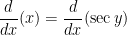
\displaystyle \frac{d}{dx} (x) = \displaystyle \frac{d}{dx} (\sec y)

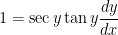
1 = \sec y \tan y \displaystyle \frac{dy}{dx}

\displaystyle \frac{1}{\sec y \tan y} = \displaystyle \frac{dy}{dx}

 At this point, the object is to convert the left-hand side to something involving only x. Clearly, we can replace \sec y with x. However, doing the same with \tan y is trickier. We begin with one of the Pythagorean identities:

1 + \tan^2 y = \sec^2 y

\tan^2 y = \sec^2 y - 1

\tan^2 y = x^2 - 1

\tan y = \sqrt{x^2 - 1} \qquad \hbox{or} \tan y = -\sqrt{x^2 - 1}

So which is it, the positive answer or the negative answer? The answer is, without additional information, we don’t know!

  • If 0 \le y < \pi/2 (so that x = \sec y \ge 1), then \tan y is positive, and so \tan y = \sqrt{\sec^2 y - 1}.
  • If \pi/2 < y \le \pi (so that x = \sec y \le 1), then \tan y is negative, and so \tan y = -\sqrt{\sec^2 y - 1}.

We therefore have two formulas for the derivative of y = \sec^{-1} x:

\displaystyle \frac{d}{dx} sec^{-1} x = \displaystyle \frac{1}{x \sqrt{x^2-1}} \qquad \hbox{if} \qquad x > 1

\displaystyle \frac{d}{dx} sec^{-1} x = \displaystyle -\frac{1}{x \sqrt{x^2-1}} \qquad \hbox{if} \qquad x < 1

These may then be combined into the single formula

\displaystyle \frac{d}{dx} sec^{-1} x = \displaystyle \frac{1}{|x| \sqrt{x^2-1}}

green lineIt gets better. Let’s now find the integral

\displaystyle \int \frac{dx}{x \sqrt{x^2 -1}}

arcsec2

Several calculus textbooks that I’ve seen will lazily give the answer

\displaystyle \int \frac{dx}{x \sqrt{x^2 -1}} = \sec^{-1} x + C

This answer works as long as x > 1, so that |x| reduces to simply x. For example, the red signed area in the above picture on the interval [2\sqrt{3}/3,2] may be correctly computed as

\displaystyle \int_{2\sqrt{3}/3}^2 \frac{dx}{x \sqrt{x^2 -1}} = \sec^{-1} 2 - \sec^{-1} \displaystyle \frac{2\sqrt{3}}{3}

= \cos^{-1} \left( \displaystyle \frac{1}{2} \right) - \cos^{-1} \left( \displaystyle \frac{\sqrt{3}}{2} \right)

= \displaystyle \frac{\pi}{3} - \frac{\pi}{6}

= \displaystyle \frac{\pi}{6}

However, the orange signed area on the interval [-2,-2\sqrt{3}/3]  is incorrectly computed using this formula!

\displaystyle \int_{-2}^{-2\sqrt{3}/3} \frac{dx}{x \sqrt{x^2 -1}} = \sec^{-1} \left( - \displaystyle \frac{2\sqrt{3}}{3} \right) - \sec^{-1} (-2)

= \cos^{-1} \left( -\displaystyle \frac{\sqrt{3}}{2} \right) -\cos^{-1} \left( \displaystyle \frac{1}{2} \right)

= \displaystyle \frac{5\pi}{6} - \frac{2\pi}{3}

= \displaystyle \frac{\pi}{6}

This is patently false, as the picture clearly indicates that the above integral has to be negative. For this reason, careful calculus textbooks will often ask students to solve a problem like

\displaystyle \int \frac{dx}{x \sqrt{x^2 -1}}, \qquad x > 1

and the caveat x > 1 is needed to ensure that the correct antiderivative is used. Indeed, a calculus textbook that doesn’t include such caveats are worthy of any scorn that an instructor cares to heap upon it.

Inverse Functions: Arcsecant (Part 26)

We now turn to a little-taught and perhaps controversial inverse function: arcsecant. As we’ve seen throughout this series, the domain of this inverse function must be chosen so that the graph of y = \sec x satisfies the horizontal line test. It turns out that the choice of domain has surprising consequences that are almost unforeseeable using only the tools of Precalculus.

The standard definition of y = \sec^{-1} x uses the interval [0,\pi] — or, more precisely, [0,\pi/2) \cup (\pi/2, \pi] to avoid the vertical asymptote at x = \pi/2. This portion of the graph of y = \sec x satisfies the horizontal line test and, conveniently, matches almost perfectly the domain of y = \cos^{-1} x. This is perhaps not surprising since, when both are defined, \cos x and \sec x are reciprocals.

arcsec1


Since this range of \sec^{-1} x matches that of \cos^{-1} x, we have the convenient identity

\sec^{-1} x = \cos^{-1} \left( \displaystyle \frac{1}{x} \right)

To see why this works, let’s examine the right triangle below. Notice that

\cos \theta = \displaystyle \frac{x}{1} \qquad \Longrightarrow \qquad \theta = \cos^{-1} x.

Also,

\sec\theta = \displaystyle \frac{1}{x} \qquad \Longrightarrow \qquad \theta = \cos^{-1} \left( \displaystyle \frac{1}{x} \right).

This argument provides the justification for 0 < \theta < \pi/2 — that is, for x > 1 — but it still works for x = 1 and x \le -1.

So this seems like the most natural definition in the world for \sec^{-1} x. Unfortunately, there are consequences for this choice in calculus, as we’ll see in tomorrow’s post.

Exponential growth and decay (Part 16): Logistic growth model

In this series of posts, I provide a deeper look at common applications of exponential functions that arise in an Algebra II or Precalculus class. In the previous posts in this series, I considered financial applications, radioactive decay, and Newton’s Law of Cooling.

Today, I discuss the logistic growth model, which describes how an infection (like a disease, a rumor, or advertise) spreads in a population. In yesterday’s post, I described an in-class demonstration that engages students while also making the following formula believable:

A(t) = \displaystyle \frac{Ly_0}{y_0+ (L-y_0)e^{-rt}}.

I’d like to discuss some observations about this somewhat complicated function that will make producing its graph easier. The first two observations are within reach of Precalculus students.

1. Let’s figure out the y-intercept:

A(0) = \displaystyle \frac{Ly_0}{y_0+ (L-y_0)e^{-r \cdot 0}} = \displaystyle \frac{Ly_0}{y_0+ L-y_0} = y_0.

In other words, the number y_0 represents the initial number of people who have the infection.

2. Let’s figure out the limiting value as t gets large:

\displaystyle \lim_{t \to \infty} A(t) = \displaystyle \frac{Ly_0}{y_0+ (L-y_0) \cdot 0} = \displaystyle \frac{Ly_0}{y_0} = L.

As expected, all L people will get the infection eventually. (Of course, Precalculus students won’t be familiar with the $\displaystyle \lim$ notation, but they should understand that e^{-rt} decays to zero as t gets large.

3. Let’s now figure out the point of inflection. Ordinarily, points of inflection are found by setting the second derivative equal to zero. Though this can be done for the function A(t) above, it would be a somewhat daunting exercise!

The good news is that the points of inflection can be found quite simply using the governing differential equation, which is

A' = r A [ L - A] = r L A - r A^2

Let’s take the derivative of both sides, remembering that r and L are constants:

A'' = r L A' - 2 r A A'

A'' = A' (r L - 2 r A)

So the second derivative is equal to zero when either A' = 0 or else r L - 2 r A = 0. The first case corresponds to the trivial cases A(t) \equiv 0 and A(t) \equiv L; these constants are called the equilibrium solutions. The second case is the more interesting one:

r L - 2 r A = 0

r L = 2 r A

\displaystyle \frac{L}{2} = A

This suggests that, as the infection spreads throughout a population, the curve changes concavity at the time that half of the population becomes infected. In other words, the infection spreads fastest throughout the population at the time when half of the population has been infected.

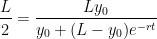
The time at which the point of inflection occurs can be found by setting A(t) = \displaystyle \frac{L}{2} and solving for t:

\displaystyle \frac{L}{2} = \displaystyle \frac{Ly_0}{y_0+ (L-y_0)e^{-rt}}.

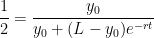
\displaystyle \frac{1}{2} = \displaystyle \frac{y_0}{y_0+ (L-y_0)e^{-rt}}.

y_0 + (L-y_0) e^{-rt} = 2y_0

(L-y_0) e^{-rt} = y_0

e^{-rt} = \displaystyle \frac{y_0}{L-y_0}

-rt = \displaystyle \ln \left( \frac{y_0}{L-y_0} \right)

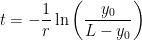
t = \displaystyle - \frac{1}{r} \ln \left( \frac{y_0}{L-y_0} \right)

This technique for finding the points of inflection directly from the differential equation is possible whenever the differential equation is autonomous, which loosely means that the independent variable does not appear on the right-hand side.


Different definitions of e (Part 12): Numerical computation

In this series of posts, we have seen that the number e can be thought about in three different ways.

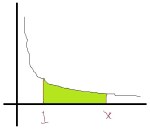
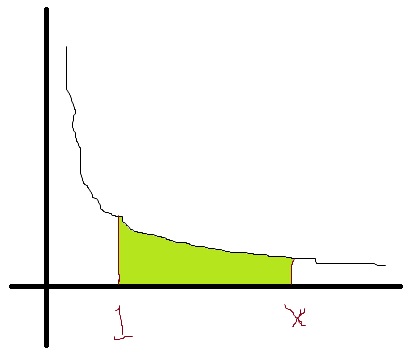
1. e defines a region of area 1 under the hyperbola y = 1/x.logarea2. We have the limits

e = \displaystyle \lim_{h \to 0} (1+h)^{1/h} = \displaystyle \lim_{n \to \infty} \left(1 + \frac{1}{n} \right)^n.

These limits form the logical basis for the continuous compound interest formula.

3. We have also shown that \frac{d}{dx} \left(e^x \right) = e^x. From this derivative, the Taylor series expansion for e^x about x = 0 can be computed:

e^x = \displaystyle \sum_{n=0}^\infty \frac{x^n}{n!}

Therefore, we can let x = 1 to find e:

e = \displaystyle \sum_{n=0}^\infty \frac{1}{n!} = \displaystyle 1 + 1 + \frac{1}{2} + \frac{1}{6} + \frac{1}{24} + \dots

green line

In yesterday’s post, I showed that using the original definition (in terms of an area under a hyperbola) does not lend itself well to numerically approximating e. Let’s now look at the other two methods.

2. The limit e = \displaystyle \lim_{n \to \infty} \left(1 + \frac{1}{n} \right)^n gives a somewhat more tractable way of approximating e, at least with a modern calculator. However, you can probably imagine the fun of trying to use this formula without a calculator.
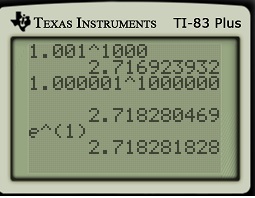
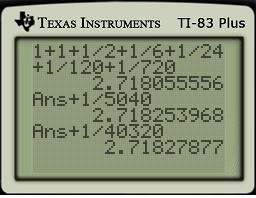
ecalculator3. The best way to compute e (or, in general, e^x) is with Taylor series. The fractions \frac{1}{n!} get very small very quickly, leading to rapid convergence. Indeed, with only terms up to 1/6!, this approximation beats the above approximation with n = 1000. Adding just two extra terms comes close to matching the accuracy of the above limit when n = 1,000,000.

ecalculator2

More about approximating e^x via Taylor series can be found in my previous post.


Different definitions of e (Part 10): Connecting the two definitions

In this series of posts, I consider how two different definitions of the number e are related to each other. The number e is usually introduced at two different places in the mathematics curriculum:

  1. Algebra II/Precalculus: If P dollars are invested at interest rate r for t years with continuous compound interest, then the amount of money after t years is A = Pe^{rt}.
  2. Calculus: The number e is defined to be the number so that the area under the curve y = 1/x from x = 1 to x = e is equal to 1, so that

\displaystyle \int_1^e \frac{dx}{x} = 1.

These two definitions appear to be very, very different. One deals with making money. The other deals with the area under a hyperbola. Amazingly, these two definitions are related to each other. In this series of posts, I’ll discuss the connection between the two.

logareagreen line

In yesterday’s post, I proved the following theorem, thus completing a long train of argument that began with the second definition of e and ending with a critical step in the derivation of the continuous compound interest formula. Today, I present an alternate proof of the theorem using L’Hopital’s rule.

Theorem. \displaystyle \lim_{n \to \infty} P \left( 1 + \frac{r}{n} \right)^{nt} = P e^{rt}.

Proof #2. Let’s write the left-hand side as

L = \displaystyle \lim_{n \to \infty} P \left( 1 + \frac{r}{n} \right)^{nt}.

Let’s take the natural logarithm of both sides:

\ln L = \displaystyle \ln \left[ \lim_{n \to \infty} P \left( 1 + \frac{r}{n} \right)^{nt} \right]

Since g(x) = \ln x is continuous, we can interchange the function and the limit on the right-hand side:

\ln L = \displaystyle \lim_{n \to \infty} \ln \left[ P \left( 1 + \frac{r}{n} \right)^{nt} \right]

\ln L = \displaystyle \lim_{n \to \infty} \left[ \ln P + \ln \left( 1 + \frac{r}{n} \right)^{nt} \right]

\ln L = \displaystyle \lim_{n \to \infty} \left[ \ln P + nt \ln \left( 1 + \frac{r}{n} \right)\right]

\ln L = \ln P + \displaystyle \lim_{n \to \infty} \frac{t \displaystyle \ln \left(1 + \frac{r}{n} \right)}{1/n}

\ln L = \ln P + \displaystyle t \lim_{n \to \infty} \frac{\displaystyle \ln \left(1 + \frac{r}{n} \right)}{1/n}

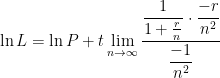
The limit on the right-hand side follows the indeterminate form 0/0, as so we may apply L’Hopital’s Rule. Taking the derivative of both the numerator and denominator with respect to n, we find

\ln L = \ln P + \displaystyle t \lim_{n \to \infty} \frac{\displaystyle \frac{1}{1 + \frac{r}{n}} \cdot \frac{-r}{n^2}}{\displaystyle \frac{-1}{n^2}}

\ln L = \ln P + \displaystyle t \lim_{n \to \infty}\frac{r}{1 + \frac{r}{n}}

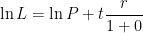
\ln L = \ln P + \displaystyle t \frac{r}{1 + 0}

\ln L = rt + \ln P

We now solve for the original limit L:

L = e^{rt + \ln P}

L = e^{rt} e^{\ln P}

L = Pe^{rt}


Different definitions of e (Part 9): Connecting the two definitions

In this series of posts, I consider how two different definitions of the number e are related to each other. The number e is usually introduced at two different places in the mathematics curriculum:

  1. Algebra II/Precalculus: If P dollars are invested at interest rate r for t years with continuous compound interest, then the amount of money after t years is A = Pe^{rt}.
  2. Calculus: The number e is defined to be the number so that the area under the curve y = 1/x from x = 1 to x = e is equal to 1, so that

\displaystyle \int_1^e \frac{dx}{x} = 1.

These two definitions appear to be very, very different. One deals with making money. The other deals with the area under a hyperbola. Amazingly, these two definitions are related to each other. In this series of posts, I’ll discuss the connection between the two.

logareagreen line

We begin with the second definition, which is usually considered the true definition of e. From this definition, I have shown in a previous post that we can derive the differentiation formulas

\displaystyle \frac{d}{dx} (\ln x) = \frac{1}{x} \qquad and \qquad \displaystyle \frac{d}{dx} \left( e^x \right) = e^x

beginning with this definition of the number e.

Theorem. \displaystyle \lim_{n \to \infty} P \left( 1 + \frac{r}{n} \right)^{nt} = Pe^{rt}.

Proof #1.In an earlier post in this series, I showed that

\displaystyle \frac{1}{x} = \displaystyle \lim_{h \to 0} \ln \left(1 + \frac{h}{x} \right)^{1/h}

Let’s now replace h with 1/n. Also, replace x with 1/r. Then we obtain

r = \displaystyle \lim_{n \to \infty} \ln \left(1 + \frac{1/n}{1/r} \right)^{n}

r = \displaystyle \lim_{n \to \infty} \ln \left(1 + \frac{r}{n} \right)^{n}

Multiply both sides by t:

rt = \displaystyle t \lim_{n \to \infty} \ln \left(1 + \frac{r}{n} \right)^{n}

rt = \displaystyle \lim_{n \to \infty} t \ln \left(1 + \frac{r}{n} \right)^{n}

rt = \displaystyle \lim_{n \to \infty} \ln \left[ \left(1 + \frac{r}{n} \right)^{n} \right]^t

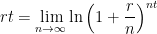
rt = \displaystyle \lim_{n \to \infty} \ln \left(1 + \frac{r}{n} \right)^{nt}

Since g(x) = \ln x is continuous, we can interchange the function and the limit on the right-hand side:

rt = \displaystyle \ln \left[ \lim_{n \to \infty} \left(1 + \frac{r}{n} \right)^{nt} \right]

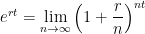
e^{rt} = \displaystyle \lim_{n \to \infty} \left(1 + \frac{r}{n} \right)^{nt}

Finally, we multiply both sides by P:

P e^{rt} = \displaystyle \lim_{n \to \infty} P \left(1 + \frac{r}{n} \right)^{nt}

(A second proof of this theorem, using L’Hopital’s Rule, will be presented in tomorrow’s post.)

This firmly established, at last, the connection between the continuous compound interest formula and the area under the hyperbola. I’ve noted that my students feel a certain sense of accomplishment after reaching this point of the exposition.

Different definitions of e (Part 8): Connecting the two definitions

In this series of posts, I consider how two different definitions of the number e are related to each other. The number e is usually introduced at two different places in the mathematics curriculum:

  1. Algebra II/Precalculus: If P dollars are invested at interest rate r for t years with continuous compound interest, then the amount of money after t years is A = Pe^{rt}.
  2. Calculus: The number e is defined to be the number so that the area under the curve y = 1/x from x = 1 to x = e is equal to 1, so that

\displaystyle \int_1^e \frac{dx}{x} = 1.

These two definitions appear to be very, very different. One deals with making money. The other deals with the area under a hyperbola. Amazingly, these two definitions are related to each other. In this series of posts, I’ll discuss the connection between the two.

logareagreen line

In yesterday’s post, I proved the following theorem, thus completing a long train of argument that began with the second definition of e and ending with a critical step in the derivation of the continuous compound interest formula. Today, I present an alternate proof of the theorem using L’Hopital’s rule.

Theorem. \displaystyle \lim_{h \to 0} \left( 1 + h \right)^{1/h} = e.

Proof #2. Let’s write the left-hand side as

L = \displaystyle \lim_{h \to 0} \left( 1 + h \right)^{1/h}.

Let’s take the natural logarithm of both sides:

\ln L = \displaystyle \ln \left[ \lim_{h \to 0} \left( 1 + h \right)^{1/h} \right]

Since g(x) = \ln x is continuous, we can interchange the function and the limit on the right-hand side:

\ln L = \displaystyle \lim_{h \to 0} \ln (1+h)^{1/h}

\ln L = \displaystyle \lim_{h \to 0} \frac{1}{h} \ln(1+h)

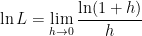
\ln L = \displaystyle \lim_{h \to 0} \frac{\ln(1+h)}{h}

The right-hand side follows the indeterminate form 0/0, as so we may apply L’Hopital’s Rule. Taking the derivative of both the numerator and denominator, we find

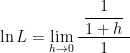
\ln L = \displaystyle \lim_{h \to 0} \frac{ \displaystyle ~ \frac{1}{1+h} ~}{1}

\ln L = \displaystyle \lim_{h \to 0} \frac{1}{1+h}

\ln L = \displaystyle \frac{1}{1+0} = 1.

Therefore, the original limit is L = e^1 = e.


Different definitions of e (Part 7): Connecting the two definitions

In this series of posts, I consider how two different definitions of the number e are related to each other. The number e is usually introduced at two different places in the mathematics curriculum:

  1. Algebra II/Precalculus: If P dollars are invested at interest rate r for t years with continuous compound interest, then the amount of money after t years is A = Pe^{rt}.
  2. Calculus: The number e is defined to be the number so that the area under the curve y = 1/x from x = 1 to x = e is equal to 1, so that

\displaystyle \int_1^e \frac{dx}{x} = 1.

These two definitions appear to be very, very different. One deals with making money. The other deals with the area under a hyperbola. Amazingly, these two definitions are related to each other. In this series of posts, I’ll discuss the connection between the two.

logareagreen line

We begin with the second definition, which is usually considered the true definition of e. From this definition, I have shown in a previous post that we can derive the differentiation formulas

\displaystyle \frac{d}{dx} (\ln x) = \frac{1}{x} \qquad and \qquad \displaystyle \frac{d}{dx} \left( e^x \right) = e^x

beginning with this definition of the number e.

Theorem. \displaystyle \lim_{h \to 0} \left( 1 + h \right)^{1/h} = e.

Proof #1. Recall the definition of a derivative

f'(x) = \displaystyle \lim_{h \to 0} \frac{f(x+h) - f(x)}{h}.

Let’s apply this to the function f(x) = \ln x:

\displaystyle \frac{d}{dx} (\ln x) = \displaystyle \lim_{h \to 0} \frac{\ln(x+h) - \ln x}{h}

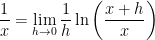
\displaystyle \frac{1}{x} = \displaystyle \lim_{h \to 0} \frac{1}{h} \ln \left( \frac{x+h}{x} \right)

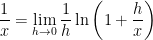
\displaystyle \frac{1}{x} = \displaystyle \lim_{h \to 0} \frac{1}{h} \ln \left( 1 + \frac{h}{x} \right)

\displaystyle \frac{1}{x} = \displaystyle \lim_{h \to 0} \ln \left(1 + \frac{h}{x} \right)^{1/h}

(I’ll note parenthetically that I’ll need the above line for a future post in this series.) At this point, let’s substitute x = 1:

1 = \displaystyle \lim_{h \to 0} \ln (1 + h)^{1/h}

Let’s now apply the exponential function to both sides:

e^1 = \exp \left[ \displaystyle \lim_{h \to 0} \ln (1 + h)^{1/h} \right]

Since g(x) = e^x is continuous, we can interchange the function and the limit on the right-hand side:

e = \displaystyle \lim_{h \to 0} \exp \left[ \ln (1 + h)^{1/h} \right]

Finally, since g(x) = e^x and f(x) = \ln x are inverse functions, we can conclude

e = \displaystyle \lim_{h \to 0} (1 + h)^{1/h}.

(A second proof of this theorem, using L’Hopital’s Rule, will be presented in tomorrow’s post.)

green line

The next theorem establishes, at last, the connection between the continuous compound interest formula and the area under the hyperbola. I’ve noted that my students feel a certain sense of accomplishment after reaching this point of the exposition.

Theorem. \displaystyle \lim_{n \to \infty} \left(1 + \frac{1}{n} \right)^{n} = e.

Proof. Though a little bit of real analysis is necessary to make this rigorous, we can informally see why this has to be true by letting n = 1/h for h positive. Then the expression (1+h)^{1/h} becomes \left( 1 + \frac{1}{n} \right)^n. Also, as h \to 0, then n \to \infty.

Functions that commute

At the bottom of this post is a one-liner that I use in my classes the first time I present a theorem where two functions are permitted to commute. At many layers of the mathematics curriculum, students learn about that various functions can essentially commute with each other. In other words, the order in which the operations is performed doesn’t affect the final answer. Here’s a partial list off the top of my head:

  1. Arithmetic/Algebra: a \cdot (b + c) = a \cdot b + a \cdot c. This of course is commonly called the distributive property (and not the commutative property), but the essential idea is that the same answer is obtained whether the multiplications are performed first or if the addition is performed first.
  2. Algebra: If a,b > 0, then \sqrt{ab} = \sqrt{a} \sqrt{b}.
  3. Algebra: If a,b > 0 and x is any real number, then (ab)^x = a^x b^x.
  4. Precalculus: \displaystyle \sum_{i=1}^n (a_i+b_i) = \displaystyle \sum_{i=1}^n a_i + \sum_{i=1}^n b_i.
  5. Precalculus: \displaystyle \sum_{i=1}^n c a_i = c \displaystyle \sum_{i=1}^n a_i.
  6. Calculus: If f is continuous at an interior point c, then \displaystyle \lim_{x \to c} f(x) = f(c).
  7. Calculus: If f and g are differentiable, then (f+g)' = f' + g'.
  8. Calculus: If f is differentiable and c is a constant, then (cf)' = cf'.
  9. Calculus: If f and g are integrable, then \int (f+g) = \int f + \int g.
  10. Calculus: If f is integrable and c is a constant, then \int cf = c \int f.
  11. Calculus: If f: \mathbb{R}^2 \to \mathbb{R} is integrable, \iint f(x,y) dx dy = \iint f(x,y) dy dx.
  12. Calculus: For most differentiable function f: \mathbb{R}^2 \to \mathbb{R} that arise in practice, \displaystyle \frac{\partial^2 f}{\partial x \partial y} = \displaystyle \frac{\partial^2 f}{\partial y \partial x}.
  13. Probability: If X and Y are random variables, then E(X+Y) = E(X) + E(Y).
  14. Probability: If X is a random variable and c is a constant, then E(cX) = c E(X).
  15. Probability: If X and Y are independent random variables, then E(XY) = E(X) E(Y).
  16. Probability: If X and Y are independent random variables, then \hbox{Var}(X+Y) = \hbox{Var}(X) + \hbox{Var}(Y).
  17. Set theory: If A, B, and C are sets, then A \cup (B \cap C) = (A \cup B) \cap (A \cup C).
  18. Set theory: If A, B, and C are sets, then A \cap (B \cup C) = (A \cap B) \cup (A \cap C).

However, there are plenty of instances when two functions do not commute. Most of these, of course, are common mistakes that students make when they first encounter these concepts. Here’s a partial list off the top of my head. (For all of these, the inequality sign means that the two sides do not have to be equal… though there may be special cases when equality happens to happen.)

  1. Algebra: (a+b)^x \ne a^x + b^x if x \ne 1. Important special cases are x = 2, x = 1/2, and x = -1.
  2. Algebra/Precalculus: \log_b(x+y) = \log_b x + \log_b y. I call this the third classic blunder.
  3. Precalculus: (f \circ g)(x) \ne (g \circ f)(x).
  4. Precalculus: \sin(x+y) \ne \sin x + \sin y, \cos(x+y) \ne \cos x + \cos y, etc.
  5. Precalculus: \displaystyle \sum_{i=1}^n (a_i b_i) \ne \displaystyle \left(\sum_{i=1}^n a_i \right) \left( \sum_{i=1}^n b_i \right).
  6. Calculus: (fg)' \ne f' \cdot g'.
  7. Calculus \left( \displaystyle \frac{f}{g} \right)' \ne \displaystyle \frac{f'}{g'}
  8. Calculus: \int fg \ne \left( \int f \right) \left( \int g \right).
  9. Probability: If X and Y are dependent random variables, then E(XY) \ne E(X) E(Y).
  10. Probability: If X and Y are dependent random variables, then \hbox{Var}(X+Y) \ne \hbox{Var}(X) + \hbox{Var}(Y).

All this to say, it’s a big deal when two functions commute, because this doesn’t happen all the time.

green lineI wish I could remember the speaker’s name, but I heard the following one-liner at a state mathematics conference many years ago, and I’ve used it to great effect in my classes ever since. Whenever I present a property where two functions commute, I’ll say, “In other words, the order of operations does not matter. This is a big deal, because, in real life, the order of operations usually is important. For example, this morning, you probably got dressed and then went outside. The order was important.”