Engaging students: Adding, subtracting, and multiplying matrices

In my capstone class for future secondary math teachers, I ask my students to come up with ideas for engaging their students with different topics in the secondary mathematics curriculum. In other words, the point of the assignment was not to devise a full-blown lesson plan on this topic. Instead, I asked my students to think about three different ways of getting their students interested in the topic in the first place.

I plan to share some of the best of these ideas on this blog (after asking my students’ permission, of course).

This student submission again comes from my former student Joe Wood. His topic, from Algebra: adding, subtracting, and multiplying matrices.

green line

A1. What interesting (i.e., uncontrived) word problems using this topic can your students do now?

One interesting real world problem for matrix operations can be found in Chapter 4.1.3 at http://spacemath.gsfc.nasa.gov/algebra2.html. The problem deals with astronomical photography. It starts by explaining the process by which NASA gets its images and relates the process of taking the pictures from blurry to clear using matrices. The problem goes as follows:
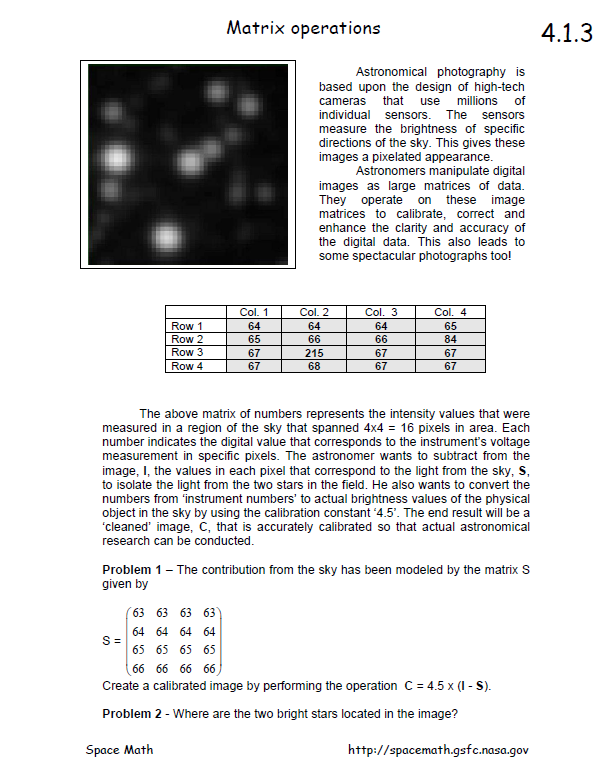
spacemath

For a way to engage students who are not interested in astronomy, and to allow students to learn more on their own time of the uses, a homework assignment could be for them to find places other than NASA that this process could be used.

green line

D1. What interesting things can you say about the people who contributed to the discovery and/or the development of this topic? (You might want to consult Math Through The Ages.)

“Nine Chapters of the Mathematical Art”, an ancient book that dates between 300 BC and AD 200, gives the first documented use of matrices. Even though matrices were used as early as 300 BC, the term “matrix” was not used until 1850 by James Joseph Sylvester. The term matrix actually comes from a Latin word meaning “womb”.

Below is a list published on the Harvard website of important matrix concepts and the years they were introduced.

200 BC: Han dynasty, coefficients are written on a counting board [6]
1545 Cardan: Cramer rule for 2×2 matrices. [6]
1683 Seki and Leibnitz independently first appearance of Determinants [6]
1750 Cramer (1704-1752) rule for solving systems of linear equations using determinants [8]
1764 Bezout rule to determine determinants
1772 Laplace expansion of determinants
1801 Gauss first introduces determinants [6]
1812 Cauchy multiplication formula of determinant. Independent of Binet
1812 Binet (1796-1856) discovered the rule det(AB) = det(A) det(B) [1]
1826 Cauchy Uses term “tableau” for a matrix [6]
1844 Grassman, geometry in n dimensions [14], (50 years ahead of its epoch [14 p. 204-205]
1850 Sylvester first use of term “matrix” (matrice=pregnant animal in old french or matrix=womb in latin as it generates determinants)
1858 Cayley matrix algebra [7] but still in 3 dimensions [14]
1888 Giuseppe Peano (1858-1932) axioms of abstract vector space [12]


green line

B1. How can this topic be used in your students’ future courses in mathematics or science?

Matrices and matrix operations are used in many math classes from Algebra and Calculus, to Linear Algebra and beyond. So any student interested in studying any discipline of Engineering or mathematics should become very familiar with matrices since they are used in a wide variety of ways (one way is seen above). Matrices are also useful in other courses as well. In Chemistry, matrices can be used for balancing chemical equations. In Physics, matrices can be used to decompose forces. Even in ecology or biology classes, matrices can be crucial. A great example would be studying animal populations under given conditions.
One hope in giving so many brief examples is that a student who cares nothing about the topic of matrices would here about a topic they are interested in (say animals) and that would spark questions into how or why matrices are useful. And of course, when dealing with matrices, addition subtraction, and multiplication of matrices follows closely behind.


References:

“Common Topics Covered in Standard Algebra II Textbooks.” Space Math @ NASA. NASA, n.d. Web. 18 Sept. 2015.

Knill, Oliver. “When Was Matrix Multiplication Invented?” When Was Matrix Multiplication Invented?  Harvard, 24 July 2014. Web. 18 Sept. 2015.

Smoller, Laura. “The History of Matrices.” The History of Matrices. University of Arkansas at Little Rock, Apr. 2001. Web. 18 Sept. 2015.


Severe Weather Protocol During State Testing

Here in Texas, it’s the start of tornado season as well as the start of high-stakes testing season, so it’s important for teachers to know what to do if the two events should overlap. (Source: http://suzyred.com/takstestprotocol.html)

  1. Should a severe weather situation occur during testing, please remain calm. To display any kind of anxiety would be a testing irregularity and must be reported.
  1. Please do not look out the window to watch for approaching tornadoes. You must monitor the students at all times. To do otherwise would be a testing irregularity and must be reported.
  1. Should students notice an approaching tornado and begin to cry, please make every effort to protect their testing materials from the flow of tears and sinus drainage.
  1. Should a flying object come through your window during testing, please make every effort to ensure that it does not land on a testing booklet or an answer sheet. Please make sure to soften the landing of the flying object so that it will not disturb the students while testing.
  1. Should shards of glass from a broken window come flying into the room, have the students use their bodies to shield their testing materials so that they will not be damaged. Have plenty of gauze on hand to ensure that no one accidentally bleeds on the answer documents. Damaged answer sheets will not scan properly.
  1. Should gale force winds ensue, please have everyone stuff their test booklets and answer sheets into their shirts….. being very careful not to bend them because bent answer documents will not scan properly.
  1. If any student gets sucked into the vortex of the funnel cloud, please make sure they mark at least one answer before departing. And of course make sure they leave their answer sheets and test booklets behind. You WILL have to account for those.
  1. Should a funnel cloud pick you, the test administrator, up and take you flying over the rainbow, you will still be required to account for all of your testing materials when you land. So…..please take extra precautions. Remember…..once you have checked them out, they should never leave your hands.
  1. When rescue workers arrive to dig you out of the rubble, please make sure that they do not, at any time, look at or handle the testing materials. Once you have been treated for your injuries, you will still be responsible for checking your materials back in. Search dogs will not be allowed to sift through the rubble for lost tests, unless of course they have been through standardized test training.
  1. Please do not pray should a severe weather situation arise. Your priority is to actively monitor the test and a student might mark in the wrong section if you are praying instead of monitoring. I’m sure God will put war, world hunger, crime, and the presidential primaries on hold until after testing is over. He knows how important this test is.

Predicate Logic and Popular Culture: Index

I’m doing something that I should have done a long time ago: collecting a series of posts into one single post. The following links comprised my series on using examples from popular culture to illustrate principles of predicate logic.

Unlike other series that I’ve made, this series didn’t have a natural chronological order. So I’ll list these by concept illustrated from popular logic.

green lineLogical and \land: Part 1

  • Part 1: “You Belong To Me,” by Taylor Swift
  • Part 21: “Do You Hear What I Hear,” covered by Whitney Houston
  • Part 31: The Godfather (1972)
  • Part 45: The Blues Brothers (1980)
  • Part 53: “What Does The Fox Say,” by Ylvis
  • Part 54: “Billie Jean,” by Michael Jackson

Logical or \lor:

  • Part 1: Shawshank Redemption (1994)

Logical negation \lnot:

  • Part 1: Richard Nixon
  • Part 32: “Satisfaction!”, by the Rolling Stones
  • Part 39: “We Are Never Ever Getting Back Together,” by Taylor Swift

Logical implication \Rightarrow:

  • Part 1: Field of Dreams (1989), and also “Roam,” by the B-52s
  • Part 2: “Word Crimes,” by Weird Al Yankovic
  • Part 7: “I’ll Be There For You,” by The Rembrandts (Theme Song from Friends)
  • Part 43: “Kiss,” by Prince
  • Part 50: “I’m Still A Guy,” by Brad Paisley

For all \forall:

  • Part 3: Casablanca (1942)
  • Part 4: A Streetcar Named Desire (1951)
  • Part 34: “California Girls,” by The Beach Boys
  • Part 37: Fellowship of the Ring, by J. R. R. Tolkien
  • Part 49: “Buy Me A Boat,” by Chris Janson
  • Part 57: “Let It Go,” by Idina Menzel and from Frozen (2013)

For all and implication:

  • Part 8 and Part 9: “What Makes You Beautiful,” by One Direction
  • Part 13: “Safety Dance,” by Men Without Hats
  • Part 16: The Fellowship of the Ring, by J. R. R. Tolkien
  • Part 24 : “The Chipmunk Song,” by The Chipmunks
  • Part 55: The Quiet Man (1952)

There exists \exists:

  • Part 10: “Unanswered Prayers,” by Garth Brooks
  • Part 15: “Stand by Your Man,” by Tammy Wynette (also from The Blues Brothers)
  • Part 36: Hamlet, by William Shakespeare
  • Part 57: “Let It Go,” by Idina Menzel and from Frozen (2013)

Existence and uniqueness:

  • Part 14: “Girls Just Want To Have Fun,” by Cyndi Lauper
  • Part 20: “All I Want for Christmas Is You,” by Mariah Carey
  • Part 23: “All I Want for Christmas Is My Two Front Teeth,” covered by The Chipmunks
  • Part 29: “You’re The One That I Want,” from Grease
  • Part 30: “Only You,” by The Platters
  • Part 35: “Hound Dog,” by Elvis Presley

DeMorgan’s Laws:

  • Part 5: “Never Gonna Give You Up,” by Rick Astley
  • Part 28: “We’re Breaking Free,” from High School Musical (2006)

Simple nested predicates:

  • Part 6: “Everybody Loves Somebody Sometime,” by Dean Martin
  • Part 25: “Every Valley Shall Be Exalted,” from Handel’s Messiah
  • Part 33: “Heartache Tonight,” by The Eagles
  • Part 38: “Everybody Needs Somebody To Love,” by Wilson Pickett and covered in The Blues Brothers (1980)
  • Part 46: “Mean,” by Taylor Swift
  • Part 56: “Turn! Turn! Turn!” by The Byrds

Maximum or minimum of a function:

  • Part 12: “For the First Time in Forever,” by Kristen Bell and Idina Menzel and from Frozen (2013)
  • Part 19: “Tennessee Christmas,” by Amy Grant
  • Part 22: “The Most Wonderful Time of the Year,” by Andy Williams
  • Part 48: “I Got The Boy,” by Jana Kramer
  • Part 60: “I Loved Her First,” by Heartland

Somewhat complicated examples:

  • Part 11 : “Friends in Low Places,” by Garth Brooks
  • Part 27 : “There is a Castle on a Cloud,” from Les Miserables
  • Part 41: Winston Churchill
  • Part 44: Casablanca (1942)
  • Part 51: “Everybody Wants to Rule the World,” by Tears For Fears
  • Part 58: “Fifteen,” by Taylor Swift
  • Part 59: “We Are Never Ever Getting Back Together,” by Taylor Swift
  • Part 61: “Style,” by Taylor Swift

Fairly complicated examples:

  • Part 17 : Richard Nixon
  • Part 47: “Homegrown,” by Zac Brown Band
  • Part 52: “If Ever You’re In My Arms Again,” by Peabo Bryson

Really complicated examples:

  • Part 18: “Sleigh Ride,” covered by Pentatonix
  • Part 26: “All the Gold in California,” by the Gatlin Brothers
  • Part 40: “One of These Things Is Not Like the Others,” from Sesame Street
  • Part 42: “Take It Easy,” by The Eagles

Predicate Logic and Popular Culture (Part 61): Taylor Swift

Let S(t) be the proposition “We are in style at time t,” let C(t) be the proposition “We crash down at time t,” and let B(t) be the proposition “We come back at time t.” Translate the logical statement

\forall t (\lnot S(t)) \Rightarrow (\forall t(C(t) \Rightarrow \exists u>t(B(u))).

The straightforward way of translating this into English is, “If we never go out of style, then whenever we crash down we come back at a later time. This approximately matches the second half of the chorus of one of Taylor Swift’s hit songs.

green line

Context: This semester, I taught discrete mathematics for the first time. Part of the discrete mathematics course includes an introduction to predicate and propositional logic for our math majors. As you can probably guess from their names, students tend to think these concepts are dry and uninteresting even though they’re very important for their development as math majors.

In an effort to making these topics more appealing, I spent a few days mining the depths of popular culture in a (likely futile) attempt to make these ideas more interesting to my students. In this series, I’d like to share what I found. Naturally, the sources that I found have varying levels of complexity, which is appropriate for students who are first learning prepositional and predicate logic.

When I actually presented these in class, I either presented the logical statement and had my class guess the statement in actual English, or I gave my students the famous quote and them translate it into predicate logic. However, for the purposes of this series, I’ll just present the statement in predicate logic first.

Predicate Logic and Popular Culture (Part 60): Heartland

Let L(x,t) be the proposition “x loves her at time t.” Translate the logical statement

\exists t<0(L(\hbox{I},t) \land \forall x \forall s < t (\lnot L(x,t))),

where t = 0 is now.

The clunky translation is “There was a time that I loved her, and nobody loved her before that time.” More succinctly, this is the title of the song that’s been played for countless father-daughter dances at wedding receptions since 2006. (I cannot tell a lie: I always turn into a sobbing and amorphous pile of mush whenever I hear this song.)

green line

Context: This semester, I taught discrete mathematics for the first time. Part of the discrete mathematics course includes an introduction to predicate and propositional logic for our math majors. As you can probably guess from their names, students tend to think these concepts are dry and uninteresting even though they’re very important for their development as math majors.

In an effort to making these topics more appealing, I spent a few days mining the depths of popular culture in a (likely futile) attempt to make these ideas more interesting to my students. In this series, I’d like to share what I found. Naturally, the sources that I found have varying levels of complexity, which is appropriate for students who are first learning prepositional and predicate logic.

When I actually presented these in class, I either presented the logical statement and had my class guess the statement in actual English, or I gave my students the famous quote and them translate it into predicate logic. However, for the purposes of this series, I’ll just present the statement in predicate logic first.

Predicate Logic and Popular Culture (Part 59): Taylor Swift

Let T(x) be the proposition “You go talk to x,” and let G(x) be the proposition “We are getting back together at time t.” Translate the logical statement

T(\hbox{your friends}) \land T(\hbox{my friends}) \land T(\hbox{me}) \land \forall t\ge 0 (\lnot G(t)),

where time 0 is now.

Of course, this is the ending part of the chorus to “We Are Never Ever Getting Back Together.”

green line

Context: This semester, I taught discrete mathematics for the first time. Part of the discrete mathematics course includes an introduction to predicate and propositional logic for our math majors. As you can probably guess from their names, students tend to think these concepts are dry and uninteresting even though they’re very important for their development as math majors.

In an effort to making these topics more appealing, I spent a few days mining the depths of popular culture in a (likely futile) attempt to make these ideas more interesting to my students. In this series, I’d like to share what I found. Naturally, the sources that I found have varying levels of complexity, which is appropriate for students who are first learning prepositional and predicate logic.

When I actually presented these in class, I either presented the logical statement and had my class guess the statement in actual English, or I gave my students the famous quote and them translate it into predicate logic. However, for the purposes of this series, I’ll just present the statement in predicate logic first.

Predicate Logic and Popular Culture (Part 58): Taylor Swift

Let Y(x) be the proposition “You are x years old,” and let L(x) be the proposition “x tell you that x loves you,” and let B(x) be the proposition “You believe x.” Translate the logical statement

(Y(15) \land \exists x(L(x))) \Rightarrow B(x),

where the domain is all people.

The straightforward way of translating this into English is, “If you are 15 years old and there exists someone who says that he/she loves you, then you believe him/her.” This approximately matches the chorus of one of Taylor Swift’s earliest hits.

green line

Context: This semester, I taught discrete mathematics for the first time. Part of the discrete mathematics course includes an introduction to predicate and propositional logic for our math majors. As you can probably guess from their names, students tend to think these concepts are dry and uninteresting even though they’re very important for their development as math majors.

In an effort to making these topics more appealing, I spent a few days mining the depths of popular culture in a (likely futile) attempt to make these ideas more interesting to my students. In this series, I’d like to share what I found. Naturally, the sources that I found have varying levels of complexity, which is appropriate for students who are first learning prepositional and predicate logic.

When I actually presented these in class, I either presented the logical statement and had my class guess the statement in actual English, or I gave my students the famous quote and them translate it into predicate logic. However, for the purposes of this series, I’ll just present the statement in predicate logic first.

Predicate Logic and Popular Culture (Part 57): Frozen

Let C(t) be the proposition “The cold bothers me at time t.” Translate the logical statement

\lnot(\exists t\le 0 (C(t))),

where the domain is all times and t=0 is now.

The straightforward way of translating this into English is, “It is false that there exists a time in the past that the cold bothered me.” Also, DeMorgan’s Laws could be applied:

\forall t\le 0(\lnot C(t)),

which can be read “For all times in the past, the cold did not bother me.” Of course, this is the closing line of the chorus of the signature tune from Frozen.

Of course, I can’t mention Frozen without mentioning its parodies; this is the best one that I’ve seen.

green line

Context: This semester, I taught discrete mathematics for the first time. Part of the discrete mathematics course includes an introduction to predicate and propositional logic for our math majors. As you can probably guess from their names, students tend to think these concepts are dry and uninteresting even though they’re very important for their development as math majors.

In an effort to making these topics more appealing, I spent a few days mining the depths of popular culture in a (likely futile) attempt to make these ideas more interesting to my students. In this series, I’d like to share what I found. Naturally, the sources that I found have varying levels of complexity, which is appropriate for students who are first learning prepositional and predicate logic.

When I actually presented these in class, I either presented the logical statement and had my class guess the statement in actual English, or I gave my students the famous quote and them translate it into predicate logic. However, for the purposes of this series, I’ll just present the statement in predicate logic first.

Predicate Logic and Popular Culture (Part 56): The Byrds

Let S(x,t) be the proposition “t is the season for x.” Translate the logical statement

\forall x \exists t (S(x,t)).

This pretty much matches the opening line of the 1960s hit song by The Byrds from Ecclesiastes 3.

green line

Context: This semester, I taught discrete mathematics for the first time. Part of the discrete mathematics course includes an introduction to predicate and propositional logic for our math majors. As you can probably guess from their names, students tend to think these concepts are dry and uninteresting even though they’re very important for their development as math majors.

In an effort to making these topics more appealing, I spent a few days mining the depths of popular culture in a (likely futile) attempt to make these ideas more interesting to my students. In this series, I’d like to share what I found. Naturally, the sources that I found have varying levels of complexity, which is appropriate for students who are first learning prepositional and predicate logic.

When I actually presented these in class, I either presented the logical statement and had my class guess the statement in actual English, or I gave my students the famous quote and them translate it into predicate logic. However, for the purposes of this series, I’ll just present the statement in predicate logic first.


