In my capstone class for future secondary math teachers, I ask my students to come up with ideas for engaging their students with different topics in the secondary mathematics curriculum. In other words, the point of the assignment was not to devise a full-blown lesson plan on this topic. Instead, I asked my students to think about three different ways of getting their students interested in the topic in the first place.
I plan to share some of the best of these ideas on this blog (after asking my students’ permission, of course).
This student submission again comes from my former student Loc Nguyen. His topic, from Algebra: fitting data to a quadratic function.
A1. What interesting (i.e., uncontrived) word problems using this topic can your students do now?
To engage students on this topic, I will provide them the word problems in the real life so they can see the usefulness of quadratic regression in predictive purposes. The question to the problem is about the estimated numbers of AIDS cases that can be diagnosed in 2006. The data only show from 1999 to 2003. This will be students’ job to figure out the prediction. I will provide the instructions for this task and I will also walk them through the process of finding the best curve that fit the given data. The best fit to the curve will give us the estimation. Here is how the instruction looks like:
In the end, students will be able to acquire the parabola curve which fit the given data. By letting students work through the real life problems, they will be able to understand why mathematics is important and see how this concept is useful in their lives.
B2. How does this topic extend what your students should have learned in previous courses?
Before getting into this topic, the students should have eventually been familiar with the word “quadratic” such as quadratic function, quadratic equation. Students should have been taught when the curve concaves up or down. In the previous course, students would be given the quadratic functions and they would be asked to find the maxima, minima, or intercepts. Or they would be asked to solve the quadratic equation and find the roots. The universal properties of quadratic function never change. When students encountered the concept of quadratic regression, they would not be so overwhelmed with the topic. There is no new rule or properties. The process is just backward. The Instead of having the given function, in this case, students will have to find the function based on the given data so that the curve would fit the data. Their prior knowledge is really essential for this topic, and this would help them to understand the concept of quadratic regression easier.
C1. How has this topic appeared in pop culture (movies, TV, current music, video games, etc.)?
At the beginning of the class, I would like to show students the short video of football incident.
This incident was really interesting. The Titans punt went so high so that it hit the scoreboard in Cowboys stadium. Surprisingly, this was Cowboy’s new stadium. There were many questions about what was going on when the architecture built this stadium. It was supposed to be great. This incident revealed the errors in predicting the height of the scoreboard. The data they collected in past year may have been incorrect. I want to incorporate this incident into the concept of quadratic regression. I will pose several questions such as:
Was Titan football punter really that powerful? What was really wrong in this situation?
When the architectures built this stadium, did they ever think that the ball would reach the ceiling?
How come did the architectures fail to measure the height of the ceiling? Did they just assume the height of the stadium tall enough?
What was the path of the ball?
Students will eagerly respond to these questions, and I will slowly bring in the important of quadratic regression. I will then explain how quadratic regression helps us to predict the height based on collected data from past years.
In my capstone class for future secondary math teachers, I ask my students to come up with ideas for engaging their students with different topics in the secondary mathematics curriculum. In other words, the point of the assignment was not to devise a full-blown lesson plan on this topic. Instead, I asked my students to think about three different ways of getting their students interested in the topic in the first place.
I plan to share some of the best of these ideas on this blog (after asking my students’ permission, of course).
This student submission again comes from my former student Joe Wood. His topic, from Algebra: adding, subtracting, and multiplying matrices.
A1. What interesting (i.e., uncontrived) word problems using this topic can your students do now?
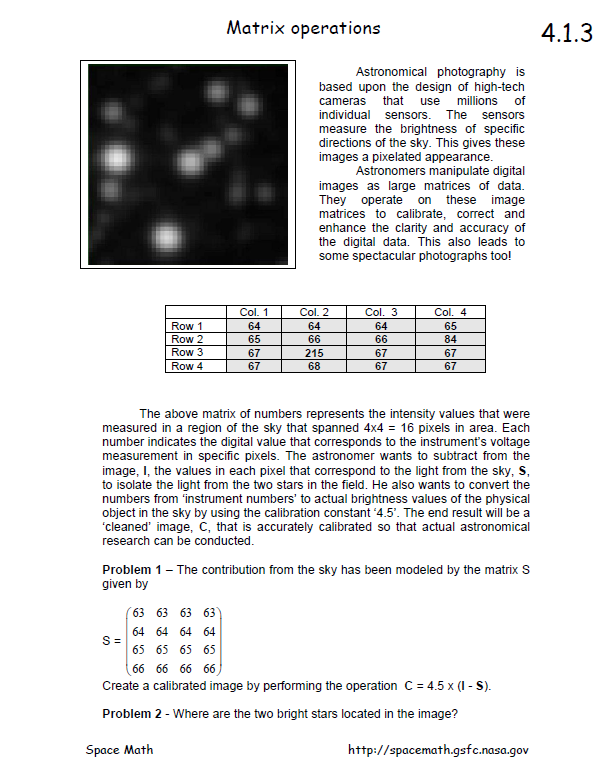
One interesting real world problem for matrix operations can be found in Chapter 4.1.3 at http://spacemath.gsfc.nasa.gov/algebra2.html. The problem deals with astronomical photography. It starts by explaining the process by which NASA gets its images and relates the process of taking the pictures from blurry to clear using matrices. The problem goes as follows:
For a way to engage students who are not interested in astronomy, and to allow students to learn more on their own time of the uses, a homework assignment could be for them to find places other than NASA that this process could be used.
D1. What interesting things can you say about the people who contributed to the discovery and/or the development of this topic? (You might want to consult Math Through The Ages.)
“Nine Chapters of the Mathematical Art”, an ancient book that dates between 300 BC and AD 200, gives the first documented use of matrices. Even though matrices were used as early as 300 BC, the term “matrix” was not used until 1850 by James Joseph Sylvester. The term matrix actually comes from a Latin word meaning “womb”.
Below is a list published on the Harvard website of important matrix concepts and the years they were introduced.
200 BC: Han dynasty, coefficients are written on a counting board [6]
1545 Cardan: Cramer rule for 2×2 matrices. [6]
1683 Seki and Leibnitz independently first appearance of Determinants [6]
1750 Cramer (1704-1752) rule for solving systems of linear equations using determinants [8]
1764 Bezout rule to determine determinants
1772 Laplace expansion of determinants
1801 Gauss first introduces determinants [6]
1812 Cauchy multiplication formula of determinant. Independent of Binet
1844 Grassman, geometry in n dimensions [14], (50 years ahead of its epoch [14 p. 204-205]
1850 Sylvester first use of term “matrix” (matrice=pregnant animal in old french or matrix=womb in latin as it generates determinants)
1858 Cayley matrix algebra [7] but still in 3 dimensions [14]
1888 Giuseppe Peano (1858-1932) axioms of abstract vector space [12]
B1. How can this topic be used in your students’ future courses in mathematics or science?
Matrices and matrix operations are used in many math classes from Algebra and Calculus, to Linear Algebra and beyond. So any student interested in studying any discipline of Engineering or mathematics should become very familiar with matrices since they are used in a wide variety of ways (one way is seen above). Matrices are also useful in other courses as well. In Chemistry, matrices can be used for balancing chemical equations. In Physics, matrices can be used to decompose forces. Even in ecology or biology classes, matrices can be crucial. A great example would be studying animal populations under given conditions.
One hope in giving so many brief examples is that a student who cares nothing about the topic of matrices would here about a topic they are interested in (say animals) and that would spark questions into how or why matrices are useful. And of course, when dealing with matrices, addition subtraction, and multiplication of matrices follows closely behind.
References:
“Common Topics Covered in Standard Algebra II Textbooks.” Space Math @ NASA. NASA, n.d. Web. 18 Sept. 2015.
Knill, Oliver. “When Was Matrix Multiplication Invented?” When Was Matrix Multiplication Invented? Harvard, 24 July 2014. Web. 18 Sept. 2015.
Smoller, Laura. “The History of Matrices.” The History of Matrices. University of Arkansas at Little Rock, Apr. 2001. Web. 18 Sept. 2015.
I’m doing something that I should have done a long time ago: collecting a series of posts into one single post. The following links comprised my series on using examples from popular culture to illustrate principles of predicate logic.
Unlike other series that I’ve made, this series didn’t have a natural chronological order. So I’ll list these by concept illustrated from popular logic.
In my capstone class for future secondary math teachers, I ask my students to come up with ideas for engaging their students with different topics in the secondary mathematics curriculum. In other words, the point of the assignment was not to devise a full-blown lesson plan on this topic. Instead, I asked my students to think about three different ways of getting their students interested in the topic in the first place.
I plan to share some of the best of these ideas on this blog (after asking my students’ permission, of course).
This student submission again comes from my former student Avery Fortenberry. His topic, from Algebra: ratios and rates of change.
In this viral YouTube video a man asks his wife the question “If you are traveling 80 miles per hour, how long does it take to travel 80 miles.” The wife overthinks the question and instead of trying to calculate how long it would take using the information of 80 miles per hour and how that they were going to travel one hour, she tries to think of how quick the tires are spinning and estimating the speed using her speed in running. The couple later goes on to talk on the Comedy Central show Tosh.0 where the wife explains the reason she was confused was that she had not slept well the night before and she was stressed with just finishing her finals. This video stresses the importance of making sure people understand that 80 miles per hour means you travel 80 miles in one hour.
The history of a rate of change is interesting when you consider the history of calculus itself. An important concept of calculus is finding derivatives, which is finding the rate of change or slope of a line. Calculus’s discovery was credited to both Isaac Newton and Gottfried Leibniz who both published their work around roughly the same time. This caused a dispute between the two men and they both accused the other of stealing their work. While both contributed much to the world of mathematics, it was many of Leibniz’s concepts of calculus that we still use today such as his notation dy/dx used for derivatives. Despite that Leibniz died poor and dishonored while Newton had a state funeral.
One of my favorite websites is khanacademy.org. This website has helped me from when I was in high school all the way to now it is still helping me understand concepts I may not have fully understood in class. It is a valuable resource to use when teaching about rates of change because there are countless videos over rates of change and slope and derivative that explain in detail all the concepts of it. Also, it has multiple practice problems that help you practice and study for an exam. I even used it for this project to help refresh my memory on rates of change and I was also looking at its word problems to help think of a word problem on my own for the A1 section of this project. Khan Academy also teaches you by reviewing all difficult steps in problems so that you can understand all the concepts.
One of the basic notions of functions that’s taught in Precalculus and in Discrete Mathematics is the notion of an inverse function: if is a one-to-one and onto function, then there is an inverse function so that
for all and
for all .
If , this is commonly taught in high school as a function that satisfies the horizontal line test.
In other words, if the function is applied to , the result is . When the inverse function is applied to that, the answer is the original number . Therefore, I’ll tell my class, “By applying the function , we uh-uh-uh-uh-uh-uh-uh-undo it.”
If I have a few country music fans in the class, this always generates a bit of a laugh.
See also the amazing duet with Carrie Underwood and Steven Tyler at the 2011 ACM awards:
To give my students a little appreciation for their elders, I’ll demonstrate for them how to use a slide rule. Though I have my own slide rule which I can pass around the classroom, demonstrating how to use a slide rule is a little cumbersome since they don’t have their own slide rules to use.
I’m doing something that I should have done a long time ago: collecting a series of posts into one single post. The following links comprised my series on the computation of
Sometimes it’s pretty easy for students to push through a proof from beginning to end. For example, in my experience, math majors have little trouble with each step of the proof of the following theorem.
Theorem. If , then .
Proof. Let , where , and let , where . Then
For other theorems, it’s not so easy for students to start with the left-hand side and end with the right-hand side. For example:
Theorem. If , then .
Proof. Let , where , and let , where . Then
.
A sharp math major can then provide the next few steps of the proof from here; however, it’s not uncommon for a student new to proofs to get stuck at this point. Inevitably, somebody asks if we can do the same thing to the right-hand side to get the same thing. I’ll say, “Sure, let’s try it”:
.
I call working with both the left and right sides to end up at the same spot the Diamond Rio approach to proofs: “I’ll start walking your way; you start walking mine; we meet in the middle ‘neath that old Georgia pine.” Not surprisingly, labeling this with a catchy country song helps the idea stick in my students’ heads.
Though not the most elegant presentation, this is logically correct because the steps for the right-hand side can be reversed and appended to the steps for the left-hand side:
Proof (more elegant). Let , where , and let , where . Then


 :
:  :
: :
: :
: :
: :
: is a one-to-one and onto function, then there is an inverse function
  so that
 for all
  and
and for all
  .
. , this is commonly taught in high school as a function that satisfies the horizontal line test.
 is applied to
  , the result is
  . When the inverse function is applied to that, the answer is the original number
  , we uh-uh-uh-uh-uh-uh-uh-undo it.”

 , then
  .
. , where
  , and let
  , where
  . Then


 .
.



 .
.



 .
. Mean Green Math