Engaging students: Using radians to measure angles instead of degrees

In my capstone class for future secondary math teachers, I ask my students to come up with ideas for engaging their students with different topics in the secondary mathematics curriculum. In other words, the point of the assignment was not to devise a full-blown lesson plan on this topic. Instead, I asked my students to think about three different ways of getting their students interested in the topic in the first place.

I plan to share some of the best of these ideas on this blog (after asking my students’ permission, of course).

This student submission comes from my former student A’Lyssa Rodriguez. Her topic, from Precalculus: using radians to measure angles instead of degrees

green line

D1. How did people’s conception of this topic change over time?

Babylonians came up with the degree system. For their number system they liked to use the number 60 and multiples thereof. Therefore they decided on the number 360 and each number represented a degree in a circle. This number was completely arbitrary and was simply a matter of preference by the Babylonians. Although this makes handling circles and angles seem easier, due to it being an arbitrary number, it makes degrees unnatural. So the deeper concepts in math needed a more natural number. Radians are that more natural measurement we needed. Using the length of the radius of any circle and wrapping around the outside of that circle, one can see that it almost completely goes around the entire circle 6 times. To make up for what is left we multiply the radius by 2pi. Thus the equation for the circumference of a circle is C = 2 πr. This is the reason and the change over time for the use of radians instead of degrees.


green line


C2. How has this topic appeared in high culture (art, classical music, theatre, etc.)?
Pure tones are found in music. Regardless of other musical properties such as amplitude or the time relation to other sound waves (phase), these tones will have a consistent sinusoidal sound wave. The sine function used to measure these waves use radians. Although degrees are technically possible, this function is most accurate when using radians. According to Mathematics and Music: Composition, Perception, and Performance by James S. Walker and Gary W. Don, the formula that can be used to determine the oscillation for a tuning fork is y= Asin(θ) where θ is measured in radians and is equal to 2 πvt+ θ0 and θ0 is the initial value of θ when t=0. So y = Asin(2 πvt+ π/2).

green line

B2. How does this topic extend what your students should have learned in previous courses?

In previous courses, students use degrees to measure angles and to refer to circles. Even activities outside of the classroom, such as snowboarding, use degrees. This was easiest and best for learning purposes, up until this point that is. Now that trigonometric functions will be introduced, the circle will be studied more in depth, and more real life situations will be given, it is necessary to use radians instead of degrees. The calculations will become more accurate in some cases, some even easier, and it is essential to use a more natural number. This topic merely adds on to what the students already know about angles but also makes them think about it in a different way. One way their previous knowledge of degrees will be extended is by learning to convert from degrees to radians and back again.
 

Engaging students: Finding the domain and range of a function

In my capstone class for future secondary math teachers, I ask my students to come up with ideas for engaging their students with different topics in the secondary mathematics curriculum. In other words, the point of the assignment was not to devise a full-blown lesson plan on this topic. Instead, I asked my students to think about three different ways of getting their students interested in the topic in the first place.

I plan to share some of the best of these ideas on this blog (after asking my students’ permission, of course).

This student submission comes from my former student Esmeralda Sheran. Her topic, from Precalculus: finding the domain and range of a function.

green line

I found that Free Math Help and Khan Academy are both interactive websites that help students learn how to find domain and range of functions. If I were to have a lesson on how to find domain and range of functions I would have my students use the Free Math Help website to explore the concept of domain and range. Using the Free Math Help website a student can input any type of function that they come up with to see what the graph looks like, the steps of how to find the domain/range, and how the domain and range correspond with the graph. I could choose to have students come up with their own functions and they could experiment with expression that are not functions just so they can share some findings they came up on their own. Conversely I could make handouts with a variety of functions both continuous and discrete, expression that are not functions so that I could manage their learning in a way that they can see different graphs and their corresponding domain and ranges. Also I could give them a series of functions with different translations based off of one main parent function.

Then using Khan Academy website I could perform an active elaborate in which the students see a graph and then must give the corresponding domain and range intervals. I can walk around to each student to see what they have recorded and ask them to provide a justification for their answer or explain what properties the graph has that gives the domain and range they come up with. However I chose to structure the activities the students will be able to observe and discuss the changes in the domain and range interactively by using either Khan Academy or Free Math Help.


green line

How can this topic be used in your students’ future courses in mathematics or science?

Knowing how to find domain is fundamental to most any mathematical course proceeding and not excluding pre-calculus. Once students are able to understand how to find the domain and range of a function they are able to learn deeper concepts used in calculus, discrete mathematics, and real analysis. Once in calculus students are expected to use domain and range in order to complete derivative problems specifically pertaining to finding critical points like the maximum/minimum and to describe the function as it changes from interval to interval. Understanding domain and range is also important when students must contrive and solve a definite integral from analyzing a graph or data. Then in discrete mathematics students must apply what they have learned from domain and range in the past to understand what preimage and codomain means and how they relate to the domain and how they differ from range. Apart from the regular mathematic courses, physics, differential equations and similar course also have applications of derivatives and integrals that require previous knowledge on how to find the domain and range of a function.


green line

How could you as a teacher create an activity or project that involves your topic?

  • I would have the students create maps such as the ones from The Emperor’s New Groove using colored pencils and paper provided in class.
  • The instructions for the activity would be:
  • Leave an inch of blank space on the bottom of the page and the left edge.
  • Then create your own chase scene
    • Using two different characters
    • Make sure your chase can pass the vertical line test.
  • Then with rulers use the centimeter side to mark your x and y axis
  • Now you must find the length and height of each of your chase scenes
    • instead of writing 7 cm long; 5 cm high use interval notation [2,9];[1,5]

This activity will help students connect domain and range to being the span of the function’s graph and the possible input and output values. It will be engaging because a kid’s movie is tied into the activity. Also the students can work independently and creatively, which is something different than what they are used to doing in the average classroom. After this activity we could move on to a more in depth discussion of the domain of discrete and discontinuous functions.

References:


The Emperor’s New Groove – Disney Movie


Free Math Help interactive website

http://www.freemathhelp.com/domain-range.html

Khan Academy interactive website

https://www.khanacademy.org/math/algebra/algebra-functions/domain-and-range/e/domain_and_range_0.5

Engaging students: Defining sine, cosine and tangent in a right triangle

In my capstone class for future secondary math teachers, I ask my students to come up with ideas for engaging their students with different topics in the secondary mathematics curriculum. In other words, the point of the assignment was not to devise a full-blown lesson plan on this topic. Instead, I asked my students to think about three different ways of getting their students interested in the topic in the first place.

I plan to share some of the best of these ideas on this blog (after asking my students’ permission, of course).

This student submission comes from my former student Loc Nguyen. His topic, from Geometry: defining sine, cosine and tangent in a right triangle.

green line

What interesting (i.e., uncontrived) word problems using this topic can your students do now?

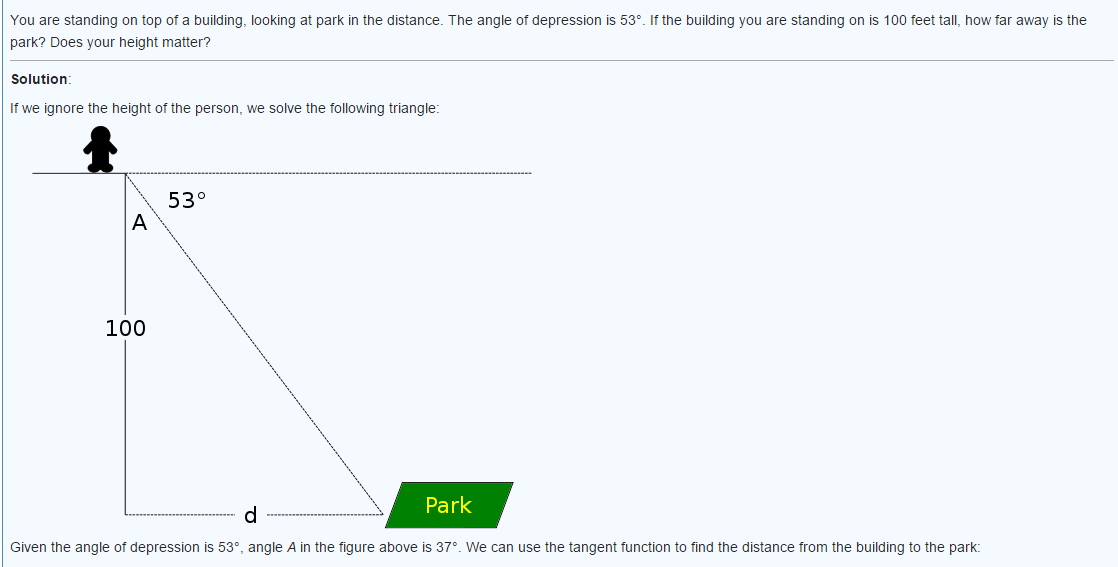
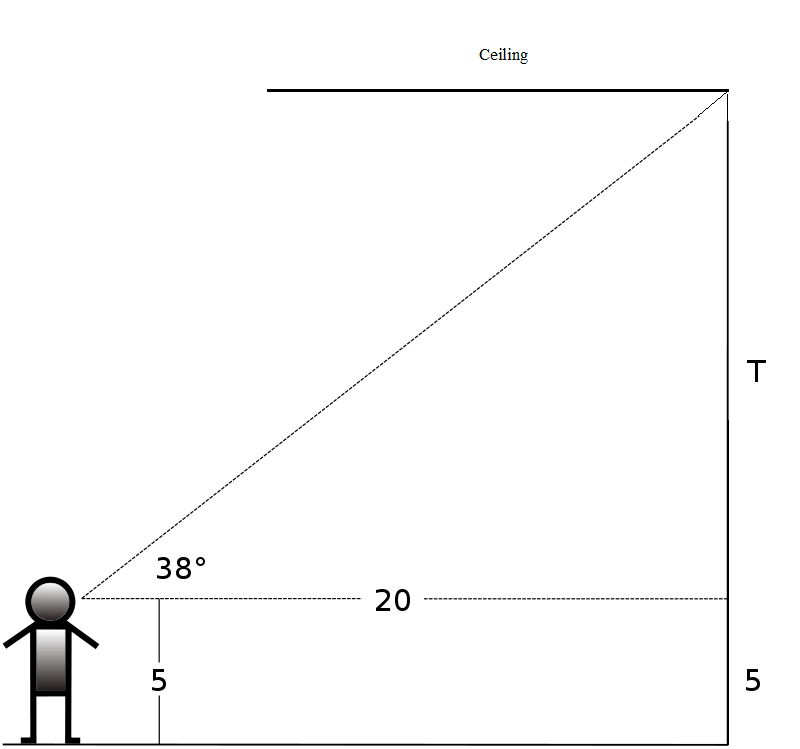
There are many real world applications that involve in this topic and I will incorporate some problems in real life to engage the students.  Suppose I have a classroom that has the shape of rectangular prism.  I will begin my lesson by challenging the students to find the height of the classroom and of course I will award them with something cool.  I believe this will ignite students’ curiosity and excitement to participate into the problem.  In the process of finding the height, I will gradually introduce the concept of right triangle trigonometry.  The students will learn the relationship of ratios of the sides in the triangle.  Eventually, the students will realize that they need this concept for finding the height of the classroom.  I will pose some guiding questions to drive them toward the solution.  Such questions could be: what can I measure? Can we measure the angle from our eyes to the opposite corner of the ceiling point?   What formula will help me to find the height?
trig1


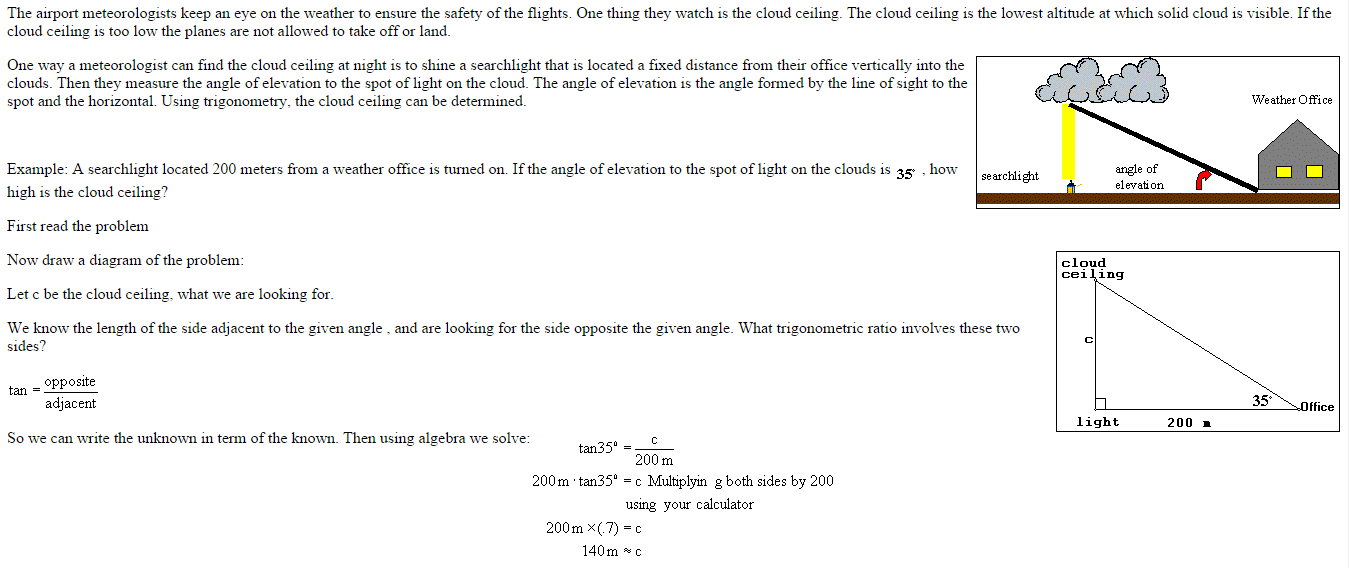
After this problem I will provide them many different real world problems to practice such as:

trig2 trig3


green line

How can this topic be used in your students’ future courses in mathematics or science?

Knowing how to compute sine, cosine or tangent in the right triangle will help students a lot when they get to higher level math or other science class, especially Physics.  In higher level math, students will always have the chance to encounter this concept.  For example, in Pre-Calculus, the students will likely learn about polar system.  This requires students to have the strong fundamental understandings of sine, cosine and tangent in a right triangle.  Students will be asked to convert from the Cartesian system to polar system, or vice versa.  If they do not grasp the ideas of this topic, they will eventually encounter huge obstacles in future.  In science, especially physics, the students will learn a lot about the motions of an objects.  This will involve concepts of force, velocity, speed, momentum.  The students will need to understand the how to compute sine, cosine and tangent in the right triangle so that they can easily know how to approach the problems in physics.

green line

How can technology (YouTube, Khan Academy [khanacademy.org], Vi Hart, Geometers Sketchpad, graphing calculators, etc.) be used to effectively engage students with this topic?

This website, https://www.geogebra.org/material/simple/id/48148 , can be a great tool for the students to understand the relationships of the sides in the right triangle.  The website creates an activity for students to explore the ratios of the sides such as AC/BC, AC/AB, and BC/AB.  The students will observe the changes of the ratios based on the changes of theta and side BC which is the hypotenuse.  At this point, the students will be introduced the name of each side of the right triangle which corresponds to theta such as opposite, adjacent and hypotenuse.  This activity allows the students to visualize what happens to the triangle when we change the angle or its side lengths.  The students will then explore the activity to find interesting facts about the side ratios.  I will pose some questions to help the students understand the relationships of side ratios. Such questions could be:  What type of triangle is it?  Tell me how the triangle changes as we change the hypotenuse or angle.  If we know one side length and the angle, how can we find the other side lengths?  Those questions allow me to introduce the terms sine, cosine, and tangent in the right triangle.

trig4

References

https://en.wikibooks.org/wiki/High_School_Trigonometry/Applications_of_Right_Triangle_Trigonometry

https://www.geogebra.org/material/simple/id/48148


My Mathematical Magic Show: Index

I’m doing something that I should have done a long time ago: collecting a series of posts into one single post. Here’s my series on the mathematical magic show that I’ll perform from time to time.

Part 1: Introduction.

Part 2a, 2b, and 2c: The 1089 trick.

Part 3a, 3b, and 3c: A geometric magic trick (see also here).

Part 4a, 4b, 4c, and 4d: A trick using binary numbers.

Part 5a, 5b, 5c, 5d: Predicting a digit that’s been erased from a number.

Part 6: Finale.

Part 7: The Fitch-Cheney 5-card trick.

Part 8a, 8b, 8c: A trick using Pascal’s triangle.


Fun With Permutations and Asimov’s Three Laws of Robotics

I’m not a big fan of science fiction, but I know enough to know that Isaac Asimov was one of the great science fiction novelists of the 20th century. The following was written by him in the October 1980 issue of The Magazine of Fantasy and Science Fiction and was reprinted in his book Counting the Eons, which was published in 1983. (I’m now holding the battered and torn pages of my copy of this book; I devoured Asimov’s musings on mathematics and science when I was young.)

Robotics has become a sufficiently well development technology to warrant articles and books on its history and I have watched this in amazement, and in some disbelief, because I invented it.

No, not the technology, the word.

In October 1941, I wrote a robot story entitled “Runaround,” first published in the March 1942 issue of Astounding Science Fiction, in which I recited, for the first time, my Three Laws of Robotics. Here they are:

  1. A robot must not injure a human being or, through inaction, allow a human being to come to harm.
  2. A robot must obey the orders give it by human beings except where those orders would conflict with the First Law.
  3. A robot must protect its own existence, except where such protection would conflict with the First or Second Laws.

Clearly, the order in which the Three Laws of Robotics matters. Shuffling the order leads to 3! = 6 possible permutations, and xkcd recently had some fun about what the consequences would be of those permutations.
Source: http://www.xkcd.com/1613/

SOHCAHTOA

Years ago, when I first taught Precalculus at the college level, I was starting a section on trigonometry by reminding my students of the acronym SOHCAHTOA for keeping the trig functions straight:

\sin \theta = \displaystyle \frac{\hbox{Opposite}}{\hbox{Hypotenuse}},

\cos \theta = \displaystyle \frac{\hbox{Adjacent}}{\hbox{Hypotenuse}},

\tan \theta = \displaystyle \frac{\hbox{Opposite}}{\hbox{Adjacent}}.

At this point, one of my students volunteered that a previous math teacher had taught her an acrostic to keep these straight: Some Old Hippie Caught Another Hippie Tripping On Acid.

Needless to say, I’ve been passing this pearl of wisdom on to my students ever since.