How I Impressed My Wife: Part 2c

Some husbands try to impress their wives by lifting extremely heavy objects or other extraordinary feats of physical prowess.

That will never happen in the Quintanilla household in a million years.

But she was impressed that I broke an impasse in her research and resolved a discrepancy between Mathematica 4 and Mathematica 8 by finding the following integral by hand in less than an hour:

Q = \displaystyle \int_0^{2\pi} \frac{dx}{\cos^2 x + 2 a \sin x \cos x + (a^2 + b^2) \sin^2 x}

In this series, I’ll explore different ways of evaluating this integral.green lineSo far in this series, I’ve shown that

Q = 2 \displaystyle \int_{-\pi/2}^{\pi/2} \frac{dx}{\cos^2 x + 2 a \sin x \cos x + (a^2 + b^2) \sin^2 x}

= 2 \displaystyle \int_{-\pi/2}^{\pi/2} \frac{\sec^2 x dx}{1 + 2 a \tan x + (a^2 + b^2) \tan^2 x}

I now employ the substitution u = \tan x, so that du = \sec^2 x dx. Also, the endpoints change from -\pi/2 < x < \pi/2 to -\infty < u < \infty, so that

Q = 2 \displaystyle \int_{-\infty}^{\infty} \frac{du}{1 + 2 a u + (a^2+b^2) u^2}

green line

I’ll continue with the evaluation of this integral in tomorrow’s post.

Inverse Functions: Arcsecant (Part 29)

We now turn to a little-taught and perhaps controversial inverse function: arcsecant. As we’ve seen throughout this series, the domain of this inverse function must be chosen so that the graph of y = \sec x satisfies the horizontal line test. It turns out that the choice of domain has surprising consequences that are almost unforeseeable using only the tools of Precalculus.

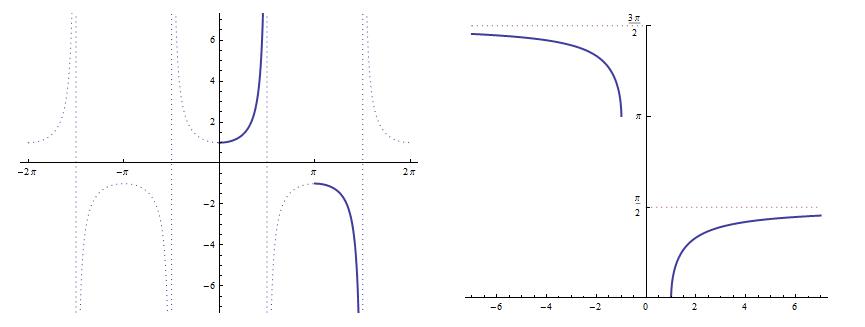
The standard definition of y = \sec^{-1} x uses the interval [0,\pi] — or, more precisely, [0,\pi/2) \cup (\pi/2, \pi] to avoid the vertical asymptote at x = \pi/2 — in order to approximately match the range of \cos^{-1} x. However, when I was a student, I distinctly remember that my textbook chose [0,\pi/2) \cup [\pi,3\pi/2) as the range for \sec^{-1} x.

I believe that this definition has fallen out of favor today. However, for the purpose of today’s post, let’s just run with this definition and see what happens. This portion of the graph of y = \sec x is perhaps unorthodox, but it satisfies the horizontal line test so that the inverse function can be defined.

arcsec3

Let’s fast-forward a couple of semesters and use implicit differentiation (see also https://meangreenmath.com/2014/08/08/different-definitions-of-logarithm-part-8/ for how this same logic is used for other inverse functions) to find the derivative of y = \sec^{-1} x:

x = \sec y

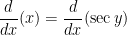
\displaystyle \frac{d}{dx} (x) = \displaystyle \frac{d}{dx} (\sec y)

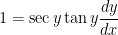
1 = \sec y \tan y \displaystyle \frac{dy}{dx}

\displaystyle \frac{1}{\sec y \tan y} = \displaystyle \frac{dy}{dx}

 At this point, the object is to convert the left-hand side to something involving only x. Clearly, we can replace \sec y with x. As it turns out, the replacement of \tan y is a lot simpler than we saw in yesterday’s post. Once again, we begin with one of the Pythagorean identities:

1 + \tan^2 y = \sec^2 y

\tan^2 y = \sec^2 y - 1

\tan^2 y = x^2 - 1

\tan y = \sqrt{x^2 - 1} \qquad \hbox{or} \tan y = -\sqrt{x^2 - 1}

So which is it, the positive answer or the negative answer? In yesterday’s post, the answer depended on whether x was positive or negative. However, with the current definition of \sec^{-1} x, we know for certain that the answer is the positive one! How can we be certain? The angle y must lie in either the interval [0,\pi/2) or else the interval [\pi,3\pi/2). In either interval, \tan y is positive. So, using this definition of \sec^{-1} x, we can simply say that

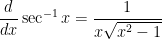
\displaystyle \frac{d}{dx} \sec^{-1} x = \displaystyle \frac{1}{x \sqrt{x^2-1}},

and we don’t have to worry about |x| that appeared in yesterday’s post.

green line

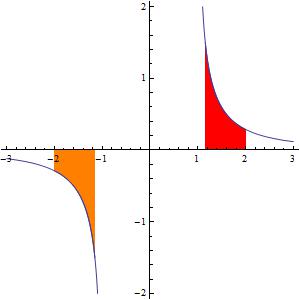
arcsec2Turning to integration, we now have the simple formula

\displaystyle \int \frac{dx}{x \sqrt{x^2 -1}} = \sec^{-1} x + C

that works whether x is positive or negative. For example, the orange area can now be calculated correctly:

\displaystyle \int_{-2}^{-2\sqrt{3}/3} \frac{dx}{x \sqrt{x^2 -1}} = \sec^{-1} \left( - \displaystyle \frac{2\sqrt{3}}{3} \right) - \sec^{-1} (-2)

= \displaystyle \frac{7\pi}{6} - \frac{4\pi}{3}

= \displaystyle -\frac{\pi}{6}

So, unlike yesterday’s post, this definition of \sec^{-1} x produces a simple integration formula.

green line

So why isn’t this the standard definition for \sec^{-1} x? I’m afraid the answer is simple: with this definition, the equation

\sec^{-1} x = \cos^{-1} \left( \displaystyle \frac{1}{x} \right)

is no longer correct if x < -1. Indeed, I distinctly remember thinking, back when I was a student taking trigonometry, that the definition of \sec^{-1} x seemed really odd, and it seemed to me that it would be better if it matched that of \cos^{-1} x. Of course, at that time in my mathematical development, it would have been almost hopeless to explain that the range [0,\pi/2) \cup [\pi,3\pi/2) had been chosen to simplify certain integrals from calculus.

So I suppose that The Powers That Be have decided that it’s more important for this identity to hold than to have a simple integration formula for \displaystyle \int \frac{dx}{x \sqrt{x^2 -1}}

Inverse Functions: Arcsecant (Part 28)

We now turn to a little-taught and perhaps controversial inverse function: arcsecant. As we’ve seen throughout this series, the domain of this inverse function must be chosen so that the graph of y = \sec x satisfies the horizontal line test. It turns out that the choice of domain has surprising consequences that are almost unforeseeable using only the tools of Precalculus.

The standard definition of y = \sec^{-1} x uses the interval [0,\pi], so that

\sec^{-1} x = \cos^{-1} \left( \displaystyle \frac{1}{x} \right)

Why would this be controversial? Yesterday, we saw that \tan x is both positive and negative on the interval [0,\pi], and so great care has to be used to calculate the integral:

\displaystyle \int \frac{dx}{x \sqrt{x^2 -1}}

Here’s another example: let’s use trigonometric substitution to calculate

\displaystyle \int_{-6}^{-3} \frac{ \sqrt{x^2-9} }{x} dx

The standard trick is to use the substitution x = 3 \sec \theta. With this substitution:

  • x^2 - 9 = 9 \sec^2 \theta - 9 = 9 \tan^2 \theta, and
  • dx = 3 \sec \theta \tan \theta \, d\theta
  • x = -3 \quad \Longrightarrow \quad \sec \theta = -1 \quad \Longrightarrow \quad \theta = \sec^{-1} (-1) = \pi
  • x = -6 \quad \Longrightarrow \quad \sec \theta = -2 \quad \Longrightarrow \quad \theta = \sec^{-1} (-2) = \displaystyle \frac{2\pi}{3}

Therefore,

\displaystyle \int_{-6}^{-3} \frac{ \sqrt{x^2-9} }{x} dx = \displaystyle \int_{2\pi/3}^{\pi} \frac{ \sqrt{9 \tan^2 \theta}} { 3 \sec \theta} 3 \sec \theta \tan \theta \, d\theta

At this point, the common mistake would be to replace \sqrt{9 \tan^2 \theta} with 3 \tan \theta. This is a mistake because

\sqrt{9 \tan^2 \theta} = |3 \tan \theta|

Furthermore, for this particular problem, \tan \theta is negative on the interval [2\pi/3,\pi]. Therefore, for this problem, we should replace \sqrt{9 \tan^2 \theta} with -3 \tan \theta.

Continuing the calculation,

\displaystyle \int_{-6}^{-3} \frac{ \sqrt{x^2-9} }{x} dx = \displaystyle \int_{2\pi/3}^{\pi} \frac{ -3 \tan \theta} { 3 \sec \theta} 3 \sec \theta \tan \theta

= \displaystyle \int_{2\pi/3}^{\pi} -3\tan^2 \theta \, d\theta

= \displaystyle \int_{2\pi/3}^{\pi} -3(\sec^2 \theta-1) \, d\theta

= \displaystyle \int_{2\pi/3}^{\pi} (3-3 \sec^2 \theta) \, d\theta

= \displaystyle \bigg[ 3 \theta - 3 \tan \theta \bigg]_{2\pi/3}^{\pi}

= \displaystyle \left[ 3 \pi - 3 \tan \pi \right] - \left[ 3 \left( \frac{2\pi}{3} \right) - 3 \tan \left( \frac{2\pi}{3} \right) \right]

= \displaystyle 3\pi - 0 - 2\pi + 3(-\sqrt{3})

= \pi - 3\sqrt{3}

So if great care wasn’t used to correctly simplify \sqrt{9 \tan^2 \theta}, one would instead obtain the incorrect answer 3\sqrt{3} - \pi.

Inverse Functions: Arcsecant (Part 27)

We now turn to a little-taught and perhaps controversial inverse function: arcsecant. As we’ve seen throughout this series, the domain of this inverse function must be chosen so that the graph of y = \sec x satisfies the horizontal line test. It turns out that the choice of domain has surprising consequences that are almost unforeseeable using only the tools of Precalculus.

The standard definition of y = \sec^{-1} x uses the interval [0,\pi], so that

\sec^{-1} x = \cos^{-1} \left( \displaystyle \frac{1}{x} \right)

Why would this be controversial? Let’s fast-forward a couple of semesters and use implicit differentiation (see also https://meangreenmath.com/2014/08/08/different-definitions-of-logarithm-part-8/ for how this same logic is used for other inverse functions) to find the derivative of y = \sec^{-1} x:

x = \sec y

\displaystyle \frac{d}{dx} (x) = \displaystyle \frac{d}{dx} (\sec y)

1 = \sec y \tan y \displaystyle \frac{dy}{dx}

\displaystyle \frac{1}{\sec y \tan y} = \displaystyle \frac{dy}{dx}

 At this point, the object is to convert the left-hand side to something involving only x. Clearly, we can replace \sec y with x. However, doing the same with \tan y is trickier. We begin with one of the Pythagorean identities:

1 + \tan^2 y = \sec^2 y

\tan^2 y = \sec^2 y - 1

\tan^2 y = x^2 - 1

\tan y = \sqrt{x^2 - 1} \qquad \hbox{or} \tan y = -\sqrt{x^2 - 1}

So which is it, the positive answer or the negative answer? The answer is, without additional information, we don’t know!

  • If 0 \le y < \pi/2 (so that x = \sec y \ge 1), then \tan y is positive, and so \tan y = \sqrt{\sec^2 y - 1}.
  • If \pi/2 < y \le \pi (so that x = \sec y \le 1), then \tan y is negative, and so \tan y = -\sqrt{\sec^2 y - 1}.

We therefore have two formulas for the derivative of y = \sec^{-1} x:

\displaystyle \frac{d}{dx} sec^{-1} x = \displaystyle \frac{1}{x \sqrt{x^2-1}} \qquad \hbox{if} \qquad x > 1

\displaystyle \frac{d}{dx} sec^{-1} x = \displaystyle -\frac{1}{x \sqrt{x^2-1}} \qquad \hbox{if} \qquad x < 1

These may then be combined into the single formula

\displaystyle \frac{d}{dx} sec^{-1} x = \displaystyle \frac{1}{|x| \sqrt{x^2-1}}

green lineIt gets better. Let’s now find the integral

\displaystyle \int \frac{dx}{x \sqrt{x^2 -1}}

arcsec2

Several calculus textbooks that I’ve seen will lazily give the answer

\displaystyle \int \frac{dx}{x \sqrt{x^2 -1}} = \sec^{-1} x + C

This answer works as long as x > 1, so that |x| reduces to simply x. For example, the red signed area in the above picture on the interval [2\sqrt{3}/3,2] may be correctly computed as

\displaystyle \int_{2\sqrt{3}/3}^2 \frac{dx}{x \sqrt{x^2 -1}} = \sec^{-1} 2 - \sec^{-1} \displaystyle \frac{2\sqrt{3}}{3}

= \cos^{-1} \left( \displaystyle \frac{1}{2} \right) - \cos^{-1} \left( \displaystyle \frac{\sqrt{3}}{2} \right)

= \displaystyle \frac{\pi}{3} - \frac{\pi}{6}

= \displaystyle \frac{\pi}{6}

However, the orange signed area on the interval [-2,-2\sqrt{3}/3]  is incorrectly computed using this formula!

\displaystyle \int_{-2}^{-2\sqrt{3}/3} \frac{dx}{x \sqrt{x^2 -1}} = \sec^{-1} \left( - \displaystyle \frac{2\sqrt{3}}{3} \right) - \sec^{-1} (-2)

= \cos^{-1} \left( -\displaystyle \frac{\sqrt{3}}{2} \right) -\cos^{-1} \left( \displaystyle \frac{1}{2} \right)

= \displaystyle \frac{5\pi}{6} - \frac{2\pi}{3}

= \displaystyle \frac{\pi}{6}

This is patently false, as the picture clearly indicates that the above integral has to be negative. For this reason, careful calculus textbooks will often ask students to solve a problem like

\displaystyle \int \frac{dx}{x \sqrt{x^2 -1}}, \qquad x > 1

and the caveat x > 1 is needed to ensure that the correct antiderivative is used. Indeed, a calculus textbook that doesn’t include such caveats are worthy of any scorn that an instructor cares to heap upon it.

Inverse Functions: Arcsecant (Part 26)

We now turn to a little-taught and perhaps controversial inverse function: arcsecant. As we’ve seen throughout this series, the domain of this inverse function must be chosen so that the graph of y = \sec x satisfies the horizontal line test. It turns out that the choice of domain has surprising consequences that are almost unforeseeable using only the tools of Precalculus.

The standard definition of y = \sec^{-1} x uses the interval [0,\pi] — or, more precisely, [0,\pi/2) \cup (\pi/2, \pi] to avoid the vertical asymptote at x = \pi/2. This portion of the graph of y = \sec x satisfies the horizontal line test and, conveniently, matches almost perfectly the domain of y = \cos^{-1} x. This is perhaps not surprising since, when both are defined, \cos x and \sec x are reciprocals.

arcsec1


Since this range of \sec^{-1} x matches that of \cos^{-1} x, we have the convenient identity

\sec^{-1} x = \cos^{-1} \left( \displaystyle \frac{1}{x} \right)

To see why this works, let’s examine the right triangle below. Notice that

\cos \theta = \displaystyle \frac{x}{1} \qquad \Longrightarrow \qquad \theta = \cos^{-1} x.

Also,

\sec\theta = \displaystyle \frac{1}{x} \qquad \Longrightarrow \qquad \theta = \cos^{-1} \left( \displaystyle \frac{1}{x} \right).

This argument provides the justification for 0 < \theta < \pi/2 — that is, for x > 1 — but it still works for x = 1 and x \le -1.

So this seems like the most natural definition in the world for \sec^{-1} x. Unfortunately, there are consequences for this choice in calculus, as we’ll see in tomorrow’s post.

Inverse Functions: Arctangent and Angle Between Two Lines (Part 25)

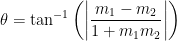
The smallest angle between the non-perpendicular lines y = m_1 x + b_1 and y = m_1 x + b_2 can be found using the formula

\theta = \displaystyle \tan^{-1} \left( \left| \frac{m_1 - m_2}{1 + m_1 m_2} \right| \right).

A generation ago, this formula used to be taught in a typical Precalculus class (or, as it was called back then, analytical geometry). However, I find that analytic geometry has fallen out of favor in modern Precalculus courses.

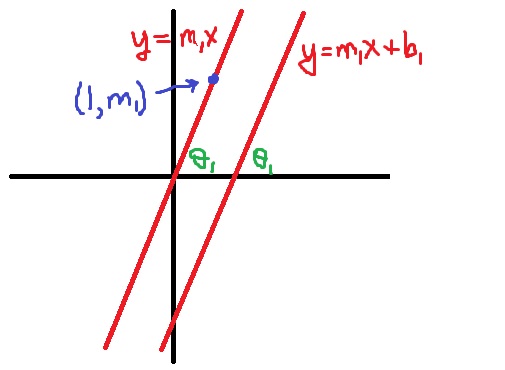
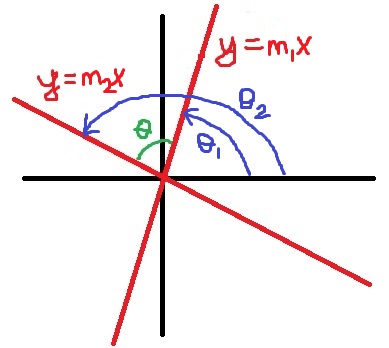
Why does this formula work? Consider the graphs of y = m_1 x and y = m_1 x + b_1, and let’s measure the angle that the line makes with the positive x-axis.

dotproduct5The lines y = m_1 x + b_1 and y = m_1 x are parallel, and the x-axis is a transversal intersecting these two parallel lines. Therefore, the angles that both lines make with the positive x-axis are congruent. In other words, the + b_1 is entirely superfluous to finding the angle \theta_1. The important thing that matters is the slope of the line, not where the line intersects the y-axis.

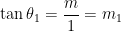
The point (1, m_1) lies on the line y = m_1 x, which also passes through the origin. By definition of tangent, \tan \theta_1 can be found by dividing the y- and x-coordinates:

\tan \theta_1 = \displaystyle \frac{m}{1} = m_1.

green linedotproduct6


We now turn to the problem of finding the angle between two lines. As noted above, the y-intercepts do not matter, and so we only need to find the smallest angle between the lines y = m_1 x and y = m_2 x.

The angle \theta will either be equal to \theta_1 - \theta_2 or \theta_2 - \theta_1, depending on the values of m_1 and m_2. Let’s now compute both \tan (\theta_1 - \theta_2) and \tan (\theta_2 - \theta_1) using the formula for the difference of two angles:

\tan (\theta_1 - \theta_2) = \displaystyle \frac{\tan \theta_1 - \tan \theta_2}{1 + \tan \theta_1 \tan \theta_2}

\tan (\theta_2 - \theta_1) = \displaystyle \frac{\tan \theta_2 - \tan \theta_1}{1 + \tan \theta_2 \tan \theta_1}

Since the smallest angle \theta must lie between 0 and \pi/2, the value of \tan \theta must be positive (or undefined if \theta = \pi/2… for now, we’ll ignore this special case). Therefore, whichever of the above two lines holds, it must be that
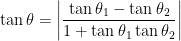
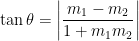
\tan \theta = \displaystyle \left| \frac{\tan \theta_1 - \tan \theta_2}{1 + \tan \theta_1 \tan \theta_2} \right|

We now use the fact that m_1 = \tan \theta_1 and m_2 = \tan \theta_2:

\tan \theta = \displaystyle \left| \frac{m_1 - m_2}{1 + m_1 m_2} \right|

\theta = \tan^{-1} \left( \displaystyle \left| \frac{m_1 - m_2}{1 + m_1 m_2} \right| \right)

green line

The above formula only applies to non-perpendicular lines. However, the perpendicular case may be remembered as almost a special case of the above formula. After all, \tan \theta is undefined at \theta = \pi/2 = 90^\circ, and the right hand side is also undefined if 1 + m_1 m_2 = 0. This matches the theorem that the two lines are perpendicular if and only if m_1 m_2 = -1, or that the slopes of the two lines are negative reciprocals.

Inverse Functions: Arctangent and Angle Between Two Lines (Part 24)

Here’s a straightforward application of arctangent that, a generation ago, used to be taught in a typical Precalculus class (or, as it was called back then, analytical geometry).

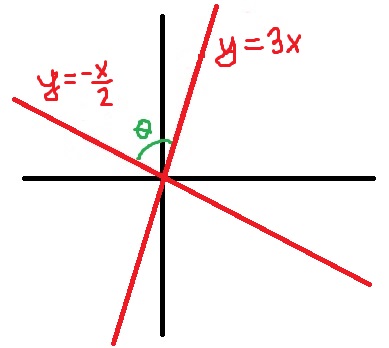
Find the smallest angle between the lines y= 3x and y = -x/2.

dotproduct3

This problem is almost equivalent to finding the angle between the vectors \langle 1,3 \rangle and \langle -2,1 \rangle. I use the caveat almost because the angle between two vectors could be between 0 and \pi, while the smallest angle between two lines must lie between 0 and \pi/2.

This smallest angle can be found using the formula

\theta = \displaystyle \tan^{-1} \left( \left| \frac{m_1 - m_2}{1 + m_1 m_2} \right| \right),

where m_1 and m_2 are the slopes of the two lines. In the present case,

\theta = \tan^{-1} \left( \left| \displaystyle \frac{ 3 - (-1/2) }{1 + (3)(-1/2)} \right| \right)

\theta = \tan^{-1} \left( \left| \displaystyle \frac{7/2}{-1/2} \right| \right)

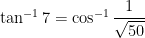
\theta = \tan^{-1} 7

\theta \approx 81.87^\circ.

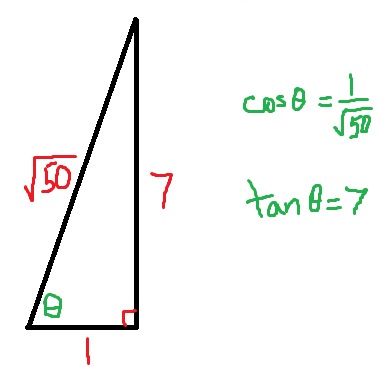
Not surprisingly, we obtain the same answer that we obtained a couple of posts ago using arccosine. The following picture makes clear why \tan^{-1} 7 = \cos^{-1} \displaystyle \frac{1}{\sqrt{50}}.

dotproduct4In tomorrow’s post, I’ll explain why the above formula actually works.


Inverse Functions: Arccosine and Arctangent (Part 18)

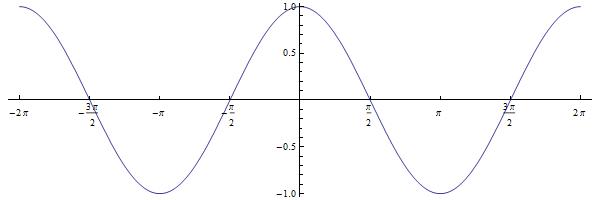
In this series, we’ve seen that the inverse of function that fails the horizontal line test can be defined by appropriately restricting the domain of the function. For example, we now look at the graph of y = \cos x:

cos1As with the graph of y = \sin x, we select a section that satisfies the horizontal line test and ignore the rest of the graph. (I described this in more rigorous terms when I considered arcsine, so I will not repeat the rigor here.) There are plenty of choices that could be made; by tradition, the interval [0,\pi] is chosen.
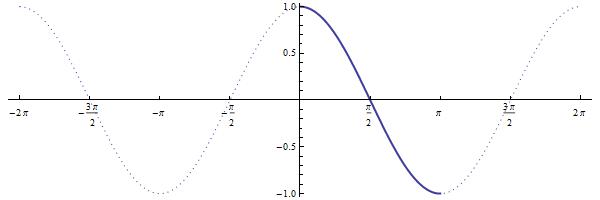
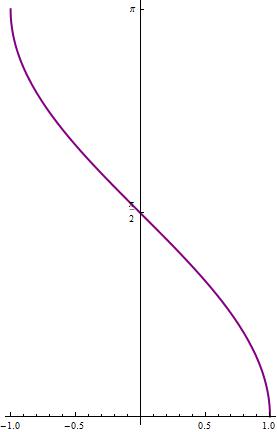
cos2Reflecting only the half-wave of the cosine graph on the interval [0,\pi] through the line y = x produces the graph of y= \cos^{-1} x. Again, to assist my students when graphing this function, I point out that the graph of cosine has horizontal tangent lines at the points (0,1) and (\pi,-1). Therefore, after reflecting through the line y = x, we see that the graph of \cos^{-1} x has vertical tangent lines at (1,0) and (-1,\pi).

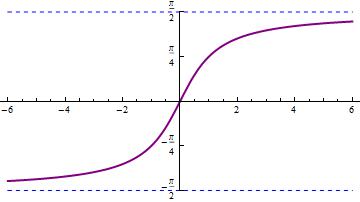
cos3green lineThe same logic applies when defining the arctangent function. By tradition, the interval (-\pi/2,\pi/2) is chosen as the section of the graph of y = \tan x that satisfies the horizontal line test.
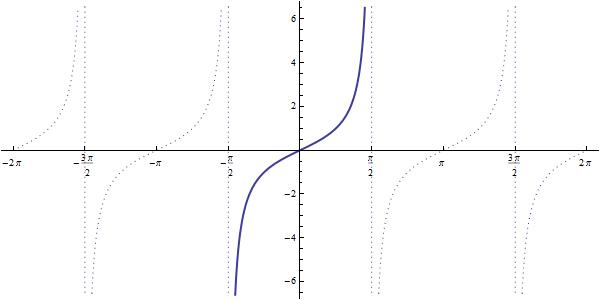
tan1Reflecting only the half-wave of the cosine graph on the interval [0,\pi] through the line y = x produces the graph of y= \tan^{-1} x. Like the (more complicated) logistic growth function, this function has two different horizontal asymptotes that govern the behavior of the function as x \to \pm \infty.

tan2green line

So here are the rules that I want my Precalculus students to memorize:

y = \sin^{-1} x means that x = \sin y and \displaystyle -\frac{\pi}{2} \le y \le \displaystyle \frac{\pi}{2}

y = \cos^{-1} x means that x = \cos y and 0 \le y \le \pi

y = \sin^{-1} x means that x = \sin y and \displaystyle -\frac{\pi}{2} < y < \displaystyle \frac{\pi}{2}

Students using forget that the range of arccosine is different than the other two, and I’ll usually have to produce the graph of y = \cos x to explain and re-explain why this one is different.

Because these functions are defined on restricted domains, the usual funny things can happen. For example,

\cos^{-1} (\cos 2\pi) = \cos^{-1} 1 = 0 \ne 2 \pi

\tan^{-1} \left( \tan \displaystyle \frac{3\pi}{4} \right) = \tan^{-1} (-1) = -\displaystyle \frac{\pi}{4} \ne \displaystyle \frac{3\pi}{4}


Is there an easy function without an easy Taylor series expansion?

After class one day, a student approached me with an interesting question:

Is there an easy function without an easy Taylor expansion?

This question really struck me for several reasons.

  1. Most functions do not have an easy Taylor (or Maclaurin) expansion. After all, the formula for a Taylor expansion involves the nth derivative of the original function, and higher-order derivatives usually get progressively messier with each successive differentiation.
  2. Most of the series expansions that are taught in Calculus II arise from functions that somehow violate the above rule, like f(x) = \sin x, f(x) = \cos x, f(x) = e^x, and f(x) = 1/(1-x).
  3. Therefore, this student was under the misconception that most easy functions have easy Taylor expansions, while in reality most functions do not.

It took me a moment to answer his question, but I answered with f(x) = tan x. Successively using the Quotient Rule makes the derivatives of tan x messier and messier, but tan x definitely qualifies as an easy function that most students have seen since high school. It turns out that the Taylor expansion of f(x) = \sin x can be written as an infinite series using the Bernoulli numbers, but that’s a concept that most calculus students haven’t seen yet.

Earlier posts on Taylor series:

https://meangreenmath.com/2013/07/01/reminding-students-about-taylor-series-part-1/

https://meangreenmath.com/2013/07/02/reminding-students-about-taylor-series-part-2/

https://meangreenmath.com/2013/07/03/giving-students-a-refresher-about-taylor-series-part-3/

https://meangreenmath.com/2013/07/04/giving-students-a-refresher-about-taylor-series-part-4/

https://meangreenmath.com/2013/07/05/reminding-students-about-taylor-series-part-5/

https://meangreenmath.com/2013/07/06/reminding-students-about-taylor-series-part-6/

https://meangreenmath.com/2013/07/24/taylor-series-without-calculus-2/

Why do we still require students to rationalize denominators?

Which answer is simplified: \displaystyle \frac{1}{2 \sqrt{2}} or \displaystyle \frac{ \sqrt{2} }{4}? From example, here’s a simple problem from trigonometry:

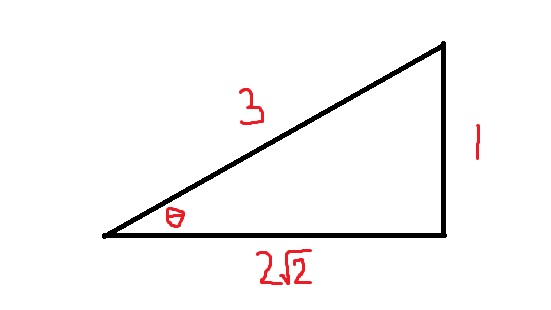
Suppose \theta is an acute angle so that \sin \theta = \displaystyle \frac{1}{3}. Find \tan \theta.

triangle13

To solve, we make a right triangle whose side opposite of \theta has length 1 and hypotenuse with length 3. The adjacent side has length \sqrt{3^2 - 1^2} = \sqrt{8} = 2\sqrt{2}. Therefore,

\tan \theta = \displaystyle \frac{ \hbox{Opposite} }{ \hbox{Adjacent} } = \displaystyle \frac{1}{2 \sqrt{2}}

This is the correct answer, and it could be plugged into a calculator to obtain a decimal approximation. However, in my experience, it seems that most students are taught that this answer is not yet simplified, and that they must rationalize the denominator to get the “correct” answer:

\tan \theta = \displaystyle \frac{1}{2 \sqrt{2}} \cdot \frac{ \sqrt{2} }{ \sqrt{2} } = \displaystyle \frac{ \sqrt{2} }{4}

Of course, this is equivalent to the first answer. So my question is philosophical: why are students taught that the first answer isn’t simplified but the second is? Stated another way, why is a square root in the numerator so much more preferable than a square root in the denominator?

Feel free to correct me if I’m wrong, but it seems to me that rationalizing denominators is a vestige of an era before cheap pocket calculators. Let’s go back in time to an era before pocket calculators… say, 1927, when The Jazz Singer was just released and stars of silent films, like Don Lockwood, were trying to figure out how to act in a talking movie.

Before cheap pocket calculators, how would someone find \displaystyle \frac{1}{2 \sqrt{2}} ~~ or ~~ \displaystyle \frac{ \sqrt{2} }{4} to nine decimal places? Clearly, the first step is finding \sqrt{2} by hand, which I discussed in a previous post. So these expressions reduce to

\displaystyle \frac{1}{2 (1.41421356\dots)} or \displaystyle \frac{1.41421356\dots}{4}

Next comes the step of dividing. If you don’t have a calculator and had to use long division, which would rather do: divide by 4 or divide by 2.82842712\dots?

Clearly, long division with 4 is easier.

It seems to me that ease of computation was the reason that rationalizing denominators was required of students in previous generations. So I’m a little bemused why rationalizing denominators is still required of students now that cheap calculators are so prevalent.

Lest I be misunderstood, I absolutely believe that all students should be able to convert \displaystyle \frac{1}{2 \sqrt{2}} into \displaystyle \frac{ \sqrt{2} }{4}. But I see no compelling reason why the “simplified” answer to the above trigonometry problem should be the second answer and not the first.