Let be the proposition “Blue is your color.” Translate the logical statement
.
This is the (grammatically incorrect) title of a recent popular country song by Keith Urban.
Context: Part of the discrete mathematics course includes an introduction to predicate and propositional logic for our math majors. As you can probably guess from their names, students tend to think these concepts are dry and uninteresting even though they’re very important for their development as math majors.
In an effort to making these topics more appealing, I spent a few days mining the depths of popular culture in a (likely futile) attempt to make these ideas more interesting to my students. In this series, I’d like to share what I found. Naturally, the sources that I found have varying levels of complexity, which is appropriate for students who are first learning prepositional and predicate logic.
When I actually presented these in class, I either presented the logical statement and had my class guess the statement in actual English, or I gave my students the famous quote and them translate it into predicate logic. However, for the purposes of this series, I’ll just present the statement in predicate logic first.
Let be the proposition “ trusts at time ,” let be the proposition “ is on Earth at time ,” and let be the proposition “ is a fish.” Translate the logical statement
.
This matches one of the King’s laments about how to rule wisely in The King and I.
Context: Part of the discrete mathematics course includes an introduction to predicate and propositional logic for our math majors. As you can probably guess from their names, students tend to think these concepts are dry and uninteresting even though they’re very important for their development as math majors.
In an effort to making these topics more appealing, I spent a few days mining the depths of popular culture in a (likely futile) attempt to make these ideas more interesting to my students. In this series, I’d like to share what I found. Naturally, the sources that I found have varying levels of complexity, which is appropriate for students who are first learning prepositional and predicate logic.
When I actually presented these in class, I either presented the logical statement and had my class guess the statement in actual English, or I gave my students the famous quote and them translate it into predicate logic. However, for the purposes of this series, I’ll just present the statement in predicate logic first.
Let be the proposition “ is legal in New Jersey.” Translate the logical statement
.
This translates as “Everything is legal in New Jersey,” one of the running gags in the hit musical Hamilton.
Context: Part of the discrete mathematics course includes an introduction to predicate and propositional logic for our math majors. As you can probably guess from their names, students tend to think these concepts are dry and uninteresting even though they’re very important for their development as math majors.
In an effort to making these topics more appealing, I spent a few days mining the depths of popular culture in a (likely futile) attempt to make these ideas more interesting to my students. In this series, I’d like to share what I found. Naturally, the sources that I found have varying levels of complexity, which is appropriate for students who are first learning prepositional and predicate logic.
When I actually presented these in class, I either presented the logical statement and had my class guess the statement in actual English, or I gave my students the famous quote and them translate it into predicate logic. However, for the purposes of this series, I’ll just present the statement in predicate logic first.
Let be the proposition “You walk with at time .” Translate the logical statement
.
The straightforward way of translating this into English is, “If you stand for nothing, then you’ll fall for anything,” one of the motifs (with a slightly different wording) of the hit musical Hamilton.
Context: I recently taught discrete mathematics for the first time. Part of the discrete mathematics course includes an introduction to predicate and propositional logic for our math majors. As you can probably guess from their names, students tend to think these concepts are dry and uninteresting even though they’re very important for their development as math majors.
In an effort to making these topics more appealing, I spent a few days mining the depths of popular culture in a (likely futile) attempt to make these ideas more interesting to my students. In this series, I’d like to share what I found. Naturally, the sources that I found have varying levels of complexity, which is appropriate for students who are first learning prepositional and predicate logic.
When I actually presented these in class, I either presented the logical statement and had my class guess the statement in actual English, or I gave my students the famous quote and them translate it into predicate logic. However, for the purposes of this series, I’ll just present the statement in predicate logic first.
Let be the proposition “ is a man,” let be the proposition “ is with you,” and let be the proposition “I knew .” Translate the logical statement
.
This matches the chorus of “Do Wot You Do” by INXS, which also was on one of the all-time best movie soundtracks.
Context: This semester, I taught discrete mathematics for the first time. Part of the discrete mathematics course includes an introduction to predicate and propositional logic for our math majors. As you can probably guess from their names, students tend to think these concepts are dry and uninteresting even though they’re very important for their development as math majors.
In an effort to making these topics more appealing, I spent a few days mining the depths of popular culture in a (likely futile) attempt to make these ideas more interesting to my students. In this series, I’d like to share what I found. Naturally, the sources that I found have varying levels of complexity, which is appropriate for students who are first learning prepositional and predicate logic.
When I actually presented these in class, I either presented the logical statement and had my class guess the statement in actual English, or I gave my students the famous quote and them translate it into predicate logic. However, for the purposes of this series, I’ll just present the statement in predicate logic first.
Let be the proposition “I want to do .” Translate the logical statement
.
This matches the chorus of one of the songs from High School Musical 3.
Context: This semester, I taught discrete mathematics for the first time. Part of the discrete mathematics course includes an introduction to predicate and propositional logic for our math majors. As you can probably guess from their names, students tend to think these concepts are dry and uninteresting even though they’re very important for their development as math majors.
In an effort to making these topics more appealing, I spent a few days mining the depths of popular culture in a (likely futile) attempt to make these ideas more interesting to my students. In this series, I’d like to share what I found. Naturally, the sources that I found have varying levels of complexity, which is appropriate for students who are first learning prepositional and predicate logic.
When I actually presented these in class, I either presented the logical statement and had my class guess the statement in actual English, or I gave my students the famous quote and them translate it into predicate logic. However, for the purposes of this series, I’ll just present the statement in predicate logic first.
I’m doing something that I should have done a long time ago: collecting a series of posts into one single post. The following links comprised my series on using examples from popular culture to illustrate principles of predicate logic. My experiences teaching these ideas to my discrete mathematics students led to my recent publication (John Quintanilla, “Name That Tune: Teaching Predicate Logic with Popular Culture,” MAA Focus, Vol. 36, No. 4, pp. 27-28, August/September 2016).
Unlike other series that I’ve made, this series didn’t have a natural chronological order. So I’ll list these by concept illustrated from popular logic.
In my capstone class for future secondary math teachers, I ask my students to come up with ideas for engaging their students with different topics in the secondary mathematics curriculum. In other words, the point of the assignment was not to devise a full-blown lesson plan on this topic. Instead, I asked my students to think about three different ways of getting their students interested in the topic in the first place.
I plan to share some of the best of these ideas on this blog (after asking my students’ permission, of course).
This student submission comes from my former student Heidee Nicoll. Her topic, from Geometry: finding the inverse, converse, and contrapositive.
How could you as a teacher create an activity or project that involves your topic?
I would start this lesson with if-then statements that were not math related. I would use simple examples such as “If it is raining, then my mother will not let me play outside.” Students will be in groups, and will each group will have a set of cutouts, with each set containing two copies of the word “not”, a card with “if” and a card with “then,” and each “if” statement and each “then” statement on separate cards. They will also have a worksheet that gives them space to write the sentences that we come up with as a class. As the teacher, I will have a set of cutouts that will have either magnets or tape on the back that I will have on the board. I will show them an example, before having them work on their own. I will have the cards, for example “If” “It is raining” “then” “my mother will not let me play outside” on the board. Then I will put a “not” card in front of each statement and ask the students what this statement means. It will say “If” “not” “it is raining” “then” “not” “my mother will not let me play outside,” which translates to “If it is not raining, my mother will let me play outside.” The students will copy the grammatically correct statement onto their worksheet. I will ask them if it is a true statement. Then, I will put the statement back in its original form, and then will switch the “if” and “then” statements, which would result in “If” “my mother will not let me play outside” “then” “it is raining.” The students will copy down this sentence and will discuss whether or not it is true. Lastly, we will do the contrapositive of the statement, and switch the “if” and “then” statements and add the “not” cards. The students will then do several sentences on their own, moving around the cards to form the statements, copying the sentences onto their worksheets, and talking as a group about whether or not the statements are true. This will help the students see the concept behind these different statements before having to learn the names inverse, converse, and contrapositive, and without having to think about them in terms of geometry.
How has this topic appeared in pop culture (movies, TV, current music, video games, etc.)?
This clip from some Star Trek episode shows an example of times in the English language when it might be hard to decode exactly what someone is saying because of the word “not” or the use of double negatives.
I would show the students the clip and ask them what the man meant by “nobody helps nobody but himself” and if that was a true statement. If they decide that it is not true, then I would ask them what they would change about the sentence to make it true. Although this clip does not explicitly use the ideas of inverse, converse, or contrapositive, it shows the importance of being able to take a somewhat confusing or ambiguous statement and understand it logically. In order for students to understand inverse, converse, and contrapositive, they need to understand that the phrase “this is not an odd number” also means “this is an even number,” or that “this polygon does not have an uneven number of sides” means that “this polygon has an even number of sides.” I would show them examples such as these, and have the students share what they think the statements mean. We would have a class discussion about how language can be confusing at times, and how we need to be able to decode it.
How can technology (YouTube, Khan Academy [khanacademy.org], Vi Hart, Geometers Sketchpad, graphing calculators, etc.) be used to effectively engage students with this topic?
I would use Kahoot! to create an online quiz. I would have questions such as “which of these statements is logically true?” and “which of these statements is logically false?” Each answer choice would be a short statement, some math related, such as “if a number ends in 2 it is even” and some not related, such as “if the sun is out today, then it is warm outside.” I would also include statements that were the inverse, converse, or contrapositive, such as “if it is not warm outside, then the sun is not out today.” The students would have to read all the answer choices and pick the one that was true or false, depending on what the question was asking. This would get them thinking about whether or not certain statements are true, and would give them practice logically decoding words and phrases. Kahoot! keeps track of the students that answer correctly and quickly and keeps points, so it would be a small competition, which students normally enjoy.
In my capstone class for future secondary math teachers, I ask my students to come up with ideas for engaging their students with different topics in the secondary mathematics curriculum. In other words, the point of the assignment was not to devise a full-blown lesson plan on this topic. Instead, I asked my students to think about three different ways of getting their students interested in the topic in the first place.
I plan to share some of the best of these ideas on this blog (after asking my students’ permission, of course).
This student submission comes from my former student Anna Park. Her topic, from Geometry: truth tables.
How could you as a teacher create an activity or project that involves your topic?
The student’s will each be given half a sentence. The student’s have to walk around and talk to everyone in the class and compare their slivers of paper. They have to logically match up with someone in order to finish their statement. For example, one student will have “If I have a flat tire,” and another student will have,” then I will have to change the tire” then they would be matched together. Once all of the students find their match the student’s will stand up with their partner and present their sentence and explain why it logically works.
How can this topic be used in your students’ future courses in mathematics or science?
Truth tables will be used in geometry and in nearly every math class that follows. In college, truth tables are used in discrete mathematics, real analysis, and any proof based class. Truth tables help develop logical thinking, which is needed when one writes a mathematical proof. Many students understand the idea of cause and effect, but they do not logically think out their actions before they do them. Truth tables allow you to think deeper in cause and effect. Which, they will need later in life when making big decisions. For instance, in college there are many things to juggle. For example; assignments, sleep, physical activity, social life, and work. I have to consider all of my options logically in order to get everything done. I think about how many hours I have left in the day after I have class and work, then I look at my assignments and their due dates and see which ones I can complete given the time I have. Then I plan my workout to go with the exact amount of time left over, and still manage to get around seven hours of sleep. I have to think to my self, “ If I get this assignment done today, then I can do my other assignment tomorrow.” Students will need to learn cause and effect and truth tables is a good place to start.
How can technology (YouTube, Khan Academy [khanacademy.org], Vi Hart, Geometers Sketchpad, graphing calculators, etc.) be used to effectively engage students with this topic?
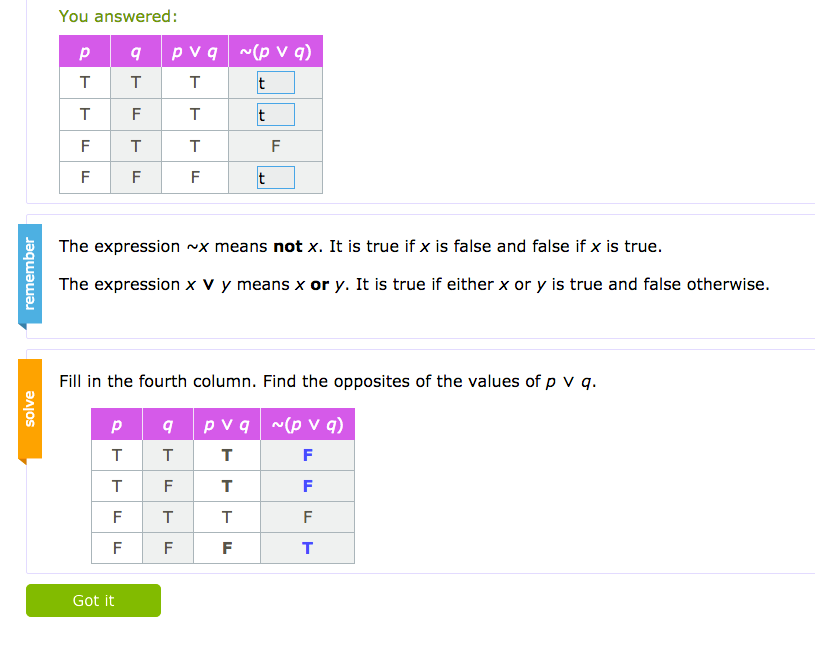
There are many youtube videos that show you how to do truth tables, which is great for when you are learning. But there is a website where students can practice writing truth tables and get immediate feedback if they are right or wrong. The students’ can practice for as long as they want, and it is great repetition for the student to remember how truth tables work and the rules they must follow. With the website when the students get it wrong it will explain why the student was wrong and why the table should be what it is. Below is an example of what the website does when the answer is incorrect.
In this series, I’m compiling some of the quips and one-liners that I’ll use with my students to hopefully make my lessons more memorable for them.
Here’s a problem that might arise in my discrete mathematics class:
Find the negation of .
This requires a couple of reasonably complex steps. First, we use the fact that is logically equivalent to $\lnot p \lor q$:
.
Next, we have to apply DeMorgan’s Law to find the negation:
Finally, we arrive at the final step: simplifying . At this point, I tell my class, it’s a bit of joke, especially after the previous, more complicated steps. “Not not ,” of course, is the same as . So this step is a bit of a joke. Which steps up the following cringe-worthy pun:
In fact, you might even call this a not-not joke.
After the groans settle down, we finish the derivation:

be the proposition “Blue is your color.” Translate the logical statement
.

 be the proposition “
 trusts
  at time
  ,” let
  be the proposition “
 be the proposition “
 .
. be the proposition “
 .
. be the proposition “You walk with
  .
. be the proposition “
 be the proposition “
 be the proposition “I knew
  .
. .
. :
: :
: :
: :
: :
: :
:
 .
. .
.
 . At this point, I tell my class, it’s a bit of joke, especially after the previous, more complicated steps. “Not not
  .
. Mean Green Math