Different definitions of e (Part 12): Numerical computation

In this series of posts, we have seen that the number e can be thought about in three different ways.

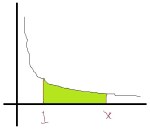
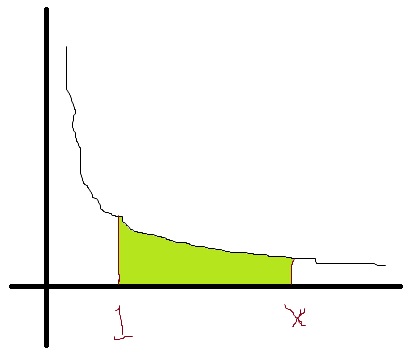
1. e defines a region of area 1 under the hyperbola y = 1/x.logarea2. We have the limits

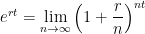
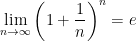
e = \displaystyle \lim_{h \to 0} (1+h)^{1/h} = \displaystyle \lim_{n \to \infty} \left(1 + \frac{1}{n} \right)^n.

These limits form the logical basis for the continuous compound interest formula.

3. We have also shown that \frac{d}{dx} \left(e^x \right) = e^x. From this derivative, the Taylor series expansion for e^x about x = 0 can be computed:

e^x = \displaystyle \sum_{n=0}^\infty \frac{x^n}{n!}

Therefore, we can let x = 1 to find e:

e = \displaystyle \sum_{n=0}^\infty \frac{1}{n!} = \displaystyle 1 + 1 + \frac{1}{2} + \frac{1}{6} + \frac{1}{24} + \dots

green line

In yesterday’s post, I showed that using the original definition (in terms of an area under a hyperbola) does not lend itself well to numerically approximating e. Let’s now look at the other two methods.

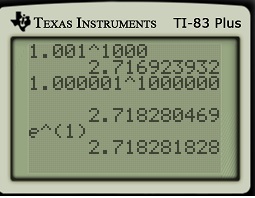
2. The limit e = \displaystyle \lim_{n \to \infty} \left(1 + \frac{1}{n} \right)^n gives a somewhat more tractable way of approximating e, at least with a modern calculator. However, you can probably imagine the fun of trying to use this formula without a calculator.

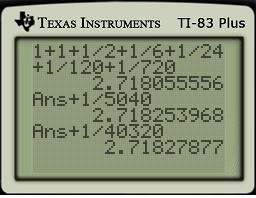
ecalculator3. The best way to compute e (or, in general, e^x) is with Taylor series. The fractions \frac{1}{n!} get very small very quickly, leading to rapid convergence. Indeed, with only terms up to 1/6!, this approximation beats the above approximation with n = 1000. Adding just two extra terms comes close to matching the accuracy of the above limit when n = 1,000,000.

ecalculator2

More about approximating e^x via Taylor series can be found in my previous post.


Different definitions of e (Part 10): Connecting the two definitions

In this series of posts, I consider how two different definitions of the number e are related to each other. The number e is usually introduced at two different places in the mathematics curriculum:

  1. Algebra II/Precalculus: If P dollars are invested at interest rate r for t years with continuous compound interest, then the amount of money after t years is A = Pe^{rt}.
  2. Calculus: The number e is defined to be the number so that the area under the curve y = 1/x from x = 1 to x = e is equal to 1, so that

\displaystyle \int_1^e \frac{dx}{x} = 1.

These two definitions appear to be very, very different. One deals with making money. The other deals with the area under a hyperbola. Amazingly, these two definitions are related to each other. In this series of posts, I’ll discuss the connection between the two.

logareagreen line

In yesterday’s post, I proved the following theorem, thus completing a long train of argument that began with the second definition of e and ending with a critical step in the derivation of the continuous compound interest formula. Today, I present an alternate proof of the theorem using L’Hopital’s rule.

Theorem. \displaystyle \lim_{n \to \infty} P \left( 1 + \frac{r}{n} \right)^{nt} = P e^{rt}.

Proof #2. Let’s write the left-hand side as

L = \displaystyle \lim_{n \to \infty} P \left( 1 + \frac{r}{n} \right)^{nt}.

Let’s take the natural logarithm of both sides:

\ln L = \displaystyle \ln \left[ \lim_{n \to \infty} P \left( 1 + \frac{r}{n} \right)^{nt} \right]

Since g(x) = \ln x is continuous, we can interchange the function and the limit on the right-hand side:

\ln L = \displaystyle \lim_{n \to \infty} \ln \left[ P \left( 1 + \frac{r}{n} \right)^{nt} \right]

\ln L = \displaystyle \lim_{n \to \infty} \left[ \ln P + \ln \left( 1 + \frac{r}{n} \right)^{nt} \right]

\ln L = \displaystyle \lim_{n \to \infty} \left[ \ln P + nt \ln \left( 1 + \frac{r}{n} \right)\right]

\ln L = \ln P + \displaystyle \lim_{n \to \infty} \frac{t \displaystyle \ln \left(1 + \frac{r}{n} \right)}{1/n}

\ln L = \ln P + \displaystyle t \lim_{n \to \infty} \frac{\displaystyle \ln \left(1 + \frac{r}{n} \right)}{1/n}

The limit on the right-hand side follows the indeterminate form 0/0, as so we may apply L’Hopital’s Rule. Taking the derivative of both the numerator and denominator with respect to n, we find

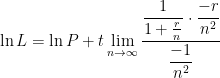
\ln L = \ln P + \displaystyle t \lim_{n \to \infty} \frac{\displaystyle \frac{1}{1 + \frac{r}{n}} \cdot \frac{-r}{n^2}}{\displaystyle \frac{-1}{n^2}}

\ln L = \ln P + \displaystyle t \lim_{n \to \infty}\frac{r}{1 + \frac{r}{n}}

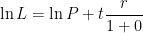
\ln L = \ln P + \displaystyle t \frac{r}{1 + 0}

\ln L = rt + \ln P

We now solve for the original limit L:

L = e^{rt + \ln P}

L = e^{rt} e^{\ln P}

L = Pe^{rt}


Different definitions of e (Part 9): Connecting the two definitions

In this series of posts, I consider how two different definitions of the number e are related to each other. The number e is usually introduced at two different places in the mathematics curriculum:

  1. Algebra II/Precalculus: If P dollars are invested at interest rate r for t years with continuous compound interest, then the amount of money after t years is A = Pe^{rt}.
  2. Calculus: The number e is defined to be the number so that the area under the curve y = 1/x from x = 1 to x = e is equal to 1, so that

\displaystyle \int_1^e \frac{dx}{x} = 1.

These two definitions appear to be very, very different. One deals with making money. The other deals with the area under a hyperbola. Amazingly, these two definitions are related to each other. In this series of posts, I’ll discuss the connection between the two.

logareagreen line

We begin with the second definition, which is usually considered the true definition of e. From this definition, I have shown in a previous post that we can derive the differentiation formulas

\displaystyle \frac{d}{dx} (\ln x) = \frac{1}{x} \qquad and \qquad \displaystyle \frac{d}{dx} \left( e^x \right) = e^x

beginning with this definition of the number e.

Theorem. \displaystyle \lim_{n \to \infty} P \left( 1 + \frac{r}{n} \right)^{nt} = Pe^{rt}.

Proof #1.In an earlier post in this series, I showed that

\displaystyle \frac{1}{x} = \displaystyle \lim_{h \to 0} \ln \left(1 + \frac{h}{x} \right)^{1/h}

Let’s now replace h with 1/n. Also, replace x with 1/r. Then we obtain

r = \displaystyle \lim_{n \to \infty} \ln \left(1 + \frac{1/n}{1/r} \right)^{n}

r = \displaystyle \lim_{n \to \infty} \ln \left(1 + \frac{r}{n} \right)^{n}

Multiply both sides by t:

rt = \displaystyle t \lim_{n \to \infty} \ln \left(1 + \frac{r}{n} \right)^{n}

rt = \displaystyle \lim_{n \to \infty} t \ln \left(1 + \frac{r}{n} \right)^{n}

rt = \displaystyle \lim_{n \to \infty} \ln \left[ \left(1 + \frac{r}{n} \right)^{n} \right]^t

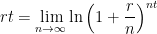
rt = \displaystyle \lim_{n \to \infty} \ln \left(1 + \frac{r}{n} \right)^{nt}

Since g(x) = \ln x is continuous, we can interchange the function and the limit on the right-hand side:

rt = \displaystyle \ln \left[ \lim_{n \to \infty} \left(1 + \frac{r}{n} \right)^{nt} \right]

e^{rt} = \displaystyle \lim_{n \to \infty} \left(1 + \frac{r}{n} \right)^{nt}

Finally, we multiply both sides by P:

P e^{rt} = \displaystyle \lim_{n \to \infty} P \left(1 + \frac{r}{n} \right)^{nt}

(A second proof of this theorem, using L’Hopital’s Rule, will be presented in tomorrow’s post.)

This firmly established, at last, the connection between the continuous compound interest formula and the area under the hyperbola. I’ve noted that my students feel a certain sense of accomplishment after reaching this point of the exposition.

Different definitions of e (Part 8): Connecting the two definitions

In this series of posts, I consider how two different definitions of the number e are related to each other. The number e is usually introduced at two different places in the mathematics curriculum:

  1. Algebra II/Precalculus: If P dollars are invested at interest rate r for t years with continuous compound interest, then the amount of money after t years is A = Pe^{rt}.
  2. Calculus: The number e is defined to be the number so that the area under the curve y = 1/x from x = 1 to x = e is equal to 1, so that

\displaystyle \int_1^e \frac{dx}{x} = 1.

These two definitions appear to be very, very different. One deals with making money. The other deals with the area under a hyperbola. Amazingly, these two definitions are related to each other. In this series of posts, I’ll discuss the connection between the two.

logareagreen line

In yesterday’s post, I proved the following theorem, thus completing a long train of argument that began with the second definition of e and ending with a critical step in the derivation of the continuous compound interest formula. Today, I present an alternate proof of the theorem using L’Hopital’s rule.

Theorem. \displaystyle \lim_{h \to 0} \left( 1 + h \right)^{1/h} = e.

Proof #2. Let’s write the left-hand side as

L = \displaystyle \lim_{h \to 0} \left( 1 + h \right)^{1/h}.

Let’s take the natural logarithm of both sides:

\ln L = \displaystyle \ln \left[ \lim_{h \to 0} \left( 1 + h \right)^{1/h} \right]

Since g(x) = \ln x is continuous, we can interchange the function and the limit on the right-hand side:

\ln L = \displaystyle \lim_{h \to 0} \ln (1+h)^{1/h}

\ln L = \displaystyle \lim_{h \to 0} \frac{1}{h} \ln(1+h)

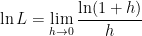
\ln L = \displaystyle \lim_{h \to 0} \frac{\ln(1+h)}{h}

The right-hand side follows the indeterminate form 0/0, as so we may apply L’Hopital’s Rule. Taking the derivative of both the numerator and denominator, we find

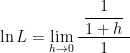
\ln L = \displaystyle \lim_{h \to 0} \frac{ \displaystyle ~ \frac{1}{1+h} ~}{1}

\ln L = \displaystyle \lim_{h \to 0} \frac{1}{1+h}

\ln L = \displaystyle \frac{1}{1+0} = 1.

Therefore, the original limit is L = e^1 = e.


Different definitions of e (Part 7): Connecting the two definitions

In this series of posts, I consider how two different definitions of the number e are related to each other. The number e is usually introduced at two different places in the mathematics curriculum:

  1. Algebra II/Precalculus: If P dollars are invested at interest rate r for t years with continuous compound interest, then the amount of money after t years is A = Pe^{rt}.
  2. Calculus: The number e is defined to be the number so that the area under the curve y = 1/x from x = 1 to x = e is equal to 1, so that

\displaystyle \int_1^e \frac{dx}{x} = 1.

These two definitions appear to be very, very different. One deals with making money. The other deals with the area under a hyperbola. Amazingly, these two definitions are related to each other. In this series of posts, I’ll discuss the connection between the two.

logareagreen line

We begin with the second definition, which is usually considered the true definition of e. From this definition, I have shown in a previous post that we can derive the differentiation formulas

\displaystyle \frac{d}{dx} (\ln x) = \frac{1}{x} \qquad and \qquad \displaystyle \frac{d}{dx} \left( e^x \right) = e^x

beginning with this definition of the number e.

Theorem. \displaystyle \lim_{h \to 0} \left( 1 + h \right)^{1/h} = e.

Proof #1. Recall the definition of a derivative

f'(x) = \displaystyle \lim_{h \to 0} \frac{f(x+h) - f(x)}{h}.

Let’s apply this to the function f(x) = \ln x:

\displaystyle \frac{d}{dx} (\ln x) = \displaystyle \lim_{h \to 0} \frac{\ln(x+h) - \ln x}{h}

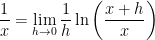
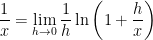
\displaystyle \frac{1}{x} = \displaystyle \lim_{h \to 0} \frac{1}{h} \ln \left( \frac{x+h}{x} \right)

\displaystyle \frac{1}{x} = \displaystyle \lim_{h \to 0} \frac{1}{h} \ln \left( 1 + \frac{h}{x} \right)

\displaystyle \frac{1}{x} = \displaystyle \lim_{h \to 0} \ln \left(1 + \frac{h}{x} \right)^{1/h}

(I’ll note parenthetically that I’ll need the above line for a future post in this series.) At this point, let’s substitute x = 1:

1 = \displaystyle \lim_{h \to 0} \ln (1 + h)^{1/h}

Let’s now apply the exponential function to both sides:

e^1 = \exp \left[ \displaystyle \lim_{h \to 0} \ln (1 + h)^{1/h} \right]

Since g(x) = e^x is continuous, we can interchange the function and the limit on the right-hand side:

e = \displaystyle \lim_{h \to 0} \exp \left[ \ln (1 + h)^{1/h} \right]

Finally, since g(x) = e^x and f(x) = \ln x are inverse functions, we can conclude

e = \displaystyle \lim_{h \to 0} (1 + h)^{1/h}.

(A second proof of this theorem, using L’Hopital’s Rule, will be presented in tomorrow’s post.)

green line

The next theorem establishes, at last, the connection between the continuous compound interest formula and the area under the hyperbola. I’ve noted that my students feel a certain sense of accomplishment after reaching this point of the exposition.

Theorem. \displaystyle \lim_{n \to \infty} \left(1 + \frac{1}{n} \right)^{n} = e.

Proof. Though a little bit of real analysis is necessary to make this rigorous, we can informally see why this has to be true by letting n = 1/h for h positive. Then the expression (1+h)^{1/h} becomes \left( 1 + \frac{1}{n} \right)^n. Also, as h \to 0, then n \to \infty.

Different definitions of e (Part 5): Continuous compound interest

In this series of posts, I consider how two different definitions of the number e are related to each other. The number e is usually introduced at two different places in the mathematics curriculum:

  1. Algebra II/Precalculus: If P dollars are invested at interest rate r for t years with continuous compound interest, then the amount of money after t years is A = Pe^{rt}.
  2. Calculus: The number e is defined to be the number so that the area under the curve y = 1/x from x = 1 to x = e is equal to 1, so that

\displaystyle \int_1^e \frac{dx}{x} = 1.

These two definitions appear to be very, very different. One deals with making money. The other deals with the area under a hyperbola. Amazingly, these two definitions are related to each other. In this series of posts, I’ll discuss the connection between the two.

I should say at the outset that the second definition is usually considered the true definition of e. However, compound interest usually appears earlier in the mathematics curriculum than definite integrals, and so an informal definition of e is given at that stage of the curriculum.

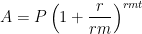
logareagreen lineAt this point in the exposition, I have justified the formula A = \displaystyle P \left(1 + \frac{r}{n} \right)^{nt} for computing the value of an investment when interest is compounded n times a year. We have also made the informal definition

\displaystyle \left(1 + \frac{1}{n} \right) \to e \qquad as \qquad n \to \infty.

We are now in position to give an informal derivation of the continuous compound interest formula. Though this derivation is informal, I have found it to be very convincing for my Precalculus students (as well as to my class of future high school teachers).

The basic idea is to rewrite the discrete compound interest formula so that it contains a term like \displaystyle \frac{1}{\hbox{something}} instead of \displaystyle \frac{r}{\hbox{something}}. In this way, we can think like an MIT freshman and reduce to previous work.

To this end, let n = mr. Then the discrete compound interest formula becomes

A = P\displaystyle \left( 1 + \frac{r}{n} \right)^{nt}

A = P\displaystyle \left( 1 + \frac{r}{rm} \right)^{rmt}

A = P\displaystyle \left( 1 + \frac{1}{m} \right)^{mrt}

A = P\displaystyle \left[ \left( 1 + \frac{1}{m} \right)^m \right]^{rt}

Inside of the brackets is our familiar friend \displaystyle \left( 1 + \frac{1}{m} \right)^m, except that the name of the variable has changed from n to m. But that’s no big deal: as n tends to infinity, then m does as well since m = n/r and both n and r are positive. Therefore, as interest is compounded more frequently, we have replace the thing inside the brackets with the number e. This leads us to the formula for continuous compound interest:

A =P e^{rt}

Again, my experience is that college students have no conceptual understanding of this formula or even a memory of seeing it derived once upon a time. They remember is it as coming out of nowhere, as a number in a formula or as a button on a calculator. It really shouldn’t be this way. The above calculation is perhaps a harder sell to high school students that the other calculations that I’ve posted in this series, but I firmly believe that this explanation is within the grasp of good students at the time that they take Algebra II and Precalculus.
Of course, the above derivation is highly informal. For starters, it rests upon the limit

\displaystyle \lim_{n \to \infty} \left(1 + \frac{1}{n} \right)^n = e,

which cannot be formally proven using only the tools of Algebra II and Precalculus. Second, the above computation rests upon the continuity of the function A(x) = P x^{rt}, so that we can simply replace \displaystyle \left( 1 + \frac{1}{m} \right)^m with its limit e. My experience is that students are completely comfortable making this substitution, even though professional mathematicians realize that interchanging limits requires continuity.

So, mathematically speaking, the above argument should not be considered a proper derivation of the continuous compound interest formula. Still, I have found that the above argument to be quite convincing to Algebra II and Precalculus students, appropriate to their current level of mathematical development.


Different definitions of e (Part 4): Continuous compound interest

In this series of posts, I consider how two different definitions of the number e are related to each other. The number e is usually introduced at two different places in the mathematics curriculum:

  1. Algebra II/Precalculus: If P dollars are invested at interest rate r for t years with continuous compound interest, then the amount of money after t years is A = Pe^{rt}.
  2. Calculus: The number e is defined to be the number so that the area under the curve y = 1/x from x = 1 to x = e is equal to 1, so that

\displaystyle \int_1^e \frac{dx}{x} = 1.

These two definitions appear to be very, very different. One deals with making money. The other deals with the area under a hyperbola. Amazingly, these two definitions are related to each other. In this series of posts, I’ll discuss the connection between the two.

I should say at the outset that the second definition is usually considered the true definition of e. However, compound interest usually appears earlier in the mathematics curriculum than definite integrals, and so an informal definition of e is given at that stage of the curriculum.

logareagreen lineAt this point in the exposition, I have justified the formula A = \displaystyle P \left(1 + \frac{r}{n} \right)^{nt} for computing the value of an investment when interest is compounded n times a year. We have also seen that A increases as n increases, but that A appears to level off as n gets very large. This observation forms the basis for the continuous compound interest formula A = P e^{rt}.

To begin, let’s consider plug in variables to make the compound interest formula as simple as possible. Let’s start with 1 dollar (so that P = 1) that earns 100% interest (so that r = 1) for one year (so that t = 1). This isn’t financially realistic, of course, but let’s run with it. Then the compound interest formula becomes

A = \displaystyle \left( 1 + \frac{1}{n} \right)^n

As before, let’s see what happens as n increases. As before, I’ll plug numbers into a calculator in real time, asking my students to use their calculators along with me.

  1. If n = 1, then A = (1+1)^1 = 2. I’ll usually double-check with my class to make sure that they believe this answer… that $1 compounded once at 100% interest results in $2.
  2. If n = 2, then A = (1.5)^2 = 2.25.
  3. If n = 4, then A = (1.25)^4 \approx 2.441.
  4. If n = 10, then A = (1.1)^{10} \approx 2.593.
  5. If n = 1000, then A = (1.001)^{1000} \approx 2.71692
  6. If n = 1,000,000, then A = (1.000001)^{1000000} \approx 2.71828

As before, the final amount A appears to be increasing toward something. That something is defined to be the number e. So, as n tends toward infinity, we’ll define the limiting value to be the number e.

ecalculatorIn my experience, college students have no memory of learning how they first saw the number e when they were in high school. They remember is it as coming out of nowhere, as a number in a formula or as a button on a calculator. It really shouldn’t be this way. The above calculation is a natural consequence of the discrete compound interest formula, which makes the appearance of the number e to be a bit more natural.

Of course, this “definition” of the number e is highly informal. What we’re really claiming is

\displaystyle \lim_{n \to \infty} \left(1 + \frac{1}{n} \right)^n = e.

At this point in the mathematical curriculum, students only have the haziest notion of what a limit actually means, let alone the more formal treatment that’s presented in calculus… not to mention a proper \delta-\epsilon treatment of limit in an honors calculus class or in real analysis. So, mathematically speaking, the above argument should not be considered a proper definition of the number e, but a working definition so that high school students can get comfortable with the number e before seeing it again in their future mathematical courses.


Day One of my Calculus I class: Part 6

In this series of posts, I’d like to describe what I tell my students on the very first day of Calculus I. On this first day, I try to set the table for the topics that will be discussed throughout the semester. I should emphasize that I don’t hold students immediately responsible for the content of this lecture. Instead, this introduction, which usually takes 30-45 minutes, depending on the questions I get, is meant to help my students see the forest for all of the trees. For example, when we start discussing somewhat dry topics like the definition of a continuous function and the Mean Value Theorem, I can always refer back to this initial lecture for why these concepts are ultimately important.

I’ve told students that the topics in Calculus I build upon each other (unlike the topics of Precalculus), but that there are going to be two themes that run throughout the course:

  1. Approximating curved things by straight things, and
  2. Passing to limits

I’ve then quickly used these themes to solve two completely different problems: (1) finding the speed of a falling object at impact and (2) finding the area under a parabola. I can usually cover these topics in less than 50 minutes, sometimes in 35 minutes. Again, because I’m not immediately holding my students responsible for the contents of this introduction, I feel freer to move a little quicker than I would otherwise in the hopes of showing the forest for all of the trees.

I then ask the obvious question: what do these two questions have to do with each other. One involves the distance-rate-time formula. The other involves the areas of rectangles. At first blush, these two questions seem completely unrelated. And at second blush. And at third blush.

I tell my class that these two apparently unrelated questions are indeed related by something called the Fundamental Theorem of Calculus. Somehow, the process of finding the area under a curve is intimately related to finding an instantaneous rate of change. I then make a bold, eye-catching statement: The Fundamental Theorem of Calculus is one of the greatest discoveries in the history of mankind, period. And, at the ripe old age of 17, 18, or 19 years old, my students are now privileged to understand this great accomplishment.

This ends my introduction to Calculus I. I’ll then begin the more mundane development of limits on the way to formally defining a derivative.

Day One of my Calculus I class: Part 5

In this series of posts, I’d like to describe what I tell my students on the very first day of Calculus I. On this first day, I try to set the table for the topics that will be discussed throughout the semester. I should emphasize that I don’t hold students immediately responsible for the content of this lecture. Instead, this introduction, which usually takes 30-45 minutes, depending on the questions I get, is meant to help my students see the forest for all of the trees. For example, when we start discussing somewhat dry topics like the definition of a continuous function and the Mean Value Theorem, I can always refer back to this initial lecture for why these concepts are ultimately important.

I’ve told students that the topics in Calculus I build upon each other (unlike the topics of Precalculus), but that there are going to be two themes that run throughout the course:

  1. Approximating curved things by straight things, and
  2. Passing to limits

We are now trying to answer the following problem.

Problem #2. Find the area under the parabola f(x) = x^2 between x=0 and x=1.

Using five rectangles with right endpoints, we find the approximate answer of 0.44. With ten rectangles, the approximation is 0.385. With one hundred rectangles (and Microsoft Excel), the approximation is 0.33835. This last expression was found by evaluating

0.01[ (0.01)^2 + (0.02)^2 + \dots + (0.99)^2 + 1^2]

At this juncture, what I’ll do depends on my students’ background. For many years, I had the same group of students for both Precalculus and Calculus I, and so I knew full well that they had seen the formula for \displaystyle \sum_{k=1}^n k^2. And so I’d feel comfortable showing my students the contents of this post. However, if I didn’t know for sure that my students had at least seen this formula, I probably would just ask them to guess the limiting answer without doing any of the algebra to follow.

Assuming students have the necessary prerequisite knowledge, I’ll ask, “What happens if we have n rectangles?” Without much difficulty, they’ll see that the rectangles have a common width of 1/n. The heights of the rectangles take a little more work to determine. I’ll usually work left to right. The left-most rectangle has right-most x-coordinate of 1/n, and so the height of the leftmost rectangle is (1/n)^2. The next rectangle has a height of (2/n)^2, and so we must evaluate

\displaystyle \frac{1}{n} \left[ \frac{1^2}{n^2} + \frac{2^2}{n^2} + \dots + \frac{n^2}{n^2} \right], or

\displaystyle \frac{1}{n^3} \left[ 1^2 + 2^2 + \dots + n^2 \right]

I then ask my class, what’s the formula for this sum? Invariably, they’ve forgotten the formula in the five or six weeks between the end of Precalculus and the start of Calculus I, and I’ll tease them about this a bit. Eventually, I’ll give them the answer (or someone volunteers an answer that’s either correct or partially correct):

\displaystyle \frac{1}{n^3} \times \frac{n(n+1)(2n+1)}{6}, or \frac{(n+1)(2n+1)}{6n^2}.

I’ll then directly verify that our previous numerical work matches this expression by plugging in n=5, n= 10, and n = 100.

I then ask, “What limit do we need to take this time?” Occasionally, I’ll get the incorrect answer of sending n to zero, as students sometimes get mixed up thinking about the width of the rectangles instead of the number of rectangles. Eventually, the class will agree that we should send n to plus infinity. Fortunately, the answer \displaystyle \frac{(n+1)(2n+1)}{6n^2} is an example of a rational function, and so the horizontal asymptote can be immediately determined by dividing the leading coefficients of the numerator and denominator (since both have degree 2). We conclude that the limit is 2/6 = 1/3, and so that’s the area under the parabola.