We’ve seen in this series that blinding using the arcsine function on a calculator is insufficient for finding all solutions of an equation like  . In today’s post, I discuss one of the first places that this becomes practically important: solving the ambiguous case of solving a triangle given two sides and an nonincluded angle.
A note on notation: when solving for the parts of  ,
,  will be the length of the side opposite
  ,
,  will be the length of the side opposite
  , and
, and  will be the length of the side opposite angle
  . Also
  will be the measure of ,
  will be measure of , and
  will be the measure of
  . Modern textbooks tend not to use , , and for these kinds of problems, for which I have only one response:

Why does an SSA triangle produce an ambiguous case (unlike the SAS, SSS, or ASA cases)? Here’s a possible problem that has two different solutions:
Solve if  ,
,  , and
, and  .
.
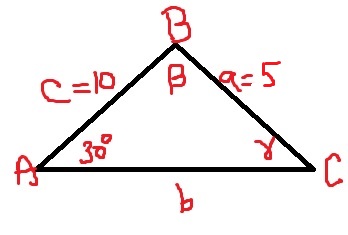
A student new to the Law of Sines might naively start solving the problem by drawing something like this:

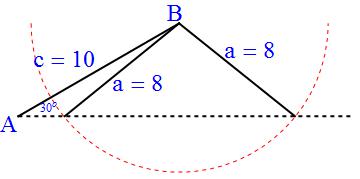
Of course, that’s an inaccurate picture that isn’t drawn to scale. A more accurate picture would look like this:
 This time, the red circle intersects the dashed black line at two different points. So there will be two different solutions for this case. In other words, the phrasing of the question is somewhat deceptive. Usually when the question asks, “Solve the triangle…”, it’s presumed that there is only one solution. In this case, however, there are two different solutions.
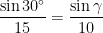
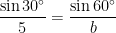
These two different solutions appear when using the Law of Sines:

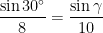


At this point, the natural inclination of a student is to pop out the calculator and find  .
.

This is incorrect logic that, as discussed extensively in earlier in this series of posts, there are two angles between  and
and  with a sine of
  :
:
 ,
,
or, in degrees,

So we have two different cases to check. Unlike the previous posts in this series, it’s really, really important that we list both of these cases.
Case 1:  . We begin by solving for :

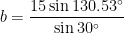
Then we can use the Law of Sines to find . In this case, it’s best to use the pair  instead of
  since the values of and are both known exactly.


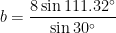

This triangle with ,  , and corresponds to the bigger of the two triangles in the above picture, or the rightmost of the two places where the dotted circle intersects the black dotted line.
Case 2:  . We again begin by solving for :

Unlike yesterday’s example, this is possible. So we have to continue the calculation to find :
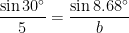
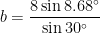

This second triangle with ,  , and corresponds to the thinner of the two triangles in the above picture, or the leftmost of the two places where the dotted circle intersects the black dotted line.

,
, and
.





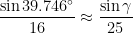



 For this reason, it would have been far better to solve for the biggest angle first. For the present example, the biggest answer is



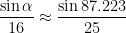

![[0^\circ, 180^\circ]](https://s0.wp.com/latex.php?latex=%5B0%5E%5Ccirc%2C+180%5E%5Ccirc%5D&bg=ffffff&fg=000000&s=0&c=20201002)


 latex a = 16$,
  .
. , thus quickly demonstrating that the triangle is impossible. However, this also falls out of the Law of Cosines:






 . And the good news is that there is no need to overthink this… this is guaranteed to be the angle since the range of
  is
is ![[0,\pi]](https://s0.wp.com/latex.php?latex=%5B0%2C%5Cpi%5D&bg=ffffff&fg=000000&s=0&c=20201002) , or
, or 
 . And since an angle in a triangle must lie between
 ![[0^\circ,90^\circ]](https://s0.wp.com/latex.php?latex=%5B0%5E%5Ccirc%2C90%5E%5Ccirc%5D&bg=ffffff&fg=000000&s=0&c=20201002) and also the interval
and also the interval ![[90^\circ, 180^\circ]](https://s0.wp.com/latex.php?latex=%5B90%5E%5Ccirc%2C+180%5E%5Ccirc%5D&bg=ffffff&fg=000000&s=0&c=20201002) .
. :
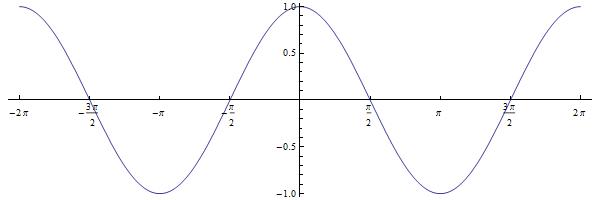
:
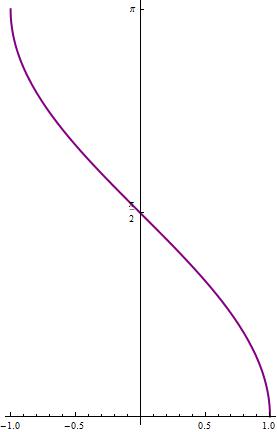
 , we select a section that satisfies the horizontal line test and ignore the rest of the graph. (I described this in more rigorous terms when I considered arcsine, so I will not repeat the rigor here.) There are plenty of choices that could be made; by tradition, the interval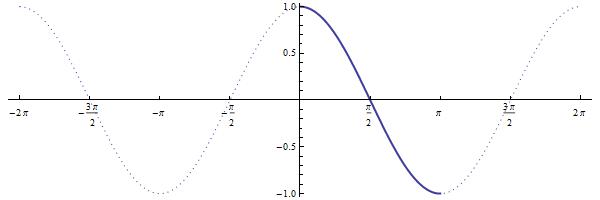
 produces the graph of
  . Again, to assist my students when graphing this function, I point out that the graph of cosine has horizontal tangent lines at the points
  and
and  . Therefore, after reflecting through the line
  has vertical tangent lines at
  and
and  .
.
 is chosen as the section of the graph of
  that satisfies the horizontal line test.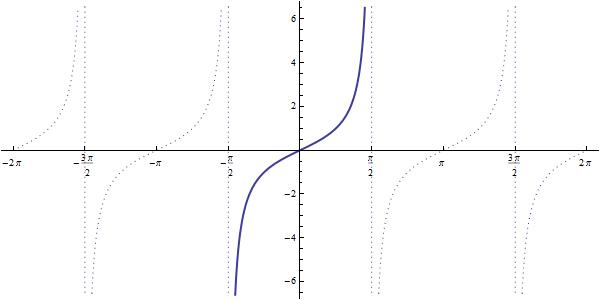
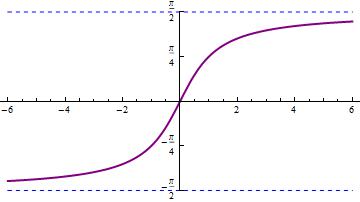
 . Like the (more complicated)
  .
.
 means that
  and
and 
 and
and 



 on the interval
  . In this case, there are no solutions. When the Law of Sines is employed and we reach the step
 is greater than 1, which is impossible.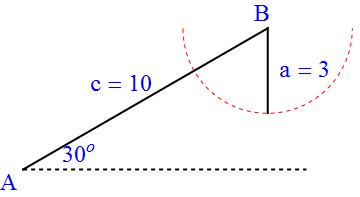
 . This rarely arises in practice (except by careful writers of textbooks). In this case, there is exactly one solution. When the Law of Sines is employed, we obtain
 , so that
 . This is the ambiguous case that yields two solutions. The Law of Sines yields
 and
and  .
.
 . This yields one solution. Similar to Case 3, the Law of Sines yields
 Many mathematics students prefer to memorize rules like those listed above. However, I try to encourage my students not to blindly use rules when solving the SSA case, as it’s just too easy to make a mistake in identifying the proper case. Instead, I encourage them to use the Law of Sines and to remember that the equation



 ,
, 



 :
: ,
,
 . We begin by solving for


 . We again begin by solving for
 , and
, and  ). However, I prefer that my students not memorize this rule. Instead, I’d prefer that they list the two possible values of
  and
and  axis are in degrees). This graph intersects the line
  in two different places between
 ![[-\pi/2,\pi/2]](https://s0.wp.com/latex.php?latex=%5B-%5Cpi%2F2%2C%5Cpi%2F2%5D&bg=ffffff&fg=000000&s=0&c=20201002) , or
, or ![[-90^\circ, 90^\circ]](https://s0.wp.com/latex.php?latex=%5B-90%5E%5Ccirc%2C+90%5E%5Ccirc%5D&bg=ffffff&fg=000000&s=0&c=20201002) in degrees.
in degrees.
 axis.
axis.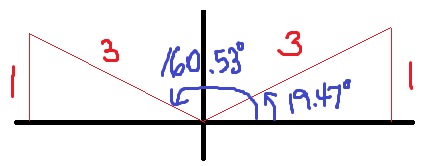
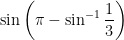 :
:


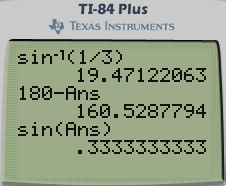
 ,
, 
 , so that the triangle is a right triangle.


 . In the next couple posts in this series, we’ll see what happens when we get a step where
  .
.


 ,
, 
 illustrates the dilemma: “side”
  is simply too short to reach the horizontal dashed line to make the vertex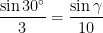


 must like between
  and
and  is undefined), we know that this triangle cannot be solved.
 Mean Green Math