Arithmetic and Geometric Series: Index

I’m using the Twelve Days of Christmas (and perhaps a few extra days besides) to do something that I should have done a long time ago: collect past series of posts into a single, easy-to-reference post. The following posts formed my series on how I remind students about Taylor series. I often use this series in a class like Differential Equations, when Taylor series are needed but my class has simply forgotten about what a Taylor series is and why it’s important.

Part 1: Deriving the formulas for the nth term of arithmetic and geometric sequences.

Part 2: Pedagogical thoughts on conceptual barriers that students often face when encountering sequences and series.

Part 3: The story of how young Carl Frederich Gauss, at age 10, figured out how to add the integers from 1 to 100 in his head.

Part 4: Deriving the formula for an arithmetic series.

Part 5: Deriving the formula for an arithmetic series, using mathematical induction. Also, extensions to other series.

Part 6: Deriving the formula for an arithmetic series, using telescoping series. Also, extensions to other series.

Part 7: Pedagogical thoughts on assessing students’ depth of understanding the formula for an arithmetic series.

Part 8: Deriving the formula for a finite geometric series.

Part 9: Infinite geometric series and Xeno’s paradox.

Part 10: Deriving the formula for an infinite geometric series.

Part 11: Applications of infinite geometric series in future mathematics courses.

Part 12: Other commonly-arising infinite series.


Why Does 0.999… = 1? (Index)

I’m using the Twelve Days of Christmas (and perhaps a few extra days besides) to do something that I should have done a long time ago: collect past series of posts into a single, easy-to-reference post. The following posts formed my series on different techniques that I’ll use to try to convince students that 0.999\dots = 1.

Part 1: Converting the decimal expansion to a fraction, with algebra.

Part 2: Rewriting both sides of the equation 1 = 3 \times \displaystyle \frac{1}{3}.

Part 3: Converting the decimal expansion to a fraction, using infinite series.

Part 4: A proof by contradiction: what number can possibly be between 0.999\dots and 1?

Part 5: Same as Part 4, except by direct reasoning.


Area of a Triangle and Volume of Common Shapes: Index

I’m using the Twelve Days of Christmas (and perhaps a few extra days besides) to do something that I should have done a long time ago: collect past series of posts into a single, easy-to-reference post. The following posts formed my series on different ways of finding the area of a triangle as well as finding the volumes of common shapes.

Part 1: Deriving the formula A = \displaystyle \frac{1}{2} bh.

Part 2: Cavalieri’s principle and finding areas using calculus.

Part 3: Cavalieri’s principle and finding the volume of a pyramid and then the volume of a sphere.

Part 4: Finding the area of a triangle using the Law of Sines.

Part 5: Finding the area of a triangle using the Law of Cosines.

Part 6: Finding the area of a triangle using the triangle’s incenter.

Part 7: Finding the area of a triangle using a determinant and the coordinates of the vertices.

Part 8: Finding the area of a triangle using Pick’s theorem.


A Curious Square Root: Index

I’m using the Twelve Days of Christmas (and perhaps a few extra days besides) to do something that I should have done a long time ago: collect past series of posts into a single, easy-to-reference post. The following posts formed my series on expressions containing nested square roots that nevertheless can be simplified.

Part 1: Simplifying \sqrt{5 - \sqrt{6} + \sqrt{22+8\sqrt{6}}}.

Part 2: DIfferent ways of calculating \sin 15^\circ.


Reminding students about Taylor series: Index

I’m doing something that I should have done a long time ago: collect past series of posts into a single, easy-to-reference post. The following posts formed my series on how I remind students about Taylor series. I often use this series in a class like Differential Equations, when Taylor series are needed but my class has simply forgotten about what a Taylor series is and why it’s important.

Part 1: Introduction – Why a Taylor series is important, and different applications of Taylor series.

Part 2: How I get students to understand the finite Taylor polynomial by solving a simple initial-value problem.

Part 3: Making the jump to an infinite series, and issues about tests of convergence.

Part 4: Application to f(x) = e^x, and a numerical investigation of speed of convergence.

Part 5: Application to f(x) = \displaystyle \frac{1}{1-x} and other related functions, including f(x) = \ln(1+x) and f(x) = \tan^{-1} x.

Part 6: Application to f(x) = \sin x and f(x) = \cos x, and Euler’s formula.


Area of a Circle: Index

I’m using the Twelve Days of Christmas (with a week-long head start) to do something that I should have done a long time ago: collect past series of posts into a single, easy-to-reference post. The following posts formed my series on the formula for the area of a circle.

Part 1: Why the circumference function C(r) = 2 \pi r is the derivative of the area function A(r) = \pi r^2.

Part 2: Finding the area of a circle via integration by trigonometric substitution.

Part 3: Finding the area of a circle via a double integral.

Part 4: Justifying the formula A(r) = \pi r^2 to geometry students by slicing a circle into pieces and rearranging the pieces as a parallelogram (approximately).


Common Core, Subtraction, and the Open Number Line: Index

While the implementation of the Common Core has left much to be desired (understatement of the day), I do endorse — whether it’s done through Common Core or not — the fostering of deeper conceptual understanding when teaching mathematics to elementary school students. I have plenty of opinions on teaching for conceptual understanding, Common Core mathematics, and (where the Common Core has utterly failed) assessing for conceptual understanding:

Division 1: A discussion about the usefulness of unorthodox ways of teaching long division.

Division 2: A continuation of the above discussion.

Subtraction 1: Introducing a viral picture about the Common Core, and its easy solution.

Subtraction 2: The pedagogical rationale for using an open number line (even though I personally do not endorse this technique as superior to other ways of teaching subtraction).

Subtraction 3: The abject failure of current developmentally inappropriate ways of assessing the depth of a student’s mathematical knowledge.

Subtraction 4: The importance of engaging parents when unorthodox methods are used to teach mathematics to children.


2048 and algebra: Index

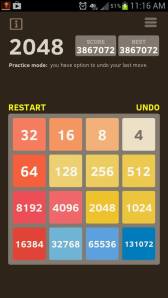
I’m doing something that I should have done a long time ago: collect past series of posts into a single, easy-to-reference post. The following posts formed my series on using algebra to study the 2048 game… with a special focus on reaching the event horizon of 2048 which cannot be surpassed.

2048-0Part 1: Introduction and statement of problem

Part 2: First insight: How points are accumulated in 2048

Part 3: Second insight: The sum of the tiles on the board

Part 4: Algebraic formulation of the two insights

Part 5: Algebraic formulation applied to a more complicated board

Part 6: Algebraic formulation applied to the event horizon of 2048

Part 7: Calculating one of the complicated sums in Part 6 using a finite geometric series

Part 8: Calculating another complicated sum in Part 6 using a finite geometric series

Part 9: Repeating Part 8 by reversing the order of summation in a double sum

Part 10: Estimating the probability of reaching the event horizon in game mode


A probability problem involving two cards: Index

I’m doing something that I should have done a long time ago: collect past series of posts into a single, easy-to-reference post. The following posts formed my series on different ways (correct and incorrect) to solve a two-part probability problem.

Part 1: Two different and correct ways of solving the following problem: “Two cards are dealt from a well-shuffled deck. Find the probability that the first is an ace or the second is a ace.”

Part 2: Two different ways — one correct, one incorrect — of solving the following problem: “Two cards are dealt from a well-shuffled deck. Find the probability that the first is an ace or the second is a jack.”

Part 3: Explaining the incorrect solution, and salvaging the solution to obtain the correct answer.