

It Could Be Worse…

I’m taking a break from my usual posts on mathematics and mathematics education to note a symbolic milestone: meangreenmath.com has had more than 250,000 total page views since its inception in June 2013. Many thanks to the followers of this blog, and I hope that you’ll continue to find this blog to be a useful resource to you.

Twenty most viewed individual posts:
Twenty most viewed series:
 and
and  ?
?Twenty most viewed posts (guest presenters):
If I’m still here at that time, I’ll make a summary post like this again when this blog has over 500,000 page views.
Another bonehead word problem. Notice the word “her”. While Usain Bolt holds the current 100-meter world record of 9.58 seconds, the women’s world record is currently 10.49 seconds.
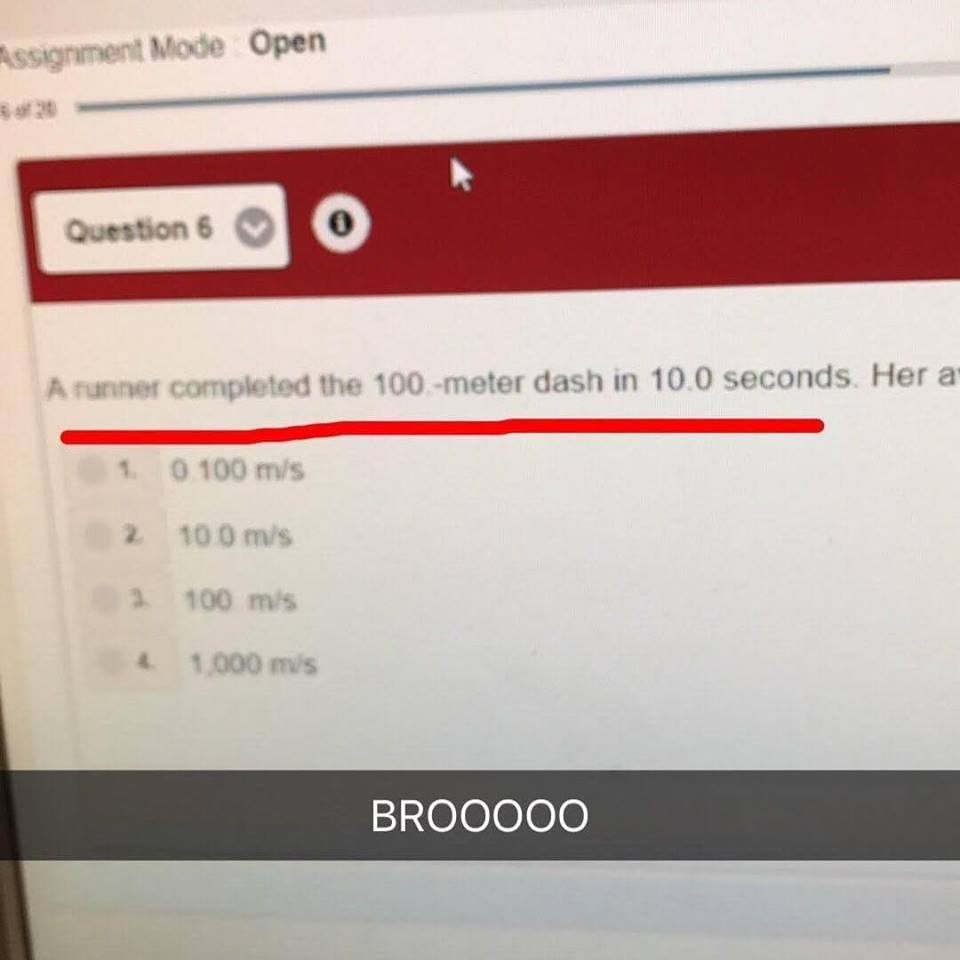
Source: https://www.facebook.com/FloTrack/photos/a.432324889444/10156764197654445/?type=3&theater
I enjoyed this article from the magazine Physics Today about the historical background behind three-dimensional spherical trigonometry: https://physicstoday.scitation.org/doi/10.1063/PT.3.3798
Somehow I found this fun website with various teaching resources using different coding and decoding methods: http://www.cimt.org.uk/resources/codes/?fbclid=IwAR2yX_yDK0UAmLB2acIgbk15wJMy_QXFJSuKaQOj3q-SlrFkuuuxpsEXoyI
Here’s another T-shirt that I found in my quest for the perfect ugly mathematical Christmas sweater: https://www.amazon.com/Fibonacci-Christmas-Tree-Holiday-Shirt/dp/B07KCF1F6D/
 Unlike the shirt in my previous post, this one actually gets the first ten rows of Pascal’s triangle correct. So that’s a good thing.
There’s one small error: while the Fibonacci numbers can be found by adding along shallow diagonals of Pascal’s triangle, this really shouldn’t be called a “Fibonacci Christmas Tree.”
Oops.
I didn’t know this interesting bit of internet history:
“It’s July 1977,” Hellman tells the audience. “Whit and I are involved in a major fight with NSA over the data encryption standard.”
American law banned the unlicensed export of weapons. Makes sense: the government doesn’t want civilians wandering into Moscow with a trenchcoat full of fighter jet parts. The question is: Does this law apply to abstract mathematical ideas? By developing new approaches to cryptography, are Hellman, Diffie, and their collaborators de facto arms traffickers? If so, Hellman says, “then by publishing our papers in international journals, we are in some sense exporting plans for implements of war.”
“I think the penalty,” Hellman recalls, “was something like five years in jail.”
Full story: https://mathwithbaddrawings.com/2017/10/11/the-professor-vs-the-nsa/
Using the British day/month/year format of abbreviating dates, today is 2/7/18, matching the first four significant digits in the decimal expansion of 
Using the British convention, it’ll be
In the United States, today is 2/7/18, matching the first four significant digits of
The next time that this date can be celebrated is July 2, 2018 (using the day/month/year format of abbreviated dates.) After that, we’ll have to wait until 27/1/82, or January 27, 2082. (Sadly, I knew about the number


