Lessons from teaching gifted elementary students (Part 8f)

Every so often, I’ll informally teach a class of gifted elementary-school students. I greatly enjoy interacting with them, and I especially enjoy the questions they pose. Often these children pose questions that no one else will think about, and answering these questions requires a surprisingly depth of mathematical knowledge.

Here’s a question I once received, in the students’ original handwriting. They wanted me to add adjacent numbers on the bottom row to produce the number on the next row, building upward until I reached the apex of the triangle. Then, after I reached the top number, they wanted me to take the square root of that number. (Originally, they wanted me to first multiply by 80 before taking the square root, but evidently they decided to take it easy on me.)

And, just to see if I could do it, they wanted me to do all of this without using a calculator. But they were nice and allowed me to use pencil and paper.

PascalProblem

So far, I’ve used Pascal’s triangle to obtain

y = \displaystyle \sum_{k=0}^{11} (k+1)^2 {11 \choose k}

= \displaystyle \sum_{k=2}^{11} k(k-1) {11 \choose k} +  \sum_{k=1}^{11} 3k {11 \choose k} + \sum_{k=0}^{11} {11 \choose k}.

= \displaystyle \sum_{k=2}^{11} k(k-1) \left( \frac{11!}{k!(11-k)!} \right) +  \sum_{k=1}^{11} 3k \left( \frac{11!}{k!(11-k)!} \right) + \sum_{k=0}^{11} \left( \frac{11!}{k!(11-k)!} \right).

= \displaystyle \sum_{k=2}^{11}  \frac{11!}{(k-2)!(11-k)!}  +  3 \sum_{k=1}^{11}  \frac{11!}{(k-1)!(11-k)!}  + \sum_{k=0}^{11}  \frac{11!}{k!(11-k)!} .

= \displaystyle \sum_{i=0}^{9} \frac{11!}{i!(9-i)!}  +  3 \sum_{j=0}^{10}  \frac{11!}{j!(10-j)!}  + \sum_{k=0}^{11}  \frac{11!}{k!(11-k)!} .

= \displaystyle \sum_{i=0}^{9} 11 \times 10 \frac{9!}{i!(9-i)!}  +  3 \sum_{j=0}^{10}  11 \frac{10!}{j!(10-j)!}  + \sum_{k=0}^{11}  \frac{11!}{k!(11-k)!}

= \displaystyle 110 \sum_{i=0}^{9} {9 \choose i}  +  33 \sum_{j=0}^{10} {10 \choose j} + \sum_{k=0}^{11}  {11 \choose k}

To numerically evaluate y, I use the identity

\sum_{r=0}^n {n \choose r} = 2^n;

this identity can be proven by using the binomial theorem

\sum_{r=0}^n {n \choose r} x^r y^{n-r} = (x+y)^n

and then plugging in x = 1 and y = 1. Using this identity, I conclude that

y = 110 \times 2^9 + 33 \times 2^{10} + 2^{11}

= 55 \times 2 \times 2^9 + 33 \times 2^{10} + 2 \times 2^{10}

= 55 \times 2^{10} + 33 \times 2^{10} + 2 \times 2^{10}

= (55+33+2) \times 2^{10}

= 90 \times 2^{10}.

Since I know that 2^{10} = 1024, it’s now a simple matter of multiplication:

y = 90 \times 1024 = 92,160.

 (Trust me; after I showed my students this answer about five minutes after it was posed, I was ecstatic when I confirmed this answer with Mathematica.)

Lessons from teaching gifted elementary students (Part 8e)

Every so often, I’ll informally teach a class of gifted elementary-school students. I greatly enjoy interacting with them, and I especially enjoy the questions they pose. Often these children pose questions that no one else will think about, and answering these questions requires a surprisingly depth of mathematical knowledge.

Here’s a question I once received, in the students’ original handwriting. They wanted me to add adjacent numbers on the bottom row to produce the number on the next row, building upward until I reached the apex of the triangle. Then, after I reached the top number, they wanted me to take the square root of that number. (Originally, they wanted me to first multiply by 80 before taking the square root, but evidently they decided to take it easy on me.)

And, just to see if I could do it, they wanted me to do all of this without using a calculator. But they were nice and allowed me to use pencil and paper.

PascalProblem

So far, I’ve used Pascal’s triangle to obtain

y = \displaystyle \sum_{k=0}^{11} (k+1)^2 {11 \choose k}

= \displaystyle \sum_{k=2}^{11} k(k-1) {11 \choose k} +  \sum_{k=1}^{11} 3k {11 \choose k} + \sum_{k=0}^{11} {11 \choose k}.

= \displaystyle \sum_{k=2}^{11} k(k-1) \left( \frac{11!}{k!(11-k)!} \right) +  \sum_{k=1}^{11} 3k \left( \frac{11!}{k!(11-k)!} \right) + \sum_{k=0}^{11} \left( \frac{11!}{k!(11-k)!} \right).

= \displaystyle \sum_{k=2}^{11}  \frac{11!}{(k-2)!(11-k)!}  +  3 \sum_{k=1}^{11}  \frac{11!}{(k-1)!(11-k)!}  + \sum_{k=0}^{11}  \frac{11!}{k!(11-k)!} .

= \displaystyle \sum_{i=0}^{9} \frac{11!}{i!(9-i)!}  +  3 \sum_{j=0}^{10}  \frac{11!}{j!(10-j)!}  + \sum_{k=0}^{11}  \frac{11!}{k!(11-k)!} .

In the first series, I’ll rewrite 11! as 11 \times 10 \times 9!. Also, in the second series, I’ll rewrite 11! as 11 \times 10!. Therefore,

y = \displaystyle \sum_{i=0}^{9} 11 \times 10 \frac{9!}{i!(9-i)!}  +  3 \sum_{j=0}^{10}  11 \frac{10!}{j!(10-j)!}  + \sum_{k=0}^{11}  \frac{11!}{k!(11-k)!}

y = \displaystyle 110 \sum_{i=0}^{9} \frac{9!}{i!(9-i)!}  +  33 \sum_{j=0}^{10}  \frac{10!}{j!(10-j)!}  + \sum_{k=0}^{11}  \frac{11!}{k!(11-k)!}

We now see that binomial coefficients appear in each of these series:

y = \displaystyle 110 \sum_{i=0}^{9} {9 \choose i}  +  33 \sum_{j=0}^{10} {10 \choose j} + \sum_{k=0}^{11}  {11 \choose k}

I’ll conclude the evaluation of y in tomorrow’s post.

Lessons from teaching gifted elementary students (Part 8d)

Every so often, I’ll informally teach a class of gifted elementary-school students. I greatly enjoy interacting with them, and I especially enjoy the questions they pose. Often these children pose questions that no one else will think about, and answering these questions requires a surprisingly depth of mathematical knowledge.

Here’s a question I once received, in the students’ original handwriting. They wanted me to add adjacent numbers on the bottom row to produce the number on the next row, building upward until I reached the apex of the triangle. Then, after I reached the top number, they wanted me to take the square root of that number. (Originally, they wanted me to first multiply by 80 before taking the square root, but evidently they decided to take it easy on me.)

And, just to see if I could do it, they wanted me to do all of this without using a calculator. But they were nice and allowed me to use pencil and paper.

PascalProblem

So far, I’ve used Pascal’s triangle to obtain

y = \displaystyle \sum_{k=0}^{11} (k+1)^2 {11 \choose k}

= \displaystyle \sum_{k=2}^{11} k(k-1) {11 \choose k} +  \sum_{k=1}^{11} 3k {11 \choose k} + \sum_{k=0}^{11} {11 \choose k}.

I now use the definition of the binomial coefficient:

= \displaystyle \sum_{k=2}^{11} k(k-1) \left( \frac{11!}{k!(11-k)!} \right) +  \sum_{k=1}^{11} 3k \left( \frac{11!}{k!(11-k)!} \right) + \sum_{k=0}^{11} \left( \frac{11!}{k!(11-k)!} \right).

Since k! = k(k-1) \times (k-2)! and k! = k \times (k-1)!, this simplifies as

y = \displaystyle \sum_{k=2}^{11} \frac{11!}{(k-2)!(11-k)!}+  3 \sum_{k=1}^{11} \frac{11!}{(k-1)!(11-k)!} + \sum_{k=0}^{11} \frac{11!}{k!(11-k)!} .

In the first series, I’ll use the change of index i = k-2, so that k = i+2 and 11-k = 11-(i+2) = 9-i. Also, in the first series, the index will change from k = 2 to k = 11 to i = 0 to i = 9.

In the second series, I’ll use the change of index j = k-1, so that k = j+1 and 11-k = 11-(j+1) = 10-j. Also, in the first series, the index will change from k = 1 to k = 11 to j = 0 to j = 10.

With these changes, I obtain

y = \displaystyle \sum_{i=0}^{9}\frac{11!}{(i!(9-i)!}  +  3 \sum_{j=0}^{10} \frac{11!}{j!(10-j)!}  + \sum_{k=0}^{11}  \frac{11!}{k!(11-k)!} .

I’ll continue the simplification of these series in tomorrow’s post.

Lessons from teaching gifted elementary students (Part 8c)

Every so often, I’ll informally teach a class of gifted elementary-school students. I greatly enjoy interacting with them, and I especially enjoy the questions they pose. Often these children pose questions that no one else will think about, and answering these questions requires a surprisingly depth of mathematical knowledge.

Here’s a question I once received, in the students’ original handwriting. They wanted me to add adjacent numbers on the bottom row to produce the number on the next row, building upward until I reached the apex of the triangle. Then, after I reached the top number, they wanted me to take the square root of that number. (Originally, they wanted me to first multiply by 80 before taking the square root, but evidently they decided to take it easy on me.)

And, just to see if I could do it, they wanted me to do all of this without using a calculator. But they were nice and allowed me to use pencil and paper.

PascalProblem

In yesterday’s post, I explained how Pascal’s triangle can be used to conclude

y = \displaystyle \sum_{k=0}^{11} (k+1)^2 {11 \choose k},

thus allowing me to get the top number without getting all of the intermediate steps.

To compute this sum without a calculator, I’ll start rearranging the terms. The reasons for rearranging the terms in this way will become evident later.

y = \displaystyle \sum_{k=0}^{11} (k+1)^2 {11 \choose k}

= \displaystyle \sum_{k=0}^{11} (k^2 + 2k + 1) {11 \choose k}

= \displaystyle \sum_{k=0}^{11} ([k^2 -k] + 3k + 1) {11 \choose k}

=\displaystyle \sum_{k=0}^{11} [k(k-1) + 3k + 1] {11 \choose k}

= \displaystyle \sum_{k=0}^{11} k(k-1) {11 \choose k} +  \sum_{k=0}^{11} 3k {11 \choose k} + \sum_{k=0}^{11} {11 \choose k}.

The terms of the first sum are clearly equal to 0 when k = 0 and k =1. Also, the $k=0$ term of the second sum is clearly 0. Therefore,

y = \displaystyle \sum_{k=2}^{11} k(k-1) {11 \choose k} +  \sum_{k=1}^{11} 3k {11 \choose k} + \sum_{k=0}^{11} {11 \choose k}.

It doesn’t look like I’ve improved matters much with this rearrangement of y; I’ll continue the solution in tomorrow’s post.

Lessons from teaching gifted elementary students (Part 8b)

Every so often, I’ll informally teach a class of gifted elementary-school students. I greatly enjoy interacting with them, and I especially enjoy the questions they pose. Often these children pose questions that no one else will think about, and answering these questions requires a surprisingly depth of mathematical knowledge.

Here’s a question I once received, in the students’ original handwriting. They wanted me to add adjacent numbers on the bottom row to produce the number on the next row, building upward until I reached the apex of the triangle. Then, after I reached the top number, they wanted me to take the square root of that number. (Originally, they wanted me to first multiply by 80 before taking the square root, but evidently they decided to take it easy on me.)

And, just to see if I could do it, they wanted me to do all of this without using a calculator. But they were nice and allowed me to use pencil and paper.

PascalProblem

Here’s how I started the problem, using a trick that I use in my mathematical magic show. Suppose that there are only six numbers instead of twelve, and let the six numbers be a, b, c, d, e, and f. Then here’s how the triangle unfolds (turning the triangle upside down):

a \qquad \qquad \qquad \quad b \qquad \qquad \qquad \quad c \qquad \qquad \qquad \quad d \qquad \qquad \qquad \quad e \qquad \qquad \qquad \quad f

a+b \qquad \qquad \qquad b+c \qquad \qquad \qquad c+d \qquad \qquad \qquad d+e \qquad \qquad \qquad e+f

a+2b+c \qquad \qquad b+2c+d \qquad \qquad c+2d+e \qquad \qquad d+2e+f

a+3b+3c+d \qquad \quad b+3c+3d+e \qquad \quad c+3d+3e+f

a+4b+6c+4d+e \qquad b+4c+6d+5e+f

a+5b+10c+10d+5e+f

In other words, the top number can be obtained by using the numbers on the fifth row of Pascal’s triangle (recall that the fifth row of Pascal’s triangle has six numbers on it). Specifically, if I multiply the bottom numbers by the corresponding number in a row of Pascal’s triangle and add them up, I’ll get the number on top without having to compute all of the intermediate steps.

For the problem my students gave me, the bottom row has 12 numbers, which means I’ll need to use the 11th row of Pascal’s triangle. Also, as we’ll see, I was fortunate that my students gave me a simple pattern of consecutive squares for the numbers on the bottom row. Since the numbering in Pascal’s triangle starts on zero, the numbers in the bottom row are (k+1)^2 as k varies from 0 to 11.

Putting all this together, I can conclude that

y = \displaystyle \sum_{k=0}^{11} (k+1)^2 {11 \choose k}.

Beginning with tomorrow’s post, I’ll discuss how I computed this sum without a calculator.

Lessons from teaching gifted elementary school students (Part 8a)

Every so often, I’ll informally teach a class of gifted elementary-school students. I greatly enjoy interacting with them, and I especially enjoy the questions they pose. Often these children pose questions that no one else will think about, and answering these questions requires a surprisingly depth of mathematical knowledge.

Here’s a question I once received, in the students’ original handwriting:

PascalProblem

Here’s the explanation that my students told me (but didn’t write down): they wanted me to add adjacent numbers on the bottom row to produce the number on the next row, building upward until I reached the apex of the triangle. For example, the lower-left portion of the triangle would build like this (since 1+4=5, 4+9=13, 9+16=25, etc.):

56

18   38

5    13    25

1     4     9     16

Then, after I reached the top number, they wanted me to take the square root of that number. (Originally, they wanted me to first multiply by 80 before taking the square root, but evidently they decided to take it easy on me.)

And, just to see if I could do it, they wanted me to do all of this without using a calculator. But they were nice and allowed me to use pencil and paper.

And I produced the answer in less than five minutes.

I’ll reveal how I got the answer so quickly in this series. In the meantime, I’ll leave a thought bubble if you’d like to think about it on your own.

green_speech_bubble

Thoughts on Infinity: Index

I’m doing something that I should have done a long time ago: collect past series of posts into a single, easy-to-reference post. The following posts formed my series on various lessons I’ve learned while trying to answer the questions posed by gifted elementary school students.

Part 1: Different types of countable sets

Part 2a: Divergence of the harmonic series.

Part 2b: Convergence of the Kempner series.

Part 3a: Conditional convergent series or products shouldn’t be rearranged.

Part 3b: Definition of the Euler-Mascheroni constant \gamma.

Part 3c: Evaluation of the conditionally convergent series \displaystyle 1 - \frac{1}{2} + \frac{1}{3} - \frac{1}{4} + \frac{1}{5} \dots

Part 3d: Confirmation of this evaluation using technology.

Part 3e: Evaluation of a rearrangement of this conditionally convergent series.

Part 3f: Confirmation of this different evaluation using technology.

Part 3g: Closing thoughts.


A Visual Proof of a Remarkable Trig Identity

Strange but true (try it on a calculator):

\displaystyle \cos \left( \frac{\pi}{9} \right) \cos \left( \frac{2\pi}{9} \right) \cos \left( \frac{4\pi}{9} \right) = \displaystyle \frac{1}{8}.

Richard Feynman learned this from a friend when he was young, and it stuck with him his whole life.

Recently, the American Mathematical Monthly published a visual proof of this identity using a regular 9-gon:

Feynman identity

Source: https://www.facebook.com/AmerMathMonthly/photos/a.250425975006394.53155.241224542593204/1045091252206525/?type=3&theater

This same argument would work for any 2^n+1-gon. For example, a regular pentagon can be used to show that

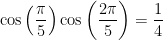
\displaystyle \cos \left( \frac{\pi}{5} \right)  \cos \left( \frac{2\pi}{5} \right) = \displaystyle \frac{1}{4},

and a regular 17-gon can be used to show that

\displaystyle \cos \left( \frac{\pi}{17} \right) \cos \left( \frac{2\pi}{17} \right) \cos \left( \frac{4\pi}{17} \right) \cos \left( \frac{8\pi}{17} \right) = \displaystyle \frac{1}{16}.

Computing e to Any Power (Part 5)

In this series, I’m exploring the following ancedote from the book Surely You’re Joking, Mr. Feynman!, which I read and re-read when I was young until I almost had the book memorized.

One day at Princeton I was sitting in the lounge and overheard some mathematicians talking about the series for e^x, which is 1 + x + x^2/2! + x^3/3! Each term you get by multiplying the preceding term by x and dividing by the next number. For example, to get the next term after x^4/4! you multiply that term by x and divide by 5. It’s very simple.

When I was a kid I was excited by series, and had played with this thing. I had computed e using that series, and had seen how quickly the new terms became very small.

I mumbled something about how it was easy to calculate e to any power using that series (you just substitute the power for x).

“Oh yeah?” they said. “Well, then what’s e to the 3.3?” said some joker—I think it was Tukey.

I say, “That’s easy. It’s 27.11.”

Tukey knows it isn’t so easy to compute all that in your head. “Hey! How’d you do that?”

Another guy says, “You know Feynman, he’s just faking it. It’s not really right.”

They go to get a table, and while they’re doing that, I put on a few more figures.: “27.1126,” I say.

They find it in the table. “It’s right! But how’d you do it!”

“I just summed the series.”

“Nobody can sum the series that fast. You must just happen to know that one. How about e to the 3?”

“Look,” I say. “It’s hard work! Only one a day!”

“Hah! It’s a fake!” they say, happily.

“All right,” I say, “It’s 20.085.”

They look in the book as I put a few more figures on. They’re all excited now, because I got another one right.

Here are these great mathematicians of the day, puzzled at how I can compute e to any power! One of them says, “He just can’t be substituting and summing—it’s too hard. There’s some trick. You couldn’t do just any old number like e to the 1.4.”

I say, “It’s hard work, but for you, OK. It’s 4.05.”

As they’re looking it up, I put on a few more digits and say, “And that’s the last one for the day!” and walk out.

What happened was this: I happened to know three numbers—the logarithm of 10 to the base e (needed to convert numbers from base 10 to base e), which is 2.3026 (so I knew that e to the 2.3 is very close to 10), and because of radioactivity (mean-life and half-life), I knew the log of 2 to the base e, which is.69315 (so I also knew that e to the.7 is nearly equal to 2). I also knew e (to the 1), which is 2. 71828.

The first number they gave me was e to the 3.3, which is e to the 2.3—ten—times e, or 27.18. While they were sweating about how I was doing it, I was correcting for the extra.0026—2.3026 is a little high.

I knew I couldn’t do another one; that was sheer luck. But then the guy said e to the 3: that’s e to the 2.3 times e to the.7, or ten times two. So I knew it was 20. something, and while they were worrying how I did it, I adjusted for the .693.

Now I was sure I couldn’t do another one, because the last one was again by sheer luck. But the guy said e to the 1.4, which is e to the.7 times itself. So all I had to do is fix up 4 a little bit!

They never did figure out how I did it.

My students invariably love this story; let’s take a look at the third calculation.

Feynman knew that e^{0.69315} \approx 2, so that

e^{0.69315} e^{0.69315} = e^{1.3863} \approx 2 \times 2 = 4.

Therefore, again using the Taylor series expansion:

e^{1.4} = e^{1.3863} e^{0.0137} = 4 e^{0.0137}

\approx 4 \times (1 + 0.0137)

= 4 + 4 \times 0.0137

\approx 4.05.

Again, I have no idea how he put on a few more digits in his head (other than his sheer brilliance), as this would require knowing the value of \ln 2 to six or seven digits as well as computing the next term in the Taylor series expansion.

Computing e to Any Power (Part 4)

In this series, I’m exploring the following ancedote from the book Surely You’re Joking, Mr. Feynman!, which I read and re-read when I was young until I almost had the book memorized.

One day at Princeton I was sitting in the lounge and overheard some mathematicians talking about the series for e^x, which is 1 + x + x^2/2! + x^3/3! Each term you get by multiplying the preceding term by x and dividing by the next number. For example, to get the next term after x^4/4! you multiply that term by x and divide by 5. It’s very simple.

When I was a kid I was excited by series, and had played with this thing. I had computed e using that series, and had seen how quickly the new terms became very small.

I mumbled something about how it was easy to calculate e to any power using that series (you just substitute the power for x).

“Oh yeah?” they said. “Well, then what’s e to the 3.3?” said some joker—I think it was Tukey.

I say, “That’s easy. It’s 27.11.”

Tukey knows it isn’t so easy to compute all that in your head. “Hey! How’d you do that?”

Another guy says, “You know Feynman, he’s just faking it. It’s not really right.”

They go to get a table, and while they’re doing that, I put on a few more figures.: “27.1126,” I say.

They find it in the table. “It’s right! But how’d you do it!”

“I just summed the series.”

“Nobody can sum the series that fast. You must just happen to know that one. How about e to the 3?”

“Look,” I say. “It’s hard work! Only one a day!”

“Hah! It’s a fake!” they say, happily.

“All right,” I say, “It’s 20.085.”

They look in the book as I put a few more figures on. They’re all excited now, because I got another one right.

Here are these great mathematicians of the day, puzzled at how I can compute e to any power! One of them says, “He just can’t be substituting and summing—it’s too hard. There’s some trick. You couldn’t do just any old number like e to the 1.4.”

I say, “It’s hard work, but for you, OK. It’s 4.05.”

As they’re looking it up, I put on a few more digits and say, “And that’s the last one for the day!” and walk out.

What happened was this: I happened to know three numbers—the logarithm of 10 to the base e (needed to convert numbers from base 10 to base e), which is 2.3026 (so I knew that e to the 2.3 is very close to 10), and because of radioactivity (mean-life and half-life), I knew the log of 2 to the base e, which is.69315 (so I also knew that e to the.7 is nearly equal to 2). I also knew e (to the 1), which is 2. 71828.

The first number they gave me was e to the 3.3, which is e to the 2.3—ten—times e, or 27.18. While they were sweating about how I was doing it, I was correcting for the extra.0026—2.3026 is a little high.

I knew I couldn’t do another one; that was sheer luck. But then the guy said e to the 3: that’s e to the 2.3 times e to the.7, or ten times two. So I knew it was 20. something, and while they were worrying how I did it, I adjusted for the .693.

Now I was sure I couldn’t do another one, because the last one was again by sheer luck. But the guy said e to the 1.4, which is e to the.7 times itself. So all I had to do is fix up 4 a little bit!

They never did figure out how I did it.

My students invariably love this story; let’s take a look at the second calculation.

Feynman knew that e^{2.3026} \approx 10 and e^{0.69315} \approx 2, so that

e^{2.3026} e^{0.69315} = e^{2.99575} \approx 10 \times 2 = 20.

Therefore, again using the Taylor series expansion:

e^3 = e^{2.99575} e^{0.00425} = 20 e^{0.00425}

\approx 20 \times (1 + 0.00425)

= 20 + 20 \times 0.00425

= 20.085.

Again, I have no idea how he put on a few more digits in his head (other than his sheer brilliance), as this would require knowing the values of \ln 10 and \ln 2 to six or seven digits as well as computing the next term in the Taylor series expansion:

e^3 = e^{\ln 20} e^{3 - \ln 20}

\approx 20 (1 +e^{ 0.0042677})

$\approx 20 \times \left(1 + 0.0042677 + \frac{0.0042677^2}{2!} \right)$

\approx 20.0855361\dots

This compares favorably with the actual answer, e^3 \approx 20.0855392\dots.