My Favorite One-Liners: Part 75

In this series, I’m compiling some of the quips and one-liners that I’ll use with my students to hopefully make my lessons more memorable for them.

The \delta-\epsilon definition of a limit is often really hard for students to swallow:

\forall \epsilon > 0 \exists \delta > 0 \forall x (0 < |x - c| < \delta \Rightarrow |f(x) - L| < \epsilon)

To make this a little more palatable, I’ll choose a simple specific example, like \lim_{x \to 2} x^2 = 4, or

\forall \epsilon > 0 \exists \delta > 0 \forall x (0 < |x - 2| < \delta \Rightarrow |x^2 - 4| < \epsilon)

I’ll use one of the famous lines from “Annie Get Your Gun”:

Anything you can do, I can do better.

In other words, no matter how small a \delta they give me, I can find an \epsilon that meets the requirements of this limit.


My Favorite One-Liners: Part 74

In this series, I’m compiling some of the quips and one-liners that I’ll use with my students to hopefully make my lessons more memorable for them.

After presenting the Fundamental Theorem of Calculus to my calculus students, I make a point of doing the following example in class:

\displaystyle \int_0^4 \frac{1}{4} x^2 \, dx

Hopefully my students are able to produce the correct answer:

\displaystyle \int_0^4 \frac{1}{4} x^2 \, dx = \displaystyle \left[ \frac{x^3}{12} \right]^4_0

= \displaystyle \frac{(4)^3}{12} - \frac{(0)^3}{12}

= \displaystyle \frac{64}{12}

= \displaystyle \frac{16}{3}

Then I tell my students that they’ve probably known the solution of this one since they were kids… and I show them the classic video “Unpack Your Adjectives” from Schoolhouse Rock. They’ll watch this video with no small amount of confusion (“How is this possibly connected to calculus?”)… until I reach the 1:15 mark of the video below, when I’ll pause and discuss this children’s cartoon. This never fails to get an enthusiastic response from my students.

If you have no idea what I’m talking about, be sure to watch the first 75 seconds of the video below. I think you’ll be amused.

My Favorite One-Liners: Part 73

In this series, I’m compiling some of the quips and one-liners that I’ll use with my students to hopefully make my lessons more memorable for them.

Today’s entry is courtesy of Season 1 of The Simpsons. I’ll tell this joke just after introducing derivatives to my calculus students. Here is some dialogue from the episode “Bart The Genius”:

Teacher:  So y = r cubed over 3. And if you determine the rate of change in this curve correctly, I think you’ll be pleasantly surprised.
[The class laughs except for Bart who appears confused.]
Teacher:  Don’t you get it, Bart? Derivative dy = 3 r squared dr over 3, or r squared dr, or r dr r. Har-de-har-har!  Get it?

For a more detailed listing of mathematical references, I highly recommend http://www.simpsonsmath.com (or http://mathsci2.appstate.edu/~sjg/simpsonsmath/), maintained by Dr. Sarah J. Greenwald of Appalachian State University and Dr. Andrew Nestler of Santa Monica College.

My Favorite One-Liners: Part 72

In this series, I’m compiling some of the quips and one-liners that I’ll use with my students to hopefully make my lessons more memorable for them.

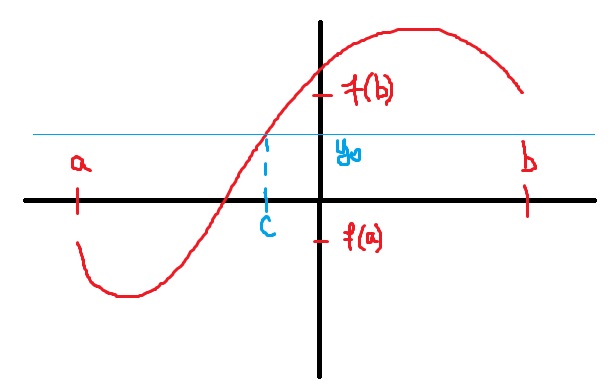
In calculus, the Intermediate Value Theorem states that if f is a continuous function on the closed interval [a,b] and y_0 is any number between f(a) and f(b), then there is at least one point c \in [a,b] so that $f(c) =y_0$.

When I first teach this, I’ll draw some kind of crude diagram on the board:

In this picture, f(a) is less than y_0 while f(b) is greater than y_0. Hence the one-liner:

I call the Intermediate Value Theorem the Goldilocks principle. After all, f(a) is too low, and f(b) is too high, but there is some point in between that is just right.


My Favorite One-Liners: Part 60

In this series, I’m compiling some of the quips and one-liners that I’ll use with my students to hopefully make my lessons more memorable for them.

I’m a big believer using scaffolded lesson plans, starting from elementary ideas and gradually building up to complicated ideas. For example, when teaching calculus, I’ll use the following sequence of problems to introduce students to finding the volume of a solid of revolution using disks, washers, and shells:

  • Find the volume of a cone with height h and base radius r.
  • Find the volume of the solid generated by revolving  the region bounded by y=2, y=2\sin x for 0 \le x \le \pi/2, and the y-axis about the line y=2.
  • Find the volume of the solid generated by revolving the region bounded by y=2, y=\sqrt{x}, and the y-axis about the line y=2 .
  • Find the volume of the solid generated by revolving the region bounded by y=2, y=\sqrt{x}, and the y-axis about the y-axis .
  • Find the volume of the solid generated by revolving the region bounded by x=\sqrt{2y}/(y+1), y=1, and the y-axis about the y-axis .
  • Find the volume of the solid generated by revolving  the region bounded by the parabola x=y^2+1 and the line x=3 about the line x=3.
  • Water is poured into a spherical tank of radius R to a depth h. How much water is in the tank?
  • Find the volume of the solid generated by revolving the region bounded by y= x^2, the x-axis, and x=4 about the x-axis.
  • Find the volume of the solid generated by revolving the region bounded by y= x^2, the x-axis, and x=4 about the y-axis.
  • Repeat the previous problem using cylindrical shells.

In this sequence of problems, I slowly get my students accustomed to the ideas of horizontal and vertical slices, integrating with respect to either x and y, the creation of disks and washers and (eventually) cylindrical shells.

As the problems increase in difficulty, I enjoy using the following punch line:

To quote the great philosopher Emeril Lagasse, “Let’s kick it up a notch.”

My Favorite One-Liners: Part 50

In this series, I’m compiling some of the quips and one-liners that I’ll use with my students to hopefully make my lessons more memorable for them.

Here’s today’s one-liner: “To prove that two things are equal, show that the difference is zero.” This principle is surprisingly handy in the secondary mathematics curriculum. For example, it is the basis for the proof of the Mean Value Theorem, one of the most important theorems in calculus that serves as the basis for curve sketching and the uniqueness of antiderivatives (up to a constant).

And I have a great story that goes along with this principle, from 30 years ago.

I forget the exact question out of Apostol’s calculus, but there was some equation that I had to prove on my weekly homework assignment that, for the life of me, I just couldn’t get. And for no good reason, I had a flash of insight: subtract the left- and right-hand sides. While it was very difficult to turn the left side into the right side, it turned out that, for this particular problem, was very easy to show that the difference was zero. (Again, I wish I could remember exactly which question this was so that I could show this technique and this particular example to my own students.)

So I finished my homework, and I went outside to a local basketball court and worked on my jump shot.

Later that week, I went to class, and there was a great buzz in the air. It took ten seconds to realize that everyone was up in arms about how to do this particular problem. Despite the intervening 30 years, I remember the scene as clear as a bell. I can still hear one of my classmates ask me, “Quintanilla, did you get that one?”

I said with great pride, “Yeah, I got it.” And I showed them my work.

And, either before then or since then, I’ve never heard the intensity of the cussing that followed.

Truth be told, probably the only reason that I remember this story from my adolescence is that I usually was the one who had to ask for help on the hardest homework problems in that Honors Calculus class. This may have been the one time in that entire two-year calculus sequence that I actually figured out a homework problem that had stumped everybody else.

My Favorite One-Liners: Part 29

In this series, I’m compiling some of the quips and one-liners that I’ll use with my students to hopefully make my lessons more memorable for them. Today’s quip is one that I’ll use when I need my students to remember something from a previous course — especially when it’s a difficult concept from a previous course — that somebody else taught them in a previous semester.

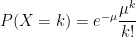
For example, in my probability class, I’ll introduce the Poisson distribution

P(X = k) = e^{-\mu} \displaystyle \frac{\mu^k}{k!},

where \mu > 0 and the permissible values of k are non-negative integers.

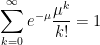
In particular, since these are probabilities and one and only one of these values can be taken, this means that

\displaystyle \sum_{k=0}^\infty e^{-\mu} \frac{\mu^k}{k!} = 1.

At this point, I want students to remember that they’ve actually seen this before, so I replace \mu by x and then multiply both sides by e^x:

\displaystyle \sum_{k=0}^\infty \frac{x^k}{k!} = e^x.

Of course, this is the Taylor series expansion for e^x. However, my experience is that most students have decidedly mixed feelings about Taylor series; often, it’s the last thing that they learn in Calculus II, which means it’s the first thing that they forget when the semester is over. Also, most students have a really hard time with Taylor series when they first learn about them.

So here’s my one-liner that I’ll say at this point: “Does this bring back any bad memories for anyone? Perhaps like an old Spice Girls song?” And this never fails to get an understanding laugh before I remind them about Taylor series.


My Favorite One-Liners: Part 25

In this series, I’m compiling some of the quips and one-liners that I’ll use with my students to hopefully make my lessons more memorable for them.

Consider the integral

\displaystyle \int_0^2 2x(1-x^2)^3 \, dx

The standard technique — other than multiplying it out — is using the substitution u = 1-x^2. With this substitution du = -2x \, dx. Also, x = 0 corresponds to u = 1, while x = 2 corresponds to u = -3. Therefore,

\displaystyle\int_0^2 2x(1-x^2)^3 \, dx = - \displaystyle\int_0^2 (-2x)(1-x^2)^3 \, dx = -\displaystyle\int_1^{-3} u^3 \, du.

My one-liner at this point is telling my students, “At this point, about 10,000 volts of electricity should be going down your spine.” I’ll use this line when a very unexpected result happens — like a “left” endpoint that’s greater than the “right” endpoint. Naturally, for this problem, the next step — though not logically necessary, it’s psychologically reassuring — is to absorb the negative sign by flipping the endpoints:

\displaystyle\int_0^2 2x(1-x^2)^3 \, dx =  -\displaystyle\int_1^{-3} u^3 \, du = \displaystyle\int_{-3}^1 u^3 \, du,

and then the calculation can continue.

My Favorite One-Liners: Part 24

In this series, I’m compiling some of the quips and one-liners that I’ll use with my students to hopefully make my lessons more memorable for them.

Here’s a problem that could appear in my class in probability or statistics:

Let f(x) = 3x^2 be a probability density function for 0 \le x \le 1. Find F(x) = P(X \le x), the cumulative distribution function of X.

A student’s first reaction might be to set up the integral as

\displaystyle \int_0^x 3x^2 \, dx

The problem with this set-up, of course, is that the letter x has already been reserved as the right endpoint for this definite integral. Therefore, inside the integral, we should choose any other letter — just not x — as the dummy variable.

Which sets up my one-liner: “In the words of the great philosopher Jean-Luc Picard: Plenty of letters left in the alphabet.”

We then write the integral as something like

\displaystyle \int_0^x 3t^2 \, dt

and then get on with the business of finding F(x).

My Favorite One-Liners: Part 8

In this series, I’m compiling some of the quips and one-liners that I’ll use with my students to hopefully make my lessons more memorable for them.

At many layers of the mathematics curriculum, students learn about that various functions can essentially commute with each other. In other words, the order in which the operations is performed doesn’t affect the final answer. Here’s a partial list off the top of my head:

  1. Arithmetic/Algebra: a \cdot (b + c) = a \cdot b + a \cdot c. This of course is commonly called the distributive property (and not the commutative property), but the essential idea is that the same answer is obtained whether the multiplications are performed first or if the addition is performed first.
  2. Algebra: If a,b > 0, then \sqrt{ab} = \sqrt{a} \sqrt{b}.
  3. Algebra: If a,b > 0 and x is any real number, then (ab)^x = a^x b^x.
  4. Precalculus: \displaystyle \sum_{i=1}^n (a_i+b_i) = \displaystyle \sum_{i=1}^n a_i + \sum_{i=1}^n b_i.
  5. Precalculus: \displaystyle \sum_{i=1}^n c a_i = c \displaystyle \sum_{i=1}^n a_i.
  6. Calculus: If f is continuous at an interior point c, then \displaystyle \lim_{x \to c} f(x) = f(c).
  7. Calculus: If f and g are differentiable, then (f+g)' = f' + g'.
  8. Calculus: If f is differentiable and c is a constant, then (cf)' = cf'.
  9. Calculus: If f and g are integrable, then \int (f+g) = \int f + \int g.
  10. Calculus: If f is integrable and c is a constant, then \int cf = c \int f.
  11. Calculus: If f: \mathbb{R}^2 \to \mathbb{R} is integrable, \iint f(x,y) dx dy = \iint f(x,y) dy dx.
  12. Calculus: For most differentiable function f: \mathbb{R}^2 \to \mathbb{R} that arise in practice, \displaystyle \frac{\partial^2 f}{\partial x \partial y} = \displaystyle \frac{\partial^2 f}{\partial y \partial x}.
  13. Probability: If X and Y are random variables, then E(X+Y) = E(X) + E(Y).
  14. Probability: If X is a random variable and c is a constant, then E(cX) = c E(X).
  15. Probability: If X and Y are independent random variables, then E(XY) = E(X) E(Y).
  16. Probability: If X and Y are independent random variables, then \hbox{Var}(X+Y) = \hbox{Var}(X) + \hbox{Var}(Y).
  17. Set theory: If A, B, and C are sets, then A \cup (B \cap C) = (A \cup B) \cap (A \cup C).
  18. Set theory: If A, B, and C are sets, then A \cap (B \cup C) = (A \cap B) \cup (A \cap C).

However, there are plenty of instances when two functions do not commute. Most of these, of course, are common mistakes that students make when they first encounter these concepts. Here’s a partial list off the top of my head. (For all of these, the inequality sign means that the two sides do not have to be equal… though there may be special cases when equality happens to happen.)

  1. Algebra: (a+b)^x \ne a^x + b^x if x \ne 1. Important special cases are x = 2, x = 1/2, and x = -1.
  2. Algebra/Precalculus: \log_b(x+y) = \log_b x + \log_b y. I call this the third classic blunder.
  3. Precalculus: (f \circ g)(x) \ne (g \circ f)(x).
  4. Precalculus: \sin(x+y) \ne \sin x + \sin y, \cos(x+y) \ne \cos x + \cos y, etc.
  5. Precalculus: \displaystyle \sum_{i=1}^n (a_i b_i) \ne \displaystyle \left(\sum_{i=1}^n a_i \right) \left( \sum_{i=1}^n b_i \right).
  6. Calculus: (fg)' \ne f' \cdot g'.
  7. Calculus \left( \displaystyle \frac{f}{g} \right)' \ne \displaystyle \frac{f'}{g'}
  8. Calculus: \int fg \ne \left( \int f \right) \left( \int g \right).
  9. Probability: If X and Y are dependent random variables, then E(XY) \ne E(X) E(Y).
  10. Probability: If X and Y are dependent random variables, then \hbox{Var}(X+Y) \ne \hbox{Var}(X) + \hbox{Var}(Y).

All this to say, it’s a big deal when two functions commute, because this doesn’t happen all the time.

green lineI wish I could remember the speaker’s name, but I heard the following one-liner at a state mathematics conference many years ago, and I’ve used it to great effect in my classes ever since. Whenever I present a property where two functions commute, I’ll say, “In other words, the order of operations does not matter. This is a big deal, because, in real life, the order of operations usually is important. For example, this morning, you probably got dressed and then went outside. The order was important.”