My Favorite One-Liners: Part 8

In this series, I’m compiling some of the quips and one-liners that I’ll use with my students to hopefully make my lessons more memorable for them.

At many layers of the mathematics curriculum, students learn about that various functions can essentially commute with each other. In other words, the order in which the operations is performed doesn’t affect the final answer. Here’s a partial list off the top of my head:

  1. Arithmetic/Algebra: a \cdot (b + c) = a \cdot b + a \cdot c. This of course is commonly called the distributive property (and not the commutative property), but the essential idea is that the same answer is obtained whether the multiplications are performed first or if the addition is performed first.
  2. Algebra: If a,b > 0, then \sqrt{ab} = \sqrt{a} \sqrt{b}.
  3. Algebra: If a,b > 0 and x is any real number, then (ab)^x = a^x b^x.
  4. Precalculus: \displaystyle \sum_{i=1}^n (a_i+b_i) = \displaystyle \sum_{i=1}^n a_i + \sum_{i=1}^n b_i.
  5. Precalculus: \displaystyle \sum_{i=1}^n c a_i = c \displaystyle \sum_{i=1}^n a_i.
  6. Calculus: If f is continuous at an interior point c, then \displaystyle \lim_{x \to c} f(x) = f(c).
  7. Calculus: If f and g are differentiable, then (f+g)' = f' + g'.
  8. Calculus: If f is differentiable and c is a constant, then (cf)' = cf'.
  9. Calculus: If f and g are integrable, then \int (f+g) = \int f + \int g.
  10. Calculus: If f is integrable and c is a constant, then \int cf = c \int f.
  11. Calculus: If f: \mathbb{R}^2 \to \mathbb{R} is integrable, \iint f(x,y) dx dy = \iint f(x,y) dy dx.
  12. Calculus: For most differentiable function f: \mathbb{R}^2 \to \mathbb{R} that arise in practice, \displaystyle \frac{\partial^2 f}{\partial x \partial y} = \displaystyle \frac{\partial^2 f}{\partial y \partial x}.
  13. Probability: If X and Y are random variables, then E(X+Y) = E(X) + E(Y).
  14. Probability: If X is a random variable and c is a constant, then E(cX) = c E(X).
  15. Probability: If X and Y are independent random variables, then E(XY) = E(X) E(Y).
  16. Probability: If X and Y are independent random variables, then \hbox{Var}(X+Y) = \hbox{Var}(X) + \hbox{Var}(Y).
  17. Set theory: If A, B, and C are sets, then A \cup (B \cap C) = (A \cup B) \cap (A \cup C).
  18. Set theory: If A, B, and C are sets, then A \cap (B \cup C) = (A \cap B) \cup (A \cap C).

However, there are plenty of instances when two functions do not commute. Most of these, of course, are common mistakes that students make when they first encounter these concepts. Here’s a partial list off the top of my head. (For all of these, the inequality sign means that the two sides do not have to be equal… though there may be special cases when equality happens to happen.)

  1. Algebra: (a+b)^x \ne a^x + b^x if x \ne 1. Important special cases are x = 2, x = 1/2, and x = -1.
  2. Algebra/Precalculus: \log_b(x+y) = \log_b x + \log_b y. I call this the third classic blunder.
  3. Precalculus: (f \circ g)(x) \ne (g \circ f)(x).
  4. Precalculus: \sin(x+y) \ne \sin x + \sin y, \cos(x+y) \ne \cos x + \cos y, etc.
  5. Precalculus: \displaystyle \sum_{i=1}^n (a_i b_i) \ne \displaystyle \left(\sum_{i=1}^n a_i \right) \left( \sum_{i=1}^n b_i \right).
  6. Calculus: (fg)' \ne f' \cdot g'.
  7. Calculus \left( \displaystyle \frac{f}{g} \right)' \ne \displaystyle \frac{f'}{g'}
  8. Calculus: \int fg \ne \left( \int f \right) \left( \int g \right).
  9. Probability: If X and Y are dependent random variables, then E(XY) \ne E(X) E(Y).
  10. Probability: If X and Y are dependent random variables, then \hbox{Var}(X+Y) \ne \hbox{Var}(X) + \hbox{Var}(Y).

All this to say, it’s a big deal when two functions commute, because this doesn’t happen all the time.

green lineI wish I could remember the speaker’s name, but I heard the following one-liner at a state mathematics conference many years ago, and I’ve used it to great effect in my classes ever since. Whenever I present a property where two functions commute, I’ll say, “In other words, the order of operations does not matter. This is a big deal, because, in real life, the order of operations usually is important. For example, this morning, you probably got dressed and then went outside. The order was important.”


What I Learned by Reading “Gamma: Exploring Euler’s Constant” by Julian Havil: Index

I’m doing something that I should have done a long time ago: collecting a series of posts into one single post.

When I was researching for my series of posts on conditional convergence, especially examples related to the constant \gamma, the reference Gamma: Exploring Euler’s Constant by Julian Havil kept popping up. Finally, I decided to splurge for the book, expecting a decent popular account of this number. After all, I’m a professional mathematician, and I took a graduate level class in analytic number theory. In short, I don’t expect to learn a whole lot when reading a popular science book other than perhaps some new pedagogical insights.

Boy, was I wrong. As I turned every page, it seemed I hit a new factoid that I had not known before.

In this series, I’d like to compile some of my favorites along with the page numbers in the book — while giving the book a very high recommendation.

Part 1: The smallest value of n so that 1 + \frac{1}{2} + \dots + \frac{1}{n} > 100 (page 23).

Part 2: Except for a couple select values of m<n, the sum \frac{1}{m} + \frac{1}{m+1} + \dots + \frac{1}{n} is never an integer (pages 24-25).

Part 3: The sum of the reciprocals of the twin primes converges (page 30).

Part 4: Euler somehow calculated \zeta(26) without a calculator (page 41).

Part 5: The integral called the Sophomore’s Dream (page 44).

Part 6: St. Augustine’s thoughts on mathematicians — in context, astrologers (page 65).

Part 7: The probability that two randomly selected integers have no common factors is 6/\pi^2 (page 68).

Part 8: The series for quickly computing \gamma to high precision (page 89).

Part 9: An observation about the formulas for 1^k + 2^k + \dots + n^k (page 81).

Part 10: A lower bound for the gap between successive primes (page 115).

Part 11: Two generalizations of \gamma (page 117).

Part 12: Relating the harmonic series to meteorological records (page 125).

Part 13: The crossing-the-desert problem (page 127).

Part 14: The worm-on-a-rope problem (page 133).

Part 15: An amazingly nasty formula for the nth prime number (page 168).

Part 16: A heuristic argument for the form of the prime number theorem (page 172).

Part 17: Oops.

Part 18: The Riemann Hypothesis can be stated in a form that can be understood by high school students (page 207).


Computing e to Any Power: Index

I’m doing something that I should have done a long time ago: collecting a series of posts into one single post. The following links comprised my series examining one of Richard Feynman’s anecdotes about mentally computing e^x for three different values of x.

Part 1: Feynman’s anecdote.

Part 2: Logarithm and antilogarithm tables from the 1940s.

Part 3: A closer look at Feynman’s computation of e^{3.3}.

Part 4: A closer look at Feynman’s computation of e^{3}.

Part 5: A closer look at Feynman’s computation of e^{1.4}.


A Natural Function with Discontinuities: Index

I’m doing something that I should have done a long time ago: collecting a series of posts into one single post. The following links comprised my series on a natural function that nevertheless has discontinuities.

Part 1: Introduction

Part 2: Derivation of this piecewise function, beginning.

Part 3: Derivation of the piecewise function, ending.


What I Learned from Reading “Gamma: Exploring Euler’s Constant” by Julian Havil: Part 11

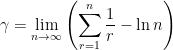
The Euler-Mascheroni  constant \gamma is defined by

\gamma = \displaystyle \lim_{n \to \infty} \left( \sum_{r=1}^n \frac{1}{r} - \ln n \right).

What I didn’t know, until reading Gamma (page 117), is that there are at least two ways to generalize this definition.

First, \gamma may be thought of as

\gamma = \displaystyle \lim_{n \to \infty} \left( \sum_{r=1}^n \frac{1}{\hbox{length of~} [0,r]} - \ln n \right),

and so this can be generalized to two dimensions as follows:

\delta = \displaystyle \lim_{n \to \infty} \left( \sum_{r=2}^n \frac{1}{\pi (\rho_r)^2} - \ln n \right),

where \rho_r is the radius of the smallest disk in the plane containing at least r points (a,b) so that a and b are both integers. This new constant \delta is called the Masser-Gramain constant; like \gamma, the exact value isn’t known.

green line

Second, let f(x) = \displaystyle \frac{1}{x}. Then \gamma may be written as

\gamma = \displaystyle \lim_{n \to \infty} \left( \sum_{r=1}^n f(r) - \int_1^n f(x) \, dx \right).

Euler (not surprisingly) had the bright idea of changing the function f(x) to any other positive, decreasing function, such as

f(x) = x^a, \qquad -1 \le a < 0,

producing Euler’s generalized constants. Alternatively (from Stieltjes), we could choose

f(x) = \displaystyle \frac{ (\ln x)^m }{x}.

green line

When I researching for my series of posts on conditional convergence, especially examples related to the constant \gamma, the reference Gamma: Exploring Euler’s Constant by Julian Havil kept popping up. Finally, I decided to splurge for the book, expecting a decent popular account of this number. After all, I’m a professional mathematician, and I took a graduate level class in analytic number theory. In short, I don’t expect to learn a whole lot when reading a popular science book other than perhaps some new pedagogical insights.

Boy, was I wrong. As I turned every page, it seemed I hit a new factoid that I had not known before.

In this series, I’d like to compile some of my favorites — while giving the book a very high recommendation.

What I Learned from Reading “Gamma: Exploring Euler’s Constant” by Julian Havil: Part 8

I had always wondered how the constant \gamma can be computed to high precision. I probably should have known this already, but here’s one way that it can be computed (Gamma, page 89):

\gamma = \displaystyle \sum_{k=1}^n \frac{1}{k} - \ln n - \sum_{k=1}^{\infty} \frac{B_{2k}}{2k \cdot n^{2k}},

where B_{2k} is the 2kth Bernoulli number.


green line

When I researching for my series of posts on conditional convergence, especially examples related to the constant \gamma, the reference Gamma: Exploring Euler’s Constant by Julian Havil kept popping up. Finally, I decided to splurge for the book, expecting a decent popular account of this number. After all, I’m a professional mathematician, and I took a graduate level class in analytic number theory. In short, I don’t expect to learn a whole lot when reading a popular science book other than perhaps some new pedagogical insights.

Boy, was I wrong. As I turned every page, it seemed I hit a new factoid that I had not known before.

In this series, I’d like to compile some of my favorites — while giving the book a very high recommendation.

What I Learned from Reading “Gamma: Exploring Euler’s Constant” by Julian Havil: Part 5

Check out this lovely integral, dubbed the Sophomore’s Dream, found by Johann Bernoulli in 1697 (Gamma, page 44):

\displaystyle \int_0^1 \frac{dx}{x^x} = \displaystyle \frac{1}{1^1} + \frac{1}{2^2} + \frac{1}{3^3} + \frac{1}{4^4} + \dots.

I’ll refer to either Wikipedia or Mathworld for the derivation.

green line

When I researching for my series of posts on conditional convergence, especially examples related to the constant \gamma, the reference Gamma: Exploring Euler’s Constant by Julian Havil kept popping up. Finally, I decided to splurge for the book, expecting a decent popular account of this number. After all, I’m a professional mathematician, and I took a graduate level class in analytic number theory. In short, I don’t expect to learn a whole lot when reading a popular science book other than perhaps some new pedagogical insights.

Boy, was I wrong. As I turned every page, it seemed I hit a new factoid that I had not known before.

In this series, I’d like to compile some of my favorites — while giving the book a very high recommendation.

What I Learned from Reading “Gamma: Exploring Euler’s Constant” by Julian Havil: Part 4

For s > 1, Riemann’s famous zeta function is defined by

\zeta(s) = \displaystyle \sum_{n=1}^{\infty} \frac{1}{n^s}.

This is also called a p-series in calculus.

What I didn’t know (Gamma, page 41) is that, in 1748, Leonhard Euler exactly computed this infinite series for s = 26 without a calculator! Here’s the answer:

\displaystyle 1 + \frac{1}{2^{26}} + \frac{1}{3^{26}} + \frac{1}{4^{26}} + \dots = \frac{1,315,862 \pi^{26}}{11,094,481,976,030,578,125}.

I knew that Euler was an amazing human calculator, but I didn’t know he was that amazing.

green line

When I researching for my series of posts on conditional convergence, especially examples related to the constant \gamma, the reference Gamma: Exploring Euler’s Constant by Julian Havil kept popping up. Finally, I decided to splurge for the book, expecting a decent popular account of this number. After all, I’m a professional mathematician, and I took a graduate level class in analytic number theory. In short, I don’t expect to learn a whole lot when reading a popular science book other than perhaps some new pedagogical insights.

Boy, was I wrong. As I turned every page, it seemed I hit a new factoid that I had not known before.

In this series, I’d like to compile some of my favorites — while giving the book a very high recommendation.

What I Learned from Reading “Gamma: Exploring Euler’s Constant” by Julian Havil: Part 3

At the time of this writing, it is unknown if there are infinitely many twin primes, which are prime numbers that differ by 2 (like 3 and 5, 5 and 7, 11 and 13, 17 and 19, etc.) However, significant progress has been made in recent years. However, it is known (Gamma, page 30) the sum of the reciprocals of the twin primes converges:

\displaystyle \left( \frac{1}{3} + \frac{1}{5} \right) + \left( \frac{1}{5} + \frac{1}{7} \right) + \left( \frac{1}{11} + \frac{1}{13} \right) + \left( \frac{1}{17} + \frac{1}{19} \right) = 1.9021605824\dots.

This constant is known as Brun’s constant (see also Mathworld). In the process of computing this number, the infamous 1994 Pentium bug was found.

Although this sum is finite, it’s still unknown if there are infinitely many twin primes since it’s possible for an infinite sum to converge (like a geometric series).

green line

When I researching for my series of posts on conditional convergence, especially examples related to the constant \gamma, the reference Gamma: Exploring Euler’s Constant by Julian Havil kept popping up. Finally, I decided to splurge for the book, expecting a decent popular account of this number. After all, I’m a professional mathematician, and I took a graduate level class in analytic number theory. In short, I don’t expect to learn a whole lot when reading a popular science book other than perhaps some new pedagogical insights.

Boy, was I wrong. As I turned every page, it seemed I hit a new factoid that I had not known before.

In this series, I’d like to compile some of my favorites — while giving the book a very high recommendation.

What I Learned from Reading “Gamma: Exploring Euler’s Constant” by Julian Havil: Part 2

Let’s define partial sums of the harmonic series as follows:

H(m,n) = \displaystyle \frac{1}{m} + \frac{1}{m+1} + \frac{1}{m+2} + \dots + \frac{1}{n-1} + \frac{1}{n},

where m < n are positive integers. Here are a couple of facts that I didn’t know before reading Gamma (pages 24-25):

  • H(m,n) is never equal to an integer.
  • The only values of n for which H(1,n) is an integer are n = 2 and n=6.

green line

When I researching for my series of posts on conditional convergence, especially examples related to the constant \gamma, the reference Gamma: Exploring Euler’s Constant by Julian Havil kept popping up. Finally, I decided to splurge for the book, expecting a decent popular account of this number. After all, I’m a professional mathematician, and I took a graduate level class in analytic number theory. In short, I don’t expect to learn a whole lot when reading a popular science book other than perhaps some new pedagogical insights.

Boy, was I wrong. As I turned every page, it seemed I hit a new factoid that I had not known before.

In this series, I’d like to compile some of my favorites — while giving the book a very high recommendation.