This was hands-down my favorite variant of the “distracted boyfriend” meme that went around the internet last year.
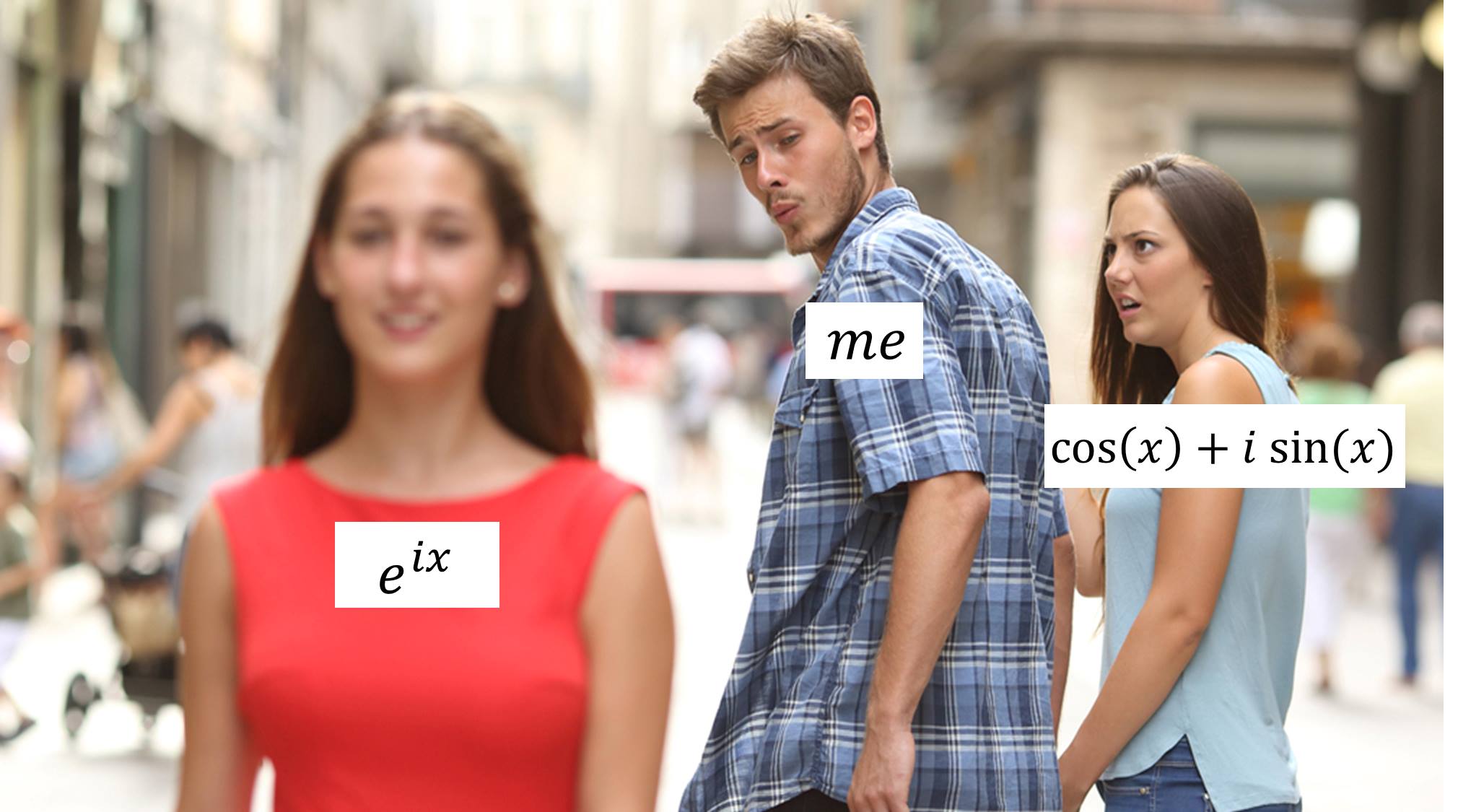
This was hands-down my favorite variant of the “distracted boyfriend” meme that went around the internet last year.
In this series, I’m compiling some of the quips and one-liners that I’ll use with my students to hopefully make my lessons more memorable for them.
I use today’s quip when discussing the Taylor series expansions for sine and/or cosine:
To try to convince students that these intimidating formulas are indeed correct, I’ll ask them to pull out their calculators and compute the first three terms of the above expansion for $x=0.2$, and then compute 
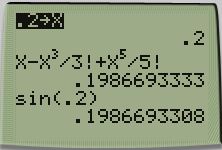
This generates a pretty predictable reaction, “Whoa; it actually works!” Of course, this shouldn’t be a surprise; calculators actually use the Taylor series expansion (and a few trig identity tricks) when calculating sines and cosines. So, I’ll tell my class,
It’s not like your calculator draws a right triangle, takes out a ruler to measure the lengths of the opposite side and the hypotenuse, and divides to find the sine of an angle.
In this series, I’m compiling some of the quips and one-liners that I’ll use with my students to hopefully make my lessons more memorable for them.
I’ll use today’s one-liner to give students my expectations about simplifying incredibly complicated answers. For example,
Find
if
.
Using the rules for differentiation,
With some effort, this simplifies somewhat:
Still, the answer is undeniably ugly, and students have been well-trained by their previous mathematical education to think the final answers are never that messy. So, if they want to try to simplify it further, I’ll give them this piece of wisdom:
You can lipstick on a pig, but it remains a pig.
In this series, I’m compiling some of the quips and one-liners that I’ll use with my students to hopefully make my lessons more memorable for them.
I’ll use today’s one-liner when the final answer is a hideous mess. For example,
Find
The answer isn’t pretty:
This leads to the only possible response:
As all the King’s horses and all the King’s men said when discovering Humpty Dumpty… yuck.
In this series, I’m compiling some of the quips and one-liners that I’ll use with my students to hopefully make my lessons more memorable for them.
I’ll use today’s one-liner when a choice has to be made between two different techniques of approximately equal difficulty. For example:
Calculate 

There are two reasonable options for calculating this double integral.
 first:
 first:
Both techniques require about the same amount of effort before getting the final answer. So which technique should we choose? Well, as the instructor, I realize that it really doesn’t matter, so I’ll throw it open for a student vote by asking my class:
Anyone ever read the Choose Your Own Adventure books when you were kids?
After the class decides which technique to use, then we’ll set off on the adventure of computing the double integral.
This quip also works well when finding the volume of a solid of revolution. We teach our students two different techniques for finding such volumes: disks/washers and cylindrical shells. If it’s a toss-up as to which technique is best, I’ll let the class vote as to which technique to use before computing the volume.
In this series, I’m compiling some of the quips and one-liners that I’ll use with my students to hopefully make my lessons more memorable for them.
Today’s quip is a light-hearted one-liner that I’ll use to lighten the mood when in the middle of a complex calculation, like the following limit problem from calculus:
Let
. Find
so that
whenever $|x-2| < \delta$.
The solution of this problem requires isolating
At this point, the next step is dividing by 
When we divide by
This usually gets the desired laugh out of the middle-school rule about how the insatiable “crocodiles” of an inequality always point to the larger quantity, leading to the next step:
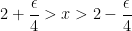
so that
![\delta = \min \left( \left[ 2 + \displaystyle \frac{\epsilon}{4} \right] - 2, 2 - \left[2 - \displaystyle \frac{\epsilon}{4} \right] \right) = \displaystyle \frac{\epsilon}{4}](https://s0.wp.com/latex.php?latex=%5Cdelta+%3D+%5Cmin+%5Cleft%28+%5Cleft%5B+2+%2B+%5Cdisplaystyle+%5Cfrac%7B%5Cepsilon%7D%7B4%7D+%5Cright%5D+-+2%2C+2+-+%5Cleft%5B2+-+%5Cdisplaystyle+%5Cfrac%7B%5Cepsilon%7D%7B4%7D+%5Cright%5D+%5Cright%29+%3D+%5Cdisplaystyle+%5Cfrac%7B%5Cepsilon%7D%7B4%7D&bg=ffffff&fg=000000&s=0&c=20201002)
Formally completing the proof requires starting with 
In this series, I’m compiling some of the quips and one-liners that I’ll use with my students to hopefully make my lessons more memorable for them.
Everyone once in a while, a student might make a careless mistake — or just choose an incorrect course of action — that changes what was supposed to be a simple problem into an incredibly difficult problem. For example, here’s a problem that might arise in Calculus I:
Find
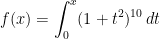
The easy way to do this problem, requiring about 15 seconds to complete, is to use the Fundamental Theorem of Calculus. The hard way is by multiplying out 
So here’s the advice that I give my students to trying to discourage them from following such rabbit trails:
If you find yourself stuck on what seems to be an incredibly difficult problem, you should ask yourself, “Just how evil do I think my professor is?”
In this series, I’m compiling some of the quips and one-liners that I’ll use with my students to hopefully make my lessons more memorable for them.
In the first few weeks of my calculus class, after introducing the definition of a derivative,

I’ll use the following steps to guide my students to find the derivatives of polynomials.
 , a constant, then
  .
. and
and  are both differentiable, then
  . is differentiable and
  is a constant, then
  .
. , where
  is a nonnegative integer, then
  .
. is a polynomial, then
  .
.After doing a few examples to help these concepts sink in, I’ll show the following two examples with about 3-4 minutes left in class.
Example 1. Let
. Notice I’ve changed the variable from
, but that’s OK. Does this remind you of anything? (Students answer: the area of a circle.)
What’s the derivative? Remember,
is just a constant. So
.
Does this remind you of anything? (Students answer: Whoa… the circumference of a circle.)
Generally, students start waking up even though it’s near the end of class. I continue:
Example 2. Now let’s try
. Does this remind you of anything? (Students answer: the volume of a sphere.)
What’s the derivative? Again,
is just a constant. So
.
Does this remind you of anything? (Students answer: Whoa… the surface area of a sphere.)
By now, I’ve really got my students’ attention with this unexpected connection between these formulas from high school geometry. If I’ve timed things right, I’ll say the following with about 30-60 seconds left in class:
Hmmm. That’s interesting. The derivative of the area of a circle is the circumference of the circle, and the derivative of the area of a sphere is the surface area of the sphere. I wonder why this works. Any ideas? (Students: stunned silence.)
This is what’s known as a cliff-hanger, and I’ll give you the answer at the start of class tomorrow. (Students groan, as they really want to know the answer immediately.) Class is dismissed.
If you’d like to see the answer, see my previous post on this topic.
In this series, I’m compiling some of the quips and one-liners that I’ll use with my students to hopefully make my lessons more memorable for them.
When teaching Calculus I, I use the following mantra throughout the semester. I heard this from my calculus instructor back in 1984, and I repeat it for my own students:
There are two themes of calculus: approximating curved things by straight things, and passing to limits.
For example, to find a derivative, we approximate a curved function by a straight tangent line and then pass to a limit. Later in the semester, to find a definite integral, we approximate the area under a curve by the sum of a bunch of straight rectangles and then pass to a limit.
For further reading, I’ll refer to this series of posts on what I typically do on the first day of my calculus class.
In this series, I’m compiling some of the quips and one-liners that I’ll use with my students to hopefully make my lessons more memorable for them.
Here’s a problem from calculus:
Let 

We begin by finding the first derivative using the Product Rule:

Next, we apply the Product Rule again to find the second derivative:

At this point, before simplifying to get the final answer, I’ll ask my students why the 


I then tell my class that there’s a technical term for this: Oops, I did it again.
While on the topic, I can’t resist also sharing this (a few years ago, this was shown on the JumboTron of Dallas Mavericks games during timeouts):


![f(x) = \displaystyle \frac{[\sqrt{x} \csc^5 (\sqrt{x} )]'(x^2+1) -[\sqrt{x} \csc^5 (\sqrt{x} )](x^2+1)' }{(x^2+1)^2}](https://s0.wp.com/latex.php?latex=f%28x%29+%3D+%5Cdisplaystyle+%5Cfrac%7B%5B%5Csqrt%7Bx%7D+%5Ccsc%5E5+%28%5Csqrt%7Bx%7D+%29%5D%27%28x%5E2%2B1%29+-%5B%5Csqrt%7Bx%7D+%5Ccsc%5E5+%28%5Csqrt%7Bx%7D+%29%5D%28x%5E2%2B1%29%27+%7D%7B%28x%5E2%2B1%29%5E2%7D&bg=ffffff&fg=000000&s=0&c=20201002)
 - \sqrt{x} \csc^5 (\sqrt{x} )](2x) }{(x^2+1)^2}](https://s0.wp.com/latex.php?latex=%3D+%5Cdisplaystyle+%5Cfrac%7B%5B%28%5Csqrt%7Bx%7D%29%27+%5Ccsc%5E5+%28%5Csqrt%7Bx%7D+%29+%2B+%5Csqrt%7Bx%7D+%28%5Ccsc%5E5%28%5Csqrt%7Bx%7D%29%29%27%5D%28x%5E2%2B1%29+-+%5Csqrt%7Bx%7D+%5Ccsc%5E5+%28%5Csqrt%7Bx%7D+%29%5D%282x%29+%7D%7B%28x%5E2%2B1%29%5E2%7D&bg=ffffff&fg=000000&s=0&c=20201002)
![= \displaystyle \frac{[\frac{1}{2\sqrt{x}} \csc^5 (\sqrt{x} ) + 5 \sqrt{x} \csc^4(\sqrt{x}) [-\csc(\sqrt{x})\cot(\sqrt{x})]\frac{1}{2\sqrt{x}}(x^2+1) - \sqrt{x} \csc^5 (\sqrt{x} )](2x) }{(x^2+1)^2}](https://s0.wp.com/latex.php?latex=%3D+%5Cdisplaystyle+%5Cfrac%7B%5B%5Cfrac%7B1%7D%7B2%5Csqrt%7Bx%7D%7D+%5Ccsc%5E5+%28%5Csqrt%7Bx%7D+%29+%2B+5+%5Csqrt%7Bx%7D%C2%A0+%5Ccsc%5E4%28%5Csqrt%7Bx%7D%29+%5B-%5Ccsc%28%5Csqrt%7Bx%7D%29%5Ccot%28%5Csqrt%7Bx%7D%29%5D%5Cfrac%7B1%7D%7B2%5Csqrt%7Bx%7D%7D%28x%5E2%2B1%29+-+%5Csqrt%7Bx%7D+%5Ccsc%5E5+%28%5Csqrt%7Bx%7D+%29%5D%282x%29+%7D%7B%28x%5E2%2B1%29%5E2%7D&bg=ffffff&fg=000000&s=0&c=20201002)