
Often intuitive appeals for the proof of the Product Rule rely on pictures like the following:

The above picture comes from https://mrchasemath.com/2017/04/02/the-product-rule/, which notes the intuitive appeal of the argument but also its lack of rigor.
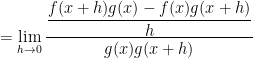
My preferred technique is to use the above rectangle picture but make it more rigorous. Assuming that the functions 


In other words,
![f(x+h) g(x+h) - f(x) g(x) = f(x+h) [g(x+h) - g(x)] + [f(x+h) - f(x)] g(x)](https://s0.wp.com/latex.php?latex=f%28x%2Bh%29+g%28x%2Bh%29+-+f%28x%29+g%28x%29+%3D+f%28x%2Bh%29+%5Bg%28x%2Bh%29+-+g%28x%29%5D+%2B+%5Bf%28x%2Bh%29+-+f%28x%29%5D+g%28x%29&bg=ffffff&fg=000000&s=0&c=20201002)
or

This gives a geometrical way of explaining this otherwise counterintuitive step for students not used to adding by a form of 0. I make a point of noting that we took one term, 



![[(fg)(x)]' = \displaystyle \lim_{h \to 0} \frac{f(x+h) g(x+h) - f(x) g(x)}{h}](https://s0.wp.com/latex.php?latex=%5B%28fg%29%28x%29%5D%27+%3D+%5Cdisplaystyle+%5Clim_%7Bh+%5Cto+0%7D+%5Cfrac%7Bf%28x%2Bh%29+g%28x%2Bh%29+-+f%28x%29+g%28x%29%7D%7Bh%7D&bg=ffffff&fg=000000&s=0&c=20201002)
![\displaystyle = \lim_{h \to 0} \frac{f(x+h) [g(x+h) - g(x)]}{h} + \lim_{h\ to 0} \frac{[f(x+h) - f(x)] g(x)}{h}](https://s0.wp.com/latex.php?latex=%5Cdisplaystyle+%3D+%5Clim_%7Bh+%5Cto+0%7D+%5Cfrac%7Bf%28x%2Bh%29+%5Bg%28x%2Bh%29+-+g%28x%29%5D%7D%7Bh%7D+%2B+%5Clim_%7Bh%5C+to+0%7D+%5Cfrac%7B%5Bf%28x%2Bh%29+-+f%28x%29%5D+g%28x%29%7D%7Bh%7D&bg=ffffff&fg=000000&s=0&c=20201002)


For what it’s worth, a Google Images search for proofs of the Product Rule yielded plenty of pictures like the one at the top of this post but did not yield any pictures remotely similar to the green and blue rectangles above. This suggests to me that the above approach of motivating this critical step of this derivation might not be commonly known.
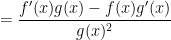
Once students have been introduced to the idea of adding by a form of 0, my experience is that the proof of the Quotient Rule is much more palatable. I’m unaware of a geometric proof that I would be willing to try with students (a description of the best attempt I’ve seen can be found here), and so adding by a form of 0 becomes unavoidable. The proof begins
![\left[\left( \displaystyle \frac{f}{g} \right)(x) \right]' = \displaystyle \lim_{h \to 0} \frac{ \displaystyle \frac{f(x+h)}{ g(x+h)} - \frac{f(x)}{ g(x)}}{h}](https://s0.wp.com/latex.php?latex=%5Cleft%5B%5Cleft%28+%5Cdisplaystyle+%5Cfrac%7Bf%7D%7Bg%7D+%5Cright%29%28x%29+%5Cright%5D%27+%3D+%5Cdisplaystyle+%5Clim_%7Bh+%5Cto+0%7D+%5Cfrac%7B+%5Cdisplaystyle+%5Cfrac%7Bf%28x%2Bh%29%7D%7B+g%28x%2Bh%29%7D+-+%5Cfrac%7Bf%28x%29%7D%7B+g%28x%29%7D%7D%7Bh%7D&bg=ffffff&fg=000000&s=0&c=20201002)


At this point, I ask my students what we should add and subtract this time to complete the derivation. Given the previous experience with the Product Rule, students are usually quick to chose one factor from the first term and another factor from the second term, usually picking 
![[(fg)(x)]' = \displaystyle \lim_{h \to 0} \frac{ \displaystyle \frac{f(x+h) g(x) - f(x) g(x+h)}{h }}{g(x) g(x+h)}](https://s0.wp.com/latex.php?latex=%5B%28fg%29%28x%29%5D%27+%3D+%5Cdisplaystyle+%5Clim_%7Bh+%5Cto+0%7D+%5Cfrac%7B+%5Cdisplaystyle+%5Cfrac%7Bf%28x%2Bh%29+g%28x%29+-+f%28x%29+g%28x%2Bh%29%7D%7Bh+%7D%7D%7Bg%28x%29+g%28x%2Bh%29%7D&bg=ffffff&fg=000000&s=0&c=20201002)


![= \displaystyle \lim_{h \to 0} \frac{ \displaystyle \frac{[f(x+h) - f(x)] g(x)}{h} - \frac{f(x) [g(x+h) - g(x)]}{h }}{g(x) g(x+h)}](https://s0.wp.com/latex.php?latex=%3D+%5Cdisplaystyle+%5Clim_%7Bh+%5Cto+0%7D+%5Cfrac%7B+%5Cdisplaystyle+%5Cfrac%7B%5Bf%28x%2Bh%29+-+f%28x%29%5D+g%28x%29%7D%7Bh%7D+-+%5Cfrac%7Bf%28x%29+%5Bg%28x%2Bh%29+-+g%28x%29%5D%7D%7Bh+%7D%7D%7Bg%28x%29+g%28x%2Bh%29%7D&bg=ffffff&fg=000000&s=0&c=20201002)

 P.S.
P.S.
- The website https://mrchasemath.com/2017/04/02/the-product-rule/ also suggests an interesting pedagogical idea: before giving the formal proof of the Product Rule, use a particular function and the limit definition of a derivative so that students can intuitively guess the form of the rule. For example, if
:

- See also this previous post for another way of deriving the Product Rule without adding or subtracting the same quantity.

![\displaystyle = \lim_{h \to 0} \left[ \frac{f(x+h) g(x+h) - f(x+h) g(x)}{h} + \frac{f(x+h) g(x) - f(x) g(x)}{h} \right]](https://s0.wp.com/latex.php?latex=%5Cdisplaystyle+%3D+%5Clim_%7Bh+%5Cto+0%7D+%5Cleft%5B+%5Cfrac%7Bf%28x%2Bh%29+g%28x%2Bh%29+-+f%28x%2Bh%29+g%28x%29%7D%7Bh%7D+%2B+%5Cfrac%7Bf%28x%2Bh%29+g%28x%29+-+f%28x%29+g%28x%29%7D%7Bh%7D+%5Cright%5D&bg=ffffff&fg=000000&s=0&c=20201002)



 into
into  . If they were to convert
 or
or  is larger. The final answer, involving the number
  , was a complete surprise to me.
 for all positive
  .
.

 Mean Green Math