Engaging students: Multiplying binomials

In my capstone class for future secondary math teachers, I ask my students to come up with ideas for engaging their students with different topics in the secondary mathematics curriculum. In other words, the point of the assignment was not to devise a full-blown lesson plan on this topic. Instead, I asked my students to think about three different ways of getting their students interested in the topic in the first place.

I plan to share some of the best of these ideas on this blog (after asking my students’ permission, of course).

This student submission again comes from my former student Andy Nabors. His topic, from Algebra: multiplying binomials.

green line

A2. How could you as a teacher create an activity or project that involves your topic?

Multiplying binomials is an interesting concept because there are so many ways in which this can be done. I can think of five ways that binomials can be multiplied: FOIL, the box method, distribution, vertical multiplication, and with algebra tiles. I would incorporate these methods into one of two different ways. In either case, I would split the class into five groups.

  1. In the first way, I would assign each group a different method of multiplication. The groups would each be responsible for exploring their method, working together to master it. Then each group would be responsible for making a poster describing their method in detail. Then would then present their poster to the class, and the students not presenting would be taking notes. Already having one concept of binomial multiplication, the students would be seeing other methods and deciding which makes most sense to them.
  2. In my second idea, I would have five stations in the classroom each with their own method. The groups would rotate station to station figuring out the different methods collaboratively. The groups would rotate every 7-10 minutes until they had been to every station. Then the class would discuss the strengths/weaknesses of each method compared to the others in a class discussion moderated by the teacher.

These activities rely on the students being able to work and learn in groups effectively, which would present difficulty if the class was not used to group work.

green line

B1. How can this topic be used in your students’ future courses in mathematics or science?

I had the privilege of teaching a multiplying binomial lesson to a freshmen algebra one class in CI last spring. My partner and I focused on the box method first, and then used that to introduce FOIL. The box method was easier to grasp because of the visual nature of it. In fact, it looks a lot like something that the students will definitely see in their biology classes. The box method looks almost identical to gene Punnet Squares in biology. In fact, my partner and I used Punnet Squares in our Engage of that lesson. We reminded the students of what a Punnet Square was, and then showed them a filled out square. We went over how the boxes were filled: the letter on top of each column goes into the boxes below and the letters to the left of the box go in each box to the right. Then we showed them an empty Punnet Square with the same letters before. We inquired about what happens when two variables are multiplied together, then filled out the boxes with multiplication signs in between the letters. The students responded well and were able to grasp the concept fairly well from the onset.

green line

E1. How can technology be used to effectively engage students with this topic?

The internet is fast becoming the only place students will go for helpful solutions to school problems. This activity is designed to be a review of multiplying binomials that would allow students to use some internet resources, but make them report as to why the resource is helpful. The class will go to the computer lab or have laptops wheeled in and they will be given a list of sites that cover binomial multiplication. They will pick a site and write about the following qualities of their chosen site: what kind of site? (calculator, tutorial, manipulative, etc.), how is it presented? (organized/easy to use), was it helpful? (just give an answer opposed to listing the steps), did it describe the method it used?, can you use it to do classwork?, etc.

This is a sample list, I would want more sites, but it gives the general idea I’m going for. (general descriptions in parentheses for this project’s sake)

http://www.mathcelebrity.com/binomult.php (calculator, shows basic steps of FOIL of inputted problem)

http://www.webmath.com/polymult.html (calculator, shows very detailed and specific steps of FOIL of inputted problem)

http://calculator.tutorvista.com/foil-calculator.html (calculator, shows general steps of FOIL, not the inputted problem)

http://www.coolmath.com/crunchers/algebra-problems-multiplying-polynomials-FOIL-1.html (calculator but only problems it gives itself, more of a practice site)

http://www.mathwarehouse.com/algebra/polynomial/foil-method-binomials.php (FOIL tutorial site with practice problems with hidden steps)

http://www.themathpage.com/alg/quadratic-trinomial.htm (wordy explanation, lots of practice problems with hidden answers)

https://www.khanacademy.org/math/algebra/multiplying-factoring-expression/multiplying-binomials/v/multiplying-polynomials-2 (many tutoring videos, just the writing no person)

http://www.zooktutoring.com/now-available-my-very-first-instructional-math-video/ (many tutoring videos, tutor is seen with the work)

http://illuminations.nctm.org/Activity.aspx?id=3482 (algebra tile manipulator)

I will assume as a teacher that my students already look for easy solutions online, so I want to make sure they look in places that will help them gain understanding. I would stress that calculator sites are dangerous because if you just use them then you will not be able to perform on your own, but could be helpful to check your answer if you were worried. At the end of the lesson they would have a greater understanding of how to use internet sources effectively and have reviewed multiplying binomials.


Resources:

http://www.mathcelebrity.com/binomult.php

http://www.webmath.com/polymult.html

http://calculator.tutorvista.com/foil-calculator.html

http://www.coolmath.com/crunchers/algebra-problems-multiplying-polynomials-FOIL-1.html

http://www.mathwarehouse.com/algebra/polynomial/foil-method-binomials.php

http://www.themathpage.com/alg/quadratic-trinomial.htm

https://www.khanacademy.org/math/algebra/multiplying-factoring-expression/multiplying-binomials/v/multiplying-polynomials-2

http://www.zooktutoring.com/now-available-my-very-first-instructional-math-video/

http://illuminations.nctm.org/Activity.aspx?id=3482

Lessons from teaching gifted elementary school students: Index

I’m doing something that I should have done a long time ago: collect past series of posts into a single, easy-to-reference post. The following posts formed my series on various lessons I’ve learned while trying to answer the questions posed by gifted elementary school students.

Part 1: A surprising pattern in some consecutive perfect squares.

Part 2: Calculating 2 to a very large exponent.

Part 3a: Calculating 2 to an even larger exponent.

Part 3b: An analysis of just how large this number actually is.

Part 4a: The chance of winning at BINGO in only four turns.

Part 4b: Pedagogical thoughts on one step of the calculation.

Part 4c: A complicated follow-up question.

Engaging students: Solving logarithmic equations

In my capstone class for future secondary math teachers, I ask my students to come up with ideas for engaging their students with different topics in the secondary mathematics curriculum. In other words, the point of the assignment was not to devise a full-blown lesson plan on this topic. Instead, I asked my students to think about three different ways of getting their students interested in the topic in the first place.

I plan to share some of the best of these ideas on this blog (after asking my students’ permission, of course).

This student submission again comes from my former student Kelley Nguyen. Her topic: how to engage Algebra II or Precalculus students when solving logarithmic equations.

green line

How could you as a teacher create an activity or project that involves your topic? (Flashcard/Match Game)


Because the rules behind logarithms can be mastered with practice, I believe an activity would help the students understand and master the concept. For an activity, I would create a matching game. It will include multiple cards that have logarithmic equations, as well as a match card with its solution or rewritten equation. For example:

logarithm1

The students would be in groups of 2-4 players. The deck of cards will be well-shuffled and laid out face down. Player 1 will turn over two cards and determine if they’re a match. If they’re a matching pair, the student will keep the two cards. If they are not, the player will turn the cards face down again and now it’s Player 2’s turn. If the Player 1 found a match, he/she will go again, following their first attempt. The other players should be observing and checking each other’s pairs to ensure that they are correct matches. They can also help each other in the process, i.e. coaching.


Another activity can also be done with logarithmic equation and solution cards. In this activity, there are 2-4 players in each group. Each player will receive five cards from the deck and the rest of the deck will be placed in the middle of the players in one stack and face down. The players are able to look at their cards and think of the solutions to them. Player 1 will turn the top card in the deck face up. If Player 1 has a matching card, he/she will take the card and start a stack of his/her matching pairs then draw a card from the deck. [Note: players will have five cards at all times.] If Player 1 does not have a match, each player will take a turn. If there is no match, Player 2 will then flip the second card and repeat the process. When all cards in the deck have been flipped over, turn the entire deck face down again and continue. The game will go on until all cards are match up. Whoever has the most matched pairs wins the game.


green line

How can this topic be used in your students’ future courses in mathematics or science?


Logarithms are used frequently in chemistry when learning about acidity. In particular, the following equation describes a derivation of pH as the measure of acidity, as well as estimating the pH of a buffer solution and finding pH at equilibrium in acid-base reactions.

 pH = pK_\alpha + \log_{10} \left( \displaystyle \frac{ [A^-]}{[HA]} \right)

There is also a time when logarithms are used in physics when working with the Beer-Lambert Law. The intensity of a light Io passing through a length of size l of a solution of concentration c is given as follows:

 \log (I_0 ll) = \epsilon c l,

where \epsilon is the absorption coefficient.

Another way logarithms are utilized is in science courses when students are to make predictions on the spread of disease in the world. This issue is greatly seen as the population grows dramatically, and using a logarithmic approach will allow the student to make a reasonable guesstimate.


Because students are introduced to logarithms at the end of Algebra II, they will work with them a lot in pre-calculus, as well as into calculus when dealing with trigonometric equations where there is a variable in the base and in the exponent.


green line

How can technology be used to effectively engage students with this topic? (graphing calculator)


Although I think it’s easier to punch logarithmic equations into a calculator to get an answer, I still think that the students should conceptually learn why we come up with the answer. So, before allowing students to use calculators, make sure they know how we came up with the solutions. Once the students have mastered that concept, let them explore with their graphing calculators.

First, have the students put in the basic log function in Y1, then give them a log function with a transformation, whether it be a vertical shift, horizontal shift, or expansion, and store it into Y2. Ask the students to describe what they see.

Another way to utilize calculators with this topic is showing that the properties of logs are true, such as the addition rules of logarithmic equations being the log of the product of the arguments. You can also show the students how to change the base of a logarithmic equation on their calculators, since the standard log key is programmed at log10. That can be found when you click MATH and choice A in the first drop-down list.


References


Square any number up to 1000 without a calculator

The Mathematical Association of America has an excellent series of 10-minute lectures on various topics in mathematics that are nevertheless accessible to the general public, including gifted elementary school students.  From the YouTube description:

Mathemagician Art Benjamin [professor of mathematics at Harvey Mudd College] demonstrates and explains the mathematics underlying a mental arithmetic technique for quickly squaring numbers.

The Fundamental Theorem of Algebra: A Visual Approach

A former student forwarded to me the following article concerning a visual way of understanding the Fundamental Theorem of Algebra, which dictates that every nonconstant polynomial has at least one complex root: http://www.cs.amherst.edu/~djv/FTAp.pdf. The paper uses a very clever idea, from the opening paragraphs:

[I]f we want to use pictures to display the behavior of polynomials defined on the complex numbers, we are immediately faced with a difficulty: the complex numbers are two-dimensional, so it appears that a graph of a complex-valued function on the complex numbers will require four dimensions. Our solution to this problem will be to use color to represent some dimensions. We begin by assigning a color to every number in the complex plane… so a complex number can be uniquely specified by giving its color.

We can now use this color scheme to draw a picture of a function f : \mathbb{C} \to \mathbb{C} as follows: we simply color each point z in the complex plane with the color corresponding to the value of f(z). From such a picture, we can read off the value of f(z)… by determining the color of the point z in the picture…

The article is engagingly written; I recommend it highly.


Did chaos cause mayhem in Jurassic Park?

I’ll happily link to this very readable introduction to chaos theory and the butterfly effect: http://plus.maths.org/content/did-chaos-cause-mayhem-jurassic-park

A sampling:

Suppose that we want to predict the future state of a system — the weather, for example — that is sensitive to initial conditions. We could measure its current state, and then iterate the system’s governing function on that seed value. This would yield an answer, but if our measurement of the system’s current state had been slightly imprecise, then the true result after a few iterations might be wildly different. Since empirical measurement with one hundred percent precision is not possible, this makes the predictive power of the model more than a few time-steps into the future essentially worthless.

The popular buzz-word for this phenonemon is the butterfly effect, a phrase inspired by a 1972 paper by the chaos theory pioneer Edward Lorenz. The astounding thing is that the unpredictability arises from a deterministic system: the function that describes the system tells you exactly what its next value will be. Nothing is left to randomness or chance, and yet accurate prediction is still impossible. To describe this strange state of affairs, Lorenz reportedly used the slogan

Chaos: When the present determines the future, but the approximate present does not determine the approximate future.

Chaotic dynamics have been observed in a wide range of phenomena, from the motion of fluids to insect populations and even the paths of planets in our solar system.

Different definitions of e: Index

I’m doing something that I should have done a long time ago: collect past series of posts into a single, easy-to-reference post. The following posts formed my series on the different definitions of e that appear in Precalculus and Calculus.

Part 1: Justification for the formula for discrete compound interest

Part 2: Pedagogical thoughts on justifying the discrete compound interest formula for students.

Part 3: Application of the discrete compound interest formula as compounding becomes more frequent.

Part 4: Informal definition of e based on a limit of the compound interest formula.

Part 5: Justification for the formula for continuous compound interest.

Part 6: A second derivation of the formula for continuous compound interest by solving a differential equation.

Part 7: A formal justification of the formula from Part 4 using the definition of a derivative.

Part 8: A formal justification of the formula from Part 4 using L’Hopital’s Rule.

Part 9: A formal justification of the continuous compound interest formula as a limit of the discrete compound interest formula.

Part 10: A second formal justification of the continuous compound interest formula as a limit of the discrete compound interest formula.

Part 11: Numerical computation of e using Riemann sums and the Trapezoid Rule to approximate areas under y = 1/x.

Part 12: Numerical computation of e using \displaystyle \left(1 + \frac{1}{n} \right)^{1/n} and also Taylor series.


Different definitions of logarithm: Index

I’m doing something that I should have done a long time ago: collect past series of posts into a single, easy-to-reference post. The following posts formed my series on how the different definitions of logarithm are in fact equivalent.

Part 1: Introduction to the two definitions: an antiderivative and an inverse function.

Part 2: The main theorem: four statements only satisfied by the logarithmic function.

Part 3: Case 1 of the proof: positive integers.

Part 4: Case 2 of the proof: positive rational numbers.

Part 5: Case 3 of the proof: negative rational numbers.

Part 6: Case 4 of the proof: irrational numbers.

Part 7: Showing that the function f(x) = \displaystyle \int_1^x \frac{dt}{t} satisfies the four statements.

Part 8: Computation of standard integrals and derivatives involving logarithmic and exponential functions.


The number of digits in n! (Part 4)

When I was in school, I stared at this graph for weeks, if not months, trying to figure out an equation for the number of digits in n!. And I never could figure it out. However, even though I was not able to figure this out for myself, there is a very good approximation using Stirling’s approximation. The next integer after \log_{10} n! gives the number of digits in n!, and

\log_{10} n! \approx \displaystyle \frac{\left(n + \displaystyle \frac{1}{2} \right) \ln n - n + \displaystyle \frac{1}{2} \ln (2\pi)}{\ln 10}

The graph below shows just how accurate this approximation really is. The solid curve is the approximation; the dots are the values of \log_{10} n!. Not bad at all… the error in the curve is smaller than the size of the dots.

stirling

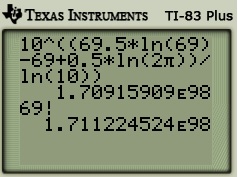
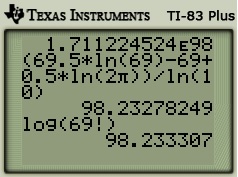
The following output from a calculator shows just how close the approximation to log_{10} 69! is to the real answer. There are also additional terms to Stirling’s series that would get even closer answers.
stirling69-2

stirling69

As I mentioned earlier in this series, I’m still mildly annoyed with my adolescent self that I wasn’t able to figure this out for myself… especially given the months that I spent staring at this problem trying to figure out the answer.

First, I’m annoyed that I didn’t think to investigate \log_{10} n!. I had ample experience using log tables (after all, this was the 1980s, before scientific calculators were in the mainstream) and I should have known this.

Second, I’m annoyed that I didn’t have at the tips of my fingers the change of base formula

\log_{10} n! = \displaystyle \frac{\ln n!}{\ln 10}

Third, I’m annoyed that, even though I knew calculus pretty well, I wasn’t able to get at least the first couple of terms of Stirling’s series on my own even though the derivation was entirely in my grasp. To begin,

\ln n! = \ln (1 \cdot 2 \cdot 3 \dots \cdot n) = \ln 1 + \ln 2 + \ln 3 + \dots + \ln n

For example, if n = 10, then \ln 10! would be the areas of the 9 rectangles shown below (since $\ln 1 = 0$):

stirlingintegralThe areas of these nine rectangles is closely approximated by the area under the curve y = \ln x between x =1\frac{1}{2} and x = 10\frac{1}{2}. (Indeed, I chose a Riemann sum with midpoints so that the approximation between the Riemann sum and the integral would be very close.)

In general, for n! instead of 10!, we have

\ln n! \approx \displaystyle \int_{3/2}^{n+1/2} \ln x \, dx

This is a standard integral that can be obtained via integration by parts:

\ln n! \approx \bigg[ \displaystyle x \ln x - x \bigg]_{3/2}^{n+1/2}

\ln n! \approx \left[ \left(n + \displaystyle \frac{1}{2} \right) \ln \left(n + \displaystyle \frac{1}{2} \right) - \left(n + \displaystyle \frac{1}{2} \right) \right] - \left[ \displaystyle \frac{3}{2} \ln \frac{3}{2} - \frac{3}{2} \right]

\ln n! \approx \left(n + \displaystyle \frac{1}{2} \right) \ln \left(n + \displaystyle \frac{1}{2} \right) - n - \displaystyle \frac{3}{2} \ln \frac{3}{2} + 1

We can see that this is already taking the form of Stirling’s approximation, given above. Indeed, this is surprisingly close. Let’s use the Taylor approximation \ln(1+x) \approx x for x \approx 0:

\ln n! \approx \left(n + \displaystyle \frac{1}{2} \right) \ln \left(n \left[1 + \displaystyle \frac{1}{2n}\right] \right) - n - \displaystyle \frac{3}{2} \ln \frac{3}{2} + 1

\ln n! \approx \left(n + \displaystyle \frac{1}{2} \right) \left[\ln n + \ln \left(1 + \displaystyle \frac{1}{2n} \right) \right] - n - \displaystyle \frac{3}{2} \ln \frac{3}{2} + 1

\ln n! \approx \left(n + \displaystyle \frac{1}{2} \right) \left[\ln n + \displaystyle \frac{1}{2n} \right] - n - \displaystyle \frac{3}{2} \ln \frac{3}{2} + 1

\ln n! \approx \left(n + \displaystyle \frac{1}{2} \right) \ln n + \left(n + \displaystyle \frac{1}{2} \right) \displaystyle \frac{1}{2n} - n - \displaystyle \frac{3}{2} \ln \frac{3}{2} + 1

\ln n! \approx \left(n + \displaystyle \frac{1}{2} \right) \ln n +\displaystyle \frac{1}{2} + \frac{1}{4n} - n - \displaystyle \frac{3}{2} \ln \frac{3}{2} + 1

\ln n! \approx \left(n + \displaystyle \frac{1}{2} \right) \ln n - n + \left(\displaystyle \frac{3}{2} - \displaystyle \frac{3}{2} \ln \frac{3}{2} \right) + \displaystyle \frac{1}{4n}

By way of comparison, the first few terms of the Stirling series for \ln n! are

\ln n! \approx \left(n + \displaystyle \frac{1}{2} \right) \ln n - n + \displaystyle \frac{1}{2} \ln (2\pi) + \displaystyle \frac{1}{12n}

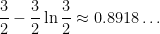
We see that the above argument, starting with an elementary Riemann sum, provides the first two significant terms in this series. Also, while the third term is incorrect, it’s closer to the correct third term that we have any right to expect:

\displaystyle \frac{3}{2} - \displaystyle \frac{3}{2} \ln \frac{3}{2} \approx 0.8918\dots

\displaystyle \frac{1}{2} \ln (2\pi) \approx 0.9189\dots

The correct third term of \displaystyle \frac{1}{2} \ln(2\pi) can also be found using elementary calculus, though the argument is much more sophisticated that the one above. See the MathWorld website for details.