
Source: https://xkcd.com/2768
See also my series on the number e.
In this series, I’m discussing how ideas from calculus and precalculus (with a touch of differential equations) can predict the precession in Mercury’s orbit and thus confirm Einstein’s theory of general relativity. The origins of this series came from a class project that I assigned to my Differential Equations students maybe 20 years ago.
One technique that will be necessary for this confirmation is the method of successive approximations. This will be needed in the context of a differential equation; however, we can illustrate the concept by finding the roots of a polynomial. Consider the quadratic equation

(Naturally, we can solve for 


Here’s the idea of the method of successive approximations to obtain a recursively defined sequence that (hopefully) convergence to a solution of this equation:
 . into the right-hand side to get a new guess,
  . into the right-hand side to get a new guess,
  .
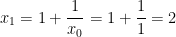
.For example, suppose that we choose 
This sequence can be computed by entering 


We see that the sequence appears to be converging to something, and that something is a root of the equation

So it looks like the above sequence is converging to the positive root 
(Parenthetically, you might notice that the Fibonacci sequence appears in the numerators and denominators of this sequence. As you might guess, that’s not a coincidence.)

Like most numerical techniques, this method doesn’t always work like we think it would. Another solution is the negative root 


I should note that the method of successive approximations generally converges at a slower pace than Newton’s method. However, this method will be good enough when we use it to predict the precession in Mercury’s orbit.
I’m doing something that I should have done a long time ago: collecting a series of posts into one single post. The links below show my series on numerical integration.
Part 1: Introduction
Part 2: Identifying the highest points of the strings
Part 3: These nine points lie on a parabola: Method #1
Part 4: These nine points lie on a parabola: Method #2
Part 5: These nine points lie on a parabola: Method #3
Part 6: Proof that all of the highest points lie on a parabola without calculus, Part 1
Part 7: Proof that all of the highest points lie on a parabola without calculus, Part 2
Part 8: Proof that all of the highest points lie on a parabola with calculus
Part 9: Proof that the strings are indeed tangent to the parabola, with calculus
Part 10: Conclusion
I’m doing something that I should have done a long time ago: collect past series of posts into a single, easy-to-reference post. The following posts formed my series on computing square roots and logarithms without a calculator (with the latest post added).
Part 1: Method #1: Trial and error.
Part 2: Method #2: An algorithm comparable to long division.
Part 3: Method #3: Introduction to logarithmic tables.
Part 4: Finding antilogarithms with a table.
Part 5: Pedagogical and historical thoughts on log tables.
Part 6: Computation of square roots using a log table.
Part 7: Method #4: Slide rules
Part 8: Method #5: By hand, using a couple of known logarithms base 10, the change of base formula, and the Taylor approximation 
Part 9: An in-class activity for getting students comfortable with logarithms when seen for the first time.
Part 10: Method #6: Mentally… anecdotes from Nobel Prize-winning physicist Richard P. Feynman and me.
Part 11: Method #7: Newton’s Method.
Part 12: Method #8: The formula
Source: https://xkcd.com/2711/
Recently, I announced that my paper Parabolic Properties from Pieces of String had been published in the magazine Math Horizons. The article had multiple aims; in chronological order of when I first started thinking about them:
While I’m generally pleased with the final form of the article, the necessity of publication constraints somewhat abbreviated the original goal of this project: determining a pedagogically sound way of convincing a bright Algebra I student that string art unexpectedly produces a parabola. In this series of posts, I’d wanted to expand on the article with some pedagogical thoughts about connecting string art to parabolas for algebra students. After all, most mathematical studies of string art curves — formally known as “envelopes” — rely on differential equations or at least limits and calculus.
However, string art is simple enough for a young child to construct, and so this study was inspired by the quest of explaining this phenomenon using only simple mathematical tools.
The article linked above has further thoughts on this problem, including a calculus-free way of deriving the reflective property of parabolas. However, I think the article pretty much has all of my thoughts on this matter, and so I don’t think I need to elaborate upon them here.
This series of posts is dedicated to an inspired and inspiring Algebra I student who wanted to understand string art curves using tools that she could understand… even though she progressed much further into the mathematics curriculum by the time my article was published and this series of posts appeared on my blog.
Recently, I announced that my paper Parabolic Properties from Pieces of String had been published in the magazine Math Horizons. The article had multiple aims; in chronological order of when I first started thinking about them:

While I’m generally pleased with the final form of the article, the necessity of publication constraints somewhat abbreviated the original goal of this project: determining a pedagogically sound way of convincing a bright Algebra I student that string art unexpectedly produces a parabola. While all the necessary mathematics is in the article, I think the article is somewhat lacking on how to sell the idea to students. So, in this series of posts, I’d like to expand on the article with some pedagogical thoughts about connecting string art to parabolas.
We have shown in the last couple of posts that if the three points that generate the Our explorations of string art led us to consider an arbitrary string 


Previously, we established that the equation for string

We also obtained a bonus result that we obtained using only algebra: string 


so that the slope of the tangent line when 
slope 
Therefore, to show that
At 


Using the point-slope formula for a line, the equation of the tangent line is thus

We now check to see if 

Therefore, the point 
Recently, I announced that my paper Parabolic Properties from Pieces of String had been published in the magazine Math Horizons. The article had multiple aims; in chronological order of when I first started thinking about them:
While I’m generally pleased with the final form of the article, the necessity of publication constraints somewhat abbreviated the original goal of this project: determining a pedagogically sound way of convincing a bright Algebra I student that string art unexpectedly produces a parabola. While all the necessary mathematics is in the article, I think the article is somewhat lacking on how to sell the idea to students. So, in this series of posts, I’d like to expand on the article with some pedagogical thoughts about connecting string art to parabolas.
We have shown in the last couple of posts that if the three points that generate the Our explorations of string art led us to consider an arbitrary string
Previously, we established that the equation for string
Finding the curve traced by the strings is a two-step process:
, find the value of that maximizes  ..
..Previously, we showed using only algebra that the optimal value of 
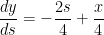
For a student who knows calculus, the optimal value of 

matching the result that we found by using only algebra.
Recently, I announced that my paper Parabolic Properties from Pieces of String had been published in the magazine Math Horizons. The article had multiple aims; in chronological order of when I first started thinking about them:
While I’m generally pleased with the final form of the article, the necessity of publication constraints somewhat abbreviated the original goal of this project: determining a pedagogically sound way of convincing a bright Algebra I student that string art unexpectedly produces a parabola. While all the necessary mathematics is in the article, I think the article is somewhat lacking on how to sell the idea to students. So, in this series of posts, I’d like to expand on the article with some pedagogical thoughts about connecting string art to parabolas.
Our explorations of string art led us to consider an arbitrary string
In the previous post, we established that the equation for string
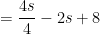
This has the appearance of a quadratic equation, but it’s actually a linear equation in

matching the equation of the blue string we found in a previous post in this series.
To prove that the strings trace a parabola, we now determine which string 



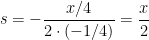
For example, if 

To complete the proof that the strings above trace a parabola, we substitute

matching the result that we found earlier in this series.
There’s also a bonus result. We further note that, for every 
We note that all of the above calculations were entirely elementary, in the sense that calculus was not used and that only techniques from algebra were employed. That said, the word “elementary” in mathematics can be a bit loaded — this means that it is based on simple ideas that are perhaps used in a profound and surprising way. Perhaps my favorite quote along these lines was this understated gem from the book Three Pearls of Number Theory after the conclusion of a very complicated multi-page proof in Chapter 1:
You see how complicated an entirely elementary construction can sometimes be. And yet this is not an extreme case; in the next chapter you will encounter just as elementary a construction which is considerably more complicated.
In the next post, we take a second look at this derivation using techniques from calculus.
Recently, I announced that my paper Parabolic Properties from Pieces of String had been published in the magazine Math Horizons. The article had multiple aims; in chronological order of when I first started thinking about them:
While I’m generally pleased with the final form of the article, the necessity of publication constraints somewhat abbreviated the original goal of this project: determining a pedagogically sound way of convincing a bright Algebra I student that string art unexpectedly produces a parabola. While all the necessary mathematics is in the article, I think the article is somewhat lacking on how to sell the idea to students. So, in this series of posts, I’d like to expand on the article with some pedagogical thoughts about connecting string art to parabolas.
As discussed previous posts, we begin our explorations with string art connecting evenly spaced points on line segments 


In previous posts, we discussed three different ways of establishing that the colored points lie on the parabola
Unfortunately, checking that a statement is true for a few points (in our case, 
To prove that the string art indeed traces a parabola, we study an arbitrary string
Since the equations of 






We now use standard algebraic techniques to find the equation of string

The coordinates of either
to finally arrive at the equation of string
This has the appearance of a quadratic equation, but it’s actually a linear equation in
matching the equation of the blue string we found in a previous post in this series.
We are now almost in position to prove that the string art traces a parabola. We demonstrate this in the next post.




































 Mean Green Math