Inverse Functions: Rational Exponents (Part 8)

In this series of posts, we have seen that the definition of \sqrt[n]{x} and saw that the definition was a little different depending if n is even or odd:

  1. If n is even, then y = \sqrt[n]{x} means that x = y^n and y \ge 0. In particular, this is impossible (for real y) if x < 0.
  2. If n is odd, then y = \sqrt[n]{x} means that x = y^n. There is no need to give a caveat on the possible values of y.

Let’s now consider the definition of x^{m/n}, where m and n are positive integers greater than 1. Ideally, we’d like to simply defined

x^{m/n} = \left[ x^{1/n} \right]^m

This definition reduces to previous work (like a good MIT freshman), using prior definition for raising to powers that are either integers or reciprocals of integers. Indeed, if x \ge 0, there is absolutely no ambiguity about this definition.

Unfortunately, if x < 0, then a little more care is required. There are four possible cases.

Case 1. m and n are odd. In this case, there is no ambiguity if x < 0 is negative. For example,

(-32)^{3/5} = \left[ (-32)^{1/5} \right]^3 = [-2]^3 = -8

Case 2: m is even but n is odd. Again, there is no ambiguity if x< 0 is negative. For example,

(-32)^{4/5} = \left[ (-32)^{4/5} \right]^3 = [-2]^4 = 16

rationalpower1

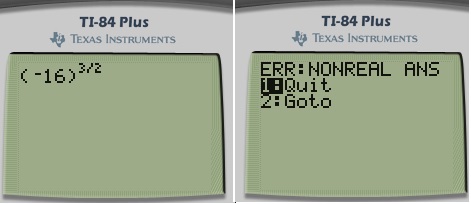
Case 3: m is odd but n is even. In this case, x^{m/n} is undefined if x < 0. For example, we would like (-16)^{3/2} to be equal to \left[ (-16)^{1/2} \right]^3, but {-16}^{1/2} = \sqrt{-16} is undefined (using real numbers).

rationalpower2

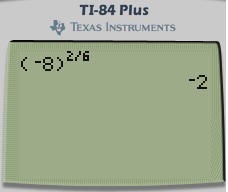
Case 4. m and $latex $n$ are both even. This is perhaps the most interesting case. For example, how should we evaluate (-8)^{4/6}?. There are two legitimate choices… which lead to different answers!

Option #1: If we just apply the proposed definition of x^{m/n}, we find that

(-8)^{2/6} = \left[ (-8)^2 \right]^{1/6} = [64]^{1/6} = 2

Option #2: We could first reduce 2/6 to lowest terms:

(-8)^{2/6} = (-8)^{1/3} = -2

So… which is it?!?!?!?! The rule that mathematicians have chosen is that simplifying the exponent takes precedence over the above definition. In other words, the definition x^{m/n} = \left[ x^{1/n} \right]^m should only be applied in m/n has been reduced to lowest terms in order to remove the above ambiguity.

rationalpower3green lineFor the sake of completeness, I note that the above discussion restricts our attention to real numbers. If complex numbers are permitted, then things become a lot more interesting. If we repeat a few of the above calculations using complex numbers, we get answers that are different!

rationalpower4

The explanation for this surprising result is not brief, but I discussed it in a previous series of posts:

https://meangreenmath.com/2014/06/19/calculators-and-complex-numbers-part-1/

https://meangreenmath.com/2014/06/20/calculators-and-complex-numbers-part-2/

https://meangreenmath.com/2014/06/21/calculators-and-complex-numbers-part-3/

https://meangreenmath.com/2014/06/22/calculators-and-complex-numbers-part-4/

https://meangreenmath.com/2014/06/23/calculators-and-complex-numbers-part-5/

https://meangreenmath.com/2014/06/24/calculators-and-complex-numbers-part-6/

https://meangreenmath.com/2014/06/25/calculators-and-complex-numbers-part-7/

https://meangreenmath.com/2014/06/26/calculators-and-complex-numbers-part-8/

https://meangreenmath.com/2014/06/27/calculators-and-complex-numbers-part-9/

https://meangreenmath.com/2014/06/28/calculators-and-complex-numbers-part-10/

https://meangreenmath.com/2014/06/29/calculators-and-complex-numbers-part-11/

https://meangreenmath.com/2014/06/30/calculators-and-complex-numbers-part-12/

https://meangreenmath.com/2014/07/01/calculators-and-complex-numbers-part-13/

https://meangreenmath.com/2014/07/02/calculators-and-complex-numbers-part-14/

https://meangreenmath.com/2014/07/03/calculators-and-complex-numbers-part-15-2/

https://meangreenmath.com/2014/07/04/calculators-and-complex-numbers-part-16/

https://meangreenmath.com/2014/07/05/calculators-and-complex-numbers-part-17/

https://meangreenmath.com/2014/07/06/calculators-and-complex-numbers-part-18/

https://meangreenmath.com/2014/07/07/calculators-and-complex-numbers-part-19/

https://meangreenmath.com/2014/07/08/calculators-and-complex-numbers-part-20/

https://meangreenmath.com/2014/07/09/calculators-and-complex-numbers-part-21/

https://meangreenmath.com/2014/07/10/calculators-and-complex-numbers-part-22/

https://meangreenmath.com/2014/07/11/calculators-and-complex-numbers-part-23/

https://meangreenmath.com/2014/07/12/calculators-and-complex-numbers-part-24/

Inverse Functions: nth Roots (Part 7)

In the previous posts of this series, I carefully considered the definition of f(x) = \sqrt{x} = x^{1/2}. Let’s now repeat this logic to consider the definition of f(x) = \sqrt[n]{x} = x^{1/n}, where n \ge 3 is an integer. We begin with n even.

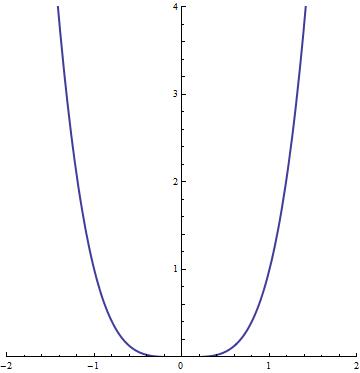
A typical case is n =4; the graph of y = x^4 is shown below.

fourthroot1

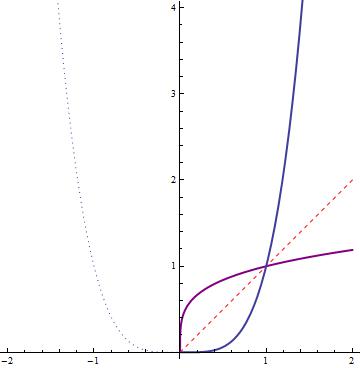
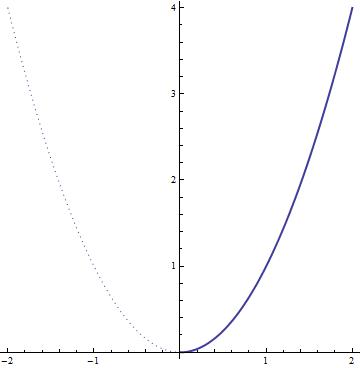
The full graph of y= x^n fails the horizontal line test if n is even. Therefore, we need to apply the same logic that we used earlier to define y = \sqrt[n]{x}. In particular, we essentially erase the left half of the graph. By restricting the domain to [0,\infty), we create a new function that does satisfy the horizontal line test, so that the graph of y = \sqrt[n]{x} is found by reflecting through the line y = x.

fourthroot2Written in sentence form,

If n is even, then y = \sqrt[n]{x} means that x = y^n and y \ge 0. In particular, this is impossible for real y if x < 0.

green line
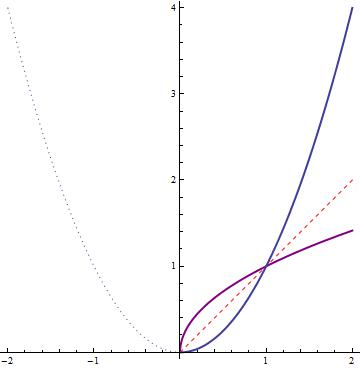
We now turn to the case of n odd. Unlike before, the full graph of y= x^n (in thick blue) satisfies the horizontal line test. Therefore, there is no need to restrict the domain to define the inverse function. (shown in thin purple).


thirdroot

In other words,

If n is odd, then y = \sqrt[n]{x} means that x = y^n. There is no need to give a caveat on the possible values of y.

In particular, \sqrt{-8} and \sqrt[4]{-8} are both undefined since there is no (real) number x so that x^2 = -8 or x^4 = -8. However, \sqrt[3]{-8} is defined and is equal to -2 since (-2)^3 = -8.

Inverse Functions: Square Root (Part 6)

In this post, I take a deeper look at the standard mistake of “simplifying” \sqrt{x^2} incorrectly as just x.

In the previous post, we noted that the function f: \mathbb{R} \to \mathbb{R} defined by f(x) = x^2 fails the horizontal line test and thus does not have an inverse function.


squareroot1

However, we can restrict the domain of f to make a new function that does satisfy the horizontal line test. This new function is identical to f where both f and g are defined. Following tradition, we restrict the domain to [0,\infty):

g: [0,\infty) \to [0,\infty) defined by g(x) = x^2.

So by essentially erasing the left half of the parabola, we form a function that passes the horizontal line test which therefore has an inverse. Naturally, this function is g^{-1}(x) = \sqrt{x}. When I teach Precalculus, I like to write this as a sentence:

y = \sqrt{x} means that x = y^2 and y \ge 0.


squareroot3

Since g and g^{-1} are inverse functions, it’s always true that g(g^{-1}(x)) = x and g^{-1}(g(x)) = x whenever these functions are defined. For example,

g(g^{-1}(16)) = g(\sqrt{16}) = g(4) = 4^2 = 16 and

g^{-1}(g(3)) = g^{-1}(3^2) = g^{-1}(9) = \sqrt{9} = 3

In other words, we are guaranteed that g^{-1}(g(x)) = g^{-1}(x^2) = \sqrt{x^2} is always equal to x — as long x lies in the domain of g… or, in other words, as long as x is nonnegative.

Because if x is negative, all bets are off.

Remember, the original function f does not have an inverse. In particular, g^{-1} and f are not inverse functions, and so it’s possible for g^{-1}(f(x)) to be something other than x. For example,

g^{-1}(f(3)) = \sqrt{3^2} = \sqrt{9} = 3, but

g^{-1}(f(-3)) = \sqrt{(-3)^2} = \sqrt{9} = 3 \ne -3

Of course, I don’t expect my Precalculus students to remember the subtle reason that this fails when they do their homework problems. But I do tell my Precalculus students that the nontrivial simplification of \sqrt{x^2} is a natural consequence of restricting the domain of a function that does not pass the horizontal line test to define an inverse function. In this example, \sqrt{x^2} = x as long as x \ge 0. However, if x < 0, then the result really could be just about anything else. For the current example, we have the pairwise simplification

\sqrt{x^2} = x if x \ge 0;

\sqrt{x^2} = -x if x < 0.

The last line is often uncomfortable for students, and so I remind them that x is assumed to be negative so that -x is positive. Of course, there’s a new notation that mathematicians have developed so that this two-line simplification of \sqrt{x^2} can be compressed to a single line:

\sqrt{x^2} = |x|

Unfortunately, in my opinion, this remains the problem that can be stated in two seconds or less (“Simplify the square root of x squared”) that, in my opinion, is missed most often by mathematics students.

Inverse Functions: Restricted Domain for Square Root (Part 5)

With the last four posts as prelude, let’s consider finding the inverse of the function f: \mathbb{R} \to \mathbb{R} defined by f(x) = x^2.


squareroot1

Of course, we can’t find an inverse for this function as stated. Colloquially, the graph of f fails the horizontal line test. More precisely, there exist two numbers x_1 and x_2 so that x_1 \ne x_2 but f(x_1) = f(x_2). (Indeed, there are infinitely many such pairs — a and -a for any a \ne 0 — but that’s beside the point.)

So how will we find the inverse of f? Well, we can’t. But we can do something almost as good: we can define a new function g that’s going look an awful lot like f. Here’s the function:

g: [0,\infty) \to [0,\infty) defined by g(x) = x^2.

Notice that the function g looks an awful lot like f, except that the domain has been restricted. In this way, the left half of the graph of f is essentially erased to produce the graph of g.

squareroot2

So while the graph of f fails the horizontal line test, the graph of g does pass the horizontal line test. Therefore, g has an inverse function. We reverse the roles of domain and range (of course, for this example, the domain and range are identical):

g^{-1}: [0,\infty) \to [0,\infty)

Also, the graph of g^{-1} can be produced by reflecting through the line y=x, producing the purple graph below.

squareroot3

Of course, the function g^{-1}(x) is more customarily written as \sqrt{x}. Stated another way using the restricted domain of g.

y = \sqrt{x} means that x = y^2 and y \ge 0.

Pedagogically, when teaching Precalculus, I’ve found that this way of writing the definition of \sqrt{x} is a useful prelude to the definition of the inverse trigonometric functions.

A couple of notes:

  1. Notice that, if the purple parabola was completed, the full parabola would violate the vertical line test and thus fail to be a function. Thinking back to the original function, that’s another way of saying that the original full parabola violates the horizontal line test.
  2. Since g and g^{-1} are inverse functions, it’s always true that g(g^{-1}(x)) = x and g^{-1}(g(x)) = x. However, g^{-1} and f are not inverse functions, and so it’s possible for g^{-1}(f(x)) to be something other than x. This subtle distinction will be discussed more in tomorrow’s post.
  3. Restricting the domain to [0,\infty) was a perfectly arbitrary decision. It would have been perfectly OK if we have chosen the left half of the original parabola instead of the right half, as either half of the parabola satisfies the horizontal line test. So why did we choose the right half (with the nonnegative domain) instead of the left half (with the nonpositive domain)? That I can answer with one word: tradition. (By the way, finding an expression for the restriction of f to (-\infty,0]) is a standard problem in a first course in real analysis.

Inverse Functions: Solving Equations (Part 4)

Although disguised, inverse functions play an important role in the ordinary solution of equations. For example, consider the steps used to solve this simple algebra problem:

2x + 4 = 10

2x = 6

x = 3

To go from the first equation to the second equation, let X_1 = 2x+4 and X_2 = 10, and let $f(x) = x – 4$. This is an bijective function with inverse f^{-1}(x) = x +4. Therefore,

X_1 = X_2 \quad \Longleftrightarrow \quad f(X_1) = f(X_2)

Stated another way,

2x + 4 = 10 \quad \Longleftrightarrow 2x = 6

Again, let $X_3 = 2x$ and $X_4 = 6$, and let $g(x) = x/2$. This is also a bijective function with inverse function $g^{-1}(x) = 2x$. Therefore,

X_3= X_4 \quad \Longleftrightarrow \quad g(X_1) = g(X_2)

Stated another way,

$latex 2x + 4 = 10 \quad \Longleftrightarrow 2x = 6 \quad \Longleftrightarrow x = 3$

So we are guaranteed that x= 3 is the one and only one solution of this equation.

green lineIf the process of solving an equation requires the use of a function that isn’t a bijection, then funny things can happen. For example, consider the slightly more complicated equation

\sqrt{x} = x - 6

Let’s starting solving by squaring both sides:

x = (x-6)^2

x = x^2 - 12x + 36

0 = x^2 - 13x + 36

0 = (x-9)(x-4)

x - 9 = 0 \quad \hbox{or} \quad x - 4 = 0

x = 9 \quad \hbox{or} \quad x = 4

So there are two solutions, right? Well…

\sqrt{9} = 3 = 9 - 6,

but \sqrt{4} \ne 4 - 6!

So what happened? In other words, what is qualitatively different about this problem that didn’t happen in the first problem to produce an extraneous solution? The problem is the first step. Let X_1 = \sqrt{x} and X_2 = x-6. We applied the function f(x) = x^2 to both sides. Unfortuntely, f(x) = x^2 is not an invertible function when using the entire real line as the domain of f. In other words,

\sqrt{x} = x -6 \quad implies \quad x = (x-6)^2,

but x =(x-6)^2 \quad does not imply that \quad \sqrt{x} = x - 6.

 The practical upshot is that, when arriving at the final step of the solution, we can’t be certain that the “solutions” we obtain actually work. Instead, what we’ve really shown that anything other than the solutions can’t work, which is different than saying that these two solutions actually do work. So it remains to actually check that these potential solutions are actually solutions (or not).

Inverse Functions: Definition and Horizontal Line Test (Part 3)

From MathWorld, a function f: A \to B  is an object f such that every a \in A is uniquely associated with an object f(a) \in B. Stated more pedantically, if a_1, a_2 \in A and a_1 = a_2, then f(a_1) = f(a_2). More colloquially, in the graphs that ordinarily appear in secondary school, every x-coordinate of the graph is associated with a unique y-coordinate.

For this reason, the figure below (taken from http://en.wikipedia.org/wiki/Vertical_line_test) is not a function. The three points share a common x-coordinate but have different y-coordinates. In school, we usually teach students to distinguish functions from non-functions by the Vertical Line Test.

It is possible for a function to be a function but not have an inverse. Also from MathWorld, a function f is said to be an injection (or, in the lingo that I learned as a student, one-to-one) if, whenever f(x_1) = f(x_2), it must be the case that x_1=x_2. Equivalently, x_1 \ne x_2 implies f(x_1) \ne f(x_2).  In other words, f is an injection if it maps distinct objects to distinct objects.

The following image (taken from http://en.wikipedia.org/wiki/Horizontal_line_test) illustrates a function that is not injective (or, more accurately, is not injective when using all of the function’s domain). The horizontal line intersects the graph of the function at three distinct points with three different x-intercepts which are associated with the same y-coordinate.


By ensuring that the range of f is restricted to the values that are actually attained by f, the function f may be considered as bijective and hence has an inverse function. The inverse function f^{-1} is logically defined as

f^{-1}(y) = x \quad \Longleftrightarrow \quad f(x) = y

In this way, f^{-1}(f(x)) = x and f \left( f^{-1}(y) \right) = y for all x in the domain of f and all y in the range of f. Becaise (x,y) is on the graph of f if and only if (y,x) is on the graph of f^{-1}, the graph of f^{-1} may be obtained by reflecting the graph of y = f(x) through the line y = x. Stated another way, to ensure that f^{-1} is a function that satisfies the horizontal line test, it must be the case (when looking at the reflection through y= x that the original function satisfies the horizontal line test.

Inverse functions: Square root (Part 2)

Here is one of the questions that I ask my class of future secondary mathematics teachers to answer.

A student asks, “My father was helping me with my homework last night and he said the book is wrong. He said that \sqrt{4} = 2 and \sqrt{4} = -2, because 2^2 = 4 and (-2)^2 = 4. But the book says \sqrt{4} = 2. He wants to know why we are using a book that has mistakes.”

This is a very similar question to the simplification of \sqrt{x^2}, which was discussed in yesterday’s post. My experience has been that the above misconceptions involves confusion surrounding two very similar-sounding questions.

Question #1: Find all values of x so that x^2 = 9.

Question #2: Find the nonnegative value of x so that x^2 = 9.

The first question can be restated as solving x^2-9 = 0, or finding all roots of a second-order polynomial. Accordingly, there are two answers. (Of course, the answers are 3 and -3, written more succinctly as \pm 3.) The second question asks for the positive answer to Question #1. This positive answer is defined to be \sqrt{9}, or 3.

In other words, it’s important to be sure that you’re answering the right question.

Is it all that important that \sqrt{9} is chosen to be the nonnegative solution to Question #1? Not really. We could have easily chosen the negative answer. The reason we choose the positive answer and not the negative answer can be answered in one word: tradition.

We want f(x) = \sqrt{x} to be a well-defined function that produces only one output value, and there’s no mathematically advantageous reason for choosing the nonnegative answer aside from the important consideration that everyone else does it that way. And though students probably won’t remember this tidbit of wisdom when the time comes, the same logic applies when choosing the range of the inverse trigonometric functions.

Of course, for the present case, it totally makes sense to take the positive, less complicated answer as the output of \sqrt{x}. However, this won’t be as readily apparent when we consider the inverse trigonometric functions.

Inverse functions: Square root (Part 1)

What is the math question that can be stated in two seconds but is most often answered incorrectly by math majors? In my opinion, here it is:

Simplify \sqrt{x^2}.

In my normal conversational voice, I can say “Simplify the square root of x squared” in a shade less than two seconds.

Here’s a thought bubble if you’d like to think about this before I give the answer.

green_speech_bubble

A common mistake made by algebra students (and also math majors in college who haven’t thought about this nuance for a while) is thinking that \sqrt{x^2} = x. This is clearly incorrect if x is negative:

\sqrt{(-3)^2} = \sqrt{9} = 3 \ne -3

The second follow-up mistake is then often mistake made by attempting to rectify the first mistake by writing \sqrt{x^2} = \pm x. The student usually intends the symbol \pm to mean “plus or minus, depending on the value of x,” whereas the true meaning is “plus or minus” without any caveats. I usually correct this second mistake by pointing out that when a student finds \sqrt{9} with a calculator, the calculator doesn’t flash between 3 and -3; it returns only one answer.

After clearing that conceptual hurdle, students can usually guess the correct simplification:

\sqrt{x^2} = |x|

green lineIn this series of posts, I’d like to expand on the thoughts above to consider some of the inverse functions that commonly appear in secondary mathematics: the square-root function and the inverse trigonometric functions.

Engaging students: Graphing an ellipse

In my capstone class for future secondary math teachers, I ask my students to come up with ideas for engaging their students with different topics in the secondary mathematics curriculum. In other words, the point of the assignment was not to devise a full-blown lesson plan on this topic. Instead, I asked my students to think about three different ways of getting their students interested in the topic in the first place.

I plan to share some of the best of these ideas on this blog (after asking my students’ permission, of course).

This student submission comes from my former student Samantha Smith. Her topic, from Precalculus: graphing an ellipse.

green line

How has this topic appeared in pop culture?

Football is America’s favorite sport. There is practically a holiday for it: Super Bowl Sunday. I do not think students realize how much math is actually involved in the game of football, from statistics, to yards, the stadium and even the football itself. The video link below explores the shape of the football and of what importance the shape is. As you can see in the picture below, a 2D look of the football shows us that it is in the shape of an ellipse.


The video further explains how the 3D shape (Prolate Spheroid) spins in the air and is aerodynamic. Also, since it is not spherical, it is very unpredictable when it hits the ground. The football can easily change directions at a moments notice. This video is a really cool introduction to graphing an ellipse; it shows what the shape does in the real world. Students could even figure out a graph to represent a football. Overall, this is just a way to engage students in something that they are interested in.

football

https://www.nbclearn.com/nfl/cuecard/50824 (Geometric Shapes –Spheres, Ellipses, & Prolate Speroids)


green line

D. History: What interesting things can you say about the people who contributed to the discovery and/or development of this topic?

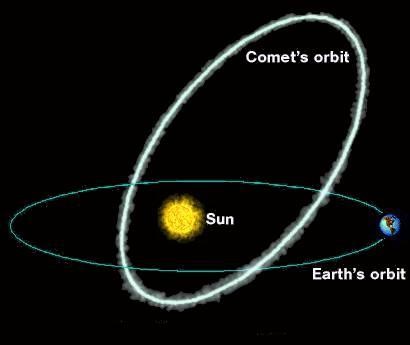
Halley’s Comet has been observed since at least 240 B.C. It could be labeled as the most well-known comet. The comet is named after one of Isaac Newton’ friends, Edmond Halley. Halley worked closely with Newton and used Newton’s laws to calculate how gravitational fields effected comets. Up until this point in history, it was believed that comets traveled in a straight path, passing the Earth only once. Halley discovered that a comet observed in 1682 followed the same path as a comet observed in 1607 and 1531. He predicted the comet would return in 76 years, and it did. Halley’s Comet was last seen in 1986 so, according to Halley’s calculations, it will reappear in 2061.
Halley’s Comet has an elliptical orbit around the sun. It gets as close to the sun as the Earth and as far away from the sun as Pluto. This is an example of how ellipses appear in nature. We could also look at the elliptical orbits of the different planets around the sun. Students have grown up hearing about Newton’s Laws, but this is an actual event that supported and developed those laws in relation to ellipses.

What is Halley’s Comet?

halley


green line

How has this topic appeared in high culture?

whisperinggallery

Through my research on ellipses, the coolest application I found is Statuary Hall (the Whispering Gallery) in our nation’s capital. The Hall was constructed in the shape of an ellipse. It is said that if you stand at one focal point of the ellipse, you can hear someone whispering across the room at the other focal point because of the acoustical properties of the elliptical shape. The YouTube video below illustrates this phenomena. The gallery used to be a meeting place of the House of Representatives. According to legend, it was John Quincy Adams that discovered the room’s sound properties. He placed his desk at a focus so he could easily hear conversations across the room.

The first link below is a problem students can work out after transitioning from the story of the hall. Given the dimensions of the room, students find the equation of the ellipse that models the room, the foci of the ellipse, and the area of the ellipse. This one topic can cover multiple applications of the elliptical form of Statuary Hall.

Click to access PreAP-PreCal-Log-6.3.pdf

http://www.pleacher.com/mp/mlessons/calculus/appellip.html

Engaging students: Graphing a hyperbola

In my capstone class for future secondary math teachers, I ask my students to come up with ideas for engaging their students with different topics in the secondary mathematics curriculum. In other words, the point of the assignment was not to devise a full-blown lesson plan on this topic. Instead, I asked my students to think about three different ways of getting their students interested in the topic in the first place.

I plan to share some of the best of these ideas on this blog (after asking my students’ permission, of course).

This student submission comes from my former student Rebekah Bennett. Her topic, from Precalculus: graphing a hyperbola.

green line

Hyperbolas are one of the hardest things to find within the real world. Relating to students, the hyperbola is popularly known as the Hurley symbol; A widely known surf symbol that is now branded on clothes and surf boards. It is also used widely in designs to create patterns on large carpets or flooring. They can also be used when building houses to make sure that a curve on the exterior or interior of the house is mirrored exactly how the buyer wants. Hyperbolas can be found when building graphics for games such as the game roller coaster tycoon. This is a game where several different graphics must be formed so that any type of roller coaster can be created. Also, when playing the wii or xbox Kinect, hyperbolas are used within the design of the system. Since both game systems are based on movement and there are several different types of ways someone can move, the system must have these resources available so that it can read what the person in doing. Hyperbolas are commonly found everywhere with some type of design.


green line

To explore this topic, I would first show the students this video of the roller coaster “Fire and Ice” which is in Orlando, Florida at Universal Studios. This roller coaster was created so that when the two roller coasters go around a loop at the same time, they will never hit, making for a fun, adventurous time. This is what a hyperbola simply is; every point lies within the same ratio from focus to directrix. During the video point out the hyperbolic part of the roller coaster which is shown at the 49-51 second mark.


Now after watching the video, the students would be given about 8 minutes to explore by themselves or with a partner, how to create their own hyperbola. The student can use any resources he/she would like. Once the students have had enough time to explore, the teacher would then have the student watch an instructional video from Kahn Academy.


The video is very useful in teaching students how to graph a hyperbola because the instructor goes through step by step carefully explaining what each part means and why each part is placed where it is in the function. The video is engaging to the students since they don’t have to listen to their teacher say it a million times and then reinforce it. This is also helpful for the teacher because the student hears it from one source and then it is reinforced by the teacher, giving the teacher a second hand because it’s now coming from two sources not just one.


After the video, the students can now split up into groups of at least 3 and create their own “Fire and Ice” roller coaster from scratch. They will have the information from the video to help them know how to create the function and may also ask questions. The student may create their hyperbola roller coaster anyway they would like, using any directrix as well. But keep in mind that you would probably want to tell them it needs to be somewhat realistic or else you could get some crazy ideas. Once all the groups are finished, they will present their roller coaster to the class and be graded by their peers for one grade and then graded by the teacher for participation and correctness.


green lineFrom previous math courses, the student should already know the terms slope and vertex. The student should’ve already learned how to graph a parabola. Everything that a student uses to graph a parabola is used to graph a hyperbola but yet with more information. Starting from the bottom, a parabola is used because all a hyperbola technically is, is the graph show a parabola and its mirrored image at the same time. From here the student learns about the directrix, which is the axis of symmetry that the parabola follows. The student will now be able to learn about asymptotes which are basically what a directrix is in a hyperbola function. This opens the door to several graphs of limits that the student will learn throughout calculus and higher math classes.