How I Impressed My Wife: Part 2b

Some husbands try to impress their wives by lifting extremely heavy objects or other extraordinary feats of physical prowess.

That will never happen in the Quintanilla household in a million years.

But she was impressed that I broke an impasse in her research and resolved a discrepancy between Mathematica 4 and Mathematica 8 by finding the following integral by hand in less than an hour:

Q = \displaystyle \int_0^{2\pi} \frac{dx}{\cos^2 x + 2 a \sin x \cos x + (a^2 + b^2) \sin^2 x}

In this series, I’ll explore different ways of evaluating this integral.green lineIn yesterday’s post, I showed that

Q = 2 \displaystyle \int_{-\pi/2}^{\pi/2} \frac{dx}{\cos^2 x + 2 a \sin x \cos x + (a^2 + b^2) \sin^2 x}

We now multiply the top and bottom of the integrand by \sec^2 x. This is permissible because \sec^2 x is defined on the interior of the interval (-\pi/2, \pi/2) — which is why I needed to adjust the limits of integration in the first place. I obtain

Q = 2 \displaystyle \int_{-\pi/2}^{\pi/2} \frac{\sec^2 x dx}{\cos^2 x \sec^2 x + 2 a \sin x \cos x \sec^2 x + (a^2 + b^2) \sin^2 x \sec^2 x}
Next, I use some trigonometric identities to simplify the denominator:
  • \cos^2 x \sec^2 x = \cos^2 x \displaystyle \frac{1}{\cos^2 x} = 1
  • \sin x \cos x \sec^2 x = \sin x \cos x \frac{1}{\cos^2 x} = \displaystyle \frac{\sin x}{\cos x} = \tan x
  • \sin^2 x \sec^2 x = \sin^2 x \displaystyle \frac{1}{\cos^2 x} = \displaystyle \left( \frac{\sin x}{\cos x} \right)^2 = \tan^2 x

Therefore, the integral becomes

Q = 2 \displaystyle \int_{-\pi/2}^{\pi/2} \frac{\sec^2 x dx}{1 + 2 a \tan x + (a^2 + b^2) \tan^2 x}

green line

I’ll continue with the evaluation of this integral in tomorrow’s post.

How I Impressed My Wife: Part 2a

Some husbands try to impress their wives by lifting extremely heavy objects or other extraordinary feats of physical prowess.

That will never happen in the Quintanilla household in a million years.

But she was impressed that I broke an impasse in her research and resolved a discrepancy between Mathematica 4 and Mathematica 8 by finding the following integral by hand in less than an hour:

Q = \displaystyle \int_0^{2\pi} \frac{dx}{\cos^2 x + 2 a \sin x \cos x + (a^2 + b^2) \sin^2 x}

In this series, I’ll explore different ways of evaluating this integral.green lineI begin by adjusting the range of integration:

Q = Q_1 + Q_2 + Q_3,

where

Q_1 = \displaystyle \int_0^{\pi/2} \frac{dx}{\cos^2 x + 2 a \sin x \cos x + (a^2 + b^2) \sin^2 x},

Q_2 = \displaystyle \int_{\pi/2}^{3\pi/2} \frac{dx}{\cos^2 x + 2 a \sin x \cos x + (a^2 + b^2) \sin^2 x},

Q_3 = \displaystyle \int_{3\pi/2}^{2\pi} \frac{dx}{\cos^2 x + 2 a \sin x \cos x + (a^2 + b^2) \sin^2 x}.

I’ll begin with Q_3 and apply the substitution u = x - 2\pi, or x = u + 2\pi. Then du = dx, and the endpoints change from 3\pi/2 \le x 2\pi to -\pi/2 \le u \le 0. Therefore,

Q_3 = \displaystyle \int_{-\pi/2}^{0} \frac{du}{\cos^2 (u+2\pi) + 2 a \sin (u+2\pi) \cos (u+2\pi) + (a^2 + b^2) \sin^2 (u+2\pi)}.

Next, we use the periodic property for both sine and cosine — \sin(x + 2\pi) = \sin x and \cos(x + 2\pi) = \cos x — to rewrite Q_3 as

Q_3 = \displaystyle \int_{-\pi/2}^{0} \frac{du}{\cos^2 u + 2 a \sin u \cos u + (a^2 + b^2) \sin^2 u}.

Changing the dummy variable from u back to x, we have

Q_3 = \displaystyle \int_{-\pi/2}^{0} \frac{dx}{\cos^2 x + 2 a \sin x \cos x + (a^2 + b^2) \sin^2 x}.

Therefore, we can combined Q_3 + Q_1 into a single integral:

Q_3 + Q_1 = \displaystyle \int_{-\pi/2}^{0} \frac{dx}{\cos^2 x + 2 a \sin x \cos x + (a^2 + b^2) \sin^2 x}

+ \displaystyle \int_0^{\pi/2} \frac{dx}{\cos^2 x + 2 a \sin x \cos x + (a^2 + b^2) \sin^2 x}

Q_3 + Q_1 = \displaystyle \int_{-\pi/2}^{\pi/2} \frac{dx}{\cos^2 x + 2 a \sin x \cos x + (a^2 + b^2) \sin^2 x}

Next, we work on the middle integral Q_2. We use the substitution u = x - \pi, or x = u + \pi, so that du = dx. Then the interval of integration changes from \pi/2 \le x \le 3\pi/2 to -\pi/2 \le u \le \pi/2, so that

Q_2 = \displaystyle \int_{\pi/2}^{3\pi/2} \frac{dx}{\cos^2 x + 2 a \sin x \cos x + (a^2 + b^2) \sin^2 x}

= \displaystyle \int_{-\pi/2}^{\pi/2} \frac{du}{\cos^2 (u+\pi) + 2 a \sin (u+\pi) \cos (u+\pi) + (a^2 + b^2) \sin^2 (u+\pi)}.

Next, we use the trigonometric identities

\sin(u + \pi) = \sin u \cos \pi + \cos u \sin \pi = \sin u \cdot (-1) + \cos u \cdot 0 = - \sin u,

\cos(u + \pi) = \cos u \cos \pi - \sin u \sin \pi = \cos u \cdot (-1) - \sin u \cdot 0 = - \cos u,

so that the last integral becomes

Q_2 = \displaystyle \int_{-\pi/2}^{\pi/2} \frac{dx}{(-\cos u)^2 + 2 a (-\sin u)(- \cos u) + (a^2 + b^2) (-\sin u)^2}

= \displaystyle \int_{-\pi/2}^{\pi/2} \frac{du}{\cos^2 u + 2 a \sin u \cos u + (a^2 + b^2) \sin^2 u}

= \displaystyle \int_{-\pi/2}^{\pi/2} \frac{dx}{\cos^2 x + 2 a \sin x \cos x + (a^2 + b^2) \sin^2 x}

On the line above, I again replaced the dummy variable of integration from u to x. We see that Q_2 = Q_1 + Q_3, and so

Q = Q_1 + Q_2 + Q_3

Q = 2 Q_2

Q = 2 \displaystyle \int_{-\pi/2}^{\pi/2} \frac{dx}{\cos^2 x + 2 a \sin x \cos x + (a^2 + b^2) \sin^2 x}

green line

I’ll continue with the evaluation of this integral in tomorrow’s post.

Proving theorems and special cases (Part 12): The sum and difference formulas for sine

In a recent class with my future secondary math teachers, we had a fascinating discussion concerning how a teacher should respond to the following question from a student:

Is it ever possible to prove a statement or theorem by proving a special case of the statement or theorem?

Usually, the answer is no. In this series of posts, we’ve seen that a conjecture could be true for the first 40 cases or even the first 10^{316} cases yet not always be true. We’ve also explored the computational evidence for various unsolved problems in mathematics, noting that even this very strong computational evidence, by itself, does not provide a proof for all possible cases.

However, there are plenty of examples in mathematics where it is possible to prove a theorem by first proving a special case of the theorem. For the remainder of this series, I’d like to list, in no particular order, some common theorems used in secondary mathematics which are typically proved by first proving a special case.

3. Theorem 1. \sin(\alpha + \beta) = \sin \alpha \cos \beta + \cos \alpha + \sin \beta

Theorem 2. \sin(\alpha - \beta) = \sin \alpha \cos \beta - \cos \alpha \sin \beta

For angles that are not acute, these theorems can be proven using a unit circle and the following four lemmas:

Lemma 1. \cos(x - y) = \cos x \cos y + \sin x \sin y

Lemma 2. \cos(x + y) = \cos x \cos y - \sin x \sin y

Lemma 3. \sin(\pi/2 - x) = \cos x

Lemma 4. \cos(\pi/2 - x) = \sin x

Specifically, assuming Lemmas 1-4, then:

\sin(\alpha + \beta) = \cos(\pi/2 - [\alpha + \beta]) by Lemma 4

= \cos([\pi/2 - \alpha] - \beta)

= \cos(\pi/2 - \alpha) \cos \beta + \sin(\pi/2 - \alpha) \sin \beta by Lemma 1

= \sin \alpha \cos \beta + \cos \alpha \sin \beta by Lemmas 3 and 4.

Also,

\sin(\alpha - \beta) = \cos(\pi/2 - [\alpha - \beta]) by Lemma 4

= \cos([\pi/2 - \alpha] + \beta)

= \cos(\pi/2 - \alpha) \cos \beta - \sin(\pi/2 - \alpha) \sin \beta by Lemma 2

= \sin \alpha \cos \beta - \cos \alpha \sin \beta by Lemmas 3 and 4.

However, we see that what I’ve called Lemma 3, often called a cofunction identity, can be considered a special case of Theorem 2. However, this is not circular logic since the cofunction identities can be proven without appealing to Theorems 1 and 2.


Engaging students: Verifying trigonometric identities

In my capstone class for future secondary math teachers, I ask my students to come up with ideas for engaging their students with different topics in the secondary mathematics curriculum. In other words, the point of the assignment was not to devise a full-blown lesson plan on this topic. Instead, I asked my students to think about three different ways of getting their students interested in the topic in the first place.

I plan to share some of the best of these ideas on this blog (after asking my students’ permission, of course).

This student submission comes from my former student Tracy Leeper. Her topic, from Precalculus: verifying trigonometric identities.

green line

Many students when first learning about trigonometric identities want to move terms across the equal sign, since that is what they have been taught to do since algebra, however, in proving a trigonometric identity only one side of the equality is worked at a time. Therefore my idea for an activity to help students is to have them look at the identities as a puzzle that needs to be solved. I would provide them with a basic mat divided into two columns with an equal sign printed between the columns, and give them trig identities written out in a variety of forms, such as \sin^2 \theta + \cos^2 \theta on one strip, and 1 written on another strip. Other examples would also include having \tan^2 \theta on one, and \sin^2 \theta/\cos^2 \theta on another. The students will have to work within one column, and step by step, change one side to eventually reflect the term on the other side, and each strip has to be one possible representation of the same value. By providing the students with the equivalent strips, they will be able to construct the proof of the identity. I feel that giving them the strips will allow them to see different possibilities for how to manipulate the expression, without leaving them feeling lost in the process, and by dividing the mat into columns, they can focus on one side, and see that the equivalency is maintained throughout the proof. The students would need to arrange the strips into the correct order to prove the left hand side is equivalent to the right hand side, while reinforcing the process of not moving anything across the equal sign.


green line

Trigonometry identities are used in most of the math courses after pre-calculus, as well as the idea of proving an equivalency. If the students learn the concept of proving an equivalency that will help them construct proofs for any future math courses, as well as learning to look at something given, and be able to see it as parts of a whole, or just be able to write it a different way to assist with the calculations. If students learn to see that

1 = \sin^2 x + \cos^2 x = \sec^2 x - \tan^2 x = \csc^2 x - \cot^2 x,

their ability to manipulate expressions will dramatically improve, and their confidence in their ability will increase, as well as their understanding of the complexities and relations throughout all of mathematics. The trigonometric identities are the fundamental part of the relationships between the trig functions. These are used in science as well, anytime a concept is taught about a wave pattern. Sound waves, light waves, every kind of wave discussed in science are sinusoidal wave. Anytime motion is calculated, trigonometry is brought into the calculations. All students who wish to progress in the study of science or math need to learn basic trigonometric identities and learn how to prove equivalency for the identities. Since proving trigonometric identities is also a practice in logical reasoning, it will also help students learn to think critically, and learn to defend their conjectures, which is a valuable skill no matter what discipline the student pursues.


green line

For learning how to verify trigonometric identities, I like the Professor Rob Bob (Mr. Tarroy’s) videos found on youtube. He’s very energetic, and very thorough in explaining what needs to be done for each identity. He also gives examples for all of the different types of identities that are used. He is very specific about using the proper terms, and he makes sure to point out multiple times that this is an identity, not an equation, so terms cannot be transferred across the equal sign. He also presents options to use for a variety of cases, and that sometimes things don’t work out, but it’s okay, because you can just erase it and start again. I also like that he uses different colored chalk to show the changes that are being made. He is very articulate, and explains things very well, and makes sure to point out that he is providing examples, but it’s important to remember that there are many different ways to prove the identity presented. I enjoyed watching him teach, and I think the students would enjoy his energy as well.


Engaging students: Graphing the sine and cosine functions

In my capstone class for future secondary math teachers, I ask my students to come up with ideas for engaging their students with different topics in the secondary mathematics curriculum. In other words, the point of the assignment was not to devise a full-blown lesson plan on this topic. Instead, I asked my students to think about three different ways of getting their students interested in the topic in the first place.

I plan to share some of the best of these ideas on this blog (after asking my students’ permission, of course).

This student submission comes from my former student Jessica Trevizo. Her topic, from Precalculus: graphing the sine and cosine functions.

green lineHow could you as a teacher create an activity or project that involves your topic?

For this activity students can either work with a partner or work individually. I enjoyed this activity because students are able to derive the sine and cosine functions on their own using fun materials other than the original paper and pencil. The knowledge that students should gain from this activity is the relationship between the unit circle and the sine/cosine function. Along with this activity, students will be practicing previous concepts learned such as converting degrees to radians, finding the domain/rage, and finding the x-intercepts and y-intercepts. Also, amplitude, period, and wavelength are important vocabulary words that can be introduced and applied to the parent functions. To complete the activity assign the students to write a paragraph comparing and contrasting both functions. In their paragraph make sure students include a discussion of the intercepts, maxima, minimum, and period. It is essential for the students to know how to graph the parent functions of sine and cosine and where they come from before teaching the students about the transformations of the functions.

http://illuminations.nctm.org/Lesson.aspx?id=2870


green line

A.1 What interesting word problems using this topic can your students do now?

Real life word problems that involve the sine and cosine function can be used to keep the students engaged in the topic. Both of the functions can used to model situations that occur in real life in a daily basis such as; recording the path of the electric currents, musical tones, radio waves, tides, and weather patterns. Here is an example of a word problem, “Throughout the day, the depth of the water at the end of a dock in Bar Harbor, Maine varies with tides. The table shows the depths (in feet) at various times during the morning.” With the data provided the students are able to do several things such as: be able to use a trigonometric function to model the data and find the depth of the water at any specific time. Also, if a boat needs at least 10 feet of water to moor at the dock, the students should be able to figure out safe dock times for the boat.

Jessica1


green lineHow can technology be used to effectively engage students with this topic?

Most of the students are familiar with sound waves. As an engage go to www.onlinemictest.com and have the students observe the sound waves that appear on the screen as you speak. Many students will recognize the various sine and cosine functions on the screen. With the online mic test students are also able to make relationships between the sound and the wave. Download several different tones and play them so the sound waves of the tones appear on the screen. Have the students sketch the graph of a soft high note, soft low note, loud high note, and a loud low note. The following graphs should look similar to the figure below. Once all of the students have recorded their own observations have the students work with a partner to compare their graphs. Also give the students a minute or two so they can compare and contrast the 4 different graphs by using the new vocabulary that they learned such as amplitude and period. Students are able to remember the new vocabulary when they have opportunities to have discussions that require them to use them.

soundwave

Engaging students: Computing trigonometric functions

In my capstone class for future secondary math teachers, I ask my students to come up with ideas for engaging their students with different topics in the secondary mathematics curriculum. In other words, the point of the assignment was not to devise a full-blown lesson plan on this topic. Instead, I asked my students to think about three different ways of getting their students interested in the topic in the first place.

I plan to share some of the best of these ideas on this blog (after asking my students’ permission, of course).

This student submission comes from my former student Nataly Arias. Her topic, from Precalculus: computing trigonometric functions.

green line

How has this topic appeared in pop culture (movies, TV, current music, video games, etc.)?


Trigonometry does not only relate to mathematics, trigonometry is also used in real life. Many people don’t know that trigonometry is involved in video games. In game development, there are many situations where you will need to use trig functions. Video games are full of triangles. For example in order to calculate the direction the player is heading you will form a triangle and use sine, cosine, or tangent to solve. The trig function used depends on the values given. For example if the opposite and adjacent values are given (the xSpeed and ySpeed), the function you will need to calculate the direction of the player is tangent. This is represented by the equation Tan( Dir ) = xSpeed /ySpeed. Again, by applying the inverted function of tan to both sides of the equal sign, we get an equation that will return the player’s direction. In a spaceship game you will need to use trigonometric functions to have one ship shoot a laser in the direction of the other ship, play a warning sound effect if an enemy ship is getting too close, or have one ship start moving in the direction of another ship to chase. Trig is used in several situations in video games some more examples include calculating a new trajectory after a collision between two objects such as billiard balls, rotating a spaceship or other vehicle, properly handling the trajectory of projectiles shot from a rotated weapon, and determining if a collision between two objects is happening.


green line

How has this topic appeared in high culture (art, classical music, theatre, etc.)?


The “unit circle” is a circle with a radius of 1 that is centered at the origin in the Cartesian coordinate system in the Euclidean plane. Because the radius is 1 we can directly measure sine, cosine, and tangent. The unit circle has made parts of mathematics easier and neater. The concepts of the unit circle go far back into the past. Not only do we use and see circles in mathematics we also can see circles in art form. We can also use trigonometric functions to determine the best position to view a painting hanging on an art gallery wall. For example you can determine the angle between a person’s eye and the top and base of the painting when a person is standing 1m away, 2 m away, 3 m away and so on. By comparing your data you can estimate the best position for a person to stand in front of the painting. Also using trig functions and your handy calculator you can develop a formula that describes the relationship between the distance away from the painting and the angle that exists between the person’s eye and the top and bottom of the painting.


green line

How have different cultures throughout time used this topic in their society?


Today the unit circle is used as a helpful tool to help calculate trig functions. Trig functions are taught in trigonometry, pre-calculus and are frequently used in advanced math classes. Many people don’t realize that not only are trig functions learned and used in school but throughout time several cultures have used trig functions in their society. The main application of trigonometry in past cultures was in astronomy. In 1900 BC the Babylonians kept details of stars, the motion of planets, and solar eclipses by using angular distance measured on the celestial sphere. In 1680-1620 BC the Egyptians used ancient forms of trigonometry for building pyramids. The idea of dividing a circle into 360 equal pieces goes back to the sexagesimal counting system of the ancient Sumerians. Early astronomical calculations wedded the sexagesimal system to circles and the rest is history. Today in trigonometry the unit circle has a radius of 1 unlike the Greek, Indian, Arabic, and early Europeans who used a circle of some other convenient radius. In today’s society trigonometry is everywhere. The mathematics used behind trigonometry is the same mathematics that allows us to store sound waves digitally onto a CD. We use it without even knowing it. When we plug something into the wall there is trigonometry involved. The sine and cosine wave are the waves that are running through the electrical circuit known as alternating current.


References


http://www.math.ucdenver.edu/~jloats/Student%20pdfs/40_Trigonometry_Trenkamp.pdf


http://www.math.dartmouth.edu/~matc/math5.geometry/unit9/unit9.html


http://en.wikipedia.org/wiki/Trigonometric_functions


http://aleph0.clarku.edu/~djoyce/ma105/trighist.html


http://www.slideshare.net/mgeis784/building-the-unit-circle


http://www.softlion.nl/download/article/Trigonometry.pdf


http://www.raywenderlich.com/35866/trigonometry-for-game-programming-part-1


http://stackoverflow.com/questions/3946892/trigonometry-and-game-development


Engaging students: Verifying trigonometric identities

In my capstone class for future secondary math teachers, I ask my students to come up with ideas for engaging their students with different topics in the secondary mathematics curriculum. In other words, the point of the assignment was not to devise a full-blown lesson plan on this topic. Instead, I asked my students to think about three different ways of getting their students interested in the topic in the first place.

I plan to share some of the best of these ideas on this blog (after asking my students’ permission, of course).

This student submission comes from my former student Michelle McKay. Her topic, from Precalculus: verifying trigonometric identities.

green line

How could you as a teacher create an activity or project that involves your topic?
polar3

Engaging students with trigonometric identities may seem daunting, but I believe the key to success for this unit lies within allowing students to make the discovery of the identities themselves.

For this particular activity, I will focus on some trigonometric identities that can be derived using the Pythagorean Theorem. Before beginning this activity, students must already know about the basic trig functions (sine, cosine, and tangent) along with their corresponding reciprocals (cosecant, secant, and cotangent).

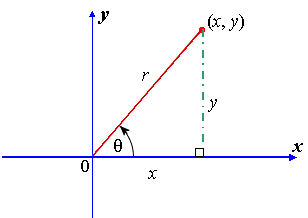
Using this diagram (or a similar one), have students write out the relationship between all sides using the Pythagorean Theorem.
Students should all come to the conclusion of: x2 + y2 = r2.

For higher leveled students, you may want to remind them of the adage SohCahToa, with emphasis on sine and cosine for this next part. You might ask, “How can we rearrange the above equation into something remotely similar to a trigonometric function?”

Ultimately, we want students to divide each side by r2. This will give us:

Again, SohCahToa. Students, perhaps with some leading questions, should see that we can substitute sine and cosine functions into the above equation, giving us the identity:

cos2θ + sin2θ = 1

From this newly derived identity, students can then go on to find tan2θ + 1 = sec2θand then 1 + cot2θ = csc2θ.


green line

How can technology be used to effectively engage students with this topic?

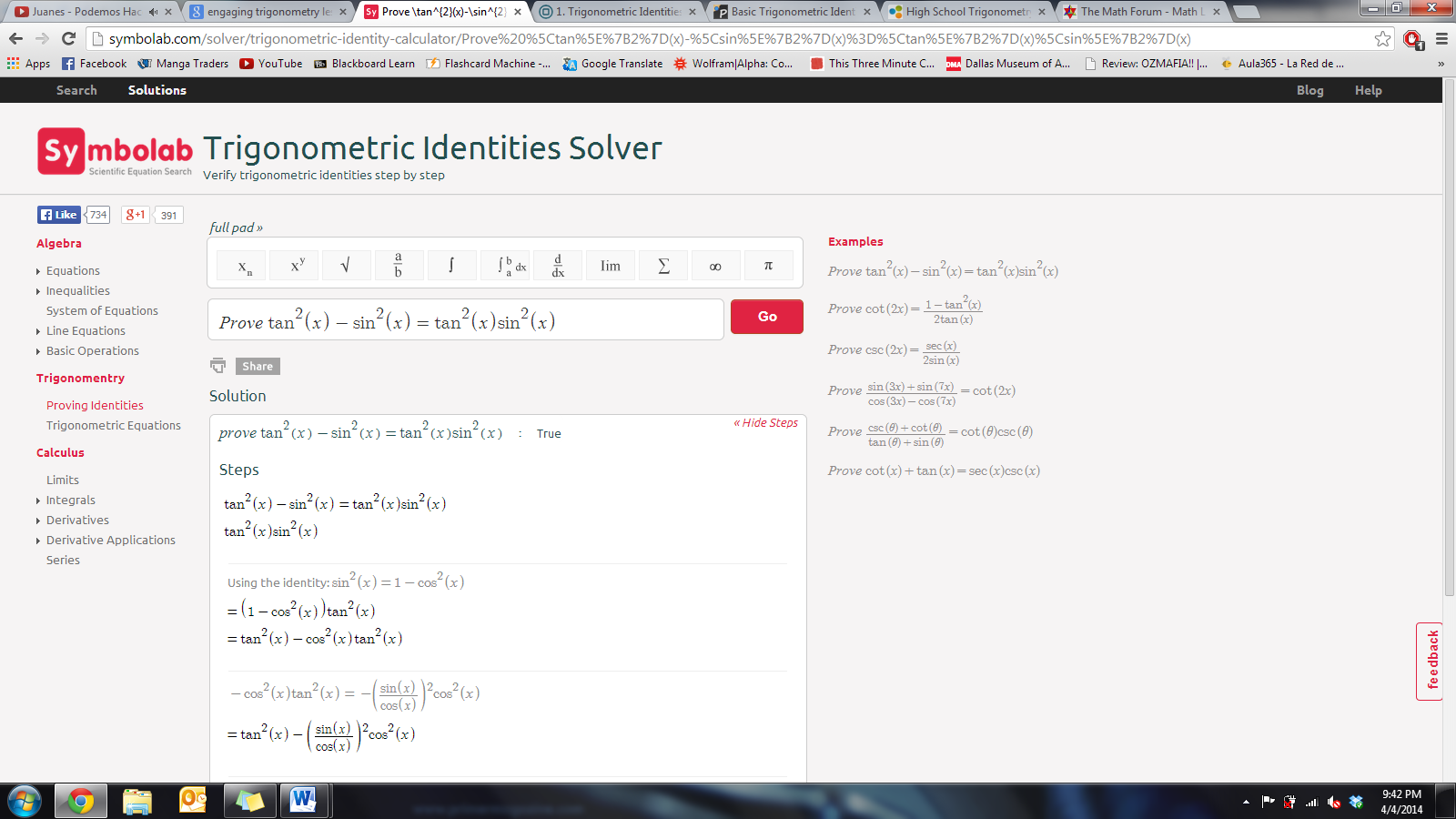
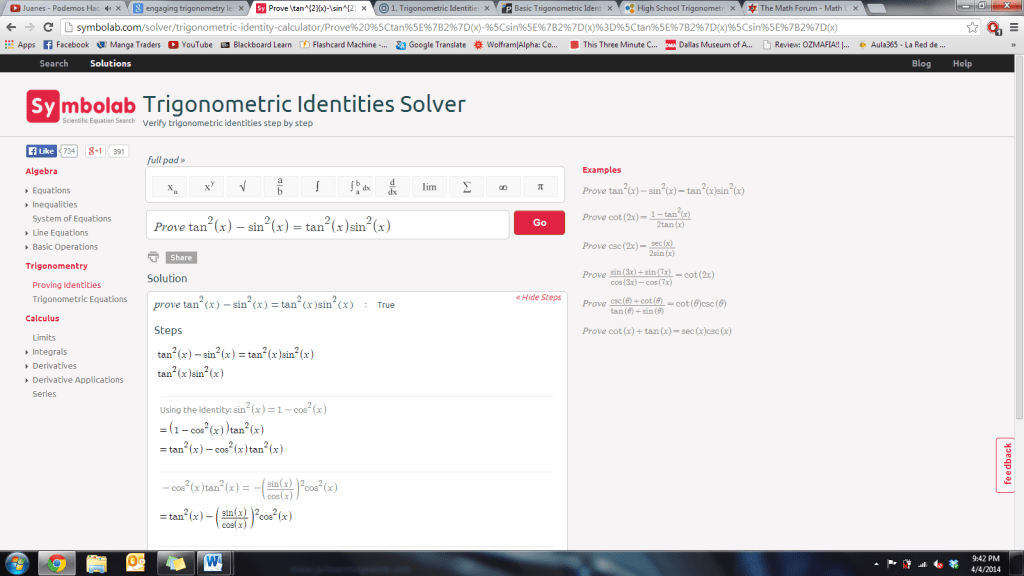
For engaging the students and encouraging them to play around with identities, I find the Trigonometric Identities Solver by Symbolab to be a fabulous technological supplement. Students can enter in identities that they may need more help understanding and this website will state whether the identity is true or not, and then provide detailed steps on how to derive the identity.
A rather fun activity that may utilize this site is to challenge the students to come up with their own elaborate trigonometric identity.
SymbolLab

Another online tool students can explore is the interactive graph from http://www.intmath.com. In fact, students could also use this right after they derive the identities from the earlier activity. This site does a wonderful job at providing a visual representation of the trigonometric functions’ relationships to one another. It also allows the students to explore the functions using concrete numbers, rather than the general Ө. Although this site only shows the cos2θ + sin2θ = 1identity in action, it would not be difficult for students to plug in the data from this graph to numerically verify the other identities.

trig1


green line

What are the contributions of various cultures to this topic?


The beginning of trigonometry began with the intention of keeping track of time and the quickly expanding interest in the study of astronomy. As each civilization inherited old discoveries from their predecessors, they added more to the field of trigonometry to better explain the world around them. The below table is a very brief compilation of some defining moments in trigonometry’s history. It is by no means complete, but was created with the intention to capture the essence of each civilization’s biggest contributions.


Civilization People of Interest Contributions
Egyptians
  • Ahmes
– Earliest ideas of angles.- The Egyptian seked was the cotangent of an angle at the base of a building.
Babylonians – Division of the circle into 360 degrees.- Detailed records of moving celestial bodies (which, when mapped out, resembled a sine or cosine curve).- May have had the first table of secants.
Greek
  • Aristarchus
  • Menelaus
  • Hippocharus
  • Ptolemy
– Chords.- Trigonometric proofs presented in a geometric way.- First widely recognized trigonometric table: Corresponding values of arcs and chords.- Equivalent of the half-angle formula.
Indian
  • Aryabhata
  • Bhaskara I
  • Bhaskara II
  • Brahmagupta
  • Madhava
– Sine and cosine series.- Formula for the sine of an acute angle.- Spherical trigonometry.- Defined modern sine, cosine, versine, and inverse sine.
Islamic
  • Muhammad ibn Mūsā al-Khwārizmī
  • Muhammad ibn Jābir al-Harrānī al-Battānī
  •  Abū al-Wafā’ al-Būzjānī
–          – First accurate sine and cosine tables.-          – First table for tangent values.-          – Discovery of reciprocal functions (secant and cosecant).-          – Law of Sines for spherical trigonometry.-          – Angle addition in trigonometric functions.
Germans – “Modern trigonometry” was born by defining trigonometry functions as ratios rather than lengths of lines.


It is interesting to note that while the Chinese were making many advances in other fields of mathematics, there was not a large appreciation for trigonometry until long after they approached the study and other civilizations had made significant contributions.


Sources

  1. http://www.intmath.com/analytic-trigonometry/1-trigonometric-identities.php
  2. http://www.intmath.com/analytic-trigonometry/trig-ratios-interactive.php
  3. http://symbolab.com/solver
  4. http://www.trigonometry-help.net/history-of-trigonometry.php
  5. http://nrich.maths.org/6843&part=
  6. http://www.scribd.com/doc/33216837/The-History-of-Trigonometry-and-of-Trigonometric-Functions-May-Span-Nearly-4
  7. http://www.britannica.com/EBchecked/topic/605281/trigonometry/12231/History-of-trigonometry

Inverse Functions: Logarithms and Complex Numbers (Part 30)

Ordinarily, there are no great difficulties with logarithms as we’ve seen with the inverse trigonometric functions. That’s because the graph of y = a^x satisfies the horizontal line test for any 0 < a < 1 or a > 1. For example,

e^x = 5 \Longrightarrow x = \ln 5,

and we don’t have to worry about “other” solutions.

However, this goes out the window if we consider logarithms with complex numbers. Recall that the trigonometric form of a complex number z = a+bi is

z = r(\cos \theta + i \sin \theta) = r e^{i \theta}

where r = |z| = \sqrt{a^2 + b^2} and \tan \theta = b/a, with \theta in the appropriate quadrant. This is analogous to converting from rectangular coordinates to polar coordinates.

Over the past few posts, we developed the following theorem for computing e^z in the case that z is a complex number.

Definition. Let z = r e^{i \theta} be a complex number so that -\pi < \theta \le \theta. Then we define

\log z = \ln r + i \theta.

Of course, this looks like what the definition ought to be if one formally applies the Laws of Logarithms to r e^{i \theta}. However, this complex logarithm doesn’t always work the way you’d think it work. For example,

\log \left(e^{2 \pi i} \right) = \log (\cos 2\pi + i \sin 2\pi) = \log 1 = \ln 1 = 0 \ne 2\pi i.

This is analogous to another situation when an inverse function is defined using a restricted domain, like

\sqrt{ (-3)^2 } = \sqrt{9} = 3 \ne -3

or

\sin^{-1} (\sin \pi) = \sin^{-1} 0 = 0 \ne \pi.

The Laws of Logarithms also may not work when nonpositive numbers are used. For example,

\log \left[ (-1) \cdot (-1) \right] = \log 1 = 0,

but

\log(-1) + \log(-1) = \log \left( e^{\pi i} \right) + \log \left( e^{\pi i} \right) = \pi i + \pi i = 2\pi i.

green line

This material appeared in my previous series concerning calculators and complex numbers: https://meangreenmath.com/2014/07/09/calculators-and-complex-numbers-part-21/


Inverse Functions: Arccosine and SSS (Part 21)

Arccosine has an important advantage over arcsine when solving for the parts of a triangle: there is no possibility ambiguity about the angle.

Solve \triangle ABC if a = 16, b = 20, and c = 25.

When solving for the three angles, it’s best to start with the biggest angle (that is, the angle opposite the biggest side). To see why, let’s see what happens if we first use the Law of Cosines to solve for one of the two smaller angles, say \alpha:

a^2 = b^2 + c^2 - 2 b c \cos \alpha

256 = 400 + 625 - 1000 \cos \alpha

-769 = -1000 \cos \alpha

0.769 = \cos \alpha

\alpha \approx 39.746^\circ

So far, so good. Now let’s try using the Law of Sines to solve for \gamma:

\displaystyle \frac{\sin \alpha}{a} = \displaystyle \frac{\sin \gamma}{c}

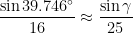
\displaystyle \frac{\sin 39.746^\circ}{16} \approx \displaystyle \frac{\sin \gamma}{25}

0.99883 \approx \sin \gamma

Uh oh… there are two possible solutions for \gamma since, hypothetically, \gamma could be in either the first or second quadrant! So we have no way of knowing, using only the Law of Sines, whether \gamma \approx 87.223^\circ or if \gamma \approx 180^\circ - 87.223^\circ = 92.777^\circ.

green lineFor this reason, it would have been far better to solve for the biggest angle first. For the present example, the biggest answer is \gamma since that’s the angle opposite the longest side.

c^2 = a^2 + b^2 - 2 a b \cos \gamma

625 = 256 + 400 - 640 \cos \gamma

-31 =-640 \cos \gamma

0.0484375 = \cos \gamma

Using a calculator, we find that \gamma \approx 87.223^\circ.

We now use the Law of Sines to solve for either \alpha or \beta (pretending that we didn’t do the work above). Let’s solve for \alpha:
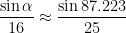
\displaystyle \frac{\sin \alpha}{a} = \displaystyle \frac{\sin \gamma}{c}

\displaystyle \frac{\sin \alpha}{16} \approx \displaystyle \frac{\sin 87.223}{25}

\sin \alpha \approx 0.63949

This equation also has two solutions in the interval [0^\circ, 180^\circ], namely, \alpha \approx 39.736^\circ and \alpha \approx 180^\circ - 39.736^\circ = 140.264^\circ. However, we know full well that the answer can’t be larger than \gamma since that’s already known to be the largest angle. So there’s no need to overthink the matter — the answer from blindly using arcsine on a calculator is going to be the answer for \alpha.

Naturally, the easiest way of finding \beta is by computing 180^\circ - \alpha - \gamma.