Lessons from teaching gifted elementary students (Part 8e)

Every so often, I’ll informally teach a class of gifted elementary-school students. I greatly enjoy interacting with them, and I especially enjoy the questions they pose. Often these children pose questions that no one else will think about, and answering these questions requires a surprisingly depth of mathematical knowledge.

Here’s a question I once received, in the students’ original handwriting. They wanted me to add adjacent numbers on the bottom row to produce the number on the next row, building upward until I reached the apex of the triangle. Then, after I reached the top number, they wanted me to take the square root of that number. (Originally, they wanted me to first multiply by 80 before taking the square root, but evidently they decided to take it easy on me.)

And, just to see if I could do it, they wanted me to do all of this without using a calculator. But they were nice and allowed me to use pencil and paper.

PascalProblem

So far, I’ve used Pascal’s triangle to obtain

y = \displaystyle \sum_{k=0}^{11} (k+1)^2 {11 \choose k}

= \displaystyle \sum_{k=2}^{11} k(k-1) {11 \choose k} +  \sum_{k=1}^{11} 3k {11 \choose k} + \sum_{k=0}^{11} {11 \choose k}.

= \displaystyle \sum_{k=2}^{11} k(k-1) \left( \frac{11!}{k!(11-k)!} \right) +  \sum_{k=1}^{11} 3k \left( \frac{11!}{k!(11-k)!} \right) + \sum_{k=0}^{11} \left( \frac{11!}{k!(11-k)!} \right).

= \displaystyle \sum_{k=2}^{11}  \frac{11!}{(k-2)!(11-k)!}  +  3 \sum_{k=1}^{11}  \frac{11!}{(k-1)!(11-k)!}  + \sum_{k=0}^{11}  \frac{11!}{k!(11-k)!} .

= \displaystyle \sum_{i=0}^{9} \frac{11!}{i!(9-i)!}  +  3 \sum_{j=0}^{10}  \frac{11!}{j!(10-j)!}  + \sum_{k=0}^{11}  \frac{11!}{k!(11-k)!} .

In the first series, I’ll rewrite 11! as 11 \times 10 \times 9!. Also, in the second series, I’ll rewrite 11! as 11 \times 10!. Therefore,

y = \displaystyle \sum_{i=0}^{9} 11 \times 10 \frac{9!}{i!(9-i)!}  +  3 \sum_{j=0}^{10}  11 \frac{10!}{j!(10-j)!}  + \sum_{k=0}^{11}  \frac{11!}{k!(11-k)!}

y = \displaystyle 110 \sum_{i=0}^{9} \frac{9!}{i!(9-i)!}  +  33 \sum_{j=0}^{10}  \frac{10!}{j!(10-j)!}  + \sum_{k=0}^{11}  \frac{11!}{k!(11-k)!}

We now see that binomial coefficients appear in each of these series:

y = \displaystyle 110 \sum_{i=0}^{9} {9 \choose i}  +  33 \sum_{j=0}^{10} {10 \choose j} + \sum_{k=0}^{11}  {11 \choose k}

I’ll conclude the evaluation of y in tomorrow’s post.

Lessons from teaching gifted elementary students (Part 8d)

Every so often, I’ll informally teach a class of gifted elementary-school students. I greatly enjoy interacting with them, and I especially enjoy the questions they pose. Often these children pose questions that no one else will think about, and answering these questions requires a surprisingly depth of mathematical knowledge.

Here’s a question I once received, in the students’ original handwriting. They wanted me to add adjacent numbers on the bottom row to produce the number on the next row, building upward until I reached the apex of the triangle. Then, after I reached the top number, they wanted me to take the square root of that number. (Originally, they wanted me to first multiply by 80 before taking the square root, but evidently they decided to take it easy on me.)

And, just to see if I could do it, they wanted me to do all of this without using a calculator. But they were nice and allowed me to use pencil and paper.

PascalProblem

So far, I’ve used Pascal’s triangle to obtain

y = \displaystyle \sum_{k=0}^{11} (k+1)^2 {11 \choose k}

= \displaystyle \sum_{k=2}^{11} k(k-1) {11 \choose k} +  \sum_{k=1}^{11} 3k {11 \choose k} + \sum_{k=0}^{11} {11 \choose k}.

I now use the definition of the binomial coefficient:

= \displaystyle \sum_{k=2}^{11} k(k-1) \left( \frac{11!}{k!(11-k)!} \right) +  \sum_{k=1}^{11} 3k \left( \frac{11!}{k!(11-k)!} \right) + \sum_{k=0}^{11} \left( \frac{11!}{k!(11-k)!} \right).

Since k! = k(k-1) \times (k-2)! and k! = k \times (k-1)!, this simplifies as

y = \displaystyle \sum_{k=2}^{11} \frac{11!}{(k-2)!(11-k)!}+  3 \sum_{k=1}^{11} \frac{11!}{(k-1)!(11-k)!} + \sum_{k=0}^{11} \frac{11!}{k!(11-k)!} .

In the first series, I’ll use the change of index i = k-2, so that k = i+2 and 11-k = 11-(i+2) = 9-i. Also, in the first series, the index will change from k = 2 to k = 11 to i = 0 to i = 9.

In the second series, I’ll use the change of index j = k-1, so that k = j+1 and 11-k = 11-(j+1) = 10-j. Also, in the first series, the index will change from k = 1 to k = 11 to j = 0 to j = 10.

With these changes, I obtain

y = \displaystyle \sum_{i=0}^{9}\frac{11!}{(i!(9-i)!}  +  3 \sum_{j=0}^{10} \frac{11!}{j!(10-j)!}  + \sum_{k=0}^{11}  \frac{11!}{k!(11-k)!} .

I’ll continue the simplification of these series in tomorrow’s post.

Lessons from teaching gifted elementary students (Part 8c)

Every so often, I’ll informally teach a class of gifted elementary-school students. I greatly enjoy interacting with them, and I especially enjoy the questions they pose. Often these children pose questions that no one else will think about, and answering these questions requires a surprisingly depth of mathematical knowledge.

Here’s a question I once received, in the students’ original handwriting. They wanted me to add adjacent numbers on the bottom row to produce the number on the next row, building upward until I reached the apex of the triangle. Then, after I reached the top number, they wanted me to take the square root of that number. (Originally, they wanted me to first multiply by 80 before taking the square root, but evidently they decided to take it easy on me.)

And, just to see if I could do it, they wanted me to do all of this without using a calculator. But they were nice and allowed me to use pencil and paper.

PascalProblem

In yesterday’s post, I explained how Pascal’s triangle can be used to conclude

y = \displaystyle \sum_{k=0}^{11} (k+1)^2 {11 \choose k},

thus allowing me to get the top number without getting all of the intermediate steps.

To compute this sum without a calculator, I’ll start rearranging the terms. The reasons for rearranging the terms in this way will become evident later.

y = \displaystyle \sum_{k=0}^{11} (k+1)^2 {11 \choose k}

= \displaystyle \sum_{k=0}^{11} (k^2 + 2k + 1) {11 \choose k}

= \displaystyle \sum_{k=0}^{11} ([k^2 -k] + 3k + 1) {11 \choose k}

=\displaystyle \sum_{k=0}^{11} [k(k-1) + 3k + 1] {11 \choose k}

= \displaystyle \sum_{k=0}^{11} k(k-1) {11 \choose k} +  \sum_{k=0}^{11} 3k {11 \choose k} + \sum_{k=0}^{11} {11 \choose k}.

The terms of the first sum are clearly equal to 0 when k = 0 and k =1. Also, the $k=0$ term of the second sum is clearly 0. Therefore,

y = \displaystyle \sum_{k=2}^{11} k(k-1) {11 \choose k} +  \sum_{k=1}^{11} 3k {11 \choose k} + \sum_{k=0}^{11} {11 \choose k}.

It doesn’t look like I’ve improved matters much with this rearrangement of y; I’ll continue the solution in tomorrow’s post.

Lessons from teaching gifted elementary students (Part 8b)

Every so often, I’ll informally teach a class of gifted elementary-school students. I greatly enjoy interacting with them, and I especially enjoy the questions they pose. Often these children pose questions that no one else will think about, and answering these questions requires a surprisingly depth of mathematical knowledge.

Here’s a question I once received, in the students’ original handwriting. They wanted me to add adjacent numbers on the bottom row to produce the number on the next row, building upward until I reached the apex of the triangle. Then, after I reached the top number, they wanted me to take the square root of that number. (Originally, they wanted me to first multiply by 80 before taking the square root, but evidently they decided to take it easy on me.)

And, just to see if I could do it, they wanted me to do all of this without using a calculator. But they were nice and allowed me to use pencil and paper.

PascalProblem

Here’s how I started the problem, using a trick that I use in my mathematical magic show. Suppose that there are only six numbers instead of twelve, and let the six numbers be a, b, c, d, e, and f. Then here’s how the triangle unfolds (turning the triangle upside down):


a \qquad \qquad \qquad \quad b \qquad \qquad \qquad \quad c \qquad \qquad \qquad \quad d \qquad \qquad \qquad \quad e \qquad \qquad \qquad \quad f

a+b \qquad \qquad \qquad b+c \qquad \qquad \qquad c+d \qquad \qquad \qquad d+e \qquad \qquad \qquad e+f

a+2b+c \qquad \qquad b+2c+d \qquad \qquad c+2d+e \qquad \qquad d+2e+f

a+3b+3c+d \qquad \quad b+3c+3d+e \qquad \quad c+3d+3e+f

a+4b+6c+4d+e \qquad b+4c+6d+5e+f

a+5b+10c+10d+5e+f

In other words, the top number can be obtained by using the numbers on the fifth row of Pascal’s triangle (recall that the fifth row of Pascal’s triangle has six numbers on it). Specifically, if I multiply the bottom numbers by the corresponding number in a row of Pascal’s triangle and add them up, I’ll get the number on top without having to compute all of the intermediate steps.

For the problem my students gave me, the bottom row has 12 numbers, which means I’ll need to use the 11th row of Pascal’s triangle. Also, as we’ll see, I was fortunate that my students gave me a simple pattern of consecutive squares for the numbers on the bottom row. Since the numbering in Pascal’s triangle starts on zero, the numbers in the bottom row are (k+1)^2 as k varies from 0 to 11.

Putting all this together, I can conclude that

y = \displaystyle \sum_{k=0}^{11} (k+1)^2 {11 \choose k}.

Beginning with tomorrow’s post, I’ll discuss how I computed this sum without a calculator.

Lessons from teaching gifted elementary school students (Part 8a)

Every so often, I’ll informally teach a class of gifted elementary-school students. I greatly enjoy interacting with them, and I especially enjoy the questions they pose. Often these children pose questions that no one else will think about, and answering these questions requires a surprisingly depth of mathematical knowledge.

Here’s a question I once received, in the students’ original handwriting:

PascalProblem

Here’s the explanation that my students told me (but didn’t write down): they wanted me to add adjacent numbers on the bottom row to produce the number on the next row, building upward until I reached the apex of the triangle. For example, the lower-left portion of the triangle would build like this (since 1+4=5, 4+9=13, 9+16=25, etc.):

56

18   38

5    13    25

1     4     9     16

Then, after I reached the top number, they wanted me to take the square root of that number. (Originally, they wanted me to first multiply by 80 before taking the square root, but evidently they decided to take it easy on me.)

And, just to see if I could do it, they wanted me to do all of this without using a calculator. But they were nice and allowed me to use pencil and paper.

And I produced the answer in less than five minutes.

I’ll reveal how I got the answer so quickly in this series. In the meantime, I’ll leave a thought bubble if you’d like to think about it on your own.

green_speech_bubble

Engaging students: Using Pascal’s triangle

In my capstone class for future secondary math teachers, I ask my students to come up with ideas for engaging their students with different topics in the secondary mathematics curriculum. In other words, the point of the assignment was not to devise a full-blown lesson plan on this topic. Instead, I asked my students to think about three different ways of getting their students interested in the topic in the first place.

I plan to share some of the best of these ideas on this blog (after asking my students’ permission, of course).

This student submission comes from my former student Jason Trejo. His topic, from Precalculus: using Pascal’s triangle.

green line

How could you as a teacher create an activity or project that involves your topic?

After some research and interesting observations I came across while examining Pascal’s Triangle, I feel like I could create some sort of riddle worksheet that involves the Triangle. Once I have taught my students how to create Pascal’s Triangle, I could give my students riddles such as:

  • Once you go and strive in prime, belittling your neighbors isn’t a crime.
    • Students might notice that each number (other than 1) in a prime number row is divisible by that prime number:
      • Row 7= 1, 7, 21, 35, 35, 21, 7, 1
      • Row 11= 1, 11, 55, 165, 330, 462, 462, 330, 165, 55, 11, 1
    • Naturally shallow slides aren’t much fun, but with a fib of raunchy, it is this one.
      • Given that I have gone over the Fibonacci sequence with my students prior to these riddles, I could include this one. The students should eventually see that if you take shallow diagonals on Pascal’s Triangle, the sum of those diagonals are the consecutive numbers in the Fibonacci sequence.
    • In a game on blades, you can’t be a schmuck with a puck. Be nimble and quick to look for the stick.
      • This one is a little more straightforward compared to the last two so hopefully the students will make the connection to notice the hockey stick pattern on the diagonals of Pascal’s Triangle. When adding the numbers down a diagonal, then the number to the side and below will be the sum, thus looking like a hockey stick.
    • What else is there? What else is in store? What patterns can you find when you know who to root four?
      • The “typo” is intentional to give a hint at another pattern the students might notice on Pascal’s Triangle. Now I am challenging the students to find more patterns within the Triangle such as:
        • Sum of rows are the powers of 2
        • Rows relate to the powers of 11 (get murky after the 4th row)
        • Counting numbers, triangular numbers, etc.

The purpose of this activity would extend the use of Pascal’s triangle from what they already know. I could assign this at the beginning of the lesson and if no one understands what the riddles meant, we could come back as a class and figure them out together once the lesson was done. These riddles could be an assignment of their own if I introduce them after they are very familiar with Pascal’s Triangle.


green line

How can this topic be used in students’ future courses in mathematics and science?

I would say the primary use most students will get from Pascal’s Triangle would be to find the coefficients of binomials since it is much easier when working on binomial expansions, but there are also other ways they can use the Triangle as well. For one, it can be of great use in many courses that involve since it is a visual in seeing the number of combinations there are based on the number of items used. For example, say there are 6 different pieces of candy in a bowl and you need to know how many different ways can you choose 3 candies? Using Pascal’s Triangle, we look at the 6th row and the 3rd entry in that row (remembering the top row is Row 0 and the first 1 in each row is Entry 0), we can see that there are 20 possible combinations of 3 different pieces of candy. Other than that, even based on the riddle activity from above, students can use Pascal’s Triangle and its various patterns to help remember such things as triangular numbers, powers of 11, etc.


green line

How has this topic appeared in high culture?

Within the past few years, the Shanghai-based design company, Super Nature Design, created the interactive art piece “Lost in Pascal’s Triangle”. This structure takes inspiration from Pascal’s Triangle and allows people to “explore the concept and magnification of the Pascal’s Triangle mathematics formula.” The following link takes you to the website that gives a bit more information behind the piece and shows how people can interact with the structure through a xylophone-type console: http://www.supernaturedesign.com/work/pascaltriangle#8

Another quick application that can be done through Pascal’s Triangle is by seeing the relationship between the Triangle and Sierpinski’s triangle (as shown below):

pascal1

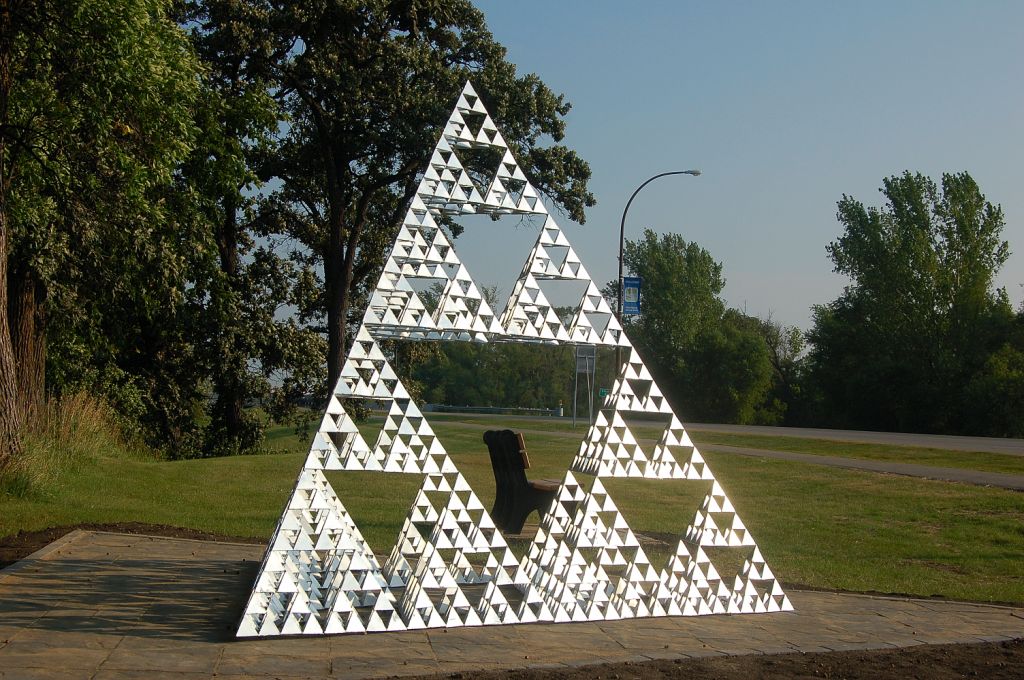
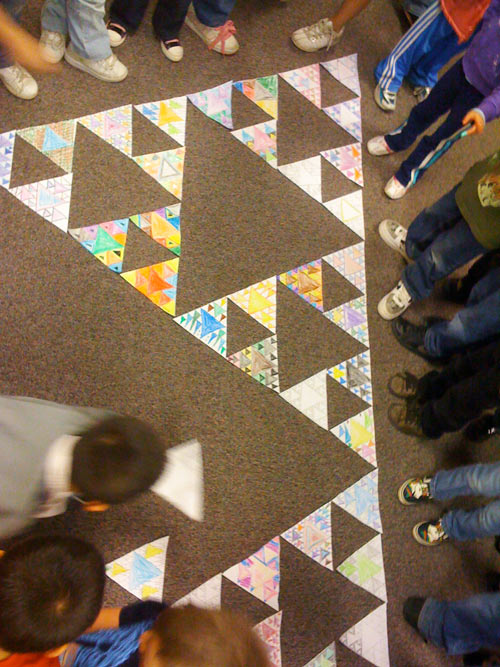
The pattern is by shading in every odd number on Pascal’s Triangle, you start creating Sierpinski’s triangle which is found in many works of art like these:

pascal2


pascal3

It might actually be a small but fun project to have the students create something like this at the beginning of the lesson and then explain the relation of the two special triangles.

References:

Pascal Triangle Information: http://jwilson.coe.uga.edu/EMAT6680Su12/Berryman/6690/BerrymanK-Pascals/BerrymanK-Pascals.html

Image of Pascal’s Triangle: http://mathforum.org/workshops/usi/pascal/images/pascal.hex2.gif

Lost in Pascal’s Triangle: http://www.designboom.com/weblog/images/images_2/andrea/super_nature_design/pascaltriangle01.jpg

Super Nature Design: http://www.supernaturedesign.com/work/pascaltriangle#2

Pascal and Sierpinski Triangle : http://mathforum.org/workshops/usi/pascal/images/sierpinski.pascalfrac.gif

Sierpinski Pyramid: http://www.sierpinskitetrahedron.com/images/sierpinski-tetrahedron-breckenridge.JPG

Sierpinski Art Project: http://fractalfoundation.org/wp-content/uploads/2009/03/sierpkids1.jpg

My Mathematical Magic Show: Index

I’m doing something that I should have done a long time ago: collecting a series of posts into one single post. Here’s my series on the mathematical magic show that I’ll perform from time to time.

Part 1: Introduction.

Part 2a, 2b, and 2c: The 1089 trick.

Part 3a, 3b, and 3c: A geometric magic trick (see also here).

Part 4a, 4b, 4c, and 4d: A trick using binary numbers.

Part 5a, 5b, 5c, 5d: Predicting a digit that’s been erased from a number.

Part 6: Finale.

Part 7: The Fitch-Cheney 5-card trick.

Part 8a, 8b, 8c: A trick using Pascal’s triangle.


My Mathematical Magic Show: Part 8c

This mathematical trick was not part of my Pi Day magic show but probably should have been… I’ve performed this for my Precalculus classes in the past but flat forgot about it when organizing my Pi Day show. The next time I perform a magic show, I’ll do this one right after the 1089 trick. (I think I learned this trick from a Martin Gardner book when I was young, but I’m not sure about that.)

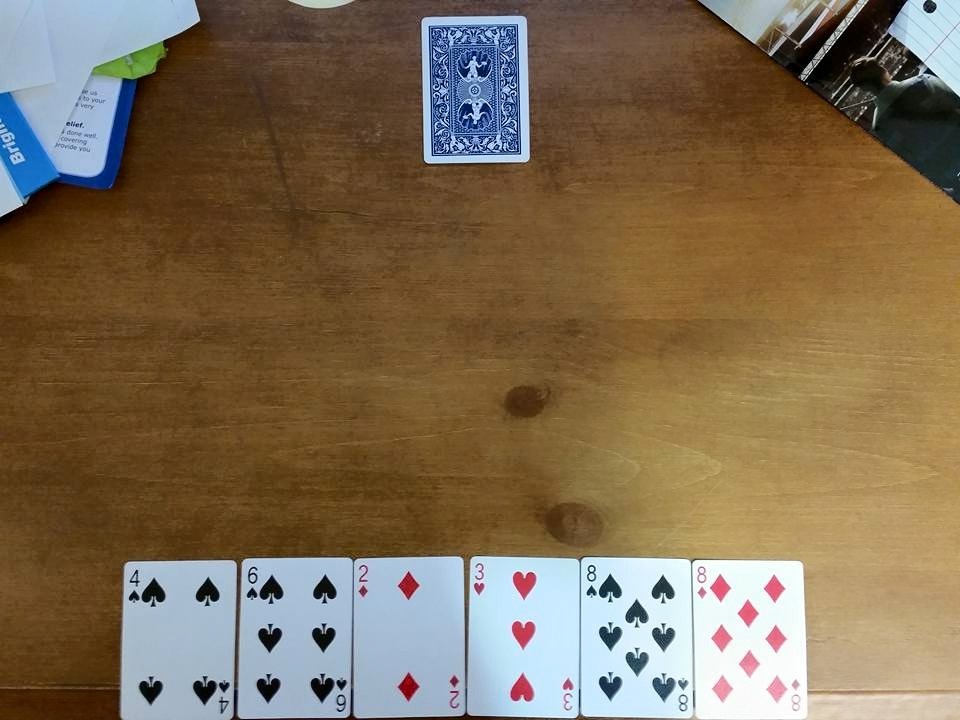
Here’s a description of the trick. I give my audience a deck of cards and ask them to select six cards between ace and nine (in other words, no tens, jacks, queens, or kings). The card are placed face up, side by side.

After about 5-10 seconds, I secretly write a pull out a card from the deck and place it face down above the others.


pascalcardtrick1

I then announce that we’re going to some addition together… with the understanding that I’ll never write down a number larger than 9. For example, the 4 and 6 of spades are next to each other. Obviously, 4+6 = 10, but my rule is that I’m going to write down a number larger than 9. So I’ll subtract 9 whenever necessary: 10-9 = 1. Since 1 corresponds to ace, I place an ace about the 4 and 6 of spades.

Continuing in this way (and having the audience participate in the arithmetic so that this doesn’t get boring), I eventually get to this position:

pascalcardtrick5

Finally, I add the two cards at the top (and, in this case, subtract 9) to get 6+9-9 = 6, and I dramatically turn over the last card to reveal a 6.

pascalcardtrick6

I’ll often perform this trick when teaching Precalculus, as the final answer involving Pascal’s triangle. As discussed yesterday, suppose that the six cards are a, b, c, d, e, and f. Forgetting for now about subtracting by 9, here’s how the triangle unfolds (turning the triangle upside down):

a \qquad \qquad \qquad \quad b \qquad \qquad \qquad \quad c \qquad \qquad \qquad \quad d \qquad \qquad \qquad \quad e \qquad \qquad \qquad \quad f

a+b \qquad \qquad \qquad b+c \qquad \qquad \qquad c+d \qquad \qquad \qquad d+e \qquad \qquad \qquad e+f

a+2b+c \qquad \qquad b+2c+d \qquad \qquad c+2d+e \qquad \qquad d+2e+f

a+3b+3c+d \qquad \quad b+3c+3d+e \qquad \quad c+3d+3e+f

a+4b+6c+4d+e \qquad b+4c+6d+5e+f

a+5b+10c+10d+5e+f

 Not surprisingly, the coefficients in the above chart involve the numbers in Pascal’s triangle. Indeed, the reason that I chose to use 6 cards (as opposed to any other number of cards) is that the bottom row has only 1, 5, and 10 as coefficients, and 10 \equiv 1 (\mod 9). Therefore, the only tricky part of the calculation is multiplying b+e by 5, as the final answer can then be found by adding the remaining four numbers.

My students usually find this to be a clever application of Pascal’s triangle for impressing their friends after class.

green lineP.S. After typing this series, it hit me that it’s really easy to do this trick mod 10 (which means getting rids of only the face cards prior to the trick). All the magician has to do is subtly ensure that the second and fifth cards are both even or both odd, so that b+e is even and hence 5(b+e) is a multiple of 10. Therefore, since 10c+10d is also a multiple of 10, the answer will be just a+f or a+f-10.

(If the magician can’t control the placement of the second and fifth cards so that one is even and one is odd, the answer will be just a+f+5 or a+f-5.)

Henceforth, I’ll be doing this trick mod 10 instead of mod 9.


My Mathematical Magic Show: Part 8b

This mathematical trick was not part of my Pi Day magic show but probably should have been… I’ve performed this for my Precalculus classes in the past but flat forgot about it when organizing my Pi Day show. The next time I perform a magic show, I’ll do this one right after the 1089 trick. (I think I learned this trick from a Martin Gardner book when I was young, but I’m not sure about that.)

Here’s a description of the trick. I give my audience a deck of cards and ask them to select six cards between ace and nine (in other words, no tens, jacks, queens, or kings). The card are placed face up, side by side.

After about 5-10 seconds, I secretly write a pull out a card from the deck and place it face down above the others.


pascalcardtrick1

I then announce that we’re going to some addition together… with the understanding that I’ll never write down a number larger than 9. For example, the 4 and 6 of spades are next to each other. Obviously, 4+6 = 10, but my rule is that I’m going to write down a number larger than 9. So I’ll subtract 9 whenever necessary: 10-9 = 1. Since 1 corresponds to ace, I place an ace about the 4 and 6 of spades.

Continuing in this way (and having the audience participate in the arithmetic so that this doesn’t get boring), I eventually get to this position:

pascalcardtrick5

Finally, I add the two cards at the top (and, in this case, subtract 9) to get 6+9-9 = 6, and I dramatically turn over the last card to reveal a 6.

pascalcardtrick6

How does this trick work? This is an exercise in modular arithmetic (see also Wikipedia). Suppose that the six cards are a, b, c, d, e, and f. Forgetting for now about subtracting by 9, here’s how the triangle unfolds (turning the triangle upside down):

a \qquad \qquad \qquad \quad b \qquad \qquad \qquad \quad c \qquad \qquad \qquad \quad d \qquad \qquad \qquad \quad e \qquad \qquad \qquad \quad f

a+b \qquad \qquad \qquad b+c \qquad \qquad \qquad c+d \qquad \qquad \qquad d+e \qquad \qquad \qquad e+f

a+2b+c \qquad \qquad b+2c+d \qquad \qquad c+2d+e \qquad \qquad d+2e+f

a+3b+3c+d \qquad \quad b+3c+3d+e \qquad \quad c+3d+3e+f

a+4b+6c+4d+e \qquad b+4c+6d+5e+f

a+5b+10c+10d+5e+f

 Therefore, the top card will simply be a+5b+10c+10d+5e+f minus a multiple of 9.

That’s a pretty big calculation for the magician to do on the spot. Fortunately, 9c + 9d is also a multiple of 9, and so the top card will be

 a+5b+10c+10d+5e+f - (9c + 9d) minus a multiple of 9, or

5(b+e) + a +  c + d +  f minus a multiple of 9.

For the case at hand, b = 6 and e =8, so 5(b+e) = 70. That’s still a big number to keep straight when performing the trick. However, since I’m going to be subtracting 9’s anyway, I can do this faster by replacing the 8 by 8 - 9 = -1. So, for the purposes of the trick, 5(b+e) = 5 \times (6-1) = 25, and I subtract 18 to get 7.

I now add the rest of the cards, subtracting 9 as I go along. For this example, I’d add the 2 first to get 9, which is 0 after subtracting another 9. I then add the remaining cards of 4, 3, and 8 (remembering that the 8 is basically 8-9 = -1, yielding 4+3-1 = 6. So the top card has to be 6.

The key point of this calculation is to subtract 9 whenever possible to keep the numbers small, making it easier to do in your head when performing the trick.


My Mathematical Magic Show: Part 8a

This mathematical trick was not part of my Pi Day magic show but probably should have been… I’ve performed this for my Precalculus classes in the past but flat forgot about it when organizing my Pi Day show. The next time I perform a magic show, I’ll do this one right after the 1089 trick. (I think I learned this trick from a Martin Gardner book when I was young, but I’m not sure about that.)

Here’s a description of the trick. I give my audience a deck of cards and ask them to select six cards between ace and nine (in other words, no tens, jacks, queens, or kings). The card are placed face up, side by side.

After about 5-10 seconds, I secretly write a pull out a card from the deck and place it face down above the others.


pascalcardtrick1

I then announce that we’re going to some addition together… with the understanding that I’ll never write down a number larger than 9. For example, the 4 and 6 of spades are next to each other. Obviously, 4+6 = 10, but my rule is that I’m going to write down a number larger than 9. So I’ll subtract 9 whenever necessary: 10-9 = 1. Since 1 corresponds to ace, I place an ace about the 4 and 6 of spades.

Next, I consider the 6 of spades and 2 of diamonds. Adding, I get 8. That’s less than 9, so I pull an 8 out of the deck.

Next, 2+3 = 5, so I pull out a 5 from the deck.

Next, 8+8=16, and 16-9=7. So I pull out a 7.

(To keep this from getting dry, I have the audience perform the arithmetic with me.)

pascalcardtrick2

On the the next row. The next cards are 1+8 = 9, 8+5-9 = 4, 5+2 =7, and 2+7 = 9.

pascalcardtrick3

On the the next row. The next cards are 9+4-9=4, $latex $4+7-9 = 2$, and 7+9-9 = 7.

pascalcardtrick4

Almost there: 4+2 = 6 and 2+7= 9.


pascalcardtrick5

Finally, 6+9-9 = 6, and I dramatically turn over the last card to reveal a 6.

 

pascalcardtrick6


Naturally, everyone wonders how I knew what the last card would be without first getting all of the cards in the middle. I’ll discuss this in tomorrow’s post.