
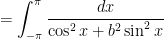
Earlier in this series, I gave three different methods of showing that

Using the fact that  is independent of
  , I’ll now give a fourth method.
 Since is independent of , I can substitute any convenient value of that I want without changing the value of . As shown in previous posts, substituting
  yields the following simplification:
is independent of , I’ll now give a fourth method. Since is independent of , I can substitute any convenient value of that I want without changing the value of . As shown in previous posts, substituting yields the following simplification:




![= \displaystyle \int_{-\infty}^{\infty} \left[ \displaystyle \left( \frac{2 - 2k_1^2}{k_2^2 - k_1^2} \right) \frac{1}{u^2 + k_1^2} + \displaystyle \left( \frac{2 k_2^2 - 2}{k_2^2 - k_1^2} \right) \frac{1}{u^2 + k_2^2} \right] du](https://s0.wp.com/latex.php?latex=%3D+%5Cdisplaystyle+%5Cint_%7B-%5Cinfty%7D%5E%7B%5Cinfty%7D+%5Cleft%5B+%5Cdisplaystyle+%5Cleft%28+%5Cfrac%7B2+-+2k_1%5E2%7D%7Bk_2%5E2+-+k_1%5E2%7D+%5Cright%29+%5Cfrac%7B1%7D%7Bu%5E2+%2B+k_1%5E2%7D+%2B+%5Cdisplaystyle+%5Cleft%28+%5Cfrac%7B2+k_2%5E2+-+2%7D%7Bk_2%5E2+-+k_1%5E2%7D+%5Cright%29+%5Cfrac%7B1%7D%7Bu%5E2+%2B+k_2%5E2%7D+%5Cright%5D+du&bg=ffffff&fg=000000&s=0&c=20201002)
where 



so that
At this point in the calculation, we can employ the now familiar antiderivative

so that
![Q = \left[ \displaystyle \left( \frac{2 - 2k_1^2}{k_2^2 - k_1^2} \right) \frac{1}{k_1}\tan^{-1} \left( \frac{u}{k_1} \right) + \displaystyle \left( \frac{2 k_2^2 - 2}{k_2^2 - k_1^2} \right) \displaystyle \frac{1}{k_2} \tan^{-1} \left( \frac{u}{k_2} \right) \right]^{\infty}_{-\infty}](https://s0.wp.com/latex.php?latex=Q+%3D+%5Cleft%5B+%5Cdisplaystyle+%5Cleft%28+%5Cfrac%7B2+-+2k_1%5E2%7D%7Bk_2%5E2+-+k_1%5E2%7D+%5Cright%29+%5Cfrac%7B1%7D%7Bk_1%7D%5Ctan%5E%7B-1%7D+%5Cleft%28+%5Cfrac%7Bu%7D%7Bk_1%7D+%5Cright%29+%2B+%5Cdisplaystyle+%5Cleft%28+%5Cfrac%7B2+k_2%5E2+-+2%7D%7Bk_2%5E2+-+k_1%5E2%7D+%5Cright%29+%5Cdisplaystyle+%5Cfrac%7B1%7D%7Bk_2%7D+%5Ctan%5E%7B-1%7D+%5Cleft%28+%5Cfrac%7Bu%7D%7Bk_2%7D+%5Cright%29+%5Cright%5D%5E%7B%5Cinfty%7D_%7B-%5Cinfty%7D&bg=ffffff&fg=000000&s=0&c=20201002)





Now it remains to simplify this fraction. To do this, we note that

so that

Matching coefficients, we see that


Since both 



Plugging these in, we finally conclude that
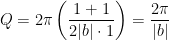
again matching our earlier result.
Using the fourth method, I’ve shown that 



 is a real number for the four roots of the denominator.
 if
if  ,
,![\left[ 2|b| \sqrt{b^2-1} \right]^2 = 4b^2 (b^2 - 1) = 4b^4 - 4b^2](https://s0.wp.com/latex.php?latex=%5Cleft%5B+2%7Cb%7C+%5Csqrt%7Bb%5E2-1%7D+%5Cright%5D%5E2+%3D+4b%5E2+%28b%5E2+-+1%29+%3D+4b%5E4+-+4b%5E2&bg=ffffff&fg=000000&s=0&c=20201002) .
.![(2b^2 - 1)^2 > \left[ 2|b| \sqrt{b^2-1} \right]^2](https://s0.wp.com/latex.php?latex=%282b%5E2+-+1%29%5E2+%3E+%5Cleft%5B+2%7Cb%7C+%5Csqrt%7Bb%5E2-1%7D+%5Cright%5D%5E2&bg=ffffff&fg=000000&s=0&c=20201002)


 ,
, ,
, and not
  . However, there are no
  and
and  terms in the denominator, I can treat
  , I clear out the denominator:
![2u^2 + 2 = A \left[ u^2 + k_2^2 \right] + B \left[ u^2 + k_1^2 \right]](https://s0.wp.com/latex.php?latex=2u%5E2+%2B+2+%3D+A+%5Cleft%5B+u%5E2+%2B+k_2%5E2+%5Cright%5D+%2B+B+%5Cleft%5B+u%5E2+%2B+k_1%5E2+%5Cright%5D&bg=ffffff&fg=000000&s=0&c=20201002)


 into the second equation, I get










![= \displaystyle \int_{-\infty}^{\infty} \frac{ 2(1+u^2) du}{u^4 + (4 \cdot [1^2] - 2) u^2 + 1}](https://s0.wp.com/latex.php?latex=%3D+%5Cdisplaystyle+%5Cint_%7B-%5Cinfty%7D%5E%7B%5Cinfty%7D+%5Cfrac%7B+2%281%2Bu%5E2%29+du%7D%7Bu%5E4+%2B+%284+%5Ccdot+%5B1%5E2%5D+-+2%29+u%5E2+%2B+1%7D&bg=ffffff&fg=000000&s=0&c=20201002)


![=\displaystyle \left[ 2\tan^{-1} x \right]^{\infty}_{-\infty}](https://s0.wp.com/latex.php?latex=%3D%5Cdisplaystyle+%5Cleft%5B+2%5Ctan%5E%7B-1%7D+x+%5Cright%5D%5E%7B%5Cinfty%7D_%7B-%5Cinfty%7D&bg=ffffff&fg=000000&s=0&c=20201002)
![=\displaystyle \left[ 2 \frac{\pi}{2} - 2 \frac{-\pi}{2} \right]](https://s0.wp.com/latex.php?latex=%3D%5Cdisplaystyle+%5Cleft%5B+2+%5Cfrac%7B%5Cpi%7D%7B2%7D+-+2+%5Cfrac%7B-%5Cpi%7D%7B2%7D+%5Cright%5D&bg=ffffff&fg=000000&s=0&c=20201002)

 , so that
 ,
, ,
, .
. to
to  , and so
![Q = \displaystyle \int_{-\infty}^{\infty} \frac{ \displaystyle \frac{2}{1+u^2} du}{ \left[\displaystyle \frac{1-u^2}{1+u^2} \right]^2 + b^2 \left[\displaystyle \frac{2u}{1+u^2}\right]^2}](https://s0.wp.com/latex.php?latex=Q+%3D+%5Cdisplaystyle+%5Cint_%7B-%5Cinfty%7D%5E%7B%5Cinfty%7D+%5Cfrac%7B+%5Cdisplaystyle+%5Cfrac%7B2%7D%7B1%2Bu%5E2%7D+du%7D%7B+%5Cleft%5B%5Cdisplaystyle+%5Cfrac%7B1-u%5E2%7D%7B1%2Bu%5E2%7D+%5Cright%5D%5E2+%2B+b%5E2+%5Cleft%5B%5Cdisplaystyle+%5Cfrac%7B2u%7D%7B1%2Bu%5E2%7D%5Cright%5D%5E2%7D&bg=ffffff&fg=000000&s=0&c=20201002)
![= \displaystyle \int_{-\infty}^{\infty} \frac{ 2(1+u^2) du}{ \left[1-u^2 \right]^2 + b^2 \left[2u \right]^2}](https://s0.wp.com/latex.php?latex=%3D+%5Cdisplaystyle+%5Cint_%7B-%5Cinfty%7D%5E%7B%5Cinfty%7D+%5Cfrac%7B+2%281%2Bu%5E2%29+du%7D%7B+%5Cleft%5B1-u%5E2+%5Cright%5D%5E2+%2B+b%5E2+%5Cleft%5B2u+%5Cright%5D%5E2%7D&bg=ffffff&fg=000000&s=0&c=20201002)

 on the second piece:








 to show that
  .
. , so that
  is a constant with respect to
  does not depend on
  ) using the Quotient Rule:
![Q'(a) = \displaystyle 2 \int_{-\infty}^{\infty} \frac{ 2a \left[ (a^2+b^2)^2 v^2 + b^2\right] - 2 (a^2+b^2) \cdot (a^2+b^2) v^2 \cdot 2a }{\left[ (a^2+b^2)^2 v^2 + b^2 \right]^2} dv](https://s0.wp.com/latex.php?latex=Q%27%28a%29+%3D+%5Cdisplaystyle+2+%5Cint_%7B-%5Cinfty%7D%5E%7B%5Cinfty%7D+%5Cfrac%7B+2a+%5Cleft%5B+%28a%5E2%2Bb%5E2%29%5E2+v%5E2+%2B+b%5E2%5Cright%5D+-+2+%28a%5E2%2Bb%5E2%29+%5Ccdot+%28a%5E2%2Bb%5E2%29+v%5E2+%5Ccdot+2a+%7D%7B%5Cleft%5B+%28a%5E2%2Bb%5E2%29%5E2+v%5E2+%2B+b%5E2+%5Cright%5D%5E2%7D+dv&bg=ffffff&fg=000000&s=0&c=20201002)
![Q'(a) = \displaystyle 4a \int_{-\infty}^{\infty} \frac{(a^2+b^2)^2 v^2 + b^2- 2 (a^2+b^2)^2 v^2}{\left[ (a^2+b^2)^2 v^2 + b^2 \right]^2} dv](https://s0.wp.com/latex.php?latex=Q%27%28a%29+%3D+%5Cdisplaystyle+4a+%5Cint_%7B-%5Cinfty%7D%5E%7B%5Cinfty%7D+%5Cfrac%7B%28a%5E2%2Bb%5E2%29%5E2+v%5E2+%2B+b%5E2-+2+%28a%5E2%2Bb%5E2%29%5E2+v%5E2%7D%7B%5Cleft%5B+%28a%5E2%2Bb%5E2%29%5E2+v%5E2+%2B+b%5E2+%5Cright%5D%5E2%7D+dv&bg=ffffff&fg=000000&s=0&c=20201002)
![Q'(a) = \displaystyle 4a \int_{-\infty}^{\infty} \frac{b^2-(a^2+b^2)^2 v^2}{\left[ (a^2+b^2)^2 v^2 + b^2 \right]^2} dv](https://s0.wp.com/latex.php?latex=Q%27%28a%29+%3D+%5Cdisplaystyle+4a+%5Cint_%7B-%5Cinfty%7D%5E%7B%5Cinfty%7D+%5Cfrac%7Bb%5E2-%28a%5E2%2Bb%5E2%29%5E2+v%5E2%7D%7B%5Cleft%5B+%28a%5E2%2Bb%5E2%29%5E2+v%5E2+%2B+b%5E2+%5Cright%5D%5E2%7D+dv&bg=ffffff&fg=000000&s=0&c=20201002)
 , so that
![(a^2+b^2)^2 v^2 = (a^2+b^2)^2 \displaystyle \left[ \frac{b}{a^2+b^2} \tan \theta \right]^2 = b^2 \tan^2 \theta](https://s0.wp.com/latex.php?latex=%28a%5E2%2Bb%5E2%29%5E2+v%5E2+%3D+%28a%5E2%2Bb%5E2%29%5E2+%5Cdisplaystyle+%5Cleft%5B+%5Cfrac%7Bb%7D%7Ba%5E2%2Bb%5E2%7D+%5Ctan+%5Ctheta+%5Cright%5D%5E2+%3D+b%5E2+%5Ctan%5E2+%5Ctheta&bg=ffffff&fg=000000&s=0&c=20201002)
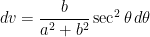
 to
to  , and so
![Q'(a) = \displaystyle 4a \int_{-\pi/2}^{\pi/2} \frac{b^2- b^2 \tan^2 \theta}{\left[ b^2 \tan^2 \theta + b^2 \right]^2} \frac{b}{a^2+b^2} \sec^2 \theta \, d\theta](https://s0.wp.com/latex.php?latex=Q%27%28a%29+%3D+%5Cdisplaystyle+4a+%5Cint_%7B-%5Cpi%2F2%7D%5E%7B%5Cpi%2F2%7D+%5Cfrac%7Bb%5E2-+b%5E2+%5Ctan%5E2+%5Ctheta%7D%7B%5Cleft%5B+b%5E2+%5Ctan%5E2+%5Ctheta+%2B+b%5E2+%5Cright%5D%5E2%7D+%5Cfrac%7Bb%7D%7Ba%5E2%2Bb%5E2%7D+%5Csec%5E2+%5Ctheta+%5C%2C+d%5Ctheta&bg=ffffff&fg=000000&s=0&c=20201002)
![= \displaystyle \frac{4ab^3}{a^2+b^2} \int_{-\pi/2}^{\pi/2} \frac{[1- \tan^2 \theta] \sec^2 \theta}{\left[ \tan^2 \theta +1 \right]^2} d\theta](https://s0.wp.com/latex.php?latex=%3D+%5Cdisplaystyle+%5Cfrac%7B4ab%5E3%7D%7Ba%5E2%2Bb%5E2%7D+%5Cint_%7B-%5Cpi%2F2%7D%5E%7B%5Cpi%2F2%7D+%5Cfrac%7B%5B1-+%5Ctan%5E2+%5Ctheta%5D+%5Csec%5E2+%5Ctheta%7D%7B%5Cleft%5B+%5Ctan%5E2+%5Ctheta+%2B1+%5Cright%5D%5E2%7D+d%5Ctheta&bg=ffffff&fg=000000&s=0&c=20201002)
![= \displaystyle \frac{4ab^3}{a^2+b^2} \int_{-\pi/2}^{\pi/2} \frac{[1-\tan^2 \theta] \sec^2 \theta}{\left[ \sec^2 \theta \right]^2} d\theta](https://s0.wp.com/latex.php?latex=%3D+%5Cdisplaystyle+%5Cfrac%7B4ab%5E3%7D%7Ba%5E2%2Bb%5E2%7D+%5Cint_%7B-%5Cpi%2F2%7D%5E%7B%5Cpi%2F2%7D+%5Cfrac%7B%5B1-%5Ctan%5E2+%5Ctheta%5D+%5Csec%5E2+%5Ctheta%7D%7B%5Cleft%5B+%5Csec%5E2+%5Ctheta+%5Cright%5D%5E2%7D+d%5Ctheta&bg=ffffff&fg=000000&s=0&c=20201002)
![= \displaystyle \frac{4ab^3}{a^2+b^2} \int_{-\pi/2}^{\pi/2} \frac{[1-\tan^2 \theta] \sec^2 \theta}{\sec^4 \theta} d\theta](https://s0.wp.com/latex.php?latex=%3D+%5Cdisplaystyle+%5Cfrac%7B4ab%5E3%7D%7Ba%5E2%2Bb%5E2%7D+%5Cint_%7B-%5Cpi%2F2%7D%5E%7B%5Cpi%2F2%7D+%5Cfrac%7B%5B1-%5Ctan%5E2+%5Ctheta%5D+%5Csec%5E2+%5Ctheta%7D%7B%5Csec%5E4+%5Ctheta%7D+d%5Ctheta&bg=ffffff&fg=000000&s=0&c=20201002)
![= \displaystyle \frac{4ab^3}{a^2+b^2} \int_{-\pi/2}^{\pi/2} \frac{[1- \tan^2 \theta]}{\sec^2 \theta} d\theta](https://s0.wp.com/latex.php?latex=%3D+%5Cdisplaystyle+%5Cfrac%7B4ab%5E3%7D%7Ba%5E2%2Bb%5E2%7D+%5Cint_%7B-%5Cpi%2F2%7D%5E%7B%5Cpi%2F2%7D+%5Cfrac%7B%5B1-+%5Ctan%5E2+%5Ctheta%5D%7D%7B%5Csec%5E2+%5Ctheta%7D+d%5Ctheta&bg=ffffff&fg=000000&s=0&c=20201002)
![= \displaystyle \frac{4ab^3}{a^2+b^2} \int_{-\pi/2}^{\pi/2} [1- \tan^2 \theta] \cos^2 \theta \, d\theta](https://s0.wp.com/latex.php?latex=%3D+%5Cdisplaystyle+%5Cfrac%7B4ab%5E3%7D%7Ba%5E2%2Bb%5E2%7D+%5Cint_%7B-%5Cpi%2F2%7D%5E%7B%5Cpi%2F2%7D+%5B1-+%5Ctan%5E2+%5Ctheta%5D+%5Ccos%5E2+%5Ctheta+%5C%2C+d%5Ctheta&bg=ffffff&fg=000000&s=0&c=20201002)
![= \displaystyle \frac{4ab^3}{a^2+b^2} \int_{-\pi/2}^{\pi/2} [\cos^2 \theta -\sin^2 \theta] d\theta](https://s0.wp.com/latex.php?latex=%3D+%5Cdisplaystyle+%5Cfrac%7B4ab%5E3%7D%7Ba%5E2%2Bb%5E2%7D+%5Cint_%7B-%5Cpi%2F2%7D%5E%7B%5Cpi%2F2%7D+%5B%5Ccos%5E2+%5Ctheta+-%5Csin%5E2+%5Ctheta%5D+d%5Ctheta&bg=ffffff&fg=000000&s=0&c=20201002)

![= \displaystyle \left[ \frac{2ab^3}{a^2+b^2} \sin 2\theta \right]^{\pi/2}_{-\pi/2}](https://s0.wp.com/latex.php?latex=%3D+%5Cdisplaystyle+%5Cleft%5B+%5Cfrac%7B2ab%5E3%7D%7Ba%5E2%2Bb%5E2%7D+%5Csin+2%5Ctheta+%5Cright%5D%5E%7B%5Cpi%2F2%7D_%7B-%5Cpi%2F2%7D&bg=ffffff&fg=000000&s=0&c=20201002)
![= \displaystyle \frac{2ab^3}{a^2+b^2} \left[ \sin \pi - \sin (-\pi) \right]](https://s0.wp.com/latex.php?latex=%3D+%5Cdisplaystyle+%5Cfrac%7B2ab%5E3%7D%7Ba%5E2%2Bb%5E2%7D+%5Cleft%5B+%5Csin+%5Cpi+-+%5Csin+%28-%5Cpi%29+%5Cright%5D&bg=ffffff&fg=000000&s=0&c=20201002)
![= \displaystyle \frac{2ab^3}{a^2+b^2} \left[ 0- 0 \right]](https://s0.wp.com/latex.php?latex=%3D+%5Cdisplaystyle+%5Cfrac%7B2ab%5E3%7D%7Ba%5E2%2Bb%5E2%7D+%5Cleft%5B+0-+0+%5Cright%5D&bg=ffffff&fg=000000&s=0&c=20201002)
 .
. :
: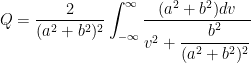
 . Since
  , the endpoints of integration do not change, and so
 .
. without altering the value of
 .
.
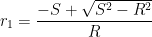
 .
. and identifying the coefficient for the term
  .
. has the form
  , where
  and
and  are differentiable functions so that
  and
and  . Therefore, we may rewrite this function using the Taylor series expansion of
  about
about  :
:![f(z) = \displaystyle \frac{1}{z-r} \left[ \frac{g(z)}{h(z)} \right]](https://s0.wp.com/latex.php?latex=f%28z%29+%3D+%5Cdisplaystyle+%5Cfrac%7B1%7D%7Bz-r%7D+%5Cleft%5B+%5Cfrac%7Bg%28z%29%7D%7Bh%28z%29%7D+%5Cright%5D&bg=ffffff&fg=000000&s=0&c=20201002)
![f(z) = \displaystyle \frac{1}{z-r} \left[ a_0 + a_1 (z-r) + a_2 (z-r)^2 + a_3 (z-r)^3 + \dots \right]](https://s0.wp.com/latex.php?latex=f%28z%29+%3D+%5Cdisplaystyle+%5Cfrac%7B1%7D%7Bz-r%7D+%5Cleft%5B+a_0+%2B+a_1+%28z-r%29+%2B+a_2+%28z-r%29%5E2+%2B+a_3+%28z-r%29%5E3+%2B+%5Cdots+%5Cright%5D&bg=ffffff&fg=000000&s=0&c=20201002)

![\displaystyle \lim_{z \to r} (z-r) f(z) = \displaystyle \lim_{z \to r} \left[ a_0 + a_1 (z-r) + a_2 (z-r)^2 + a_3 (z-r)^3 + \dots \right] = a_0](https://s0.wp.com/latex.php?latex=%5Cdisplaystyle+%5Clim_%7Bz+%5Cto+r%7D+%28z-r%29+f%28z%29+%3D+%5Cdisplaystyle+%5Clim_%7Bz+%5Cto+r%7D+%5Cleft%5B+a_0+%2B+a_1+%28z-r%29+%2B+a_2+%28z-r%29%5E2+%2B+a_3+%28z-r%29%5E3+%2B+%5Cdots+%5Cright%5D+%3D+a_0&bg=ffffff&fg=000000&s=0&c=20201002)
 . Notice that
 ,
, is the original denominator of
  .
. and
and  , so that
  . Therefore, the residue at

 ,
, , or the constant term in the Taylor expansion of
 . Therefore, the residue at
  , matching the result found earlier.
 and then employing the substitution
  (after using trig identities to adjust the limits of integration).


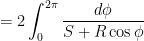
 ,
, and
and  . (Also,
  is a certain angle that is now irrelevant at this point in the calculation).
 times the sum of the residues within the contour; see


![S^2 - R^2 = [(1 + a^2 + b^2) + (1-a^2-b^2)][(1 + a^2 + b^2) - (1 - a^2 -b^2)] - 4a^2](https://s0.wp.com/latex.php?latex=S%5E2+-+R%5E2+%3D+%5B%281+%2B+a%5E2+%2B+b%5E2%29+%2B+%281-a%5E2-b%5E2%29%5D%5B%281+%2B+a%5E2+%2B+b%5E2%29+-+%281+-+a%5E2+-b%5E2%29%5D+-+4a%5E2&bg=ffffff&fg=000000&s=0&c=20201002)
![S^2 - R^2 = 2[2 a^2 + 2b^2] - 4a^2](https://s0.wp.com/latex.php?latex=S%5E2+-+R%5E2+%3D+2%5B2+a%5E2+%2B+2b%5E2%5D+-+4a%5E2&bg=ffffff&fg=000000&s=0&c=20201002)


