
I’m doing something that I should have done a long time ago: collecting a series of posts into one single post. The links below show my series on general relativity and the precession of Mercury’s orbit.
Part 1: Introduction
Part 2: Precession, polar coordinates, and conic sections
- Part 2a: Graphically exploring precession
- Part 2b: Polar coordinates and ellipses
- Part 2c: Polar coordinates, circles, and parabolas
- Part 2d: Polar coordinates and hyperbolas
Part 3: Method of successive approximations
Part 4: Principles from physics
- Part 4a: Angular momentum
- Part 4b: Acceleration in polar coordinates
- Part 4c: Newton’s Second Law and Newton’s Law of Gravitation
Part 5: Orbits under Newtonian mechanics
- Part 5a: Confirmation of solution
- Part 5b: Derivation with calculus
- Part 5c: Derivation with differential equations and the method of undetermined coefficients
- Part 5d: Derivation with differential equations and variation of parameters
Part 6: Orbits under general relativity
- Part 6a: New differential equation under general relativity
- Part 6b: Confirmation of solution
- Part 6c: Derivation with variation of parameters
- Parts 6d, 6e, 6f, 6g, 6h, 6i, 6j: Rationale for the method of undetermined coefficients
- Part 6k: Derivation with undetermined coefficients
Part 7: Computing precession
Part 8: Second- and third-order solutions with the method of successive approximations
Part 9: Pedagogical thoughts
Earlier this year, I presented these ideas for the UNT Math Department’s Undergraduate Mathematics Colloquium Series. The video of my lecture is below.


 depicted below. For brevity, this string will be called “string
  ,” matching the (possibly non-integer)
  -coordinate of its left endpoint
  . Since
  , the right endpoint
  must correspondingly be
  . Therefore, the
  .
.
 .
. , which is traced by the strings, when
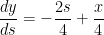
  . Of course, tangent lines are usually obtained using calculus, and so calculus should be able to confirm this result. The derivative of this function is
 ,
, . We observe that this matches the slope of line segment
  .
. , the
, the  coordinate of where the tangent line intersects the curve is
  .
.

 .
. is on the tangent line. Substituting
  , we find



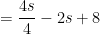


 is on the tangent line, thus confirming that
  .
. , corresponding to an optimal value of
  (or, more accurately,
  ):
):


 ,
, for a given value of
  is maximized (for negative
  ) when
  . Therefore, the string with largest
 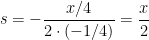 .
. , then string
  has the largest

 ,
, that intersects the parabola
  and
and  with endpoints
  ,
,  , and
, and  . We will call these colored line segments “strings.” We then found the string with the largest
  , resulting in the following picture:
 ) does not constitute a complete proof for all points. Furthermore, it’s conceivable that “fuller” string art with additional strings, like the picture below, may identify a new string with a higher
  and
and  , respectively, the
  and
and  , respectively. For example, if
  , the coordinates of
  and the coordinates of
  , matching the endpoints of the blue string in the first figure.
 .
.





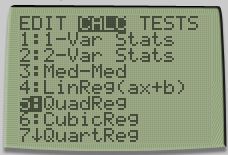
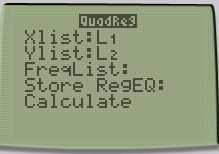

 , or
, or  indicates a correlation coefficient of 1, meaning that the points lie perfectly on this parabola. A parenthetical note: If the
  line does not appear using a TI-83 or TI-84, this can be toggled by using DiagnosticOn: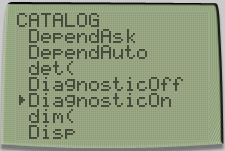

 .
. for some values of
  , and
, and  . Since there are three unknowns, we need to have three equations to solve for them. This can be done by plugging in three
  pairs into this equation. While we can pick any three pairs that we wish, it seems convenient to use the points
  ,
,  and
and  :
:


 system of linear equations


 , and so this reduces to a
  system




 .
.


 .
. ,
,  :
: 
 :
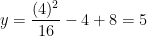
: 
 :
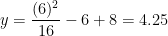
: 
 :
: 
 :
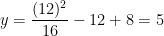
: 
 :
: 
 in the above picture. So, if it’s a parabola, the equation has the form
 .
. must be on the parabola, so that


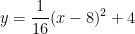

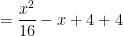
 :
: 
 Mean Green Math