Engaging students: Introducing the two-column, statement-reason paradigm of geometric proofs

In my capstone class for future secondary math teachers, I ask my students to come up with ideas for engaging their students with different topics in the secondary mathematics curriculum. In other words, the point of the assignment was not to devise a full-blown lesson plan on this topic. Instead, I asked my students to think about three different ways of getting their students interested in the topic in the first place.

I plan to share some of the best of these ideas on this blog (after asking my students’ permission, of course).

This student submission comes from my former student Derek Skipworth. His topic, from Geometry: introducing the two-column, statement-reason paradigm of geometric proofs.

green line

A. Applications – How could you as a teacher create an activity or project that involves your topic?

I would have the students get in groups and come up with 5-8 statements on one sheet of paper, numbering each one.  This could be a statement about the weather, something that happened the day before, anything.  My example would be “I wore a long sleeve shirt today”.  After coming up with these statements, I would then have the students create reasons behind these statements on a separate sheet.  For each statement, the students would have to ask “why…”.  For my example, it might be that it was laundry day and it was my only clean shirt, or that it was cold outside.  Upon generating all reasons behind each statement, I would then introduce the proof model.

green line

B. Curriculum – How can this topic be used in your students’ future courses in mathematics or science?

The two-column, statement-reason paradigm is a system that can actually be used in all subjects.  The idea behind it, giving a statement on the right and a reason on the right, can be applied to almost everything.  For problem solving, you can work through an entire problem step by step and explain why you think that is the correct process.  In a class such as Calculus, this could be used to help them memorize derivatives by doing the problem on the left and listing what “tool” they used for each step of the process.  Even for something like social studies, this process could be adapted into a tool similar to the Cornell Notes (http://coe.jmu.edu/LearningToolbox/cornellnotes.html).  In this process, you use the two-column approach.  On the left, you list your main ideas, while the right column “explains” what you know about the idea.

green line

E. Technology – How can Technology be used to effectively engage students with this topic?

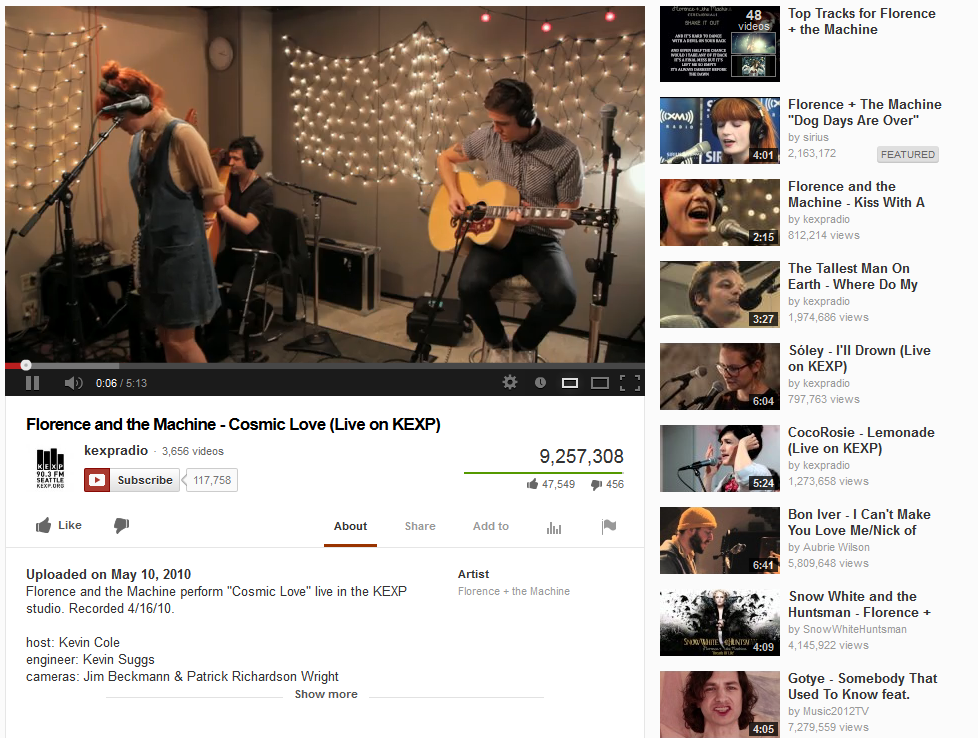
I had issues tying this topic to a third question.  While it’s a good topic, its more of a process than an actual concept.  This would actually qualify as an engage activity, slightly different to the one mentioned above, but I would see it working better as a take-home assignment than an in-class one.  The assignment would be to use YouTube and pull up a video that piques their interest.  Obviously, it needs to be school-appropriate.  This could be their favorite music video, a funny video of cats, whatever it is would work.  They would write the name of the video at the top and provide a link to the video if possible.  Then, they would take the paper and fold it in half, hot-dog style.  On the left, they list the names of videos on the suggested pane to the right, in order as they appear.  On the right, they would add comments about how that video was related to the video they chose and why it was in that order.  The idea is that this should take a bit of thinking since often times the videos appear to be randomly added to that queue.  This would reinforce the model while hopefully developing a better idea of how a website they are familiar with operates.  Though this could be done with any search engine as well, I feel those are just too similar to offer any “investigative” work for the students.
Florence and the Machine

Seen above, one would likely suspect that a Florence and the Machine video would pull up various other Florence videos in the top 9; however, the snapshot shows that this is not the case.  We see that most results have nothing to do with Florence.  We see that there are a few matches based on the KEXP live performance.  When listening to some others, it might be reason to believe they were in the queue not only based on a performance, but also because the genres are very similar.  That would be my main conclusion about Gotye’s music video being included in the list: it’s a very popular song and is in the same genre as Florence.


Area of a circle (Part 3)

Math majors are completely comfortable with the formula A = \pi r^2 for the area of a circle. However, they often tell me that they don’t remember a proof or justification for why this formula is true. And they certainly don’t remember a justification that would be appropriate for showing geometry students.

In this series of posts, I’ll discuss several ways that the area of a circle can be found using calculus. I’ll also discuss a straightforward classroom activity by which students can discover for themselves why A = \pi r^2.green lineIf R denotes a circular region with radius a centered at the origin, then

A = \displaystyle \iint_R 1 \, dx \, dy

This double integral may be computed by converting to polar coordinates. The distance from the origin varies from r=0 to r=a, while the angle varies from \theta = 0 to \theta = 2\pi. Using the conversion dx \, dy = r \, dr \, d\theta, we see that

A = \displaystyle \int_0^{2 \pi} \int_0^a r \, dr \, d \theta

A = \displaystyle \int_0^{2\pi} \left[ \frac{r^2}{2} \right]_0^a \, d\theta

A = \displaystyle \int_0^{2\pi} \frac{a^2}{2} \, d\theta

A = \displaystyle 2 \pi \cdot \frac{a^2}{2}

A = \displaystyle \pi a^2

We note that the above proof uses the fact that calculus with trigonometric functions must be done with radians and not degrees. In other words, we had to change the range of integration to [0,2\pi] and not [0^o, 360^o].

Area of a circle (Part 2)

Math majors are completely comfortable with the formula A = \pi r^2 for the area of a circle. However, they often tell me that they don’t remember a proof or justification for why this formula is true. And they certainly don’t remember a justification that would be appropriate for showing geometry students.

In this series of posts, I’ll discuss several ways that the area of a circle can be found using calculus. I’ll also discuss a straightforward classroom activity by which students can discover for themselves why A = \pi r^2.green line

A circle centered at the origin with radius r may be viewed as the region between f(x) = -\sqrt{r^2 - x^2} and g(x) = \sqrt{r^2 - x^2}. These two functions intersect at x = r and x = -r. Therefore, the area of the circle is the integral of the difference of the two functions:

A = \displaystyle \int_{-r}^r \left[g(x) - f(x) \right] \, dx= \displaystyle \int_{-r}^r 2 \sqrt{r^2 - x^2} \, dx

This may be evaluated by using the trigonometric substitution x = r \sin \theta and changing the range of integration to \theta = -\pi/2 to \theta = \pi/2. Since dx = r \cos \theta \, d\theta, we find

A = \displaystyle \int_{-\pi/2}^{\pi/2} 2 \sqrt{r^2 - r^2 \sin^2 \theta} \, r \cos \theta d\theta

A = \displaystyle \int_{-\pi/2}^{\pi/2} 2 r^2 \cos^2 \theta d\theta

A = \displaystyle r^2 \int_{-\pi/2}^{\pi/2} (1 + \cos 2\theta) d\theta

A = \displaystyle r^2 \left[ \theta + \frac{1}{2} \sin 2\theta \right]_{-\pi/2}^{\pi/2}

A = \displaystyle r^2 \left[ \left( \displaystyle \frac{\pi}{2} + \frac{1}{2} \sin \pi \right) - \left( - \frac{\pi}{2} + \frac{1}{2} \sin (-\pi) \right) \right]

A = \pi r^2

We note that the above proof uses the fact that calculus with trigonometric functions must be done with radians and not degrees. In other words, we had to change the range of integration to [-\pi/2,\pi/2] and not [-90^o, 90^o].

Area of a circle (Part 1)

Math majors are completely comfortable with the formula A = \pi r^2 for the area of a circle. However, they often tell me that they don’t remember a proof or justification for why this formula is true. And they certainly don’t remember a justification that would be appropriate for showing geometry students.

In this series of posts, I’ll discuss several ways that the area of a circle can be found using calculus. I’ll also discuss a straightforward classroom activity by which students can discover for themselves why A = \pi r^2.green lineIn the first few weeks after a calculus class, after students are introduced to the concept of limits, the derivative is introduced for the first time… often as the slope of a tangent line to the curve. Here it is: if $y = f(x)$, then

\displaystyle \frac{dy}{dx} = y' = f'(x) = \lim_{h \to 0} \displaystyle \frac{f(x+h) - f(x)}{h}

From this definition, the first few rules of differentiation are derived in approximately the following order:

1. If f(x) = c, a constant, then \displaystyle \frac{d}{dx} (c) = 0.

2. If f(x) and g(x) are both differentiable, then (f+g)'(x) = f'(x) + g'(x).

3. If f(x) is differentiable and c is a constant, then (cf)'(x) = c f'(x).

4. If f(x) = x^n, where n is a nonnegative integer, then f'(x) = n x^{n-1}. This may be proved by at least two different techniques:

  • The binomial expansion (x+h)^n = x^n + n x^{n-1} h + \displaystyle {n \choose 2} x^{n-2} h^2 + \dots + h^n
  • The Product Rule (derived later) and mathematical induction

5. If f(x) = a_n x^n + a_{n-1} x^{n-1} + \dots + a_1 x + a_0 is a polynomial, then f'(x) = n a_n x^{n-1} + (n-1) a_{n-1} x^{n-2} + a_1. In other words, taking the derivative of a polynomial is easy.

After doing a few examples to help these concepts sink in, I’ll show the following two examples with about 3-4 minutes left in class.

Example 1. Let A(r) = \pi r^2. Notice I’ve changed the variable from x to r, but that’s OK. Does this remind you of anything? (Students answer: the area of a circle.) What’s the derivative? Remember, \pi is just a constant. So A'(r) = \pi \cdot 2r = 2\pi r. Does this remind you of anything? (Students answer: Whoa… the circumference of a circle.)

Example 2. Now let’s try V(r) = \displaystyle \frac{4}{3} \pi r^3. Does this remind you of anything? (Students answer: the volume of a sphere.) What’s the derivative? Again, \displaystyle \frac{4}{3} \pi is just a constant. So V'(r) = \displaystyle \frac{4}{3} \pi \cdot 3r^2 = 4\pi r^2. Does this remind you of anything? (Students answer: Whoa… the surface area of a sphere.)


Hmmm. That’s interesting. The derivative of the area of a circle is the circumference of the circle, and the derivative of the area of a sphere is the surface area of the sphere. I wonder why this works. Any ideas? (Students: stunned silence.)

This is what’s known on television as a cliff-hanger, and I’ll give you the answer at the start of class tomorrow. (Students groan, as they really want to know the answer immediately.)

In the spirit of a cliff-hanger, I offer the following thought bubble before presenting the answer.

green_speech_bubble

By definition, if A(r) = \pi r^2, then

A'(r) = \displaystyle \lim_{h \to 0} \frac{ A(r+h) - A(r) }{h} = 2\pi r

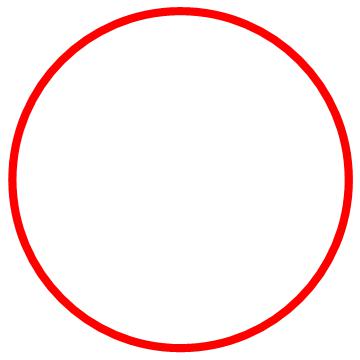
The numerator may be viewed as the area of the ring between concentric circles with radii r and r+h. In other words, imagine starting with a solid red disk of radius r +h and then removing a solid white disk of radius r. The picture would look something like this:
ring

Notice that the ring has a thickness of r+h -r = h. If this ring were to be “unpeeled” and flattened, it would approximately resemble a rectangle. The height of the rectangle would be h, while the length of the rectangle would be the circumference of the circle. So

A(r + h) - A(r) \approx 2 \pi r h

and we can conclude that

A'(r) = \displaystyle \lim_{h \to 0} \frac{ 2 \pi r h}{h} = 2\pi r

By the same reasoning, the derivative of the volume of a sphere ought to be the surface area of the sphere.

Pedagogically, I find that the above discussion helps reinforce the definition of a derivative at a time when students are most willing to forget about the formal definition in favor of the various rules of differentiation.

green line

In the above work, we started with the formula for the area of the circle and then confirmed that its derivative matched the expected result. However, the above logic can be used to derive the formula for the area of a circle from the formula $C(r) = 2\pi r$ for the circumference. We begin with the observation that A'(r) = C(r), as above. Therefore, by the Fundamental Theorem of Calculus,

A(r) - A(0) = \displaystyle \int_0^r C(t) \, dt

A(r) - A(0) = \displaystyle \int_0^r 2\pi t \, dt

A(r) - A(0) = \displaystyle \left[ \pi t^2 \right]_0^r

A(r) - A(0) = \pi r^2

Since the area of a circle with radius 0 is 0, we conclude that A(r) = \pi r^2.

Pedagogically, I don’t particularly recommend this approach, as I think students would find this explanation more confusing than the first approach. However, I can see that this could be useful for reinforcing the statement of the Fundamental Theorem of Calculus.

green line

By the way, the above reasoning works for a square or cube also, but with a little twist. For a square of side length s, the area is A(s) = s^2 and the perimeter is P(s) = 4s, which isn’t the derivative of A(s). The reason this didn’t work is because the side length s of a square corresponds to the diameter of a circle, not the radius of a circle.

But, if we let x denote half the side length of a square, then the above logic works out since

A(x) = s^2 = (2x)^2 = 4x^2

and

P(x) = 4s = 4(2x) = 8x

Written in terms of the half-sidelength x, we see that A'(x) = P(x).

Importance of the base case in a proof by induction

In Precalculus, Discrete Mathematics or Real Analysis, an arithmetic series is often used as a student’s first example of a proof by mathematical induction. Recall, from Wikipedia:

Mathematical induction is a method of mathematical proof typically used to establish a given statement for all natural numbers. It is done in two steps. The first step, known as the base case, is to prove the given statement for the first natural number. The second step, known as the inductive step, is to prove that the given statement for any one natural number implies the given statement for the next natural number. From these two steps, mathematical induction is the rule from which we infer that the given statement is established for all natural numbers.

The simplest and most common form of mathematical induction infers that a statement involving a natural number n holds for all values of n. The proof consists of two steps:

  1. The basis (base case): prove that the statement holds for the first natural number n. Usually, n=0 or n=1.
  2. The inductive step: prove that, if the statement holds for some natural number n, then the statement holds for n+1.

The hypothesis in the inductive step that the statement holds for some n is called the induction hypothesis (or inductive hypothesis). To perform the inductive step, one assumes the induction hypothesis and then uses this assumption to prove the statement for n+1.

As an inference rule, mathematical induction can be justified as follows. Having proven the base case and the inductive step, then any value can be obtained by performing the inductive step repeatedly. It may be helpful to think of the domino effect. Consider a half line of dominoes each standing on end, and extending infinitely to the right. Suppose that:

  1. The first domino falls right.
  2. If a (fixed but arbitrary) domino falls right, then its next neighbor also falls right.

With these assumptions one can conclude (using mathematical induction) that all of the dominoes will fall right.

Mathematical induction… works because n is used to represent an arbitrary natural number. Then, using the inductive hypothesis, i.e. that P(n) is true, show P(k+1) is also true. This allows us to “carry” the fact that P(0) is true to the fact that P(1) is also true, and carry P(1) to P(2), etc., thus proving P(n) holds for every natural number n.

green line

When students first encounter mathematical induction (in either Precalculus, Discrete Mathematics, or Real Analysis), the theorems that students are asked to prove usually fall into four categories:

  1. Calculating a series (examples below).
  2. Statements concerning divisibility (for example, proving that 4 is always a factor of 5^n-1).
  3. Finding a closed-form expression for a recursively defined sequence (for example, if a_1 = 4 and a_n = 3a_{n-1} if n \ge 2, proving that a_n = 4 \times 3^{n-1})
  4. Statements concerning inequality (for example, proving that n! > 4^n if n \ge 9)

Here’s a common first (or maybe second) example of mathematical induction applied to an arithmetic series.

Theorem. 1^2 + 2^2 + \dots + (n-1)^2 + n^2 = \displaystyle \frac{n(n+1)(2n+1)}{6}

Proof. Induction on n.

n = 1: The left-hand is simply 1, while the right-hand side is \displaystyle \frac{(1)(2)(3)}{6}, which is also equal to 1. So the base case works.

n: Assume that the statement holds true for the integer n.

n+1. If I replace n by n+1 in the statement of the theorem, then the right-hand side becomes

\displaystyle \frac{(n+1)[(n+1)+1][2(n+1)+1]}{6} = \displaystyle \frac{(n+1)(n+2)(2n+3)}{6}

I find it helpful to describe this to students as my target. In other words, as I manipulate the left-hand side, my ultimate goal is to end up with this target. Once I have done that, then I have completed the proof.

If I replace n by n+1 in the statement of the theorem, then the left-hand side will now end on n+1 instead of n:

1^2+ 2^2 + \dots + (n-1)^2 + n^2 + (n+1)^2

Notice that we’ve seen almost all of this before, except for the extra term (n+1)^2. So we will substitute using the induction hypothesis, carrying the extra (n+1)^2 along for the ride.

1^2 + 2^2 + \dots + (n-1)^2 + n^2 + (n+1)^2 = \displaystyle \frac{n(n+1)(2n+1)}{6} + (n+1)^2

Now our task is, by hook or by crook, using whatever algebraic tricks we can think of to convert this last expression into the target. Most students are completely comfortable doing this, although they typically multiply out the term n(n+1)(2n+1) unnecessarily. Indeed, many early proofs by induction are simplified by factoring out terms whenever possible — in the example below, (n+1) is factored on the third step — as opposed to multiplying them out. In my experience, proofs by induction often serve as a stringent test of students’ algebra skills as opposed to their skills in abstract reasoning.

In any event, here’s the end of the proof:

1^2 + 2^2 + \dots + (n-1)^2 + n^2 + (n+1)^2 = \displaystyle \frac{n(n+1)(2n+1)}{6} + (n+1)^2

1^2 + 2^2 + \dots + (n-1)^2 + n^2 + (n+1)^2 = \displaystyle \frac{n(n+1)(2n+1) + 6(n+1)^2}{6}

1^2 + 2^2 + \dots + (n-1)^2 + n^2 + (n+1)^2 = \displaystyle \frac{(n+1)[n(2n+1) + 6(n + 1)]}{6}

1^2 + 2^2 + \dots + (n-1)^2 + n^2 + (n+1)^2 = \displaystyle \frac{(n+1)(2n^2 + n + 6n + 6)}{6}

1^2 + 2^2 + \dots + (n-1)^2 + n^2 + (n+1)^2 = \displaystyle \frac{(n+1)(2n^2 + 7n + 6)}{6}

1^2 + 2^2 + \dots + (n-1)^2 + n^2 + (n+1)^2 = \displaystyle \frac{(n+1)(n+2)(2n+3)}{6}

green line

A fair amount of algebra was needed to prove the n+1 case. However, the first step — the base case — was especially easy. Indeed, in most proofs by induction seen by students, the base case is often quite trivial… to the point that students often wonder why the base case is needed in the first place.

I first saw this next example in Calculus, by Tom M. Apostol. This next fallacious example illustrates what can happen if the base case is ignored. The statement of this “theorem” doesn’t match the formula for an arithmetic series, and so clearly something is wrong with the following “proof.”

“Theorem.” 1 + 2 + \dots + (n-1) + n = \displaystyle \frac{(2n+1)^2}{8}

“Proof.” Induction on n.

n = 1: Let’s just ignore the base case, it’s unimportant.

n: Assume that the statement holds true for the integer n.

n+1. If I replace n by n+1 in the statement of the theorem, then the right-hand side — my target — becomes

\displaystyle \frac{[2(n+1)+1]^2}{8} = \displaystyle \frac{(2n+3)^2}{8}

On the left-hand side, we use the induction hypothesis:

1 + 2 + \dots + (n-1) + n + (n+1) = \displaystyle \frac{(2n+1)^2}{8} + (n+1)

Now our task is, by hook or by crook, using whatever algebraic tricks we can think of to convert this last expression into the target.

1 + 2 + \dots + (n-1) + n + (n+1) = \displaystyle \frac{(2n+1)^2}{8} + (n+1)

1 + 2 + \dots + (n-1) + n + (n+1) = \displaystyle \frac{(2n+1)^2 + 8(n+1)}{8}

1 + 2 + \dots + (n-1) + n + (n+1) = \displaystyle \frac{4n^2+4n+1+8n+8}{8}

1 + 2 + \dots + (n-1) + n + (n+1) = \displaystyle \frac{4n^2+12n+9}{8}

1 + 2 + \dots + (n-1) + n + (n+1) = \displaystyle \frac{(2n+3)^2}{8}

So that’s the end of the “proof.”

green lineClearly, something went wrong with the above proof. What went wrong, obviously, is that we didn’t check the base case. If n=1, then the left-hand side is 1. However, the right-hand side is \displaystyle \frac{[(2)(1) + 1]^2}{8} = \displaystyle \frac{9}{8}. So the base case is false.

So what happened?

We correctly showed that, if the case n is true, then the case n+1 is also true. The catch, of course, is that the case n is never true. Using the domino analogy, we showed that if a domino falls, then the next domino will fall. But the first domino never falls.

All this to say… yes, it’s important to check that the base case actually works.

Why do we teach students about radians?

Throughout grades K-10, students are slowly introduced to the concept of angles. They are told that there are 90 degrees in a right angle, 180 degrees in a straight angle, and a circle has 60 degrees. They are introduced to 30-60-90 and 45-45-90 right triangles. Fans of snowboarding even know the multiples of 180 degrees up to 1440 or even 1620 degrees.

Then, in Precalculus, we make students get comfortable with \pi, \displaystyle \frac{\pi}{2}, \displaystyle \frac{\pi}{3}, \displaystyle \frac{\pi}{4}, \displaystyle \frac{\pi}{6}, and multiples thereof.

We tell students that radians and degrees are just two ways of measuring angles, just like inches and centimeters are two ways of measuring the length of a line segment.

Still, students are extremely comfortable with measuring angles in degrees. They can easily visualize an angle of 75^o, but to visualize an angle of 2 radians, they inevitably need to convert to degrees first. In his book Surely You’re Joking, Mr. Feynman!, Nobel-Prize laureate Richard P. Feynman described himself as a boy:

I was never any good in sports. I was always terrified if a tennis ball would come over the fence and land near me, because I never could get it over the fence – it usually went about a radian off of where it was supposed to go.

Naturally, students wonder why we make them get comfortable with measuring angles with radians.

The short answer, appropriate for Precalculus students: Certain formulas are a little easier to write with radians as opposed to degrees, which in turn make certain formulas in calculus a lot easier.

The longer answer, which Precalculus students would not appreciate, is that radian measure is needed to make the derivatives of \sin x and \cos x look palatable.

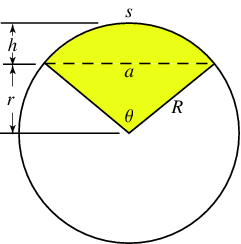
CircularSector_1000

Source: http://mathworld.wolfram.com/CircularSector.html

1. In Precalculus, the length of a circle arc with central angle \theta in a circle with radius r is

s = r\theta

Also, the area of a circular sector with central angle \theta in a circle with radius r is

A = \displaystyle \frac{1}{2} r^2 \theta

In both of these formulas, the angle \theta must be measured in radians.

Students may complain that it’d be easy to make a formula of \theta is measured in degrees, and they’d be right:

s = \displaystyle \frac{180 r \theta}{\pi} and A = \displaystyle \frac{180}{\pi} r^2 \theta

However, getting rid of the 180/\pi makes the following computations from calculus a lot easier.

2a. Early in calculus, the limit

\displaystyle \lim_{\theta \to 0} \frac{\sin \theta}{\theta} = 1

is derived using the Sandwich Theorem (or Pinching Theorem or Squeeze Theorem). I won’t reinvent the wheel by writing out the proof, but it can be found here. The first step of the proof uses the formula for the above formula for the area of a circular sector.

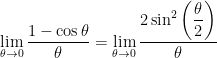
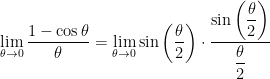
2b. Using the trigonometric identity \cos 2x = 1 - 2 \sin^2 x, we replace x by \theta/2 to find

\displaystyle \lim_{\theta \to 0} \frac{1 - \cos \theta}{\theta} = \displaystyle \lim_{\theta \to 0} \frac{2\sin^2 \displaystyle \left( \frac{\theta}{2} \right)}{ \theta}

\displaystyle \lim_{\theta \to 0} \frac{1 - \cos \theta}{\theta} = \displaystyle \lim_{\theta \to 0} \sin \left( \frac{\theta}{2} \right) \cdot \frac{\sin \displaystyle \left( \frac{\theta}{2} \right)}{ \displaystyle \frac{\theta}{2}}

\displaystyle \lim_{\theta \to 0} \frac{1 - \cos \theta}{\theta} =0 \cdot 1

\displaystyle \lim_{\theta \to 0} \frac{1 - \cos \theta}{\theta} =0

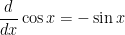
3. Both of the above limits — as well as the formulas for \sin(\alpha + \beta) and \cos(\alpha + \beta) — are needed to prove that \displaystyle \frac{d}{dx} \sin x = \cos x and \displaystyle \frac{d}{dx} \cos x = -\sin x. Again, I won’t reinvent the wheel, but the proofs can be found here.

green lineSo, to make a long story short, radians are used to make the derivatives $y = \sin x$ and $y = \cos x$ easier to remember. It is logically possible to differentiate these functions using degrees instead of radians — see http://www.math.ubc.ca/~feldman/m100/sinUnits.pdf. However, possible is not the same thing as preferable, as calculus is a whole lot easier without these extra factors of \pi/180 floating around.

All I want to be is a high school math teacher. Why do I have to take Real Analysis?

In 2012, the Conference Board for the Mathematical Sciences published The Mathematical Education of Teachers II, providing recommendations for how universities prepare future teachers at all grade levels. From Chapter 6 of this report, here are the recommendations for future secondary teachers:

This report recommends that the mathematics courses taken by prospective high school teachers include at least a three-course calculus sequence, an introductory statistics course, an introductory linear algebra course, and 18 additional semester-hours of advanced mathematics, including 9 semester-hours explicitly focused on high school mathematics from an advanced standpoint. It is desirable to have a further 9 semester-hours of mathematics…

The report then goes on to describe how advanced mathematics courses that emphasize theorems and proofs, such as abstract algebra, real analysis, group theory, and number theory,  are directly relevant for teaching the secondary mathematics curriculum.

In my experience, most math majors who want to be high school math teachers understand why they have to take calculus, statistics, linear algebra, and math courses specifically designed for their future career. But a perennial question that they often ask is, “Why do I have to take theorem-proof math classes if all I want to do is teach high school math?” Some years ago, I wrote the following document for my students to address this issue, which hopefully provide some good reasons for why these more abstract courses are required.

green line

1. A central goal of theorem-proof courses (and subsequent courses) is to emphasize that mathematics is not only an exercise in quantitative skills; it is also an exercise in explaining why the rules of mathematics work the way they do. After you become a teacher, that’s also something that you can impress upon your students — not only the “how” of solving problems but also the “why.”

Through all of the “proof” classes, you will learn that the real purpose of math is not to be able to perform arithmetic, solve for x, or even to be able to find the area under the curve. Rather, it is to be able to think logically, to reach a logical solution on well-defined terms, and to be able to problem-solve.  So many of today’s youth do not encompass any of these qualities and/or abilities; when you think about it, that is a very scary thought! So when you become a teacher and are asked the inevitable questions “Why do I need to know (fill in a math topic)? How is that going to help me in life?”, you will be prepared to respond. (But don’t be surprised when they don’t like your response!)

2. Theorem-proof courses are specified by the National Council of Teachers of Mathematics (NCTM) and the National Council for Accreditation of Teacher Education (NCATE) as part of the national standard of best practices for preparing future high school math teachers. Furthermore, you will be responsible for the material in these classes when it’s time for you to take the TExES certification exam. All this to say, including these classes in the curriculum isn’t a requirement that somebody at our university thought was a bright idea; this is an “industry standard,” so to speak, for the preparation of highly qualified secondary math teachers.

3. Of course, simply saying “You have to do this because the ‘powers that be’ say that it’s good for you” may not be a terribly motivating reason for you to be in courses that emphasize mathematical abstraction. Another good reason to take these courses is because it’s always a good idea for teachers to be familiar with a few years’ worth of mathematics above the subject matter that they’re teaching. Right now, you probably expect (perhaps subconsciously) that your professor knows not only the content immediately pertinent to your class but also the content in subsequent classes, so that you’re prepared to take those subsequent classes if you elect to do so. The same logic will apply to you when you become a teacher yourself.

By analogy, UNT’s elementary teachers often complain, “Why do I have to take College Algebra if I’m only going to be teaching arithmetic?” Well, elementary students are learning algebra without the technical terms. For example: 3 + \fbox{~?~} = 8 is a first-grade problem, and students will use the number line (or their fingers) to reach the conclusion that \fbox{~?~} = 5. However, 6th graders taking Pre-Algebra are replacing the box with the variable x and now must show their work on why x=5, which is a proof! Having taken theorem-proof courses will allow you, the teacher, to explain why we can add a -3 to both sides and it cancels out on one side and subtracts 3 from the 8. Moreover, it explains that the minus sign just tells you which direction you are moving on the number line and why the word we came up with for that idea, subtraction, means “to take away, to go to the left.”

Ideally, elementary school teachers should teach their classes mindful of the fact that elementary school arithmetic is not a mere exercise in computation but part of a process of logical thinking that will be further developed in middle-school algebra. In the same way, when you become a secondary math teacher, you should be familiar with the topics that lie beyond algebra, geometry, trigonometry, and calculus.

4. When you’re in your future classroom, you should be equipped to answer just about any mathematical question that comes your way. Someday, a bright and inquisitive student will ask you an honest question about some of the deeper concepts covered in the course that you’re teaching. Such questions typically start with “why” instead of “how.” For example:

  • “Why is the number e irrational?”
  •  “Why is the Pythagorean theorem correct?”
  • “Why can’t complex numbers be defined using \sqrt{-2}  instead of \sqrt{-1}?”
  • “Why are all of the hypotheses of the intermediate value theorem needed?”
  • “Why do the rows in Pascal’s triangle add to powers of 2?”
  • “Why do polynomials have a unique factorization using linear terms involving complex numbers?”

High school teachers (and, if they’re honest, college professors) will tell you that it’s quite embarrassing to be unable to provide an immediate answer to a student’s question, no matter how difficult. It’s even worse if the teacher is at a complete and utter loss as to who or what to consult to provide the answer. Theorem-proof classes will hopefully provide you the framework to answer such questions.

5. Many of the concepts in real analysis are directly related to concepts taught below the level of calculus. To give a few examples from the first few chapters of our textbook:

  • Unions and intersections of sets are important for developing the rules for computing P(A \cup B), the probability that event A happens or event B happens, and P(A \cap B), the chance that A and B both happen.
  • Important examples of equivalence classes are those derived from congruences, a notion which leads to the familiar grade-school rules for testing for divisibility by 2, 3, 4, 5, 6, 8, 9, 10 or 11.
  • The notion of an injective function explains why the horizontal line test works.
  • The axioms of ordered fields are the logical framework behind high school algebra, and for why the “FOIL” method is correct but the  “distributive” property (a+b)^2 = a^2 + b^2  is incorrect.
  • The density of both rational and irrational numbers is often taken for granted by high school students without explanation.

6. Many theorems in calculus, which are typically stated without proof when actually teaching a calculus course, rely on notions from real analysis. In fact, a major goal of theorem-proof courses is to “dot the i’s and cross the t’s” of familiar theorems that are often stated in a calculus class but not always completely proved for students. Here’s a sampling:

  • The order of quantifiers is important for distinguishing between the continuous functions and uniformly continuous functions. The latter notion is necessary to formally prove that every continuous function has a definite integral on a closed interval, often taken for granted in Calculus I.
  • The notion of supremum and the completeness property of \mathbb{R} underlie some important concepts in calculus, including the proof of the intermediate value theorem, the rigorous definition of a definite integral, and the proof that the definite integral of the sum of two functions equals the sum of the two definite integrals.
  • Many optimization problems in calculus rely on the fact that continuous functions assume both an absolute minimum and absolute maximum value on any closed interval. The proof of this theorem relies on properties of closed sets and compact sets.
  • The proof that the composition of two continuous functions is continuous (and also the proof of the Chain Rule for differentiation) relies on properties of open sets.
  • Limit theorems that are often taken for granted in calculus may be proven using limit theorems about sequences.
  • The Mean Value Theorem (from Calculus I) is derived from the fact that limits preserve inequalities. Many important properties of calculus, including L’Hopital’s Rule, indefinite integration, curve sketching, and Taylor series, are direct consequences of the Mean Value Theorem.
  • The Root and Ratio Tests from Calculus II are derived using the notions of limsup and liminf.

Hopefully, while you’re still in college, you will begin the process of making connections between the topics that you will directly teach your students and the topics that your students will see after they graduate from high school. This may not fully sink in until you begin student teaching; only then will you realize the importance of being able to prove something (i.e. teaching a topic in a logical manner) when you are trying to explain it to inquiring minds.

As a student taking real analysis or abstract algebra, it’s easy to lose sight of the forest for all of the trees. That is, it’s easy to simply develop your skills in abstraction and theorem-proving without realizing that the topics you’re learning are indeed relevant to your future career as a mathematics educator. Teach North Texas and the UNT Math Department both wish you well as you continue through our degree program.

Area of a triangle: Pick’s theorem (Part 8)

The following is one of my all-time favorite paragraphs to ever appear in a professional mathematical journal.

Some years ago, the Northwest Mathematics Conference was held in Eugene, Oregon. To add a bit of local flavor, a forester was included on the program, and those who attended his session were introduced to a variety of nice examples which illustrated the important role that mathematics plays in the forest industry. One of his problems was concerned with the calculation of the area inside a polygonal region drawn to scale from field data obtained for a stand of timber by a timber cruiser. The standard method is to overlay a scale drawing with a transparency on which a square dot pattern is printed. Except for a factor dependent on the relative sizes of the drawing and the square grid, the area inside the polygon is computed by counting all of the dots fully inside the polygon, and then adding half of the number of dots which fall on the bounding edges of the polygon. Although the speaker was not aware that he was essentially using Pick’s formula, I was delighted to see that one of my favorite mathematical results was not only beautiful, but even useful.

D. DeTemple, cited in Branko Grunbaum and G. C. Shephard, “Pick’s Theorem,” American Mathematical Monthly, Vol. 100, pp. 150-161 (February 1993).

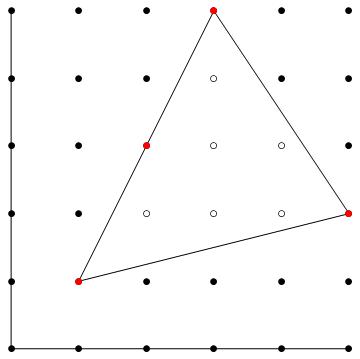
Suppose that the vertices of a triangle are (1,1), (3,5), and (4,2). What is the area of the triangle?

latticetriangleBecause the vertices of the triangle have integer coordinates, Pick’s Theorem offers an exceedingly simple way of finding the area of this triangle.

  1. There are 6 points (marked white) that are inside the triangle.
  2. There are 4 points (marked red) that are on the boundary of the triangle, including the three corners.
  3. Therefore, the area is A = 6 + \frac{1}{2} (4) - 1 = 7.

You can confirm this area by drawing the rectangle with corners at (1,1), (5,1), (5,5), and (1,5) and then taking away the three right triangles, leaving the triangle shown in the figure above.

Amazingly, this theorem is true for any polygonal figure — not just triangles — whose vertices have integer coordinates.

A decent classroom activity so that students can discover Pick’s theorem for themselves has been published by the National Council of Teachers of Mathematics. I modified this activity to teach my daughter and her friends last summer, so I say from first-hand experience that fourth-graders can use inductive reasoning to guess Pick’s theorem.

Additional references:

http://www.cut-the-knot.org/ctk/geoboard.shtml

http://www.cut-the-knot.org/ctk/Pick_proof.shtml

Area of a triangle: Incenter (Part 6)

Incenter_750Source: http://mathworld.wolfram.com/Incircle.html

The incenter I of a triangle \triangle ABC is defined by the intersection of the angle bisectors of its three angles. A circle can be inscribed within \triangle ABC, as shown in the picture.

This incircle provides a different way of finding the area of \triangle ABC commonly needed for high school math contests like the AMC 10/12. Suppose that the sides a, b, and c are known and the inradius r is also known. Then \triangle ABI is a right triangle with base c and height r. So

\hbox{Area of ~} \triangle ABI = \displaystyle \frac{1}{2} cr

Similarly,

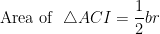
\hbox{Area of ~} \triangle ACI = \displaystyle \frac{1}{2} br

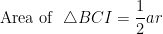
\hbox{Area of ~} \triangle BCI = \displaystyle \frac{1}{2} ar

Since the area of \triangle ABC is the sum of the areas of these three smaller triangles, we conclude that

\hbox{Area of ~} \triangle ABC = \displaystyle \frac{1}{2} r (a+b+c),

or

\hbox{Area of ~} \triangle ABC = rs,

where s = (a+b+c)/2 is the semiperimeter of \triangle ABC.

green lineThis also permits the computation of r itself. By Heron’s formula, we know that

\hbox{Area of ~} \triangle ABC = \sqrt{s(s-a)(s-b)(s-c)}

Equating these two expressions for the area of \triangle ABC, we can solve for the inradius r:

r = \displaystyle \sqrt{ \frac{(s-a)(s-b)(s-c)}{s} }

For much more about the inradius and incircle, I’ll refer to the MathWorld website.

Area of a triangle: SSS (Part 5)

triangle

In yesterday’s post, we discussed how the area K of a triangle can be found using SAS: two sides and the angle between the two sides. We found that

K = \displaystyle \frac{1}{2} a b \sin C

This can be used as the starting point for the derivation of Heron’s formula, which determines the area of a triangle using SSS (i.e., only the three sides). I won’t give the full derivation in this post — there’s no point in me retyping the details — but will refer to the Wikipedia page and the MathWorld page for the details. However, I will give the big ideas behind the derivation.

1. We begin by recalling that \sin^2 C + \cos^2 C = 1. Since 0 < C < 180^o, we know that \sin C must be positive, so that

\sin C = \sqrt{1 - \cos^2 C}

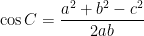
2. From the Law of Cosines, we know that

c^2 = a^2 + b^2 - 2 a b \cos C,

or

\cos C = \displaystyle \frac{a^2 + b^2 - c^2}{2ab}

3. Substituting, we see that

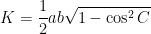
K = \displaystyle \frac{1}{2} ab \sqrt{1 - \cos^2 C}

K = \displaystyle \frac{1}{2} ab \sqrt{1 - \frac{(a^2+b^2-c^2)^2}{4a^2b^2}}

4. This last expression only contains the side lengths a, b, and c. So the “only” work that’s left is simplifying this right-hand side and seeing what happens. After considerable work — requiring factoring the difference of two squares on two different steps — we end up with Heron’s formula:

K = \sqrt{s (s-a) (s-b) (s-c)}

where s = \displaystyle \frac{a+b+c}{2} is the semiperimeter, or half the perimeter of the triangle.

A final note: If you actually are able to start with Step 3 and end with Heron’s formula on your own — without consulting a textbook or the Internet if you get stuck — feel free to cry out “More power!” and grunt like Tim “The Toolman” Taylor: