

In yesterday’s post, we discussed how the area 

This can be used as the starting point for the derivation of Heron’s formula, which determines the area of a triangle using SSS (i.e., only the three sides). I won’t give the full derivation in this post — there’s no point in me retyping the details — but will refer to the Wikipedia page and the MathWorld page for the details. However, I will give the big ideas behind the derivation.
1. We begin by recalling that 



2. From the Law of Cosines, we know that

or
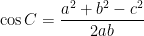
3. Substituting, we see that
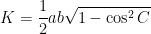

4. This last expression only contains the side lengths 


where 
A final note: If you actually are able to start with Step 3 and end with Heron’s formula on your own — without consulting a textbook or the Internet if you get stuck — feel free to cry out “More power!” and grunt like Tim “The Toolman” Taylor:


2 thoughts on “Area of a triangle: SSS (Part 5)”