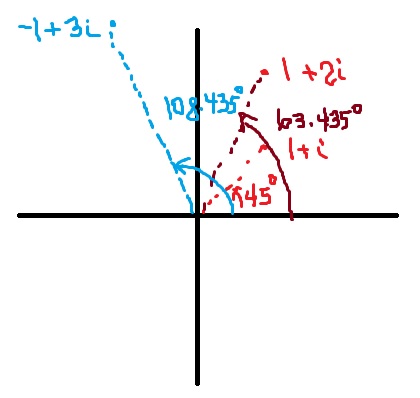
In this series of posts, I explore properties of complex numbers that explain some surprising answers to exponential and logarithmic problems using a calculator (see video at the bottom of this post). These posts form the basis for a sequence of lectures given to my future secondary teachers.
To begin, we recall that the trigonometric form of a complex number 

where 


There’s a shorthand notation for the right-hand side (
Today, I want to share some pedagogical thoughts about this series of posts. I’ll continue with the mathematical development of these ideas tomorrow.
My experience is that most math majors have never seen this particular application of trigonometry to find the 
This certainly isn’t the most important topic in the mathematics secondary curriculum. That said, I really wish that this was included in a standard Pre-AP course in Precalculus to better serve the high school students who are most likely to take more advanced courses in mathematics and science in college. These ideas are simply assumed in, say, Differential Equations, when students are asked to solve
$y^{5} – 32 y = 0$.
The characteristic equation of this differential equation is 
To give another example: In physics, even a cursory look at my old electricity and magnetism text reveals that familiarity with the trigonometric form of complex numbers can only facilitate student understanding of these physical concepts. Ditto for many concepts in electrical engineering. Stated another way, students who aren’t used to thinking of complex numbers in this way may struggle through physics and engineering in ways that could have been avoided with prior mathematical training.

For completeness, here’s the movie that I use to engage my students when I begin this sequence of lectures.
![\left[ r (\cos \theta + i \sin \theta) \right]^n = r^n (\cos n \theta + i \sin n \theta)](https://s0.wp.com/latex.php?latex=%5Cleft%5B+r+%28%5Ccos+%5Ctheta+%2B+i+%5Csin+%5Ctheta%29+%5Cright%5D%5En+%3D+r%5En+%28%5Ccos+n+%5Ctheta+%2B+i+%5Csin+n+%5Ctheta%29&bg=ffffff&fg=000000&s=0&c=20201002) .
. , namely,
  and
and  . Let’s now use De Moivre’s Theorem to take on the same task. As we’ll see, De Moivre’s Theorem provides a geometrical interpretation of this result that isn’t readily apparent using solely algebra.
 , or
, or  . (Notice that there is only one answer because
  must be a positive real number.) Also, the angles
  and
and  must be coterminal. They do not necessarily have to be equal, but the angles must point in the same direction. Therefore,
 , or
, or ![\theta = \displaystyle ]frac{\pi}{3} + \frac{2\pi k}{3}](https://s0.wp.com/latex.php?latex=%5Ctheta+%3D+%5Cdisplaystyle+%5Dfrac%7B%5Cpi%7D%7B3%7D+%2B+%5Cfrac%7B2%5Cpi+k%7D%7B3%7D&bg=ffffff&fg=000000&s=0&c=20201002)
 . At first blush, it appears that there are infinitely many solutions
  since there are infinitely many possible angles
  .
. , then
  , so that
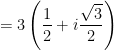
 .
. , then
  , so that
 .
. , then
 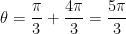 , so that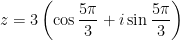

 .
. :
: , so that
 and
and  are coterminal, we end up with the same answer. This resolves the apparent paradox of having infinitely many possible angles
 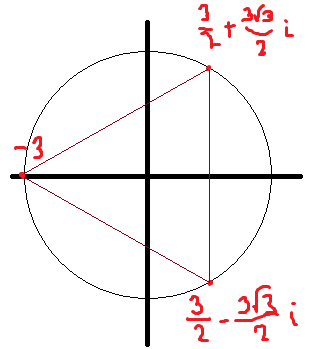 –
– as we shift from point to point. This divides the circle (with a total angle of
  into three equal parts, and so the points are evenly spaced around the circle. Also, the points form the vertices of an equilateral triangle inscribed within this circle. Again, none of this would have been apparent by strictly factoring the polynomial
  .
. . This equation has
  from the origin on the points of a regular
  gon inscribed in a circle of this radius. The only tricky part is determining the placement of the initial point (i.e., finding the initial value of
  .” To which I politely point out, “This is a cubic equation. So how many roots does it have?” Of course, they answer “Three.” To which I respond, “OK, so how do we find the other two roots?”
 has a known root of
  into
into 

 .
.

 : proof by induction.
 : let
: let  , and then use part 1.
 . Students can usually volunteer the successive steps of this special case:
![\left[ r (\cos \theta + i \sin \theta) \right]^{-5} = \displaystyle \frac{1}{ \left[ r (\cos \theta + i \sin \theta) \right]^{5} }](https://s0.wp.com/latex.php?latex=%5Cleft%5B+r+%28%5Ccos+%5Ctheta+%2B+i+%5Csin+%5Ctheta%29+%5Cright%5D%5E%7B-5%7D+%3D+%5Cdisplaystyle+%5Cfrac%7B1%7D%7B+%5Cleft%5B+r+%28%5Ccos+%5Ctheta+%2B+i+%5Csin+%5Ctheta%29+%5Cright%5D%5E%7B5%7D+%7D&bg=ffffff&fg=000000&s=0&c=20201002)


![= r^{-5} (\cos [0-5\theta] + i \sin[0-5\theta] )](https://s0.wp.com/latex.php?latex=%3D+r%5E%7B-5%7D+%28%5Ccos+%5B0-5%5Ctheta%5D+%2B+i+%5Csin%5B0-5%5Ctheta%5D+%29&bg=ffffff&fg=000000&s=0&c=20201002)
![= r^{-5} (\cos [-5\theta] + i \sin[ - 5\theta])](https://s0.wp.com/latex.php?latex=%3D+r%5E%7B-5%7D+%28%5Ccos+%5B-5%5Ctheta%5D+%2B+i+%5Csin%5B+-+5%5Ctheta%5D%29&bg=ffffff&fg=000000&s=0&c=20201002) ,
, , so that
  is equal to (students volunteer)
  . In other words,
 ![\left[ r (\cos \theta + i \sin \theta) \right]^{n} = \displaystyle \frac{1}{ \left[ r (\cos \theta + i \sin \theta) \right]^{-n} }](https://s0.wp.com/latex.php?latex=%5Cleft%5B+r+%28%5Ccos+%5Ctheta+%2B+i+%5Csin+%5Ctheta%29+%5Cright%5D%5E%7Bn%7D+%3D+%5Cdisplaystyle+%5Cfrac%7B1%7D%7B+%5Cleft%5B+r+%28%5Ccos+%5Ctheta+%2B+i+%5Csin+%5Ctheta%29+%5Cright%5D%5E%7B-n%7D+%7D&bg=ffffff&fg=000000&s=0&c=20201002)
 is positive, and so (
![= \displaystyle \frac{1}{ \left[ r (\cos \theta + i \sin \theta) \right]^m }](https://s0.wp.com/latex.php?latex=%3D+%5Cdisplaystyle+%5Cfrac%7B1%7D%7B+%5Cleft%5B+r+%28%5Ccos+%5Ctheta+%2B+i+%5Csin+%5Ctheta%29+%5Cright%5D%5Em+%7D&bg=ffffff&fg=000000&s=0&c=20201002)


![= r^{-m} (\cos [0-m\theta] + i \sin[0-m\theta] )](https://s0.wp.com/latex.php?latex=%3D+r%5E%7B-m%7D+%28%5Ccos+%5B0-m%5Ctheta%5D+%2B+i+%5Csin%5B0-m%5Ctheta%5D+%29&bg=ffffff&fg=000000&s=0&c=20201002)
![= r^{-m} (\cos [-m\theta] + i \sin[ - m \theta])](https://s0.wp.com/latex.php?latex=%3D+r%5E%7B-m%7D+%28%5Ccos+%5B-m%5Ctheta%5D+%2B+i+%5Csin%5B+-+m+%5Ctheta%5D%29&bg=ffffff&fg=000000&s=0&c=20201002)
![= r^{n} (\cos [n\theta] + i \sin[ n \theta])](https://s0.wp.com/latex.php?latex=%3D+r%5E%7Bn%7D+%28%5Ccos+%5Bn%5Ctheta%5D+%2B+i+%5Csin%5B+n+%5Ctheta%5D%29&bg=ffffff&fg=000000&s=0&c=20201002) ,
, . This is trivial, as the left-hand side is
![\left[ r (\cos \theta + i \sin \theta) \right]^0 = 1](https://s0.wp.com/latex.php?latex=%5Cleft%5B+r+%28%5Ccos+%5Ctheta+%2B+i+%5Csin+%5Ctheta%29+%5Cright%5D%5E0+%3D+1&bg=ffffff&fg=000000&s=0&c=20201002) ,
, .
. . On the board, I write the left-hand side on the top and the right-hand side on the bottom, leaving plenty of space in between:
![\left[ r (\cos \theta + i \sin \theta) \right]^{n+1}](https://s0.wp.com/latex.php?latex=%5Cleft%5B+r+%28%5Ccos+%5Ctheta+%2B+i+%5Csin+%5Ctheta%29+%5Cright%5D%5E%7Bn%2B1%7D&bg=ffffff&fg=000000&s=0&c=20201002)

![= r^{n+1} (\cos [n+1] \theta + i \sin [n+1] \theta)](https://s0.wp.com/latex.php?latex=%3D+r%5E%7Bn%2B1%7D+%28%5Ccos+%5Bn%2B1%5D+%5Ctheta+%2B+i+%5Csin+%5Bn%2B1%5D+%5Ctheta%29&bg=ffffff&fg=000000&s=0&c=20201002) .
.![\left[ r (\cos \theta + i \sin \theta) \right]^{n+1} = \left[ r (\cos \theta + i \sin \theta) \right]^n \cdot \left[ r (\cos \theta + i \sin \theta) \right]](https://s0.wp.com/latex.php?latex=%5Cleft%5B+r+%28%5Ccos+%5Ctheta+%2B+i+%5Csin+%5Ctheta%29+%5Cright%5D%5E%7Bn%2B1%7D+%3D+%5Cleft%5B+r+%28%5Ccos+%5Ctheta+%2B+i+%5Csin+%5Ctheta%29+%5Cright%5D%5En+%5Ccdot+%5Cleft%5B+r+%28%5Ccos+%5Ctheta+%2B+i+%5Csin+%5Ctheta%29+%5Cright%5D+&bg=ffffff&fg=000000&s=0&c=20201002)
![= \left[ r^n (\cos n \theta + i \sin n \theta) \right] \cdot \left[ r (\cos \theta + i \sin \theta) \right]](https://s0.wp.com/latex.php?latex=%3D+%5Cleft%5B+r%5En+%28%5Ccos+n+%5Ctheta+%2B+i+%5Csin+n+%5Ctheta%29+%5Cright%5D+%5Ccdot+%5Cleft%5B+r+%28%5Ccos+%5Ctheta+%2B+i+%5Csin+%5Ctheta%29+%5Cright%5D+&bg=ffffff&fg=000000&s=0&c=20201002)
![=r^n \cdot r (\cos [n \theta + \theta] + i \sin [n \theta + \theta])](https://s0.wp.com/latex.php?latex=%3Dr%5En+%5Ccdot+r+%28%5Ccos+%5Bn+%5Ctheta+%2B+%5Ctheta%5D+%2B+i+%5Csin+%5Bn+%5Ctheta+%2B+%5Ctheta%5D%29&bg=ffffff&fg=000000&s=0&c=20201002)
![= r^{n+1} (\cos [n+1]\theta + i \sin [n+1]\theta)](https://s0.wp.com/latex.php?latex=%3D+r%5E%7Bn%2B1%7D+%28%5Ccos+%5Bn%2B1%5D%5Ctheta+%2B+i+%5Csin+%5Bn%2B1%5D%5Ctheta%29&bg=ffffff&fg=000000&s=0&c=20201002) .
.![\left[ r_1 (\cos \theta_1 + i \sin \theta_1) \right] \cdot \left[ r_2 (\cos \theta_2 + i \sin \theta_2) \right] = r_1 r_2 (\cos [\theta_1+\theta_2] + i \sin [\theta_1+\theta_2])](https://s0.wp.com/latex.php?latex=%5Cleft%5B+r_1+%28%5Ccos+%5Ctheta_1+%2B+i+%5Csin+%5Ctheta_1%29+%5Cright%5D+%5Ccdot+%5Cleft%5B+r_2+%28%5Ccos+%5Ctheta_2+%2B+i+%5Csin+%5Ctheta_2%29+%5Cright%5D+%3D+r_1+r_2+%28%5Ccos+%5B%5Ctheta_1%2B%5Ctheta_2%5D+%2B+i+%5Csin+%5B%5Ctheta_1%2B%5Ctheta_2%5D%29&bg=ffffff&fg=000000&s=0&c=20201002) .
. . (When teaching this in class, I usually choose the exponent to be the current year.)
 as
as 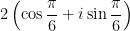 … for reasons that will become apparent later, I tell my students that I’ll use radians and not degrees for this one. Most students can recognize — and this is important, before I formally prove De Moivre’s Theorem — that they need to multiply
  by itself 2014 times and add
  to itself 2014 times. Therefore,
 without a calculator. With some prodding, they’ll recognize that
  , and so they can subtract
  (not
(not  ) without changing the values of sine and cosine. Therefore,
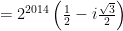

![\displaystyle \frac{ r_1 (\cos \theta_1 + i \sin \theta_1) }{ r_2 (\cos \theta_2 + i \sin \theta_2) } = \displaystyle \frac{r_1}{r_2} (\cos [\theta_1-\theta_2] + i \sin [\theta_1-\theta_2])](https://s0.wp.com/latex.php?latex=%5Cdisplaystyle+%5Cfrac%7B+r_1+%28%5Ccos+%5Ctheta_1+%2B+i+%5Csin+%5Ctheta_1%29+%7D%7B+r_2+%28%5Ccos+%5Ctheta_2+%2B+i+%5Csin+%5Ctheta_2%29+%7D+%3D+%5Cdisplaystyle+%5Cfrac%7Br_1%7D%7Br_2%7D+%28%5Ccos+%5B%5Ctheta_1-%5Ctheta_2%5D+%2B+i+%5Csin+%5B%5Ctheta_1-%5Ctheta_2%5D%29&bg=ffffff&fg=000000&s=0&c=20201002) .
. and
and  terms and then multiplying by the conjugate of the denominator:




![= \displaystyle \frac{r_1}{r_2} (\cos \theta_1 + i \sin \theta_1)( \cos [-\theta_2] + i \sin [-\theta_2])](https://s0.wp.com/latex.php?latex=%3D+%5Cdisplaystyle+%5Cfrac%7Br_1%7D%7Br_2%7D+%28%5Ccos+%5Ctheta_1+%2B+i+%5Csin+%5Ctheta_1%29%28+%5Ccos+%5B-%5Ctheta_2%5D+%2B+i+%5Csin+%5B-%5Ctheta_2%5D%29&bg=ffffff&fg=000000&s=0&c=20201002) ;
; and
and  , they are taught to just distribute (or, using the nomenclature that I don’t like, FOIL it out):
 .
.![\left[ r_1 (\cos \theta_1 + i \sin \theta_1) \right] \cdot \left[ r_2 (\cos \theta_2 + i \sin \theta_2) \right]](https://s0.wp.com/latex.php?latex=%5Cleft%5B+r_1+%28%5Ccos+%5Ctheta_1+%2B+i+%5Csin+%5Ctheta_1%29+%5Cright%5D+%5Ccdot+%5Cleft%5B+r_2+%28%5Ccos+%5Ctheta_2+%2B+i+%5Csin+%5Ctheta_2%29+%5Cright%5D+&bg=ffffff&fg=000000&s=0&c=20201002)

![= r_1 r_2 (\cos \theta_1 \cos \theta_2 - \sin \theta_1 \sin \theta_2 + i[ \sin \theta_1 \cos \theta_2 + \cos \theta_1 \sin \theta_2])](https://s0.wp.com/latex.php?latex=%3D+r_1+r_2+%28%5Ccos+%5Ctheta_1+%5Ccos+%5Ctheta_2+-+%5Csin+%5Ctheta_1+%5Csin+%5Ctheta_2+%2B+i%5B+%5Csin+%5Ctheta_1+%5Ccos+%5Ctheta_2+%2B+%5Ccos+%5Ctheta_1+%5Csin+%5Ctheta_2%5D%29&bg=ffffff&fg=000000&s=0&c=20201002)
![= r_1 r_2 (\cos [\theta_1+\theta_2] + i \sin [\theta_1+\theta_2])](https://s0.wp.com/latex.php?latex=%3D+r_1+r_2+%28%5Ccos+%5B%5Ctheta_1%2B%5Ctheta_2%5D+%2B+i+%5Csin+%5B%5Ctheta_1%2B%5Ctheta_2%5D%29&bg=ffffff&fg=000000&s=0&c=20201002) .
.
![1 + 2i = \sqrt{5} \left( \cos[\tan^{-1} 2] + i \sin[\tan^{-1} 2] \right) \approx \sqrt{5} \left( \cos 63.435^\circ + i \sin 63.435^\circ \right)](https://s0.wp.com/latex.php?latex=1+%2B+2i+%3D+%5Csqrt%7B5%7D+%5Cleft%28+%5Ccos%5B%5Ctan%5E%7B-1%7D+2%5D+%2B+i+%5Csin%5B%5Ctan%5E%7B-1%7D+2%5D+%5Cright%29+%5Capprox+%5Csqrt%7B5%7D+%5Cleft%28+%5Ccos+63.435%5E%5Ccirc+%2B+i+%5Csin+63.435%5E%5Ccirc+%5Cright%29&bg=ffffff&fg=000000&s=0&c=20201002)
 . Indeed,
 .
.