
Throughout grades K-10, students are slowly introduced to the concept of angles. They are told that there are 


Then, in Precalculus, we make students get comfortable with 


We tell students that radians and degrees are just two ways of measuring angles, just like inches and centimeters are two ways of measuring the length of a line segment.
Still, students are extremely comfortable with measuring angles in degrees. They can easily visualize an angle of 

I was never any good in sports. I was always terrified if a tennis ball would come over the fence and land near me, because I never could get it over the fence – it usually went about a radian off of where it was supposed to go.
Naturally, students wonder why we make them get comfortable with measuring angles with radians.
The short answer, appropriate for Precalculus students: Certain formulas are a little easier to write with radians as opposed to degrees, which in turn make certain formulas in calculus a lot easier.
The longer answer, which Precalculus students would not appreciate, is that radian measure is needed to make the derivatives of 

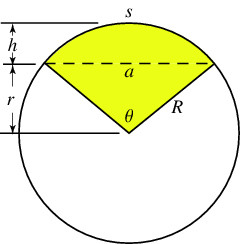
Source: http://mathworld.wolfram.com/CircularSector.html
1. In Precalculus, the length of a circle arc with central angle 


Also, the area of a circular sector with central angle

In both of these formulas, the angle
Students may complain that it’d be easy to make a formula of


However, getting rid of the 
2a. Early in calculus, the limit

is derived using the Sandwich Theorem (or Pinching Theorem or Squeeze Theorem). I won’t reinvent the wheel by writing out the proof, but it can be found here. The first step of the proof uses the formula for the above formula for the area of a circular sector.
2b. Using the trigonometric identity 


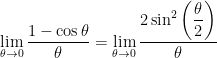
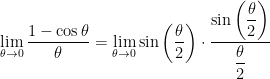


3. Both of the above limits — as well as the formulas for 


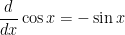
 So, to make a long story short, radians are used to make the derivatives $y = \sin x$ and $y = \cos x$ easier to remember. It is logically possible to differentiate these functions using degrees instead of radians — see http://www.math.ubc.ca/~feldman/m100/sinUnits.pdf. However, possible is not the same thing as preferable, as calculus is a whole lot easier without these extra factors of
 Mean Green Math