In a recent class with my future secondary math teachers, we had a fascinating discussion concerning how a teacher should respond to the following question from a student:
Is it ever possible to prove a statement or theorem by proving a special case of the statement or theorem?
Usually, the answer is no… even checking many special cases of a conjecture does not mean that the conjecture is correct.
The following example probably appears in every textbook that I’ve seen that handles mathematical induction to convince students that checking even many special cases of a conjecture is not sufficient for proving the conjecture.
Conjecture: If  is a positive integer, then
  is a prime number.
Is this true? Well, let’s start checking:
If  , then
  , which is a prime number.
If  , then
  , which is a prime number.
If  , then
  , which is a prime number.
If  , then
  , which is a prime number.
If  , then
  , which is a prime number.
If  , then
  , which is a prime number.
If  , then
  , which is a prime number.
If  , then
  , which is a prime number.
If  , then
  , which is a prime number.
If  , then
  , which is a prime number.
If  , then
  , which is a prime number.
If  , then
  , which is a prime number.
If  , then
  , which is a prime number.
If  , then
  , which is a prime number.
If  , then
  , which is a prime number.
If  , then
  , which is a prime number.
If  , then
  , which is a prime number.
If  , then
  , which is a prime number.
If  , then
  , which is a prime number.
If  , then
  , which is a prime number.
If  , then
  , which is a prime number.
If  , then
  , which is a prime number.
If  , then
  , which is a prime number.
If  , then
  , which is a prime number.
If  , then
  , which is a prime number.
If  , then
  , which is a prime number.
If  , then
  , which is a prime number.
If  , then
  , which is a prime number.
If  , then
  , which is a prime number.
If  , then
  , which is a prime number.
If  , then
  , which is a prime number.
If  , then
  , which is a prime number.
If  , then
  , which is a prime number.
If  , then
  , which is a prime number.
If  , then
  , which is a prime number.
If  , then
  , which is a prime number.
If  , then
  , which is a prime number.
If  , then
  , which is a prime number.
If  , then
  , which is a prime number.
If  , then
  , which is a prime number.
Okay, a show of hands… did anyone actually carefully read and check the above 40 lines? I didn’t think so. The point is that the proposition works for  . By about , or so, a student (who didn’t already know the answer) actually did the above work would begin thinking, “Wow, this probably is correct for any value of
  .”
.”
Of course, the catch happens at  :
:
If latex n = 41, then  ,
,
which is not a prime number.
All this to say, seeing a trend for the first few special cases… or the first few dozen special cases… does not necessarily mean that the trend will continue.


 is always an even number times an odd number: if
  is odd, but if
  is a multiple of 6. Therefore,
  is one more than a multiple of 6, proving the theorem.
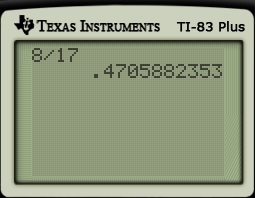
 arithmetic so that a calculator can solve addition and multiplication problems that it ordinarily could not handle. Today, we turn to division. Let’s now consider the decimal representation of
  .
.

 using long division. As shown below, the repeating block has length
  , which can be found in a few minutes with enough patience. By the end of this post, we’ll consider a modification of ordinary long division that facilitates the computation of really long repeating blocks.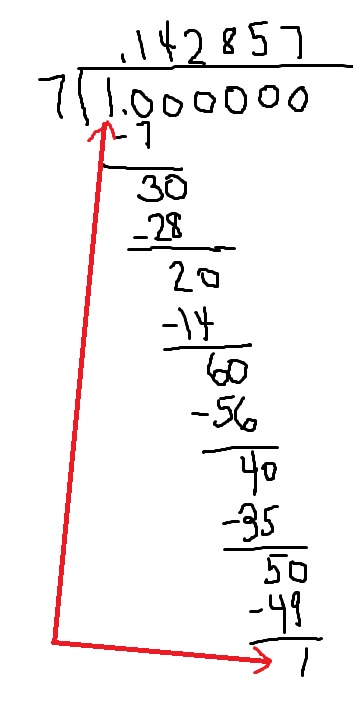
 .
. and
and  , with
  , there exist unique integers
  and
and  such that
  and $0 \le r < |b|$, where
  denotes the absolute value of
  . Dividing by
  ,
, 
 . Dividing by
  ,
, 

 . Dividing by
  ,
, 

 . Dividing by
 . Dividing by
  ,
, 

 and have found the length of the repeating block.
 or
or  and
and  , the appropriate values of
  and
and  are the two quotients needed above, and subtraction is used to find the remainders (which must be less than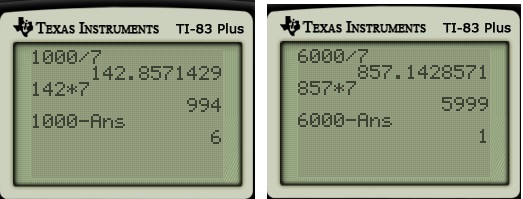
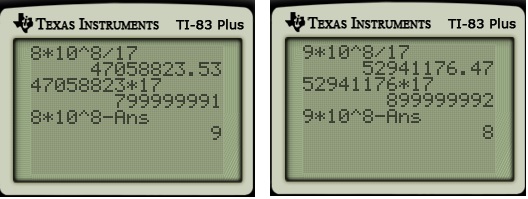
 in the first place. However, the advantage of this method becomes clear when we consider fractions who repeating blocks are longer than 10 digits.
 , where
  is the Euler toitent function, or the number of integers less than
  that are relatively prime with
  . So we can conclude that the length of the repeating block is a factor of
  , or either
  ,
,  , or
, or  .
.

 of the repeating block up to
 satisfies the horizontal line test for any
  or
or  . For example,
 ,
, is
is
 and
and  , with
  in the appropriate quadrant. This is analogous to converting from rectangular coordinates to polar coordinates.
 in the case that
  is a complex number.
 be a complex number so that
  . Then we define
 .
. . However, this complex logarithm doesn’t always work the way you’d think it work. For example,
 .
.
 .
.![\log \left[ (-1) \cdot (-1) \right] = \log 1 = 0](https://s0.wp.com/latex.php?latex=%5Clog+%5Cleft%5B+%28-1%29+%5Ccdot+%28-1%29+%5Cright%5D+%3D+%5Clog+1+%3D+0&bg=ffffff&fg=000000&s=0&c=20201002) ,
, .
.

 Mean Green Math