Engaging students: Geometric sequences

In my capstone class for future secondary math teachers, I ask my students to come up with ideas for engaging their students with different topics in the secondary mathematics curriculum. In other words, the point of the assignment was not to devise a full-blown lesson plan on this topic. Instead, I asked my students to think about three different ways of getting their students interested in the topic in the first place.

I plan to share some of the best of these ideas on this blog (after asking my students’ permission, of course).

This student submission comes from my former student Michelle McKay. Her topic, from Precalculus: geometric sequences.

green line

A.     What interesting word problems using this topic can your student do now?

In the movie Pay it Forward (2000), the young boy Trevor has the following idea: He can make the world a better place by encouraging people to help others.

payitforward

If Trevor helps three people and asks that they help three other people instead of repaying him, how can we represent this as a sequence? Write the first 5 terms.  (Hint: Let Trevor be represented by the number 1.)

What is a formula that can give us the amount of people affected after n terms?

When will 177,147 people be affected? 14,348,907 people?

green lineB.     How can this topic be used in your students’ future courses in mathematics or science?

For science classes, geometric sequences can be used to represent data collected for exponential growth or decay of a population or solution over time. Below are some examples of how geometric sequences can appear in a future science class.

Biology: A researcher is determining whether a certain species of mouse is thriving in its environment or becoming endangered. The total population of the mouse is calculated each year. What conclusions can you draw from the data below?

Year

Population

1

240

2

720

3

2,160

4

6,480

5

19,440

Chemistry: A student has been monitoring the amount of Na in a solution. Based off the data collected, when will the Na in the solution be negligible?

Day

Na %

1 95%
2 42.75%
3 19.24%
4 8.65%

Physics: Students in a physics class measure the following heights of a ball that has been dropped from 10 feet in the air. Each measured height is taken at the highest point in the ball’s trajectory.

10

8

6.4

5.12

4.096

Source: http://www.phschool.com/atschool/academy123/english/academy123_content/wl-book-demo/ph-256s.html

green lineA.     Application of geometric sequences.

The following prompt can be used as a short response or in-class debate:

A student is standing a distance of x meters away from the front of the classroom. If he decreases the distance between himself and the front of the classroom by half each time he moves, will he ever reach the front of the classroom? What if instead of a student, we use a point on a line? Justify your answer.


Engaging students: right-triangle trigonometry

In my capstone class for future secondary math teachers, I ask my students to come up with ideas for engaging their students with different topics in the secondary mathematics curriculum. In other words, the point of the assignment was not to devise a full-blown lesson plan on this topic. Instead, I asked my students to think about three different ways of getting their students interested in the topic in the first place.

I plan to share some of the best of these ideas on this blog (after asking my students’ permission, of course).

This student submission comes from my former student Kelsie Teague. Her topic, from Precalculus: right-triangle trigonometry.

green line

How has this topic appeared in popular culture?

In the famous T.V. show Numbers they do an episode using trig to find the angle of origin of the blood spatter. In forensic science they use trig every day to determine where the victim was originally injured. They can also use this to find the angle of impact, area/point of convergence, and area of origin.  The following power point goes into more detail: http://cmb.physics.wisc.edu/people/gault/Blood%20Splatter%20Trig.pdf

 If the blood was dropped by a 90-degree angle, the stain will appear to be an almost perfect circle.

We could get out some long paper and colored water and experiment with the idea of change of angle in the drop of blood and calculate the angles.

Angle of Impact =Sin (theta)= Width of drop/Length of drop.

green line

How can technology (YouTube, Khan Academy [khanacademy.org], Vi Hart, Geometers Sketchpad, graphing calculators, etc.) be used to effectively engage students with this topic?

YouTube is a great website for engagement because you can find many videos to start the lesson off with some previous knowledge that they will be using for that days lesson. The following video would be a good way to engage the students when talking about right triangle trig.

It’s to a song that they probably have already heard and it’s teaching them something they already know. Since the students already have knowledge of this, the video isn’t teaching them the topic but refreshing their memory in a entertaining fashion.

When looking for a good video, I ran across many that would work for this lesson, but this one seemed like it would grab the student’s attention more and keep their attention.

The above video is also a good one, and it shows the lyrics in the description so you can make sure what they are saying is mathematically correct so it doesn’t give the students any misconceptions.

green line

How could you as a teacher create an activity or project that involves your topic?

If I was teaching at a school that was close to a hill or a mountain outside I could take my students outside and have them figure out how far up the mountain they would have to walk to get to the top. We could use a tap measure to measure how high they had the protractor in the air and then we could look up the height and distance away of the mountain. They then could use the protractor to find the angle between themselves and the top of the mountain. We could then use this information inside the classroom to solve how far to travel up the mountain.

mountaintrigSimilar to the above picture except they will know the height of the mountain.  This would show the length of the hypotenuse of the right triangle. They will have to subtract the height they have the protractor at from the height of the mountain to be accurate since the height of the mountain is from the ground up.

Importance of the base case in a proof by induction

In Precalculus, Discrete Mathematics or Real Analysis, an arithmetic series is often used as a student’s first example of a proof by mathematical induction. Recall, from Wikipedia:

Mathematical induction is a method of mathematical proof typically used to establish a given statement for all natural numbers. It is done in two steps. The first step, known as the base case, is to prove the given statement for the first natural number. The second step, known as the inductive step, is to prove that the given statement for any one natural number implies the given statement for the next natural number. From these two steps, mathematical induction is the rule from which we infer that the given statement is established for all natural numbers.

The simplest and most common form of mathematical induction infers that a statement involving a natural number n holds for all values of n. The proof consists of two steps:

  1. The basis (base case): prove that the statement holds for the first natural number n. Usually, n=0 or n=1.
  2. The inductive step: prove that, if the statement holds for some natural number n, then the statement holds for n+1.

The hypothesis in the inductive step that the statement holds for some n is called the induction hypothesis (or inductive hypothesis). To perform the inductive step, one assumes the induction hypothesis and then uses this assumption to prove the statement for n+1.

As an inference rule, mathematical induction can be justified as follows. Having proven the base case and the inductive step, then any value can be obtained by performing the inductive step repeatedly. It may be helpful to think of the domino effect. Consider a half line of dominoes each standing on end, and extending infinitely to the right. Suppose that:

  1. The first domino falls right.
  2. If a (fixed but arbitrary) domino falls right, then its next neighbor also falls right.

With these assumptions one can conclude (using mathematical induction) that all of the dominoes will fall right.

Mathematical induction… works because n is used to represent an arbitrary natural number. Then, using the inductive hypothesis, i.e. that P(n) is true, show P(k+1) is also true. This allows us to “carry” the fact that P(0) is true to the fact that P(1) is also true, and carry P(1) to P(2), etc., thus proving P(n) holds for every natural number n.

green line

When students first encounter mathematical induction (in either Precalculus, Discrete Mathematics, or Real Analysis), the theorems that students are asked to prove usually fall into four categories:

  1. Calculating a series (examples below).
  2. Statements concerning divisibility (for example, proving that 4 is always a factor of 5^n-1).
  3. Finding a closed-form expression for a recursively defined sequence (for example, if a_1 = 4 and a_n = 3a_{n-1} if n \ge 2, proving that a_n = 4 \times 3^{n-1})
  4. Statements concerning inequality (for example, proving that n! > 4^n if n \ge 9)

Here’s a common first (or maybe second) example of mathematical induction applied to an arithmetic series.

Theorem. 1^2 + 2^2 + \dots + (n-1)^2 + n^2 = \displaystyle \frac{n(n+1)(2n+1)}{6}

Proof. Induction on n.

n = 1: The left-hand is simply 1, while the right-hand side is \displaystyle \frac{(1)(2)(3)}{6}, which is also equal to 1. So the base case works.

n: Assume that the statement holds true for the integer n.

n+1. If I replace n by n+1 in the statement of the theorem, then the right-hand side becomes

\displaystyle \frac{(n+1)[(n+1)+1][2(n+1)+1]}{6} = \displaystyle \frac{(n+1)(n+2)(2n+3)}{6}

I find it helpful to describe this to students as my target. In other words, as I manipulate the left-hand side, my ultimate goal is to end up with this target. Once I have done that, then I have completed the proof.

If I replace n by n+1 in the statement of the theorem, then the left-hand side will now end on n+1 instead of n:

1^2+ 2^2 + \dots + (n-1)^2 + n^2 + (n+1)^2

Notice that we’ve seen almost all of this before, except for the extra term (n+1)^2. So we will substitute using the induction hypothesis, carrying the extra (n+1)^2 along for the ride.

1^2 + 2^2 + \dots + (n-1)^2 + n^2 + (n+1)^2 = \displaystyle \frac{n(n+1)(2n+1)}{6} + (n+1)^2

Now our task is, by hook or by crook, using whatever algebraic tricks we can think of to convert this last expression into the target. Most students are completely comfortable doing this, although they typically multiply out the term n(n+1)(2n+1) unnecessarily. Indeed, many early proofs by induction are simplified by factoring out terms whenever possible — in the example below, (n+1) is factored on the third step — as opposed to multiplying them out. In my experience, proofs by induction often serve as a stringent test of students’ algebra skills as opposed to their skills in abstract reasoning.

In any event, here’s the end of the proof:

1^2 + 2^2 + \dots + (n-1)^2 + n^2 + (n+1)^2 = \displaystyle \frac{n(n+1)(2n+1)}{6} + (n+1)^2

1^2 + 2^2 + \dots + (n-1)^2 + n^2 + (n+1)^2 = \displaystyle \frac{n(n+1)(2n+1) + 6(n+1)^2}{6}

1^2 + 2^2 + \dots + (n-1)^2 + n^2 + (n+1)^2 = \displaystyle \frac{(n+1)[n(2n+1) + 6(n + 1)]}{6}

1^2 + 2^2 + \dots + (n-1)^2 + n^2 + (n+1)^2 = \displaystyle \frac{(n+1)(2n^2 + n + 6n + 6)}{6}

1^2 + 2^2 + \dots + (n-1)^2 + n^2 + (n+1)^2 = \displaystyle \frac{(n+1)(2n^2 + 7n + 6)}{6}

1^2 + 2^2 + \dots + (n-1)^2 + n^2 + (n+1)^2 = \displaystyle \frac{(n+1)(n+2)(2n+3)}{6}

green line

A fair amount of algebra was needed to prove the n+1 case. However, the first step — the base case — was especially easy. Indeed, in most proofs by induction seen by students, the base case is often quite trivial… to the point that students often wonder why the base case is needed in the first place.

I first saw this next example in Calculus, by Tom M. Apostol. This next fallacious example illustrates what can happen if the base case is ignored. The statement of this “theorem” doesn’t match the formula for an arithmetic series, and so clearly something is wrong with the following “proof.”

“Theorem.” 1 + 2 + \dots + (n-1) + n = \displaystyle \frac{(2n+1)^2}{8}

“Proof.” Induction on n.

n = 1: Let’s just ignore the base case, it’s unimportant.

n: Assume that the statement holds true for the integer n.

n+1. If I replace n by n+1 in the statement of the theorem, then the right-hand side — my target — becomes

\displaystyle \frac{[2(n+1)+1]^2}{8} = \displaystyle \frac{(2n+3)^2}{8}

On the left-hand side, we use the induction hypothesis:

1 + 2 + \dots + (n-1) + n + (n+1) = \displaystyle \frac{(2n+1)^2}{8} + (n+1)

Now our task is, by hook or by crook, using whatever algebraic tricks we can think of to convert this last expression into the target.


1 + 2 + \dots + (n-1) + n + (n+1) = \displaystyle \frac{(2n+1)^2}{8} + (n+1)

1 + 2 + \dots + (n-1) + n + (n+1) = \displaystyle \frac{(2n+1)^2 + 8(n+1)}{8}

1 + 2 + \dots + (n-1) + n + (n+1) = \displaystyle \frac{4n^2+4n+1+8n+8}{8}

1 + 2 + \dots + (n-1) + n + (n+1) = \displaystyle \frac{4n^2+12n+9}{8}

1 + 2 + \dots + (n-1) + n + (n+1) = \displaystyle \frac{(2n+3)^2}{8}

So that’s the end of the “proof.”

green lineClearly, something went wrong with the above proof. What went wrong, obviously, is that we didn’t check the base case. If n=1, then the left-hand side is 1. However, the right-hand side is \displaystyle \frac{[(2)(1) + 1]^2}{8} = \displaystyle \frac{9}{8}. So the base case is false.

So what happened?

We correctly showed that, if the case n is true, then the case n+1 is also true. The catch, of course, is that the case n is never true. Using the domino analogy, we showed that if a domino falls, then the next domino will fall. But the first domino never falls.

All this to say… yes, it’s important to check that the base case actually works.

Engaging students: Computing trigonometric functions using a unit circle

In my capstone class for future secondary math teachers, I ask my students to come up with ideas for engaging their students with different topics in the secondary mathematics curriculum. In other words, the point of the assignment was not to devise a full-blown lesson plan on this topic. Instead, I asked my students to think about three different ways of getting their students interested in the topic in the first place.

I plan to share some of the best of these ideas on this blog (after asking my students’ permission, of course).

This student submission comes from my former student Angel Pacheco. His topic, from Precalculus: computing trigonometric functions using a unit circle.

green line

How can this topic be used in your students’ future courses in mathematics or science?

The first course to bring in the unit circle is Pre-Calculus. It is used in a lot in calculus when it comes to finding certain values of trigonometric functions. Knowing how the unit circle works, it allows the students to solve a lot of trigonometric functions on their own. Once students reach college level mathematics, they will learn that the unit circle is a key element to trigonometry.  Trigonometry is a huge part of all the calculus courses.

Science contains a lot of trigonometry, mainly physics. The law of sine and cosine allows the students to determine the angle an object is or even how far it is. Being able to use the unit circle to solve for functions, it allows them to use it any subject whether it be a science or a math class. Students or scientists that know how to solve trigonometric functions using the unit circle allows them to compute certain things on paper as opposed to relying on a calculator to do all the work.

green line

How can technology (YouTube, Khan Academy [khanacademy.org], Vi Hart, Geometers Sketchpad, graphing calculators, etc.) be used to effectively engage students with this topic?

Technology can be used to introduce and also evaluate their content. There are different ways to use technology. One example is using Khan Academy videos to show students how it works or how Khan explains. Students having to look at a video can have them engage on the topic. My personal favorite is to create an exciting video and put it on YouTube. I have noticed that parodies are a popular trend so creating a parody with the unit circle with a popular song will be effective to engaging the students to this topic. The next thing I would use for technology is graphing calculators. I think if the students see that the calculator gives them the same answer as the values they learned from the unit circle, they would be amazed on how the concept of the unit circle is. My classmates and I were in complete shock when we realized how the unit circle worked. My former teacher also had a clock based off of the unit circle so we had to learn it in order to read the time.

green line

How could you as a teacher create an activity or project that involves your topic?

The link below shows a sample lesson that allows the students work in groups to solve trigonometric functions and create a table that shows the solution to certain problems. The students will have a calculator with them that can be used for checking their answers to see if they are on the right track with the assignment. Also, having access to the computers to research particular things that they need for explaining will be acceptable. In my opinion, I feel that there is some tweaking that I recommend making it more effective. I would like to have a website that visually shows the unit circle. If possible, I would like for the students to have a worksheet that allows them to know which steps to follow to ensure that they are on the right track. A great form of assessment will be a quiz following this activity. I feel asking them to draw the unit circle and also solve certain trigonometric functions to see if they understand it. I would also like to like to bring in all six of the functions and show the relation with the unit circle.

Source(s): http://alex.state.al.us/lesson_view.php?id=27478

Why do we teach students about radians?

Throughout grades K-10, students are slowly introduced to the concept of angles. They are told that there are 90 degrees in a right angle, 180 degrees in a straight angle, and a circle has 60 degrees. They are introduced to 30-60-90 and 45-45-90 right triangles. Fans of snowboarding even know the multiples of 180 degrees up to 1440 or even 1620 degrees.

Then, in Precalculus, we make students get comfortable with \pi, \displaystyle \frac{\pi}{2}, \displaystyle \frac{\pi}{3}, \displaystyle \frac{\pi}{4}, \displaystyle \frac{\pi}{6}, and multiples thereof.

We tell students that radians and degrees are just two ways of measuring angles, just like inches and centimeters are two ways of measuring the length of a line segment.

Still, students are extremely comfortable with measuring angles in degrees. They can easily visualize an angle of 75^o, but to visualize an angle of 2 radians, they inevitably need to convert to degrees first. In his book Surely You’re Joking, Mr. Feynman!, Nobel-Prize laureate Richard P. Feynman described himself as a boy:

I was never any good in sports. I was always terrified if a tennis ball would come over the fence and land near me, because I never could get it over the fence – it usually went about a radian off of where it was supposed to go.

Naturally, students wonder why we make them get comfortable with measuring angles with radians.

The short answer, appropriate for Precalculus students: Certain formulas are a little easier to write with radians as opposed to degrees, which in turn make certain formulas in calculus a lot easier.

The longer answer, which Precalculus students would not appreciate, is that radian measure is needed to make the derivatives of \sin x and \cos x look palatable.

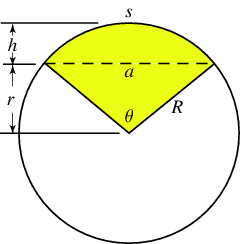
CircularSector_1000

Source: http://mathworld.wolfram.com/CircularSector.html

1. In Precalculus, the length of a circle arc with central angle \theta in a circle with radius r is

s = r\theta

Also, the area of a circular sector with central angle \theta in a circle with radius r is

A = \displaystyle \frac{1}{2} r^2 \theta

In both of these formulas, the angle \theta must be measured in radians.

Students may complain that it’d be easy to make a formula of \theta is measured in degrees, and they’d be right:

s = \displaystyle \frac{180 r \theta}{\pi} and A = \displaystyle \frac{180}{\pi} r^2 \theta

However, getting rid of the 180/\pi makes the following computations from calculus a lot easier.

2a. Early in calculus, the limit

\displaystyle \lim_{\theta \to 0} \frac{\sin \theta}{\theta} = 1

is derived using the Sandwich Theorem (or Pinching Theorem or Squeeze Theorem). I won’t reinvent the wheel by writing out the proof, but it can be found here. The first step of the proof uses the formula for the above formula for the area of a circular sector.

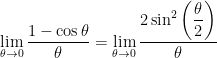
2b. Using the trigonometric identity \cos 2x = 1 - 2 \sin^2 x, we replace x by \theta/2 to find

\displaystyle \lim_{\theta \to 0} \frac{1 - \cos \theta}{\theta} = \displaystyle \lim_{\theta \to 0} \frac{2\sin^2 \displaystyle \left( \frac{\theta}{2} \right)}{ \theta}

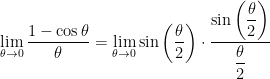
\displaystyle \lim_{\theta \to 0} \frac{1 - \cos \theta}{\theta} = \displaystyle \lim_{\theta \to 0} \sin \left( \frac{\theta}{2} \right) \cdot \frac{\sin \displaystyle \left( \frac{\theta}{2} \right)}{ \displaystyle \frac{\theta}{2}}

\displaystyle \lim_{\theta \to 0} \frac{1 - \cos \theta}{\theta} =0 \cdot 1

\displaystyle \lim_{\theta \to 0} \frac{1 - \cos \theta}{\theta} =0

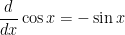
3. Both of the above limits — as well as the formulas for \sin(\alpha + \beta) and \cos(\alpha + \beta) — are needed to prove that \displaystyle \frac{d}{dx} \sin x = \cos x and \displaystyle \frac{d}{dx} \cos x = -\sin x. Again, I won’t reinvent the wheel, but the proofs can be found here.

green lineSo, to make a long story short, radians are used to make the derivatives $y = \sin x$ and $y = \cos x$ easier to remember. It is logically possible to differentiate these functions using degrees instead of radians — see http://www.math.ubc.ca/~feldman/m100/sinUnits.pdf. However, possible is not the same thing as preferable, as calculus is a whole lot easier without these extra factors of \pi/180 floating around.

Are complex numbers complex?

It’s an unfortunate fact of history that numbers of the form a+bi are called complex numbers. In modern English, of course, the word complex is usually associated with phrases like difficult, inscrutable, time-consuming, hard to solve, and other negative connotations that teachers would prefer to not introduce into a math class.

However, my understanding is that the other meaning of the word complex was in mind when the term complex numbers was coined. After all, in modern English, we still refer to a group of buildings as an apartment complex or maybe an office complex. In this sense, complex means two (or more) things that are joined together to form a single unit, which is precisely what happens as the real part a and the imaginary part $bi$ are joined to form a + bi. Indeed, my understanding is that complex was chosen to be the opposite of simplex, or a single unit (like a real number).

Anyway, hopefully this bit of history can make complex numbers less mystifying for students.

While I’m on the topic, the word imaginary was another unfortunate choice of words by our ancestors, but — like complex — we’re just stuck with it.

Also while I’m on the topic, this is a good chance to review a great piece of showmanship about teaching complex numbers:

Engaging students: Vectors in two dimensions

In my capstone class for future secondary math teachers, I ask my students to come up with ideas for engaging their students with different topics in the secondary mathematics curriculum. In other words, the point of the assignment was not to devise a full-blown lesson plan on this topic. Instead, I asked my students to think about three different ways of getting their students interested in the topic in the first place.

I plan to share some of the best of these ideas on this blog (after asking my students’ permission, of course).

This student submission comes from my former student Derek Skipworth. His topic, from Precalculus: vectors in two dimensions.

green line

A. How could you as a teacher create an activity or project that involves your topic?

While it may be a cop-out to use this example since I am developing it for an actual lesson plan, I will go ahead and use it because I feel it is a strong activity.  I am developing a series of 21 problems that will be the base for forming the students’ treasure maps.  There will be three jobs: Cartographer, the map maker; Lie Detector, who checks for orthogonality; and Calculator, who will solve the vector problems.  The 21 problems will be broken down into 7 per page, and the students will switch jobs after each page.  The rule is that any vectors that are orthogonal with each other cannot be included in your map.  There are three of these on each page, so each group should end up with a total of 12 vectors on their map.  Once orthogonality is checked by the Lie Detector, the Calculator will do the expressed operations on the vector pairs to come up with the vector to be drawn.  The map maker will then draw the vector, as well as the object the vector leads to.  Each group will have their directions in different orders so that every group has their own unique map.  The idea is for the students to realize (if they checked orthogonality correctly) that, even though every map is different, the sum of all vectors still leads you to the same place, regardless of order.


green line

B. How does this topic extend what your students should have learned in previous courses?

Vectors build upon many topics from previous courses.  For one, it teaches the student to use the Cartesian plane in a new way than they have done previously.  Vectors can be expressed in terms of force in the x and y directions, which result in a representation very similar to an ordered pair.  It gets expanded to teach the students that unlike an ordered pair, which represents a distinct point in space, a vector pair represents a specific force that can originate from any point on the Cartesian Plane.

Vectors also build on previous knowledge of triangles.  When written as \langle x,y \rangle, we can find the magnitude of the vector by using the Pythagorean Theorem.  It gives them a working example of when this theorem can be applied on objects other than triangles.  It also reinforces the students trigonometry skills since the direction of a vector can also be expressed using magnitude and angles.


green line

E. How can technology be used to effectively engage students with this topic?

The PhET website has one of the best tools I’ve seen for basic knowledge of two dimensional vector addition, located at http://phet.colorado.edu/en/simulation/vector-addition.  This is a java-based program that lets you add multiple vectors (shown in red) in any direction or magnitude you want to get the sum of the vectors (shown in green).  Also shown at the top of the program is the magnitude and angle of the vector, as well as its corresponding x and y values.

What’s great about this program is it puts the power in the student’s hands.  They are not forced to draw multiple sets of vectors themselves.  Instead, they can quickly throw them in the program and manipulate them without any hassle.  This effectively allows the teacher to cover the topic quicker and more effectively due to the decreased amount of time needed to combine all vectors on a graph.

A surprising appearance of e

Here’s a simple probability problem that should be accessible to high school students who have learned the Multiplication Rule:

Suppose that you play the lottery every day for about 20 years. Each time you play, the chance that you win is 1 chance in 1000. What is the probability that, after playing  1000 times, you never win?

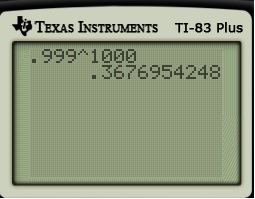
This is a straightforward application of the Multiplication Rule from probability. The chance of not winning on any one play is 0.999. Therefore, the chance of not winning 1000 consecutive times is (0.999)^{1000}, which we can approximate with a calculator.
TIlottery1

Well, that was easy enough. Now, just for the fun of it, let’s find the reciprocal of this answer.

TIlottery2

Hmmm. Two point seven one. Where have I seen that before? Hmmm… Nah, it couldn’t be that.

What if we changed the number 1000 in the above problem to 1,000,000? Then the probability would be (0.999999)^{1000000}.

TIlottery3

There’s no denying it now… it looks like the reciprocal is approximately e, so that the probability of never winning for both problems is approximately 1/e.

Why is this happening? I offer a thought bubble if you’d like to think about this before proceeding to the answer.

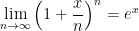
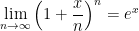
green_speech_bubbleThe above calculations are numerical examples that demonstrate the limit

\displaystyle \lim_{n \to \infty} \left(1 + \frac{x}{n}\right)^n = e^x

In particular, for the special case when n = -1, we find

\displaystyle \lim_{n \to \infty} \left(1 - \frac{1}{n}\right)^n = e^{-1} = \displaystyle \frac{1}{e}

The first limit can be proved using L’Hopital’s Rule. By continuity of the function f(x) = \ln x, we have

\ln \left[ \displaystyle \lim_{n \to \infty} \left(1 + \frac{x}{n}\right)^n \right] = \displaystyle \lim_{n \to \infty} \ln \left[ \left(1 + \frac{x}{n}\right)^n \right]

\ln \left[ \displaystyle \lim_{n \to \infty} \left(1 + \frac{x}{n}\right)^n \right] = \displaystyle \lim_{n \to \infty} n \ln \left(1 + \frac{x}{n}\right)

\ln \left[ \displaystyle \lim_{n \to \infty} \left(1 + \frac{x}{n}\right)^n \right] = \displaystyle \lim_{n \to \infty} \frac{ \displaystyle \ln \left(1 + \frac{x}{n}\right)}{\displaystyle \frac{1}{n}}

The right-hand side has the form \infty/\infty as n \to \infty, and so we may use L’Hopital’s rule, differentiating both the numerator and the denominator with respect to n.

\ln \left[ \displaystyle \lim_{n \to \infty} \left(1 + \frac{x}{n}\right)^n \right] = \displaystyle \lim_{n \to \infty} \frac{ \displaystyle \frac{1}{1 + \frac{x}{n}} \cdot \frac{-x}{n^2} }{\displaystyle \frac{-1}{n^2}}

\ln \left[ \displaystyle \lim_{n \to \infty} \left(1 + \frac{x}{n}\right)^n \right] = \displaystyle \lim_{n \to \infty} \displaystyle \frac{x}{1 + \frac{x}{n}}

\ln \left[ \displaystyle \lim_{n \to \infty} \left(1 + \frac{x}{n}\right)^n \right] = \displaystyle \frac{x}{1 + 0}

\ln \left[ \displaystyle \lim_{n \to \infty} \left(1 + \frac{x}{n}\right)^n \right] = x

Applying the exponential function to both sides, we conclude that

\displaystyle \lim_{n \to \infty} \left(1 + \frac{x}{n}\right)^n= e^x

green lineIn an undergraduate probability class, the problem can be viewed as a special case of a Poisson distribution approximating a binomial distribution if there’s a large number of trials and a small probability of success.

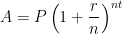
The above calculation also justifies (in Algebra II and Precalculus) how the formula for continuous compound interest A = Pe^{rt} can be derived from the formula for discrete compound interest A = P \displaystyle \left( 1 + \frac{r}{n} \right)^{nt}
All this to say, Euler knew what he was doing when he decided that e was so important that it deserved to be named.

Engaging students: Parabolas

In my capstone class for future secondary math teachers, I ask my students to come up with ideas for engaging their students with different topics in the secondary mathematics curriculum. In other words, the point of the assignment was not to devise a full-blown lesson plan on this topic. Instead, I asked my students to think about three different ways of getting their students interested in the topic in the first place.

I plan to share some of the best of these ideas on this blog (after asking my students’ permission, of course).

This student submission comes from my former student Claire McMahon. Her topic, from Precalculus: parabolas.

green line

The parabola took a long time to get to us and took a few thinkers to really get the idea down.  This website that I found really nailed the dates and also simplified the rational that led up to the parabola as we know it today.  The history of the parabola is as follows:

The parabola was explored by Menaechmus (380 BC to 320 BC), who was a pupil of Plato and Eudoxus. He was trying to duplicate the cube by finding the side of the cube that has an area double the cube. Instead, Menaechmus solved it by finding the intersection of the two parabolas x2=y and y2=2x. Euclid (325 BC to 265 BC) wrote about the parabola. Apollonius (262 BC to 190 BC) named the parabola. Pappus (290 to 350) considered the focus and directrix of the parabola. Pascal (1623 to 1662) considered the parabola as a projection of a circle. Galileo (1564 to 1642) showed that projectiles falling under uniform gravity follow parabolic paths. Gregory (1638 to 1675) and Newton (1643 to 1727) considered the properties of a parabola.

This really got me to thinking what it really took to figure out the derivation of the formula and even for the graph of the parabola.  I find it interesting that the idea had to travel through seven genius minds to come to all of the properties that the parabola holds to this day.

green line

This same website led me to another use of the parabola, other than to describe a projectile’s path.  The use of suspension bridges relies heavily on a parabolic model.  Other parabolic models would include the satellite dishes and even all types of lights.  Have you ever thought that every single place that light bulb reflects is a reflection off a point from the focus to the parabola to create your beam of light!!  Pretty cool!!  So you might ask why do I need to know anything about parabolas?  There is your answer; it’s used in everyday life.  Here are a couple of examples from the website that I found interesting:

One of the “real world” applications of parabolas involves the concept of a 3D parabolic reflector in which a parabola is revolved about its axis (the line segment joining the vertex and focus). The shape of car headlights, mirrors in reflecting telescopes, and television and radio antennae (such as the one below) all utilize this property.

Antenna of a Radio Telescope

All incoming rays parallel to the axis of the parabola are reflected through the focus.

Flashlights & Headlights

In terms of a car headlight, this property is used to reflect the light rays emanating from the focus of the parabola (where the actual light bulb is located) in parallel rays.

Here are the specs on the suspension bridge:

Hold up a chain by both ends and you’ll get a curve. What kind of curve is it? You might say it is a parabola – Galileo Galili believed it was a parabola. Yet, Galileo was wrong!!!! That curve is NOT a parabola. It is a catenary.It makes sense that you would think that the curved chain is a parabola. Both the catenary and the parabola have similar properties. Both curves have a single low point. They both have a vertical line of symmetry, they at least appear to be continuous and differentiable throughout, and the slope is steeper as we move away from the low point, but it never becomes vertical.So, how is the curve of the cable in a suspension bridge a parabola? When the structure is being built and the main cables are attached to the towers, the curve is a catenary. But when the cables are attached to the deck with hangers, it is no longer a catenary. The curve of the cables become the curve of a parabola. Unlike the catenary, which is curving under its own weight, the parabola is curving not just under its own weight, but also curving from holding up the weight of the deck. The cable of a suspension bridge is under tension from holding up the bridge.Therefore, the cables of a suspension bridge is a parabola, because the weight of the deck is equally distributed on the curve.

I never really knew that there was a difference between the two and now I know that there are certain properties that made it down through the ages that hold true today.  This was a very enlightening subject matter.

Website used: http://www.carondelet.pvt.k12.ca.us/Family/Math/03210/page2.htm