Engaging students: Solving quadratic equations

In my capstone class for future secondary math teachers, I ask my students to come up with ideas for engaging their students with different topics in the secondary mathematics curriculum. In other words, the point of the assignment was not to devise a full-blown lesson plan on this topic. Instead, I asked my students to think about three different ways of getting their students interested in the topic in the first place.

I plan to share some of the best of these ideas on this blog (after asking my students’ permission, of course).

This student submission comes from my former student Elizabeth (Markham) Atkins. Her topic, from Algebra II: solving quadratic equations.

green line

D. History: Who were some of the people who contributed to the discovery of this topic?

Factoring quadratic polynomials is a useful trick in mathematics. Mathematics started long ago. http://www.ucs.louisiana.edu/~sxw8045/history.htm stated that the Babylonians “had a general procedure equivalent to solving quadratic equations”. They taught only through examples and did not explain the process or steps to the students. http://www.mytutoronline.com/history-of-quadratic-equation states that the Babylonians solved the quadratic equations on clay tablets. Baudhayana, an Indian mathematician, began by using the equation ax^2+bx=c. He provided ways to solve the equations. Both the Babylonians and Chinese were the first to use completing the square method which states you take the equation ax^2+bx+c. You take b and divide it by two. After you divide by two you square that number and add it to ax^2+bx and subtract it from c.  Even doing it this way the Babylonians and Chinese only found positive roots. Brahmadupta, another Indian mathematician, was the first to find negative solutions. Finally after all these mathematicians found ways of solving quadratic equations Shridhara, an Indian mathematician, wrote a general rule for solving a quadratic equation.

green line

C. Culture: How has this topic appeared in the news?

USA today (http://www.usatoday.com/news/education/2007-03-04-teacher-parabola-side_N.htm) had a news article that talks about students who used quadratic equations to cook marshmallows. A teacher had students in teams choose a quadratic equation. The teams then used the quadratic equation choosen to build a device to “harness solar heat and cook marshmallows”. http://www.kveo.com/news/quadratic-equations-no-problem talks about a 6 year old who learned to solve quadratic equations. Borland Educational News (http://benewsviews.blogspot.com/2007/03/memorize-quadratic-formula-in-seconds_3620.html) talks about someone who came up with a song for the quadratic formula, which is a way to solve a quadratic equation. They sing the following words to the tune of Pop Goes the Weasel: “X is equal to negative B plus or minus the square root of B squared minus 4AC All over 2A.” It may be an elementary way to solve the equation, but it sure does work. Mathematics is all around us. It is in our everyday lives. We use it without even knowing it sometimes!

green line

A. Applications: How could you as a teacher create an activity or project that involves your topic?

Lesson Corner (http://www.lessoncorner.com/Math/Algebra/Quadratic_Equations) is an excellent resource for finding lesson plans and activities for quadratic equations. One lesson (http://distance-ed.math.tamu.edu/peic/lesson_plans/factoring_quadratics.pdf) talking about engaging the students with a game called “Guess the Numbers”. The students are given two columns, a sum column and a product column. They are then to guess the two numbers that will add to get the sum and multiply to get the product. This is an excellent game because it gets the students going and it is like a puzzle to solve. Learn (http://www.learnnc.org/lp/pages/2981) has a lesson plan for a review of quadratic equations.  The students are engaged by playing “Chutes and Ladders”. The teacher transformed it. The procedures are as follows:

  1. Draw a card.
  2. Roll the dice.
  3. If you roll a 1 or a 6, then solve your quadratic equation by completing the square.
  4. If you roll a 2 or 5, then solve your quadratic equation by using the quadratic formula.
  5. If you roll a 3, then solve your quadratic equation by graphing.
  6. If you roll a 4, then solve your quadratic equation by factoring if possible. If not, then solve it another way.
  7. If you solve your equation correctly, then you may move on the board the number of spaces that corresponds to your roll of the die.
  8. If you answer the question incorrectly, then the person to your left has the opportunity to answer your question and move your roll of the die.
  9. The first person to reach the end of the board first wins the game!
  10. Good luck!!

I think this is an excellent idea because it brings back a little of the students’ childhood!

Engaging students: Solving exponential equations

In my capstone class for future secondary math teachers, I ask my students to come up with ideas for engaging their students with different topics in the secondary mathematics curriculum. In other words, the point of the assignment was not to devise a full-blown lesson plan on this topic. Instead, I asked my students to think about three different ways of getting their students interested in the topic in the first place.

I plan to share some of the best of these ideas on this blog (after asking my students’ permission, of course).

This student submission comes from my former student Elizabeth (Markham) Atkins. Her topic, from Precalculus: solving exponential equations.

green line

A.   APPLICATIONS: What interesting (i.e., uncontrived) word problems using this topic can your students do now?

Exponential equations can be different topics. You can use exponential equations for bacterial growth or decay, population growth or decay, or even a child eating their Halloween candy. Another example would be minimum wage.  A good word problem would be at one point minimum wage was $1.50 an hour. Use A=1.6 e^{rt} to figure out when minimum wage will reach $10.25 an hour. Another good word problem would be Billy Joe gets a dollar on his first day of work. Every day he works his salary for that day doubles. How much money does he have at the end of 30 days? A good money example would also be banking. “Use the equation A=Pe^{rt}. Shawn put $100 in a savings account, which has a rate of 5% per year. How long will it take for his savings to grow to $1000? There are many ways to show exponential growth and decay.

green line

B. CURRICULUM: How can this topic be used in your students’ future courses in mathematics or science?

Exponential equations can be used in science and life for many years from now.  Students will see exponential equations when they begin to study bacteria. They will have to find the decay of growth. Students will also have to see population growth and decay throughout history. They may be asked to find out what the population will be in twenty years. When students take economics, or do their own banking, they will need to calculate interest and principal. Students will also need to do the stock market which uses exponential equations. If students go into field where they are concerned with the population of species that may be becoming extinct then the student would predict when the species would become distinct by using an exponential formula. They could also calculate how long until a certain species may take over the world, such as tree frogs or rabbits. Exponential equations are everywhere in the world and in other subjects, besides mathematics.

green line

E. TECHNOLOGY: How can technology (YouTube, Khan Academy [khanacademy.org], Geometers Sketchpad, graphing calculators, etc.) be used to effectively engage students with this topic?

Exponential equations are used with technology everyday and every which way. Khan Academy has a few examples of exponential growth and exponential decay. Youtube has many great examples of exponential equations. Crewcalc’s exponential rap is an excellent example. They are very creative high school who found a way to express a mathematical concept through music.

Zombie Growth shows another interesting way to portray the mathematical concept of exponential equations. They use the phenomenon of zombies to demonstrate how exponential equations work.

Math project on Youtube showed another way to demonstrate how exponential equations work. They posed a problem and then stated the steps to solve the problem. Students need to use graphing calculators to check whether or not they have the right graph based on information given. They also need calculators to calculate equations and check their equations.

Fun lecture on geometric series (Part 5): The Fibonacci sequence

Every once in a while, I’ll give a “fun lecture” to my students. The rules of a “fun lecture” are that I talk about some advanced applications of classroom topics, but I won’t hold them responsible for these ideas on homework and on exams. In other words, they can just enjoy the lecture without being responsible for its content.

In this series of posts, I’m describing a fun lecture on generating functions that I’ve given to my Precalculus students. In the previous post, we looked at the famed Fibonacci sequence

1, 1, 2, 3, 5, 8, 13, 21, 34, 55, \dots

We also looked at that (slightly less famous) Quintanilla sequence

1, 1, 3, 5, 11, 21, 43, 85, \dots

which is defined so that each term is the sum of the previous term and twice the term that’s two back in the sequence. Using the concept of a generating function, we found that the nth term of the Quintanilla sequence is

Q_n = \displaystyle \frac{2^{n+1} + (-1)^n}{3}

green line

To close out the fun lecture, I’ll then verify that this formula works by using mathematical induction. As seen below, it’s a lot less work to verify the formula with mathematical induction than to derive it from the generating function.

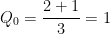
n=0: Q_0 = \displaystyle \frac{2+1}{3} = 1.

n = 1: Q_1 = \displaystyle \frac{2^2-1}{3} = 1.

n-1 and n: Assume the formula works for Q_{n-1} and Q_n.

n+1:

Q_{n+1} = Q_n + 2 Q_{n-1}

Q_{n+1} = \displaystyle \frac{2^{n+1} + (-1)^n}{3} + 2 \cdot \frac{2^n + (-1)^{n-1}}{3}

Q_{n+1} = \displaystyle \frac{2^{n+1} + (-1)^n + 2 \cdot 2^n + 2 \cdot (-1)^{n-1}}{3}

Q_{n+1} = \displaystyle \frac{2^{n+1} + 2^{n+1} + (-1)^n - 2 \cdot (-1)^n}{3}

Q_{n+1} = \displaystyle \frac{2 \cdot 2^{n+1} - (-1)^n}{3}

Q_{n+1} = \displaystyle \frac{2^{n+2} + (-1)^{n+1}}{3}

That’s the formula if n is replaced by n+1, and so we’re done.

Let me note parenthetically that the above simplification is not all intuitive when encountered by students for the first time — even really bright students who know the laws of exponents cold and who know full well that x + x = 2x and x - 2x = -x. That said, I’ve found that simplifications like 2^{n+1} + 2^{n+1} = 2 \cdot 2^{n+1} = 2^{n+2} are usually a little intimidating to most students at first blush, though they can quickly get the hang of it.

green line

By this point, I’m usually near the end of my 50-minute fun lecture. Since students are not responsible for replicating the contents of the fun lecture, I’ve found that most students are completely comfortable with this pace of presentation.

Then I ask my students which way they’d prefer: generating functions or mathematical induction? They usually respond induction. However, they also are able to realize that the thing that makes mathematical induction is also the challenge: they have to guess the correct formula and then use induction to verify that the formula actually works. On the other hand, with generating functions, there’s no need to guess the correct answer… you just follow the steps and see what comes out the other side.

Finally, to close the fun lecture, I tell them that the above steps can be used to find a closed-form expression for the Fibonacci sequence. (I devised the Quintanilla sequence for pedagogical purposes: since the denominator of its generating function easily factors, the subsequent steps aren’t too messy.) I won’t go through all the steps here, so I’ll leave it as a challenge for the reader to start with the generating function

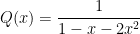
f(x) = \displaystyle \frac{1}{1-x-x^2},

factor the denominator by finding the two real roots of 1 - x - x^2 = 0, and then mimicking the above steps. If you want to cheat, just use the following Google search to find the answer: http://www.google.com/#q=fibonacci+%22generating+function%22

green lineI conclude this post with some pedagogical reflections. I taught this fun lecture to about 10 different Precalculus classes, and it was a big hit each time. I think that my students were thoroughly engaged with the topic and liked seeing an unorthodox application of the various topics in Precalculus that they were learning (sequences, series, partial fractions, factoring polynomials over \mathbb{R}, mathematical induction). So even though they would likely receive a fuller treatment of generating functions in a future course like Discrete Mathematics, I liked giving them this little hint of what was lying out there for them in the future.
I covered the content of this series of five posts in a 50-minute lecture. I’d usually finish the proof by induction as time expired and then would challenge them to think about how to similarly find the formula for the Fibonacci sequence. The rules of a “fun lecture” were important to pull this off — I made it clear that students would not have to do this for homework, so the pressure was off them to understand the fine details during the lecture. Instead, the idea was for them to appreciate the big picture of how topics in Precalculus can be used in future courses.

Fun lecture on geometric series (Part 4): The Fibonacci sequence

Every once in a while, I’ll give a “fun lecture” to my students. The rules of a “fun lecture” are that I talk about some advanced applications of classroom topics, but I won’t hold them responsible for these ideas on homework and on exams. In other words, they can just enjoy the lecture without being responsible for its content.

In this series of posts, I’m describing a fun lecture on generating functions that I’ve given to my Precalculus students. In the previous post, we looked at the famed Fibonacci sequence

1, 1, 2, 3, 5, 8, 13, 21, 34, 55, \dots

We also looked at that (slightly less famous) Quintanilla sequence

1, 1, 3, 5, 11, 21, 43, 85, \dots

which is defined so that each term is the sum of the previous term and twice the term that’s two back in the sequence. We also used the Bag of Tricks to find that the generating function is

Q(x) = \displaystyle \frac{1}{1-x-2x^2}

green lineTo get a closed-form definition of the Quintanilla sequence, let’s find the partial-fraction decomposition of Q(x). Notice that the denominator factors easily, so that

Q(x) = \displaystyle \frac{1}{(1+x)(1-2x)}

To find the partial fraction decomposition, we need to find the constants A and B so that

\displaystyle \frac{A}{1+x} + \frac{B}{1-2x} = \displaystyle \frac{1}{(1+x)(1-2x)},

or

A(1-2x) + B(1+x) = 1

Perhaps the easiest way of finding A and B is by substituting conveniently easy values of x.

  • If x = \displaystyle \frac{1}{2}, then we obtain \displaystyle \frac{3}{2} B = 1, or B = \displaystyle \frac{2}{3}.
  • If x = -1, then we obtain 3A =1, or A = \displaystyle \frac{1}{3}.

Therefore,

Q(x) = \displaystyle \frac{1}{3} \cdot \frac{1}{1+x} + \frac{2}{3} \cdot \frac{1}{1-2x}

green line

Finally, let’s write the rational functions on the right-hand side as infinite series. Using the formula for an infinite geometric series, we find

Q(x) = \displaystyle \frac{1}{3} \left(1 - x + x^2 - x^3 + x^4 - x^5 \dots \right) + \frac{2}{3} \left( 1 + 2x + 4x^2 + 8x^3 + 16x^4 + 32 x^5 \dots \right)

Notice that this matches the terms of the Quintanilla sequence! For example, the coefficient of the x^5 term is

\displaystyle -\frac{1}{3} + \frac{2}{3}(32) = \displaystyle \frac{63}{3} = 31,

which is a term of the Quintanilla sequence.

In general, the coefficient of the x^n term is

\displaystyle \frac{(-1)^n}{3} + \frac{2 \cdot 2^n}{3} = \displaystyle \frac{2^{n+1} + (-1)^n}{3}

This is the long-awaited closed-form expression for the Quintanilla sequence. For example, we quickly see that the 12th term is \displaystyle \frac{2^{13} + 1}{3} = 2731, which was obtained without knowing the 10th and 11th terms.

Fun lecture on geometric series (Part 3): The Fibonacci sequence

Every once in a while, I’ll give a “fun lecture” to my students. The rules of a “fun lecture” are that I talk about some advanced applications of classroom topics, but I won’t hold them responsible for these ideas on homework and on exams. In other words, they can just enjoy the lecture without being responsible for its content.

In the two previous posts, I introduced the idea of a generating function and then talked about its application to counting money. In this post, we’ll take on the famous Fibonacci sequence:

1, 1, 2, 3, 5, 8, 13, 21, 34, 55, \dots

The Fibonacci sequence starts with two 1s, and each subsequent term is defined as the sum of the two previous terms. Of course, the generating function for this sequence is

f(x) = 1 + x + 2x + 3x^2 + 5x^3 + 8x^4 + 13x^5 + 21x^6 + 34x^7 + 55x^8 + \dots

green lineSlightly less famous than the Fibonacci sequence is (ahem) the Quintanilla sequence. It also begins with two 1s, but each subsequent term is defined as the sum of the previous term and twice the term that’s two back in the sequence. So,

  • The first term is 1
  • The second term is 1
  • The third term is 2(1) + 1 = 3
  • The fourth term is 2(1) + 3 = 5
  • The fifth term is 2(3) + 5 = 11
  • The sixth term is 2(5) + 11 = 21
  • The seventh term is 2(11) + 21 = 43
  • The eighth term is 2(21) + 43 = 85

And so on. The generating function for the Quintanilla sequence is

Q(x) = 1 + x + 3x^2 + 5x^3 + 11x^4 + 21x^5 + 43x^6 + 85x^7 + \dots

Both the Fibonacci and the Quintanilla sequences are examples of recursively defined sequences: we need to know the previous terms in order to get the next term. The major disadvantage of a recursively defined sequence is that, in order to get the 100th term, we need to know the 99th and 98th terms. To get the 98th term, we need the 96th and 97th terms. And so on. There’s no easy way to just plug in 100 to get the answer.

When I mention this to students, they naturally start trying to figure it out on their own. Occasionally, a student will notice that each term is roughly double the previous term. With a little more time, they see that the even terms are one less than double the previous term, while the odd terms are one more than the previous term. That’s entirely correct. However, that’s another example of a recursively defined function. So if a student volunteers this, I’ll use this as an opportunity to note that it’s pretty easy to find a recursive definition for a function, but it’s a lot harder to come up with a closed-form definition.

In order to get a closed-form definition for the sequence — something that we could just plug in 100 and get the answer — we will need to use the generating functions f(x) and Q(x).

green lineTo simplify the infinite series Q(x), we pull something out of the patented Bag of Tricks. In case you’ve forgotten, Socrates gave the Bag of Tricks to Plato, Plato gave it to Aristotle, it passed down the generations, my teacher taught the Bag of Tricks to me, and I teach it to my students.

Here’s the trick: let’s rewrite Q(x) and also figure out -xQ(x) and also -2x^2 Q(x):

Q(x) = 1 + x + 3x^2 + 5x^3 + 11x^4 + 21x^5 + 43x^6 + 85x^7 + \dots

-xQ(x) = \, \, \, -x- x^2 - 3x^3 - 5x^4 -11x^5 - 21x^6 - 43x^7 - \dots

-2x^2Q(x) = \, \, \, \, \, \, -2x^2 -2 x^3 - 6x^4 - 10x^5 - 22x^6 - 42x^7 - \dots

Let’s now add the last three green equations together. Notice that everything on the right-hand cancels except for 1! Therefore,

[1 - x - 2x^2] Q(x) = 1

Q(x) = \displaystyle \frac{1}{1-x-2x^2}

The generating function for the Fibonacci sequence is similarly found. You can probably guess it since the Fibonacci sequence does not involve doubling a previous term.

It turns out that these generating functions can be used to find a closed-form definition for both the Quintanilla sequence and the Fibonacci sequence. More on this tomorrow.

Fun lecture on geometric series (Part 2): Ways of counting money

Every once in a while, I’ll give a “fun lecture” to my students. The rules of a “fun lecture” are that I talk about some advanced applications of classroom topics, but I won’t hold them responsible for these ideas on homework and on exams. In other words, they can just enjoy the lecture without being responsible for its content.

This series of posts describes a fun lecture that I’ve given to my Precalculus students after they’ve learned about partial fractions and geometric series.

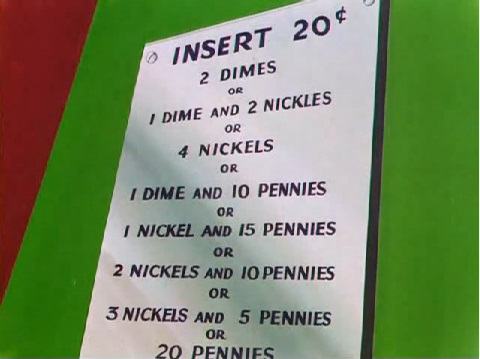
In the 1949 cartoon “Hare Do,” Bugs Bunny comes across the following sign when trying to buy candy (well, actually, a carrot) from a vending machine. The picture below can be seen at the 2:40 mark of this video: http://www.ulozto.net/live/xSG8zto/bugs-bunny-hare-do-1949-avi

BugsBunny20cents

How many ways are there of expressing 20 cents using pennies, nickels, dimes, and (though not applicable to this problem) quarters? Believe it or not, this is equivalent to the following very complicated multiplication problem:

\left[1 + x + x^2 + x^3 + x^4 + x^5 + \dots \right]

\times \left[1 + x^5 + x^{10} + x^{15} + x^{20} + x^{25} + \dots \right]

\times \left[1 + x^{10} + x^{20} + x^{30} + x^{40} + x^{50} + \dots \right]

\times \left[1 + x^{25} + x^{50} + x^{75} + x^{100} + x^{125} + \dots \right]

On the first line, the exponents are all multiples of 1. On the second line, the exponents are all multiples of 5. On the third line, the exponents are all multiples of 10. On the fourth line, the exponents are all multiples of 25.

How many ways are there of constructing a product of x^{20} from the product of these four infinite series? I offer a thought bubble if you’d like to think about it before seeing the answer.

green_speech_bubbleThere are actually 9 ways. We could choose 1 from the first, second, and fourth lines while choosing x^{20} from the third line. So,

1 \cdot 1 \cdot x^{20} \cdot 1 = x^{20}

There are 8 other ways. For each of these lines, the first term comes from the first infinite series, the second term comes from the second infinite series, and so on.

1 \cdot x^{10} \cdot x^{10} \cdot 1 = x^{20}

1 \cdot x^{20} \cdot 1 \cdot 1 = x^{20}

x^{10} \cdot 1 \cdot x^{10} \cdot 1 = x^{20}

x^5 \cdot x^{15} \cdot 1 \cdot 1 = x^{20}

x^{10} \cdot x^{10} \cdot 1 \cdot 1 = x^{20}

x^5 \cdot x^{15} \cdot 1 \cdot 1 = x^{20}

x^{20} \cdot 1 \cdot 1 \cdot 1 = x^{20}

x^5 \cdot x^5 \cdot x^{10} \cdot 1 = x^{20}

The nice thing is that each of these expressions is conceptually equivalent to a way of expressing 20 cents using pennies, nickels, dimes, and quarters. In each case, the value in parentheses matches an exponent.

  • 1 \cdot 1 \cdot x^{20} \cdot 1 = x^{20}: 2 dimes (20 cents).
  • 1 \cdot x^{10} \cdot x^{10} \cdot 1 = x^{20}: 2 nickels (10 cents) and 1 dime (10 cents)
  • 1 \cdot x^{20} \cdot 1 \cdot 1 = x^{20}: 4 nickels (20 cents)
  • x^{10} \cdot 1 \cdot x^{10} \cdot 1 = x^{20}: 10 pennies (10 cents) and 1 dime (10 cents)
  • x^{15} \cdot x^5 \cdot 1 \cdot 1 = x^{20}: 15 pennies (15 cents) and 1 nickel (5 cents)
  • x^{10} \cdot x^{10} \cdot 1 \cdot 1 = x^{20}: 10 pennies (10 cents) and 2 nickels (10 cents)
  • x^5 \cdot x^{15} \cdot 1 \cdot 1 = x^{20}: 5 pennies (5 cents) and 3 nickels (15 cents)
  • x^{20} \cdot 1 \cdot 1 \cdot 1 = x^{20}: 20 pennies (20 cents)
  • x^5 \cdot x^5 \cdot x^{10} \cdot 1 = x^{20}: 5 pennies (5 cents), 1 nickel (5 cents), and 1 dime (10 cents)

Notice that the last line didn’t appear in the Bugs Bunny cartoon.

green lineUsing the formula for an infinite geometric series (and assuming -1 < x < 1), we may write the infinite product as

f(x) = \displaystyle \frac{1}{(1-x)(1-x^5)(1-x^{10})(1-x^{25})}

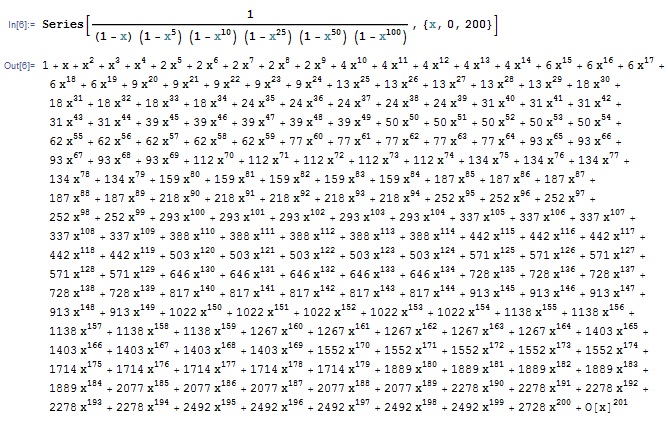
When written as an infinite series — that is, as a Taylor series about x =0 — the coefficients provide the number of ways of expressing that many cents using pennies, nickels, dimes and quarters. This Taylor series can be computed with Mathematica:

generating1Looking at the coefficient of x^{20}, we see that there are indeed 9 ways of expressing 20 cents with pennies, nickels, dimes, and quarters. We also see that there are 242 of expressing 1 dollar and 1463 ways of expressing 2 dollars.

The United States also has 50-cent coins and dollar coins, although they are rarely used in circulation. Our answers become slightly different if we permit the use of these larger coins:

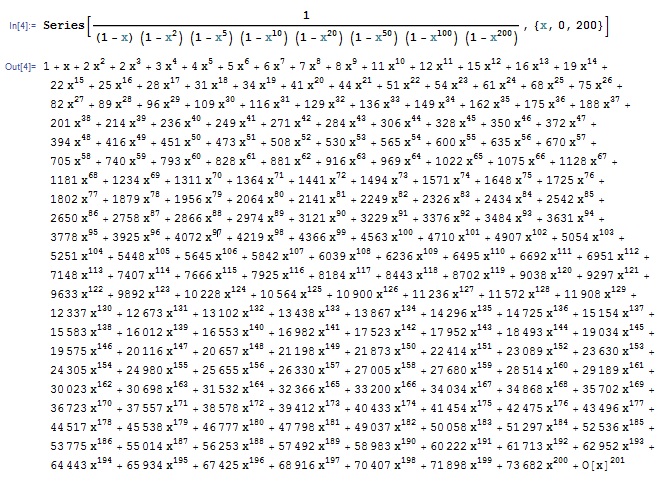
generating2Finally, just for the fun of it, the coins in the United Kingdom are worth 1 pence, 2 pence, 5 pence, 10 pence, 20 pence, 50 pence, 100 pence (1 pound), and 200 pence (2 pounds). With these different coins, there are 41 ways of expressing 20 pence, 4563 ways of expressing 1 pound, and 73,682 ways of expressing 2 pounds.

generating3

green line

For more discussion about this application of generating functions — including ways of determining the above coefficients without Mathematica — I’ll refer to the 1000+ results of the following Google search:

https://www.google.com/search?q=pennies+nickles+dimes+quarters+%22generating+function%22

FYI, previous posts on an infinite geometric series:

https://meangreenmath.com/2013/09/16/formula-for-an-infinite-geometric-series-part-9

https://meangreenmath.com/2013/09/17/formula-for-an-infinite-geometric-series-part-10

https://meangreenmath.com/2013/09/18/formula-for-an-infinite-geometric-series-part-11

Previous posts on Taylor series:

https://meangreenmath.com/2013/07/01/reminding-students-about-taylor-series-part-1/

https://meangreenmath.com/2013/07/02/reminding-students-about-taylor-series-part-2/

https://meangreenmath.com/2013/07/03/giving-students-a-refresher-about-taylor-series-part-3/

https://meangreenmath.com/2013/07/04/giving-students-a-refresher-about-taylor-series-part-4/

https://meangreenmath.com/2013/07/05/reminding-students-about-taylor-series-part-5/

https://meangreenmath.com/2013/07/06/reminding-students-about-taylor-series-part-6/

Fun lecture on geometric series (Part 1): Generating functions

Every once in a while, I’ll give a “fun lecture” to my students. The rules of a “fun lecture” are that I talk about some advanced applications of classroom topics, but I won’t hold them responsible for these ideas on homework and on exams. In other words, they can just enjoy the lecture without being responsible for its content.

This series of posts describes a 50-minute fun lecture — on the topic of generating functions — that I’ve given to my Precalculus students after they’ve learned about partial fractions and geometric series.

To launch the topic: In the 1949 cartoon “Hare Do,” Bugs Bunny comes across the following sign when trying to buy candy (well, actually, a carrot) from a vending machine. The picture below can be seen at the 2:40 mark of this video: http://www.ulozto.net/live/xSG8zto/bugs-bunny-hare-do-1949-avi

BugsBunny20cents

Notice that the price of candy from vending machines have increased somewhat since 1949. (Elsewhere in the cartoon, the price of a ticket to the movies was listed as 55 cents for adults, 20 cents for children, and 10 cents for rabbits.)

I wasn’t alive in 1949, but I vividly remember seeing this essentially mathematical problem while watching cartoons after school in the late 1970s. Now that I’m a little older — and can freeze-frame the above sign — I can see that the animators actually missed one way of expressing 20 cents. More on that later.

green line

Definition. The generating function of a sequence is defined to be an infinite series whose coefficients match the sequence.

Example #1. Consider the (boring) sequence 1, 1, 1, 1, \dots. The generating function for this sequence is

f(x) = 1 + 1x + 1x^2 + 1x^3 + \dots

If -1 < x < 1, then f(x) = \displaystyle \frac{1}{1-x}, using the formula for an infinite geometric series.

Example #2. For the slightly less boring sequence of 1, -1, 1, -1, \dots, the generating function is

f(x) = 1 - x + x^2 - x^3 + \dots,

which (if -1 < x < 1) is f(x) = \displaystyle \frac{1}{1+x}.

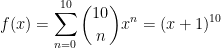
Example #3. Suppose a_n = \displaystyle {10 \choose n} if $0 \le n \le 10$ and a_n = 0 for n>10. Then the generating function is

f(x) = \displaystyle \sum_{n=0}^{10} {10 \choose n} x^n = (x+1)^{10}.

It turns out that the above problem from the Bugs Bunny cartoon can be viewed as a generating function. Let a_n denote the number of ways that n cents can be formed using pennies, nickels, dimes, and quarters? The Bugs Bunny cartoon is related to the value of a_{20}. What about one dollar? Two dollars? I’ll provide the answer in tomorrow’s post.
green line

FYI, previous posts on an infinite geometric series:

https://meangreenmath.com/2013/09/16/formula-for-an-infinite-geometric-series-part-9

https://meangreenmath.com/2013/09/17/formula-for-an-infinite-geometric-series-part-10

https://meangreenmath.com/2013/09/18/formula-for-an-infinite-geometric-series-part-11

Engaging students: Dividing fractions

In my capstone class for future secondary math teachers, I ask my students to come up with ideas for engaging their students with different topics in the secondary mathematics curriculum. In other words, the point of the assignment was not to devise a full-blown lesson plan on this topic. Instead, I asked my students to think about three different ways of getting their students interested in the topic in the first place.

I plan to share some of the best of these ideas on this blog (after asking my students’ permission, of course).

This student submission comes from my former student Dale Montgomery. His topic, from Pre-Algebra: dividing fractions.

green line

Applications

A Short Play On Numbers

By: Dale Montgomery

You see two brothers talking in the playground.

Timmy: (little brother) Gee Jonny, it sure was a good idea to sell Joe our old Pokémon deck. Now he finally has some cards to play with and we have some money to buy some new cards.

Jonny: (older brother) Yeah, I am glad we could help him get started. He has been wanting some cards for so long. Ok, you have the money so give me half.

Timmy: Ummm… (puzzling) Jonny I don’t know how to make half of 6 dollars and fifty cents, can you help?

Jonny: Of course Timmy, I learned how to divide fractions last week… lets see. (Jonny writes on the board 6 and ½ divided by 1/2 and does the division)

Timmy: How is half more than what we started with?

Jonny: I don’t know, this is the way my teacher taught me to do it. I guess you just have to find 13 dollars to give me so I can have half.

End Scene

Teacher: So class, what did Jonny do?

I came up with this idea thinking about the student asked question regarding dividing pie in half. I feel this could be a common misconception that would be addressed if we could teach students to think about math in context, rather than just a process. Dividing fractions is not the easiest thing to conceive. This short skit could be presented in any number of formats. I like the idea of having some sort of recorded show, just because it would make the intro to class go much faster. This skit introduces a situation that is very similar to word problems that children do. Also, the content can easily be modified to fit the majority class interest. For example it could have been an old Nintendo DS game that the brothers no longer play. This puts a problem that could be very real for the students right in front of them to figure out the correct process. It could lead to good discussion and make for a good lesson on dividing fractions.


green line

Manipulative

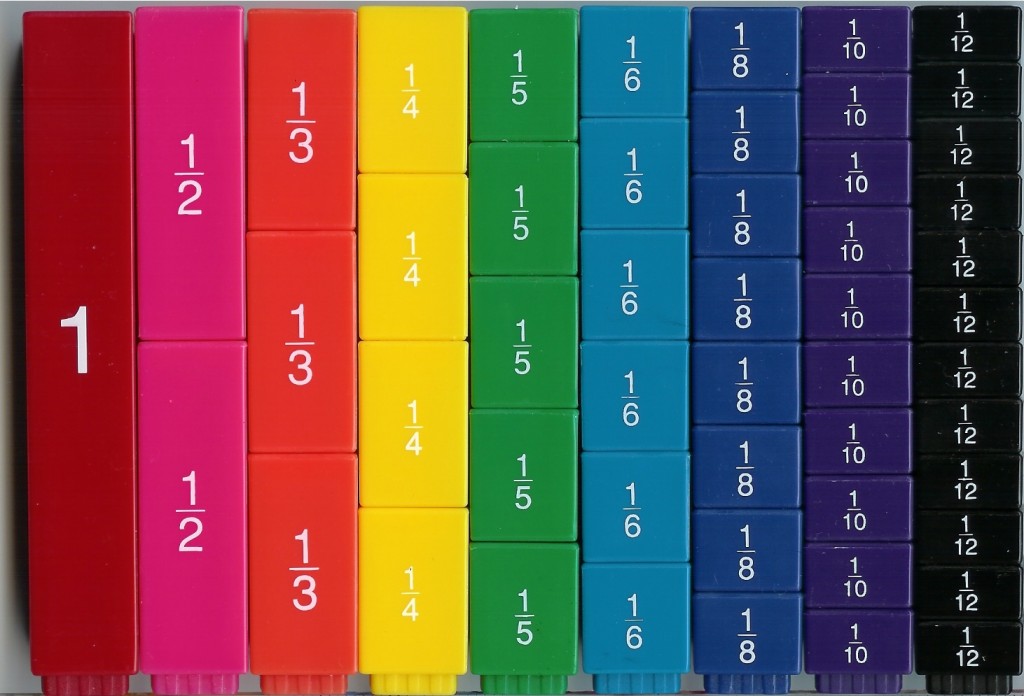
Fraction bars are great tools to help students visualize dividing fractions. For example, if you wanted to divide 2/3 by 1/6 you would line up two of the third bars alongside one of the sixth bar and find out how many times that fraction goes into 2 thirds. In this case it would be four. Fractions themselves are extremely difficult to visualize, and dividing by fractions seems conceptually ridiculous.  It can be difficult to adjust student’s thinking to this area. A manipulative like fraction bars are a good starting point in helping kids understand just how fractions work.

FractionBars


green line

Curriculum, future uses

The topic of dividing fractions has many uses in future courses. Primarily these will be in algebra 1 and 2 for most students. Having a good conceptual knowledge of fractions will help students tremendously in these courses. As an algebra student you would be required to use your knowledge of fractions on an almost daily basis. Being introduced to the concept of multiple variables and canceling them out as you divide polynomials is a very complicated process that gets even more complicated if you do not understand fractions. Laying this conceptual framework is important when you consider all that students must use these concepts for at the higher level math classes. As you consider this in the lessons don’t forget the previous concepts held here such as grouping into equal parts and counting by intervals (3,6,9).


Why do we still require students to rationalize denominators?

Which answer is simplified: \displaystyle \frac{1}{2 \sqrt{2}} or \displaystyle \frac{ \sqrt{2} }{4}? From example, here’s a simple problem from trigonometry:

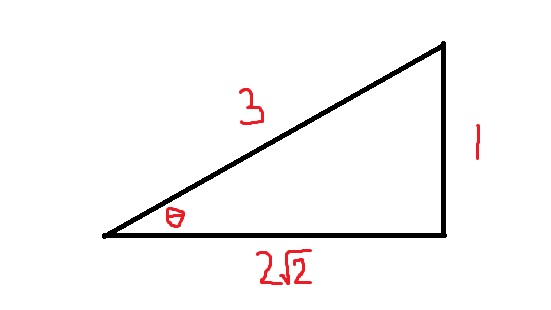
Suppose \theta is an acute angle so that \sin \theta = \displaystyle \frac{1}{3}. Find \tan \theta.

triangle13

To solve, we make a right triangle whose side opposite of \theta has length 1 and hypotenuse with length 3. The adjacent side has length \sqrt{3^2 - 1^2} = \sqrt{8} = 2\sqrt{2}. Therefore,

\tan \theta = \displaystyle \frac{ \hbox{Opposite} }{ \hbox{Adjacent} } = \displaystyle \frac{1}{2 \sqrt{2}}

This is the correct answer, and it could be plugged into a calculator to obtain a decimal approximation. However, in my experience, it seems that most students are taught that this answer is not yet simplified, and that they must rationalize the denominator to get the “correct” answer:

\tan \theta = \displaystyle \frac{1}{2 \sqrt{2}} \cdot \frac{ \sqrt{2} }{ \sqrt{2} } = \displaystyle \frac{ \sqrt{2} }{4}

Of course, this is equivalent to the first answer. So my question is philosophical: why are students taught that the first answer isn’t simplified but the second is? Stated another way, why is a square root in the numerator so much more preferable than a square root in the denominator?

Feel free to correct me if I’m wrong, but it seems to me that rationalizing denominators is a vestige of an era before cheap pocket calculators. Let’s go back in time to an era before pocket calculators… say, 1927, when The Jazz Singer was just released and stars of silent films, like Don Lockwood, were trying to figure out how to act in a talking movie.

Before cheap pocket calculators, how would someone find \displaystyle \frac{1}{2 \sqrt{2}} ~~ or ~~ \displaystyle \frac{ \sqrt{2} }{4} to nine decimal places? Clearly, the first step is finding \sqrt{2} by hand, which I discussed in a previous post. So these expressions reduce to

\displaystyle \frac{1}{2 (1.41421356\dots)} or \displaystyle \frac{1.41421356\dots}{4}

Next comes the step of dividing. If you don’t have a calculator and had to use long division, which would rather do: divide by 4 or divide by 2.82842712\dots?

Clearly, long division with 4 is easier.

It seems to me that ease of computation was the reason that rationalizing denominators was required of students in previous generations. So I’m a little bemused why rationalizing denominators is still required of students now that cheap calculators are so prevalent.

Lest I be misunderstood, I absolutely believe that all students should be able to convert \displaystyle \frac{1}{2 \sqrt{2}} into \displaystyle \frac{ \sqrt{2} }{4}. But I see no compelling reason why the “simplified” answer to the above trigonometry problem should be the second answer and not the first.

Engaging students: Mathematical induction

In my capstone class for future secondary math teachers, I ask my students to come up with ideas for engaging their students with different topics in the secondary mathematics curriculum. In other words, the point of the assignment was not to devise a full-blown lesson plan on this topic. Instead, I asked my students to think about three different ways of getting their students interested in the topic in the first place.

I plan to share some of the best of these ideas on this blog (after asking my students’ permission, of course).

This student submission comes from my former student Dale Montgomery. His topic, from Precalculus: mathematical induction.

green line

Technology

https://www.khanacademy.org/math/trigonometry/seq_induction/proof_by_induction/v/proof-by-induction

Looking at Khanacademy’s video on mathematical induction, I feel like he has one of the better explanations of mathematical induction that I have heard. This lends itself well to starting class off with a video to engage, and then moving on to an explore where the students test what can or can’t be proved by induction. This quick explanation by Khan gives a good starting point, and the fact that his videos are interesting should be sufficient enough to engage the students. Another possibility is to have the students watch this at home, that way you have more time during class do work on learning how to use the principle of induction.

green line

Application

This problem, and proof (taken from Wikipedia) has flawed logic. In it, it uses the principle of mathematical induction. This would be a good engage because it has supposedly sound logic but it says something that is obviously not true. This will engage the students by showing them something that doesn’t make sense. This will cause a imbalance in their thinking, and make them want to make sense of the situation. I would probably present it as a bell ringer or similar problem, after induction has been introduced.

All horses are the same color

The argument is proof by induction. First we establish a base case for one horse (n = 1). We then prove that if n horses have the same color, then n+1  horses must also have the same color.

Base case: One horse

The case with just one horse is trivial. If there is only one horse in the “group”, then clearly all horses in that group have the same color.

Inductive step

Assume that n  horses always are the same color. Let us consider a group consisting of n+1 horses.

First, exclude the last horse and look only at the first  horses; all these are the same color since  horses always are the same color. Likewise, exclude the first horse and look only at the last  horses. These too, must also be of the same color. Therefore, the first horse in the group is of the same color as the horses in the middle, who in turn are of the same color as the last horse. Hence the first horse, middle horses, and last horse are all of the same color, and we have proven that:

  • If n horses have the same color, then n+1  horses will also have the same color.

We already saw in the base case that the rule (“all horses have the same color”) was valid for n=1 . The inductive step showed that since the rule is valid for n=1 , it must also be valid for n=2 , which in turn implies that the rule is valid for n=3 and so on.

Thus in any group of horses, all horses must be the same color.

(taken from http://en.wikipedia.org/wiki/All_horses_are_the_same_color )

The explanation relies on the fact that a set of a single element cannot have 2 different sets with the same element. Because this assumption cannot be made, the case of n=2 falls apart and tears the argument apart.


green line

Application

Dominoes have been talked about as a way to explain mathematical induction. The idea that if you can prove that the first one falls, and you can prove that in general if a domino falls, the one after it will fall, you can prove that the entire row of dominoes would fall. I think it would be fun to students to actually demonstrate this idea. It would even be fun to illustrate what would happen if you cannot prove that the first one falls by gluing the dominoes to whatever surface that you are using (not the table).

The idea would be to have it set up as the students walked in and ask them what would happen if you pushed over the first domino. After that test the hypothesis with one row (you should probably have multiple rows set up for this). Then introduce the concepts of base case and induction step using the dominos. Then you can ask well what if we cannot push the first domino over, does that mean we cannot show that all of the dominos will fall? After this you can start taking the concept of dominos and applying it to Mathematical induction.

dominoes