Engaging students: Computing trigonometric functions

In my capstone class for future secondary math teachers, I ask my students to come up with ideas for engaging their students with different topics in the secondary mathematics curriculum. In other words, the point of the assignment was not to devise a full-blown lesson plan on this topic. Instead, I asked my students to think about three different ways of getting their students interested in the topic in the first place.

I plan to share some of the best of these ideas on this blog (after asking my students’ permission, of course).

This student submission comes from my former student Nataly Arias. Her topic, from Precalculus: computing trigonometric functions.

green line

How has this topic appeared in pop culture (movies, TV, current music, video games, etc.)?


Trigonometry does not only relate to mathematics, trigonometry is also used in real life. Many people don’t know that trigonometry is involved in video games. In game development, there are many situations where you will need to use trig functions. Video games are full of triangles. For example in order to calculate the direction the player is heading you will form a triangle and use sine, cosine, or tangent to solve. The trig function used depends on the values given. For example if the opposite and adjacent values are given (the xSpeed and ySpeed), the function you will need to calculate the direction of the player is tangent. This is represented by the equation Tan( Dir ) = xSpeed /ySpeed. Again, by applying the inverted function of tan to both sides of the equal sign, we get an equation that will return the player’s direction. In a spaceship game you will need to use trigonometric functions to have one ship shoot a laser in the direction of the other ship, play a warning sound effect if an enemy ship is getting too close, or have one ship start moving in the direction of another ship to chase. Trig is used in several situations in video games some more examples include calculating a new trajectory after a collision between two objects such as billiard balls, rotating a spaceship or other vehicle, properly handling the trajectory of projectiles shot from a rotated weapon, and determining if a collision between two objects is happening.


green line

How has this topic appeared in high culture (art, classical music, theatre, etc.)?


The “unit circle” is a circle with a radius of 1 that is centered at the origin in the Cartesian coordinate system in the Euclidean plane. Because the radius is 1 we can directly measure sine, cosine, and tangent. The unit circle has made parts of mathematics easier and neater. The concepts of the unit circle go far back into the past. Not only do we use and see circles in mathematics we also can see circles in art form. We can also use trigonometric functions to determine the best position to view a painting hanging on an art gallery wall. For example you can determine the angle between a person’s eye and the top and base of the painting when a person is standing 1m away, 2 m away, 3 m away and so on. By comparing your data you can estimate the best position for a person to stand in front of the painting. Also using trig functions and your handy calculator you can develop a formula that describes the relationship between the distance away from the painting and the angle that exists between the person’s eye and the top and bottom of the painting.


green line

How have different cultures throughout time used this topic in their society?


Today the unit circle is used as a helpful tool to help calculate trig functions. Trig functions are taught in trigonometry, pre-calculus and are frequently used in advanced math classes. Many people don’t realize that not only are trig functions learned and used in school but throughout time several cultures have used trig functions in their society. The main application of trigonometry in past cultures was in astronomy. In 1900 BC the Babylonians kept details of stars, the motion of planets, and solar eclipses by using angular distance measured on the celestial sphere. In 1680-1620 BC the Egyptians used ancient forms of trigonometry for building pyramids. The idea of dividing a circle into 360 equal pieces goes back to the sexagesimal counting system of the ancient Sumerians. Early astronomical calculations wedded the sexagesimal system to circles and the rest is history. Today in trigonometry the unit circle has a radius of 1 unlike the Greek, Indian, Arabic, and early Europeans who used a circle of some other convenient radius. In today’s society trigonometry is everywhere. The mathematics used behind trigonometry is the same mathematics that allows us to store sound waves digitally onto a CD. We use it without even knowing it. When we plug something into the wall there is trigonometry involved. The sine and cosine wave are the waves that are running through the electrical circuit known as alternating current.


References


http://www.math.ucdenver.edu/~jloats/Student%20pdfs/40_Trigonometry_Trenkamp.pdf


http://www.math.dartmouth.edu/~matc/math5.geometry/unit9/unit9.html


http://en.wikipedia.org/wiki/Trigonometric_functions


http://aleph0.clarku.edu/~djoyce/ma105/trighist.html


http://www.slideshare.net/mgeis784/building-the-unit-circle


http://www.softlion.nl/download/article/Trigonometry.pdf


http://www.raywenderlich.com/35866/trigonometry-for-game-programming-part-1


http://stackoverflow.com/questions/3946892/trigonometry-and-game-development


Engaging students: Verifying trigonometric identities

In my capstone class for future secondary math teachers, I ask my students to come up with ideas for engaging their students with different topics in the secondary mathematics curriculum. In other words, the point of the assignment was not to devise a full-blown lesson plan on this topic. Instead, I asked my students to think about three different ways of getting their students interested in the topic in the first place.

I plan to share some of the best of these ideas on this blog (after asking my students’ permission, of course).

This student submission comes from my former student Michelle McKay. Her topic, from Precalculus: verifying trigonometric identities.

green line

How could you as a teacher create an activity or project that involves your topic?

polar3

Engaging students with trigonometric identities may seem daunting, but I believe the key to success for this unit lies within allowing students to make the discovery of the identities themselves.

For this particular activity, I will focus on some trigonometric identities that can be derived using the Pythagorean Theorem. Before beginning this activity, students must already know about the basic trig functions (sine, cosine, and tangent) along with their corresponding reciprocals (cosecant, secant, and cotangent).

Using this diagram (or a similar one), have students write out the relationship between all sides using the Pythagorean Theorem.
Students should all come to the conclusion of: x2 + y2 = r2.

For higher leveled students, you may want to remind them of the adage SohCahToa, with emphasis on sine and cosine for this next part. You might ask, “How can we rearrange the above equation into something remotely similar to a trigonometric function?”

Ultimately, we want students to divide each side by r2. This will give us:

Again, SohCahToa. Students, perhaps with some leading questions, should see that we can substitute sine and cosine functions into the above equation, giving us the identity:

cos2θ + sin2θ = 1

From this newly derived identity, students can then go on to find tan2θ + 1 = sec2θand then 1 + cot2θ = csc2θ.


green line

How can technology be used to effectively engage students with this topic?

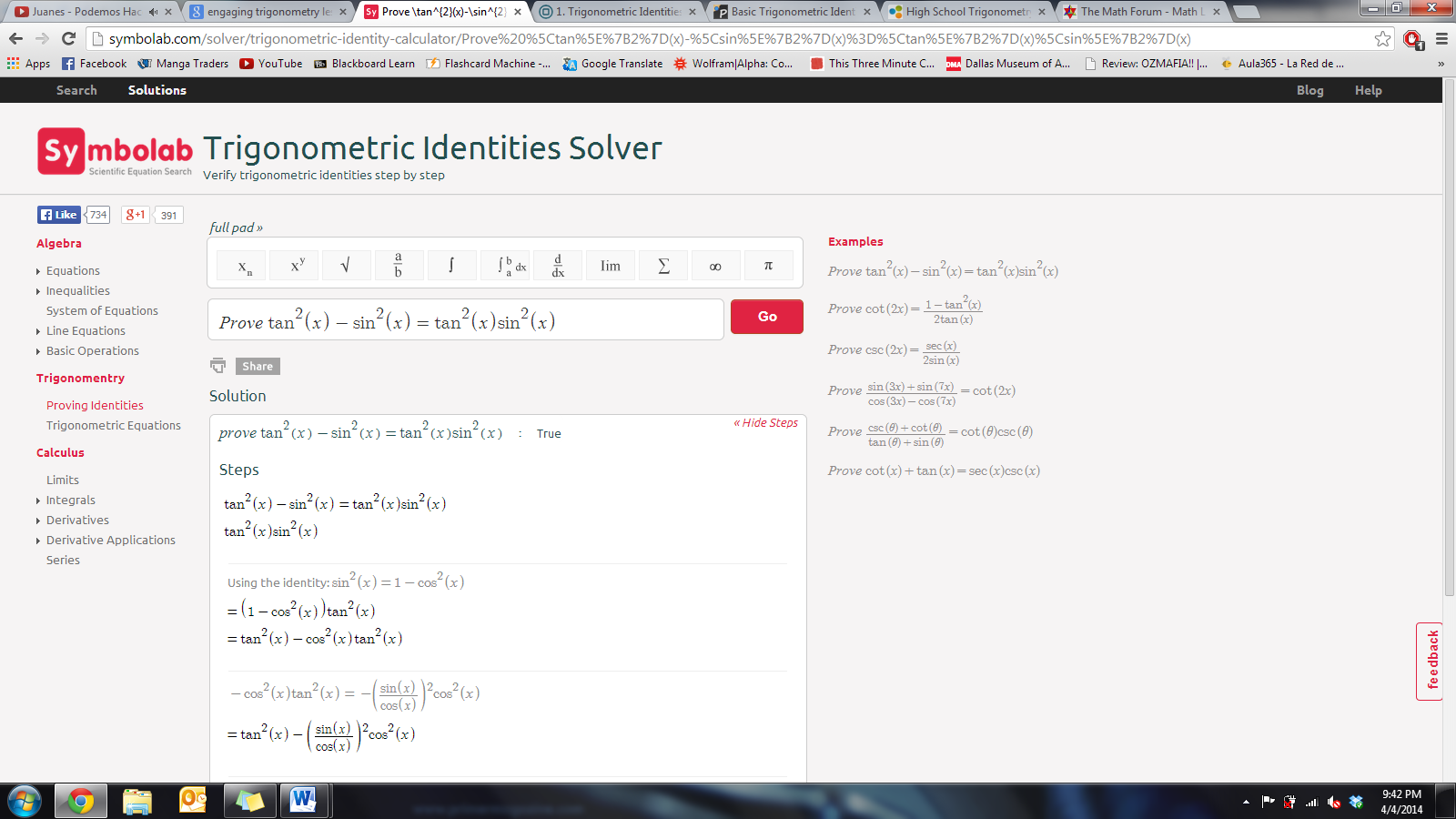
For engaging the students and encouraging them to play around with identities, I find the Trigonometric Identities Solver by Symbolab to be a fabulous technological supplement. Students can enter in identities that they may need more help understanding and this website will state whether the identity is true or not, and then provide detailed steps on how to derive the identity.
A rather fun activity that may utilize this site is to challenge the students to come up with their own elaborate trigonometric identity.

SymbolLab

Another online tool students can explore is the interactive graph from http://www.intmath.com. In fact, students could also use this right after they derive the identities from the earlier activity. This site does a wonderful job at providing a visual representation of the trigonometric functions’ relationships to one another. It also allows the students to explore the functions using concrete numbers, rather than the general Ө. Although this site only shows the cos2θ + sin2θ = 1identity in action, it would not be difficult for students to plug in the data from this graph to numerically verify the other identities.

trig1


green line

What are the contributions of various cultures to this topic?


The beginning of trigonometry began with the intention of keeping track of time and the quickly expanding interest in the study of astronomy. As each civilization inherited old discoveries from their predecessors, they added more to the field of trigonometry to better explain the world around them. The below table is a very brief compilation of some defining moments in trigonometry’s history. It is by no means complete, but was created with the intention to capture the essence of each civilization’s biggest contributions.


Civilization People of Interest Contributions
Egyptians
  • Ahmes
– Earliest ideas of angles.- The Egyptian seked was the cotangent of an angle at the base of a building.
Babylonians – Division of the circle into 360 degrees.- Detailed records of moving celestial bodies (which, when mapped out, resembled a sine or cosine curve).- May have had the first table of secants.
Greek
  • Aristarchus
  • Menelaus
  • Hippocharus
  • Ptolemy
– Chords.- Trigonometric proofs presented in a geometric way.- First widely recognized trigonometric table: Corresponding values of arcs and chords.- Equivalent of the half-angle formula.
Indian
  • Aryabhata
  • Bhaskara I
  • Bhaskara II
  • Brahmagupta
  • Madhava
– Sine and cosine series.- Formula for the sine of an acute angle.- Spherical trigonometry.- Defined modern sine, cosine, versine, and inverse sine.
Islamic
  • Muhammad ibn Mūsā al-Khwārizmī
  • Muhammad ibn Jābir al-Harrānī al-Battānī
  •  Abū al-Wafā’ al-Būzjānī
–          – First accurate sine and cosine tables.-          – First table for tangent values.-          – Discovery of reciprocal functions (secant and cosecant).-          – Law of Sines for spherical trigonometry.-          – Angle addition in trigonometric functions.
Germans – “Modern trigonometry” was born by defining trigonometry functions as ratios rather than lengths of lines.


It is interesting to note that while the Chinese were making many advances in other fields of mathematics, there was not a large appreciation for trigonometry until long after they approached the study and other civilizations had made significant contributions.


Sources

  1. http://www.intmath.com/analytic-trigonometry/1-trigonometric-identities.php
  2. http://www.intmath.com/analytic-trigonometry/trig-ratios-interactive.php
  3. http://symbolab.com/solver
  4. http://www.trigonometry-help.net/history-of-trigonometry.php
  5. http://nrich.maths.org/6843&part=
  6. http://www.scribd.com/doc/33216837/The-History-of-Trigonometry-and-of-Trigonometric-Functions-May-Span-Nearly-4
  7. http://www.britannica.com/EBchecked/topic/605281/trigonometry/12231/History-of-trigonometry

2048 and algebra: Index

I’m doing something that I should have done a long time ago: collect past series of posts into a single, easy-to-reference post. The following posts formed my series on using algebra to study the 2048 game… with a special focus on reaching the event horizon of 2048 which cannot be surpassed.

2048-0Part 1: Introduction and statement of problem

Part 2: First insight: How points are accumulated in 2048

Part 3: Second insight: The sum of the tiles on the board

Part 4: Algebraic formulation of the two insights

Part 5: Algebraic formulation applied to a more complicated board

Part 6: Algebraic formulation applied to the event horizon of 2048

Part 7: Calculating one of the complicated sums in Part 6 using a finite geometric series

Part 8: Calculating another complicated sum in Part 6 using a finite geometric series

Part 9: Repeating Part 8 by reversing the order of summation in a double sum

Part 10: Estimating the probability of reaching the event horizon in game mode


2048 and algebra (Part 9)

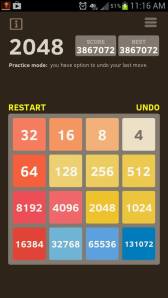
In this series of posts, I consider how algebra can be used to answer a question about the 2048 game: From looking at a screenshot of the final board, can I figure out how many moves were needed to reach the final board? Can I calculate how many new 2-tiles and 4-tiles were introduced to the board throughout the course of this game? In this post, we consider the event horizon of 2048, which I reached after about four weeks of intermittent doodling:

2048-0

In yesterday’s post, we developed a system of two equations in two unknowns to solve for t and f, the number of 2-tiles and 4-tiles (respectively) that appeared throughout the course of the game:

2t + 4f = \displaystyle \sum_{n=2}^{17} 2^n.

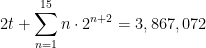
2t + \displaystyle \sum_{n=1}^{15} n \cdot 2^{n+2} = 3,867,072

In this post and tomorrow’s post, I consider how the two sums in the above equations can be obtained without directly adding the terms.

In yesterday’s post, we used the formula for the sum of a finite geometric series to calculate the second sum:

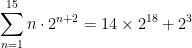
\displaystyle \sum_{n=1}^{15} n \cdot 2^{n+2} = 14 \times 2^{18} + 2^3 = 3,670,024

In this post, I perform this calculation again, except symbolically and more compactly. The key initial steps are writing the series as a double sum and then interchanging the order of summation (much like reversing the order of integration in a double integral). This is a trick that I’ve used again and again in my own research efforts, but it seems that the students that I teach have never learned this trick. Here we go:

\displaystyle \sum_{n=1}^{15} n \cdot 2^{n+2} = \displaystyle \sum_{n=1}^{15} \sum_{k=1}^n 2^{n+2} = \displaystyle \sum_{k=1}^{15} \sum_{n=k}^{15} 2^{n+2}

The inner sum is a finite geometric series with 15-k+1 terms, common ratio of 2, and initial term 2^{k+2}. Therefore,

\displaystyle \sum_{n=1}^{15} n \cdot 2^{n+2} = \displaystyle \sum_{k=1}^{15} \frac{ 2^{k+2} \left(1 - 2^{15-k+1} \right) }{1 - 2}

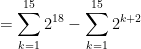
= \displaystyle \sum_{k=1}^{15} \left(2^{18} - 2^{k+2} \right)

= \displaystyle \sum_{k=1}^{15} 2^{18} -\sum_{k=1}^{15} 2^{k+2}

 The first sum is merely the sum of a constant. The second sum is another finite geometric series with 15 terms, common ratio of 2, and initial term 2^3. So

\displaystyle \sum_{n=1}^{15} n \cdot 2^{n+2} = 15 \times 2^{18} - \displaystyle \frac{ 2^3 \left(1 - 2^{15} \right) }{1 - 2}

\displaystyle \sum_{n=1}^{15} n \cdot 2^{n+2} = 15 \times 2^{18} - \left( 2^{18} - 2^3 \right)

\displaystyle \sum_{n=1}^{15} n \cdot 2^{n+2} = 14 \times 2^{18} + 2^3

\displaystyle \sum_{n=1}^{15} n \cdot 2^{n+2} = 3,670,024

2048 and algebra (Part 8)

In this series of posts, I consider how algebra can be used to answer a question about the 2048 game: From looking at a screenshot of the final board, can I figure out how many moves were needed to reach the final board? Can I calculate how many new 2-tiles and 4-tiles were introduced to the board throughout the course of this game? In this post, we consider the event horizon of 2048, which I reached after about four weeks of intermittent doodling:

2048-0

In yesterday’s post, we developed a system of two equations in two unknowns to solve for t and f, the number of 2-tiles and 4-tiles (respectively) that appeared throughout the course of the game:

2t + 4f = \displaystyle \sum_{n=2}^{17} 2^n.

2t + \displaystyle \sum_{n=1}^{15} n \cdot 2^{n+2} = 3,867,072

In this post and tomorrow’s post, I consider how the two sums in the above equations can be obtained without directly adding the terms.

In yesterday’s post, we showed that the formula for the sum of a finite geometric series can be used to calculate the first sum:

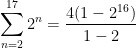
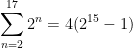
\displaystyle \sum_{n=2}^{17} 2^n = \displaystyle \frac{4(1-2^{16})}{1-2} = 4(2^{15} - 1) = 262,140

Let’s now consider the second (and more complicated) sum, which can be written as

2^3 + 2 \cdot 2^4 + 3 \cdot 2^5 + \cdot + 15 \cdot 2^{17}

For reasons that will become clear shortly, this sum can be written in expanded form as

2^3

+ 2^4 + 2^4

+ 2^5 + 2^5 + 2^5

\vdots

+ 2^{17} + 2^{17} + 2^{17} + \dots + 2^{17}

 Let’s now rearrange the terms of this sum. We will do this by adding along the diagonals instead of along the rows. In this way, the above sum can be rearranged as

2^3 + 2^4 + 2^5 + \dots + 2^{17}

+ 2^4 + 2^5 + \dots + 2^{17}

+ 2^5 + \dots + 2^{17}

\vdots

+ 2^{17}

Each of these new rows (or the original diagonals) is a geometric series and can be calculated using the formula:

2^3 + 2^4 + 2^5 + \dots + 2^{17} = \displaystyle \frac{2^3 (1-2^{15})}{1-2} = 2^{18} - 2^3

2^4 + 2^5 + \dots + 2^{17} = \displaystyle \frac{2^4 (1-2^{14})}{1-2} = 2^{18} - 2^4

2^5 + \dots + 2^{17} = \displaystyle \frac{2^5 (1-2^{13})}{1-2} = 2^{18} - 2^5

\vdots

2^{17} = (2-1) \cdot 2^{17} = 2^{18} - 2^{17}

So, thus far in the calculation, we have established that

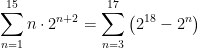
\displaystyle \sum_{n=1}^{15} n \cdot 2^{n+2} = \displaystyle \sum_{n=3}^{17} \left( 2^{18} - 2^n \right).

Simplifying,

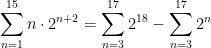
\displaystyle \sum_{n=1}^{15} n \cdot 2^{n+2}=\displaystyle \sum_{n=3}^{17} 2^{18} - \sum_{n=3}^{17} 2^n

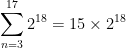
The first sum on the right is the sum of a constant being added to itself 15 times:

\displaystyle \sum_{n=3}^{17} 2^{18} = 15 \times 2^{18}

The second sum on the right is yet another geometric series. Indeed, it’s the same geometric  series from the first diagonal above:

\sum_{n=3}^{17} 2^n = \displaystyle \frac{2^3 (1-2^{15})}{1-2} = 2^{18} - 2^3

Therefore,

\displaystyle \sum_{n=1}^{15} n \cdot 2^{n+2} = 15 \times 2^{18} - \left(2^{18} - 2^3 \right)

\displaystyle \sum_{n=1}^{15} n \cdot 2^{n+2} = 14 \times 2^{18} + 2^3

\displaystyle \sum_{n=1}^{15} n \cdot 2^{n+2} = 3,670,024

Not surprisingly, this matches the sum that was found via direct addition.

2048 and algebra (Part 7)

In this series of posts, I consider how algebra can be used to answer a question about the 2048 game: From looking at a screenshot of the final board, can I figure out how many moves were needed to reach the final board? Can I calculate how many new 2-tiles and 4-tiles were introduced to the board throughout the course of this game? In this post, we consider the event horizon of 2048, which I reached after about four weeks of intermittent doodling:

2048-0

In yesterday’s post, we developed a system of two equations in two unknowns to solve for t and f, the number of 2-tiles and 4-tiles (respectively) that appeared throughout the course of the game:

2t + 4f = \displaystyle \sum_{n=2}^{17} 2^n.

2t + \displaystyle \sum_{n=1}^{15} n \cdot 2^{n+2} = 3,867,072

In this post and tomorrow’s post, I consider how the two sums in the above equations can be obtained without directly adding the terms.

The first sum is certainly the easiest to handle, as it requires the sum of a finite geometric series:

a + ar + ar^2 + \dots + a r^{n-1} = \displaystyle \sum_{i=1}^n a r^{i-1} = \displaystyle \frac{a(1-r^n)}{1-r}

For the geometric series

\displaystyle \sum_{n=2}^{17} 2^n,

there are 16 terms (after all, there are 16 tiles on the board). The first term is 4, and the common ratio is 2. Therefore,

\displaystyle \sum_{n=2}^{17} 2^n = \displaystyle \frac{4(1-2^{16})}{1-2}

\displaystyle \sum_{n=2}^{17} 2^n = 4(2^{15} - 1)

\displaystyle \sum_{n=2}^{17} 2^n = 262,140

We’ll consider the more complicated sum in tomorrow’s post.


Inverse Functions: Logarithms and Complex Numbers (Part 30)

Ordinarily, there are no great difficulties with logarithms as we’ve seen with the inverse trigonometric functions. That’s because the graph of y = a^x satisfies the horizontal line test for any 0 < a < 1 or a > 1. For example,

e^x = 5 \Longrightarrow x = \ln 5,

and we don’t have to worry about “other” solutions.

However, this goes out the window if we consider logarithms with complex numbers. Recall that the trigonometric form of a complex number z = a+bi is

z = r(\cos \theta + i \sin \theta) = r e^{i \theta}

where r = |z| = \sqrt{a^2 + b^2} and \tan \theta = b/a, with \theta in the appropriate quadrant. This is analogous to converting from rectangular coordinates to polar coordinates.

Over the past few posts, we developed the following theorem for computing e^z in the case that z is a complex number.

Definition. Let z = r e^{i \theta} be a complex number so that -\pi < \theta \le \theta. Then we define

\log z = \ln r + i \theta.

Of course, this looks like what the definition ought to be if one formally applies the Laws of Logarithms to r e^{i \theta}. However, this complex logarithm doesn’t always work the way you’d think it work. For example,

\log \left(e^{2 \pi i} \right) = \log (\cos 2\pi + i \sin 2\pi) = \log 1 = \ln 1 = 0 \ne 2\pi i.

This is analogous to another situation when an inverse function is defined using a restricted domain, like

\sqrt{ (-3)^2 } = \sqrt{9} = 3 \ne -3

or

\sin^{-1} (\sin \pi) = \sin^{-1} 0 = 0 \ne \pi.

The Laws of Logarithms also may not work when nonpositive numbers are used. For example,

\log \left[ (-1) \cdot (-1) \right] = \log 1 = 0,

but

\log(-1) + \log(-1) = \log \left( e^{\pi i} \right) + \log \left( e^{\pi i} \right) = \pi i + \pi i = 2\pi i.

green line

This material appeared in my previous series concerning calculators and complex numbers: https://meangreenmath.com/2014/07/09/calculators-and-complex-numbers-part-21/


Inverse Functions: Arcsecant (Part 29)

We now turn to a little-taught and perhaps controversial inverse function: arcsecant. As we’ve seen throughout this series, the domain of this inverse function must be chosen so that the graph of y = \sec x satisfies the horizontal line test. It turns out that the choice of domain has surprising consequences that are almost unforeseeable using only the tools of Precalculus.

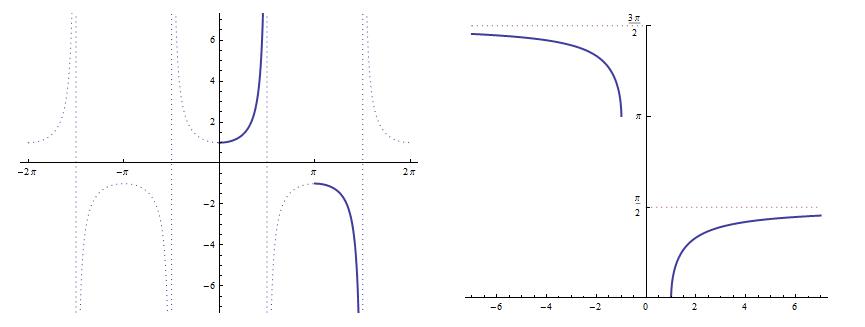
The standard definition of y = \sec^{-1} x uses the interval [0,\pi] — or, more precisely, [0,\pi/2) \cup (\pi/2, \pi] to avoid the vertical asymptote at x = \pi/2 — in order to approximately match the range of \cos^{-1} x. However, when I was a student, I distinctly remember that my textbook chose [0,\pi/2) \cup [\pi,3\pi/2) as the range for \sec^{-1} x.

I believe that this definition has fallen out of favor today. However, for the purpose of today’s post, let’s just run with this definition and see what happens. This portion of the graph of y = \sec x is perhaps unorthodox, but it satisfies the horizontal line test so that the inverse function can be defined.

arcsec3

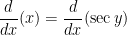
Let’s fast-forward a couple of semesters and use implicit differentiation (see also https://meangreenmath.com/2014/08/08/different-definitions-of-logarithm-part-8/ for how this same logic is used for other inverse functions) to find the derivative of y = \sec^{-1} x:

x = \sec y

\displaystyle \frac{d}{dx} (x) = \displaystyle \frac{d}{dx} (\sec y)

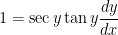
1 = \sec y \tan y \displaystyle \frac{dy}{dx}

\displaystyle \frac{1}{\sec y \tan y} = \displaystyle \frac{dy}{dx}

 At this point, the object is to convert the left-hand side to something involving only x. Clearly, we can replace \sec y with x. As it turns out, the replacement of \tan y is a lot simpler than we saw in yesterday’s post. Once again, we begin with one of the Pythagorean identities:

1 + \tan^2 y = \sec^2 y

\tan^2 y = \sec^2 y - 1

\tan^2 y = x^2 - 1

\tan y = \sqrt{x^2 - 1} \qquad \hbox{or} \tan y = -\sqrt{x^2 - 1}

So which is it, the positive answer or the negative answer? In yesterday’s post, the answer depended on whether x was positive or negative. However, with the current definition of \sec^{-1} x, we know for certain that the answer is the positive one! How can we be certain? The angle y must lie in either the interval [0,\pi/2) or else the interval [\pi,3\pi/2). In either interval, \tan y is positive. So, using this definition of \sec^{-1} x, we can simply say that

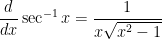
\displaystyle \frac{d}{dx} \sec^{-1} x = \displaystyle \frac{1}{x \sqrt{x^2-1}},

and we don’t have to worry about |x| that appeared in yesterday’s post.

green line

arcsec2Turning to integration, we now have the simple formula

\displaystyle \int \frac{dx}{x \sqrt{x^2 -1}} = \sec^{-1} x + C

that works whether x is positive or negative. For example, the orange area can now be calculated correctly:

\displaystyle \int_{-2}^{-2\sqrt{3}/3} \frac{dx}{x \sqrt{x^2 -1}} = \sec^{-1} \left( - \displaystyle \frac{2\sqrt{3}}{3} \right) - \sec^{-1} (-2)

= \displaystyle \frac{7\pi}{6} - \frac{4\pi}{3}

= \displaystyle -\frac{\pi}{6}

So, unlike yesterday’s post, this definition of \sec^{-1} x produces a simple integration formula.

green line

So why isn’t this the standard definition for \sec^{-1} x? I’m afraid the answer is simple: with this definition, the equation

\sec^{-1} x = \cos^{-1} \left( \displaystyle \frac{1}{x} \right)

is no longer correct if x < -1. Indeed, I distinctly remember thinking, back when I was a student taking trigonometry, that the definition of \sec^{-1} x seemed really odd, and it seemed to me that it would be better if it matched that of \cos^{-1} x. Of course, at that time in my mathematical development, it would have been almost hopeless to explain that the range [0,\pi/2) \cup [\pi,3\pi/2) had been chosen to simplify certain integrals from calculus.

So I suppose that The Powers That Be have decided that it’s more important for this identity to hold than to have a simple integration formula for \displaystyle \int \frac{dx}{x \sqrt{x^2 -1}}

Inverse Functions: Arcsecant (Part 28)

We now turn to a little-taught and perhaps controversial inverse function: arcsecant. As we’ve seen throughout this series, the domain of this inverse function must be chosen so that the graph of y = \sec x satisfies the horizontal line test. It turns out that the choice of domain has surprising consequences that are almost unforeseeable using only the tools of Precalculus.

The standard definition of y = \sec^{-1} x uses the interval [0,\pi], so that

\sec^{-1} x = \cos^{-1} \left( \displaystyle \frac{1}{x} \right)

Why would this be controversial? Yesterday, we saw that \tan x is both positive and negative on the interval [0,\pi], and so great care has to be used to calculate the integral:

\displaystyle \int \frac{dx}{x \sqrt{x^2 -1}}

Here’s another example: let’s use trigonometric substitution to calculate

\displaystyle \int_{-6}^{-3} \frac{ \sqrt{x^2-9} }{x} dx

The standard trick is to use the substitution x = 3 \sec \theta. With this substitution:

  • x^2 - 9 = 9 \sec^2 \theta - 9 = 9 \tan^2 \theta, and
  • dx = 3 \sec \theta \tan \theta \, d\theta
  • x = -3 \quad \Longrightarrow \quad \sec \theta = -1 \quad \Longrightarrow \quad \theta = \sec^{-1} (-1) = \pi
  • x = -6 \quad \Longrightarrow \quad \sec \theta = -2 \quad \Longrightarrow \quad \theta = \sec^{-1} (-2) = \displaystyle \frac{2\pi}{3}

Therefore,

\displaystyle \int_{-6}^{-3} \frac{ \sqrt{x^2-9} }{x} dx = \displaystyle \int_{2\pi/3}^{\pi} \frac{ \sqrt{9 \tan^2 \theta}} { 3 \sec \theta} 3 \sec \theta \tan \theta \, d\theta

At this point, the common mistake would be to replace \sqrt{9 \tan^2 \theta} with 3 \tan \theta. This is a mistake because

\sqrt{9 \tan^2 \theta} = |3 \tan \theta|

Furthermore, for this particular problem, \tan \theta is negative on the interval [2\pi/3,\pi]. Therefore, for this problem, we should replace \sqrt{9 \tan^2 \theta} with -3 \tan \theta.

Continuing the calculation,

\displaystyle \int_{-6}^{-3} \frac{ \sqrt{x^2-9} }{x} dx = \displaystyle \int_{2\pi/3}^{\pi} \frac{ -3 \tan \theta} { 3 \sec \theta} 3 \sec \theta \tan \theta

= \displaystyle \int_{2\pi/3}^{\pi} -3\tan^2 \theta \, d\theta

= \displaystyle \int_{2\pi/3}^{\pi} -3(\sec^2 \theta-1) \, d\theta

= \displaystyle \int_{2\pi/3}^{\pi} (3-3 \sec^2 \theta) \, d\theta

= \displaystyle \bigg[ 3 \theta - 3 \tan \theta \bigg]_{2\pi/3}^{\pi}

= \displaystyle \left[ 3 \pi - 3 \tan \pi \right] - \left[ 3 \left( \frac{2\pi}{3} \right) - 3 \tan \left( \frac{2\pi}{3} \right) \right]

= \displaystyle 3\pi - 0 - 2\pi + 3(-\sqrt{3})

= \pi - 3\sqrt{3}

So if great care wasn’t used to correctly simplify \sqrt{9 \tan^2 \theta}, one would instead obtain the incorrect answer 3\sqrt{3} - \pi.

Inverse Functions: Arcsecant (Part 27)

We now turn to a little-taught and perhaps controversial inverse function: arcsecant. As we’ve seen throughout this series, the domain of this inverse function must be chosen so that the graph of y = \sec x satisfies the horizontal line test. It turns out that the choice of domain has surprising consequences that are almost unforeseeable using only the tools of Precalculus.

The standard definition of y = \sec^{-1} x uses the interval [0,\pi], so that

\sec^{-1} x = \cos^{-1} \left( \displaystyle \frac{1}{x} \right)

Why would this be controversial? Let’s fast-forward a couple of semesters and use implicit differentiation (see also https://meangreenmath.com/2014/08/08/different-definitions-of-logarithm-part-8/ for how this same logic is used for other inverse functions) to find the derivative of y = \sec^{-1} x:

x = \sec y

\displaystyle \frac{d}{dx} (x) = \displaystyle \frac{d}{dx} (\sec y)

1 = \sec y \tan y \displaystyle \frac{dy}{dx}

\displaystyle \frac{1}{\sec y \tan y} = \displaystyle \frac{dy}{dx}

 At this point, the object is to convert the left-hand side to something involving only x. Clearly, we can replace \sec y with x. However, doing the same with \tan y is trickier. We begin with one of the Pythagorean identities:

1 + \tan^2 y = \sec^2 y

\tan^2 y = \sec^2 y - 1

\tan^2 y = x^2 - 1

\tan y = \sqrt{x^2 - 1} \qquad \hbox{or} \tan y = -\sqrt{x^2 - 1}

So which is it, the positive answer or the negative answer? The answer is, without additional information, we don’t know!

  • If 0 \le y < \pi/2 (so that x = \sec y \ge 1), then \tan y is positive, and so \tan y = \sqrt{\sec^2 y - 1}.
  • If \pi/2 < y \le \pi (so that x = \sec y \le 1), then \tan y is negative, and so \tan y = -\sqrt{\sec^2 y - 1}.

We therefore have two formulas for the derivative of y = \sec^{-1} x:

\displaystyle \frac{d}{dx} sec^{-1} x = \displaystyle \frac{1}{x \sqrt{x^2-1}} \qquad \hbox{if} \qquad x > 1

\displaystyle \frac{d}{dx} sec^{-1} x = \displaystyle -\frac{1}{x \sqrt{x^2-1}} \qquad \hbox{if} \qquad x < 1

These may then be combined into the single formula

\displaystyle \frac{d}{dx} sec^{-1} x = \displaystyle \frac{1}{|x| \sqrt{x^2-1}}

green lineIt gets better. Let’s now find the integral

\displaystyle \int \frac{dx}{x \sqrt{x^2 -1}}

arcsec2

Several calculus textbooks that I’ve seen will lazily give the answer

\displaystyle \int \frac{dx}{x \sqrt{x^2 -1}} = \sec^{-1} x + C

This answer works as long as x > 1, so that |x| reduces to simply x. For example, the red signed area in the above picture on the interval [2\sqrt{3}/3,2] may be correctly computed as

\displaystyle \int_{2\sqrt{3}/3}^2 \frac{dx}{x \sqrt{x^2 -1}} = \sec^{-1} 2 - \sec^{-1} \displaystyle \frac{2\sqrt{3}}{3}

= \cos^{-1} \left( \displaystyle \frac{1}{2} \right) - \cos^{-1} \left( \displaystyle \frac{\sqrt{3}}{2} \right)

= \displaystyle \frac{\pi}{3} - \frac{\pi}{6}

= \displaystyle \frac{\pi}{6}

However, the orange signed area on the interval [-2,-2\sqrt{3}/3]  is incorrectly computed using this formula!

\displaystyle \int_{-2}^{-2\sqrt{3}/3} \frac{dx}{x \sqrt{x^2 -1}} = \sec^{-1} \left( - \displaystyle \frac{2\sqrt{3}}{3} \right) - \sec^{-1} (-2)

= \cos^{-1} \left( -\displaystyle \frac{\sqrt{3}}{2} \right) -\cos^{-1} \left( \displaystyle \frac{1}{2} \right)

= \displaystyle \frac{5\pi}{6} - \frac{2\pi}{3}

= \displaystyle \frac{\pi}{6}

This is patently false, as the picture clearly indicates that the above integral has to be negative. For this reason, careful calculus textbooks will often ask students to solve a problem like

\displaystyle \int \frac{dx}{x \sqrt{x^2 -1}}, \qquad x > 1

and the caveat x > 1 is needed to ensure that the correct antiderivative is used. Indeed, a calculus textbook that doesn’t include such caveats are worthy of any scorn that an instructor cares to heap upon it.