Mathematical Christmas gifts

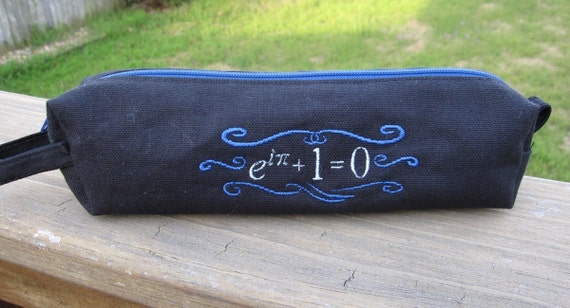
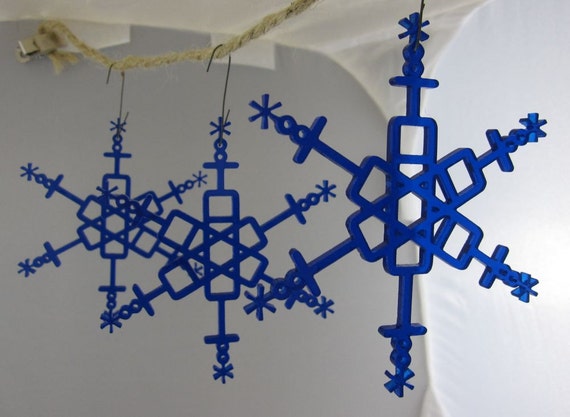
Now that Christmas is over, I can safely share the Christmas gifts that I gave to my family this year thanks to Nausicaa Distribution (https://www.etsy.com/shop/NausicaaDistribution):

Euler’s equation pencil pouch:

Box-and-whisker snowflakes to hang on our Christmas tree:

And, for me, a wonderfully and subtly punny “Confidence and Power” T-shirt.

Thanks to FiveThirtyEight (see http://fivethirtyeight.com/features/the-fivethirtyeight-2014-holiday-gift-guide/) for pointing me in this direction.

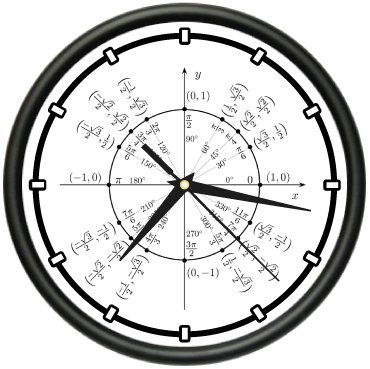
green lineFor the sake of completeness, here are the math-oriented gifts that I received for Christmas:


Arithmetic and Geometric Series: Index

I’m using the Twelve Days of Christmas (and perhaps a few extra days besides) to do something that I should have done a long time ago: collect past series of posts into a single, easy-to-reference post. The following posts formed my series on how I remind students about Taylor series. I often use this series in a class like Differential Equations, when Taylor series are needed but my class has simply forgotten about what a Taylor series is and why it’s important.

Part 1: Deriving the formulas for the nth term of arithmetic and geometric sequences.

Part 2: Pedagogical thoughts on conceptual barriers that students often face when encountering sequences and series.

Part 3: The story of how young Carl Frederich Gauss, at age 10, figured out how to add the integers from 1 to 100 in his head.

Part 4: Deriving the formula for an arithmetic series.

Part 5: Deriving the formula for an arithmetic series, using mathematical induction. Also, extensions to other series.

Part 6: Deriving the formula for an arithmetic series, using telescoping series. Also, extensions to other series.

Part 7: Pedagogical thoughts on assessing students’ depth of understanding the formula for an arithmetic series.

Part 8: Deriving the formula for a finite geometric series.

Part 9: Infinite geometric series and Xeno’s paradox.

Part 10: Deriving the formula for an infinite geometric series.

Part 11: Applications of infinite geometric series in future mathematics courses.

Part 12: Other commonly-arising infinite series.


A Curious Square Root: Index

I’m using the Twelve Days of Christmas (and perhaps a few extra days besides) to do something that I should have done a long time ago: collect past series of posts into a single, easy-to-reference post. The following posts formed my series on expressions containing nested square roots that nevertheless can be simplified.

Part 1: Simplifying \sqrt{5 - \sqrt{6} + \sqrt{22+8\sqrt{6}}}.

Part 2: DIfferent ways of calculating \sin 15^\circ.


Hands on SET

Every so often, I’ll publicize through this blog an interesting article that I’ve found in the mathematics or mathematics education literature that can be freely distributed to the general public. Today, I’d like to highlight “Hands-on SET®,” by Hannah Gordon, Rebecca Gordon, and Elizabeth McMahon. Here’s the abstract:

SET® is a fun, fast-paced game that contains a surprising amount of mathematics. We will look in particular at hands-on activities in combinatorics and probability, finite geometry, and linear algebra for students at various levels. We also include a fun extension to the game that illustrates some of the power of thinking mathematically about the game.

The full article can be found here: http://dx.doi.org/10.1080/10511970.2013.764368

Full reference: Hannah Gordon, Rebecca Gordon & Elizabeth McMahon (2013) Hands-on SET®, PRIMUS: Problems, Resources, and Issues in Mathematics Undergraduate Studies, 23:7, 646-658, DOI: 10.1080/10511970.2013.764368

Engaging students: Synthetic Division

In my capstone class for future secondary math teachers, I ask my students to come up with ideas for engaging their students with different topics in the secondary mathematics curriculum. In other words, the point of the assignment was not to devise a full-blown lesson plan on this topic. Instead, I asked my students to think about three different ways of getting their students interested in the topic in the first place.

I plan to share some of the best of these ideas on this blog (after asking my students’ permission, of course).

This student submission comes from my former student Chelsea Hancock. Her topic, from Precalculus: synthetic division.

green line

The method of synthetic division is an alternative version of long division concerning polynomials. Synthetic division uses the basic mathematical skills of addition, subtraction, multiplication, and negative signs. They must also understand the definitions of polynomial, coefficient, and remainder. A polynomial is an expression with multiple terms, poly meaning “many” and nomial meaning “term.” A coefficient is a number used to multiply a variable. The remainder is the amount left over after division. Synthetic division involves multiplying, then adding or subtracting the coefficients of two polynomials. On some occasions, there will be a remainder after dividing the polynomials.


green line

Mathematicians are lazy. That is a fact of life. One mathematician understood this, so in 1809 he created a cleaner, faster, and much simpler method for division. His name was Paolo Ruffini. In order to more efficiently divide polynomials, Ruffini invented the Ruffini’s Rule, known more commonly as synthetic division in today’s society. In 1783, he entered the University of Modena and he studied mathematics, medicine, philosophy and literature. Then, in 1798 he began teaching mathematics at the University of Modena. He was required to swear an oath of allegiance to the republic, but due to religious purposes, refused to do so. This resulted in the loss of his professorship and was prevented from teaching.


green line

There are several videos on the Internet involving synthetic division, but there are two in particular that I personally think are excellent demonstrations of both the method itself and why it works. I have labeled these clips Video 1 and Video 2. Video 1 is a demonstration of the method in action, using a specific example involving numbers, walking the viewers through the process through the whole video. Video 2 explains why using synthetic division instead of using long division is the more efficient and less complicated method for dividing polynomials. The clip uses the same example used in Video 1, but this time the polynomials are divided using long division, walking the viewers through the process the entire time. As the narrator moves through the process, he makes connections between the synthetic division method and the long division method and draws conclusions between the two. By the end of the video, it is evident which is the cleanest method to use when concerning the division of polynomials. These videos not only give great tutorials on both methods of division, but allows the viewers to see the benefits and uses of synthetic division when it is possible to use it.


Video 1:

Video 2:

References


http://www.mathsisfun.com/algebra/polynomials.html


http://www.mathsisfun.com/definitions/coefficient.html


http://www.mathsisfun.com/definitions/remainder.html


http://www-groups.dcs.st-and.ac.uk/~history/Biographies/Ruffini.html


http://www.personal.psu.edu/djh300/cyhs/trig/unit-e-adv-polyn/06-05-02-synth-div.pdf


https://www.khanacademy.org/math/algebra2/polynomial_and_rational/synthetic-division/v/synthetic-division


https://www.khanacademy.org/math/algebra2/polynomial_and_rational/synthetic-division/v/why-synthetic-division-works


My favorite SSA problem

Last month, I had a series of posts on solving a triangle when two sides and a non-included angle are given. Here is my all-time favorite word problem along these lines:

Assume that Venus and Earth both have circular orbits around the sun with radii 68 million miles and 93 million miles, respectively. Just after sunrise, an astronomer sees Venus on the horizon and measures the angle between Venus and the sun to be 20 degrees. Find the possible distances from Venus to Earth at that moment.

venus

I won’t go through the solution of the problem… it’s a fairly straightforward application of SSA techniques. But I’ve always had a soft spot for this problem… probably because I have a soft spot for astronomy and the picture of the planets in their orbits makes perfectly clear why the information can narrow down the answer to two possible solutions, but more information is needed in order to figure out which one is actually correct.

Engaging students: Introducing the number e

In my capstone class for future secondary math teachers, I ask my students to come up with ideas for engaging their students with different topics in the secondary mathematics curriculum. In other words, the point of the assignment was not to devise a full-blown lesson plan on this topic. Instead, I asked my students to think about three different ways of getting their students interested in the topic in the first place.

I plan to share some of the best of these ideas on this blog (after asking my students’ permission, of course).

This student submission comes from my former student Kenna Kilbride. Her topic, from Precalculus: introducing the number e.

green line

How can this topic be used in your students’ future courses in mathematics or science?


Students will add on to this constant from calculus up to differential equations and even further. In Calculus I students use the number e to solve exponential functions and logarithm function. Calculus II uses the number e when computing integrals. In Complex Numbers you see the number e written as the Taylor series

$latex e^x = \displaystyle \sum_{n=0}^\infty \frac{x^n}{n!}

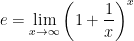
Differential equations utilizes the number e in y(x) = Ce^x. The number e can be utilized in many other areas since it is considered to be a base of the natural logarithm. The number e is also defined as:

e = \displaystyle \lim_{x \to \infty} \left(1 + \frac{1}{x} \right)^x

Also the number e can be seen in the infinite series

$latex e = \sum_{k=0}^\infty \frac{1}{k!}

The number e can be seen in many different areas of mathematics and with many different series and equations. Stirling’s approximation, Pippenger product, and Euler formula are just a few more examples of where you can see the number e.

http://mathworld.wolfram.com/e.html

http://tutorial.math.lamar.edu/Classes/CalcII/ImproperIntegralsCompTest.aspx


green line

What interesting (i.e., uncontrived) word problems using this topic can your students do now? (You may find resources such as http://www.spacemath.nasa.gov to be very helpful in this regard; feel free to suggest others.)


Introducing this constant can be a very hard thing for a teacher to do and using a word problem that involves a satellite that students can comprehend what they do in the sky will help.

A satellite has a radioisotope power supply. The power output in watts is given by the equation

P = 50e^(-t/250)

where t is the time in days and e is the base of natural logarithms.

Then when introducing, e, you can give them problems that they can easily solve without fully understanding what e is. Give them problems such as, how much power will be available in a year. The solution is:

P = 50e^(-365/250)

= 5Oe^(-1.46)

= 50 x 0.232

= 11 .6

Once e has been more formally introduced and the students can then become more familiar (this should only be added on when the students fully understand e) you can add onto this problem by giving them questions such as, what is the half-life of the power supply? Students must use natural log to solve this equation:

25 = 50e^(-t/250)

for t and obtain

– t/250 = ln O.5

= -0.693

t = 250 x 0.693

= 173 days

http://er.jsc.nasa.gov/seh/math49.html

green line

What interesting things can you say about the people who contributed to the discovery and/or the development of this topic? (You might want to consult Math Through The Ages.)


John Napier was born in Scotland around 1550. Napier started attending St. Andrews University at the age of 13. After leaving St. Andrews without a degree he attended Cambridge University. Later he studied abroad, presumably in Paris. In 1614 Napier invented logarithms and later exponential expressions. Along with mathematics, Napier was interested in peace keeping and religion. Napier died on April 4, 1617 of gout.

Euler contributed to e, a mathematical constant. He was born 1707 in the town Basel of Switzerland. By the age of 16 he had earned a Master’s degree and in 1727 he applied for a position as a Physics professor at the University of Basel and was turned down. Due to extreme health problems by 1771 he had lost almost all of his vision. By the time of his death in 1783, the Academy of Sciences in Petersburg had received 500 of his works.


http://www.macs.hw.ac.uk/~greg/calculators/napier/great.html

http://www.pdmi.ras.ru/EIMI/EulerBio.html