Engaging students: Truth tables

In my capstone class for future secondary math teachers, I ask my students to come up with ideas for engaging their students with different topics in the secondary mathematics curriculum. In other words, the point of the assignment was not to devise a full-blown lesson plan on this topic. Instead, I asked my students to think about three different ways of getting their students interested in the topic in the first place.

I plan to share some of the best of these ideas on this blog (after asking my students’ permission, of course).

This student submission comes from my former student Anna Park. Her topic, from Geometry: truth tables.

green line

How could you as a teacher create an activity or project that involves your topic?


The student’s will each be given half a sentence. The student’s have to walk around and talk to everyone in the class and compare their slivers of paper. They have to logically match up with someone in order to finish their statement. For example, one student will have “If I have a flat tire,” and another student will have,” then I will have to change the tire” then they would be matched together. Once all of the students find their match the student’s will stand up with their partner and present their sentence and explain why it logically works.


green line

How can this topic be used in your students’ future courses in mathematics or science?


Truth tables will be used in geometry and in nearly every math class that follows. In college, truth tables are used in discrete mathematics, real analysis, and any proof based class. Truth tables help develop logical thinking, which is needed when one writes a mathematical proof. Many students understand the idea of cause and effect, but they do not logically think out their actions before they do them. Truth tables allow you to think deeper in cause and effect. Which, they will need later in life when making big decisions. For instance, in college there are many things to juggle. For example; assignments, sleep, physical activity, social life, and work. I have to consider all of my options logically in order to get everything done. I think about how many hours I have left in the day after I have class and work, then I look at my assignments and their due dates and see which ones I can complete given the time I have. Then I plan my workout to go with the exact amount of time left over, and still manage to get around seven hours of sleep. I have to think to my self, “ If I get this assignment done today, then I can do my other assignment tomorrow.” Students will need to learn cause and effect and truth tables is a good place to start.


green line

How can technology (YouTube, Khan Academy [khanacademy.org], Vi Hart, Geometers Sketchpad, graphing calculators, etc.) be used to effectively engage students with this topic?


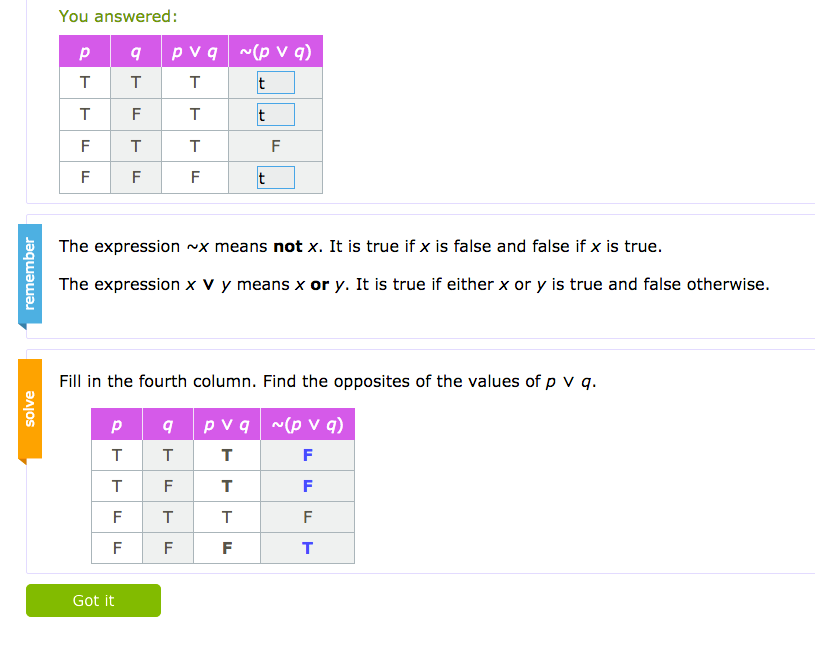
There are many youtube videos that show you how to do truth tables, which is great for when you are learning. But there is a website where students can practice writing truth tables and get immediate feedback if they are right or wrong. The students’ can practice for as long as they want, and it is great repetition for the student to remember how truth tables work and the rules they must follow. With the website when the students get it wrong it will explain why the student was wrong and why the table should be what it is. Below is an example of what the website does when the answer is incorrect.

https://www.ixl.com/math/geometry/truth-tables


Engaging students: Deriving the proportions of a 45-45-90 right triangle

In my capstone class for future secondary math teachers, I ask my students to come up with ideas for engaging their students with different topics in the secondary mathematics curriculum. In other words, the point of the assignment was not to devise a full-blown lesson plan on this topic. Instead, I asked my students to think about three different ways of getting their students interested in the topic in the first place.

I plan to share some of the best of these ideas on this blog (after asking my students’ permission, of course).

This student submission comes from my former student Amber Northcott. Her topic, from Geometry: deriving the proportions of a 45-45-90 right triangle.

green line

How could you as a teacher create an activity or project that involves your topic?

There are ways to make the 45-45-90 right triangle not only interesting, but make it fun. A project or activity that I made up involves architecture using the special right triangle 45-45-90. In the project the students become architects. Their job is to create their own architecture, whether it is a bridge or house, etc. by using 45-45-90 right triangles. They must use a three to ten 45-45-90 right triangles. Once the students figured out how many they will use, they are going to draw their architecture. Then the students will label the sides and angles of what they drew. At the end of the activity or project they will solve the 45-45-90 triangles they used. An option for a long project is to actually build the architecture using measurable materials. The project will allow them to be creative and connect real life to the 45-45-90 right triangle. The students will also present their projects.

Another way to do the activity or project is make it a group activity and give the students some word problems dealing with architecture and have them choose one of those word problems. The students will then take the word problem and create the architecture in the word problem. They can draw it or create it, but it has to be measured and labeled along with finding the missing piece. Then they can present their findings, which includes how they came up with their measurements of sides and angles.

All the ways to do the activity or project will still need the student to be able to answer any questions that their peers or myself may ask. Also, at the end their will be a reflection on the project and their interpretation of how to solve the 45-45-90 right triangle.


green line

How has this topic appeared in high culture (art, classical music, theatre, etc.)?

Triangles can be seen everywhere. For example, they can be seen on bridges and buildings. The website geometrinarchitecture.weebly.com has a section talking about the special right triangles, which includes the 45-45-90 right triangle. On the bottom of the page the website shares pictures of windows, roofs, and even a front door is seen within a triangle. The webpage also gives examples of how the special triangles can be used in architecture.

green line

How can technology (YouTube, Khan Academy [khanacademy.org], Vi Hart, Geometers Sketchpad, graphing calculators, etc.) be used to effectively engage students with this topic? Note: It’s not enough to say “such-and-such is a great website”; you need to explain in some detail why it’s a great website.

The dynamicgeometry.com website talks about the Geometers Sketchpad. After checking it out, I find that the program can be useful. The students can create their own 45-45-90 right triangles and explore the idea of 45-45-90 right triangles on their own after instructions on how to use the program. This engages them because the student will be able to think, how can I create a 45-45-90 right triangle? What is a 45-45-90 right triangle?  The students will have these questions and more, but those questions will soon be answered throughout the lesson itself.

References

http://geometrinarchitecture.weebly.com/special-triangles.html

http://www.dynamicgeometry.com/index.html


My Favorite One-Liners: Part 88

In this series, I’m compiling some of the quips and one-liners that I’ll use with my students to hopefully make my lessons more memorable for them.

In the first few weeks of my calculus class, after introducing the definition of a derivative,

\displaystyle \frac{dy}{dx} = y' = f'(x) = \lim_{h \to 0} \displaystyle \frac{f(x+h) - f(x)}{h},

I’ll use the following steps to guide my students to find the derivatives of polynomials.

  1. If f(x) = c, a constant, then \displaystyle \frac{d}{dx} (c) = 0.
  2. If f(x) and g(x) are both differentiable, then (f+g)'(x) = f'(x) + g'(x).
  3.  If f(x) is differentiable and c is a constant, then (cf)'(x) = c f'(x).
  4. If f(x) = x^n, where n is a nonnegative integer, then f'(x) = n x^{n-1}.
  5. If f(x) = a_n x^n + a_{n-1} x^{n-1} + \dots + a_1 x + a_0 is a polynomial, then f'(x) = n a_n x^{n-1} + (n-1) a_{n-1} x^{n-2} + a_1.

After doing a few examples to help these concepts sink in, I’ll show the following two examples with about 3-4 minutes left in class.

Example 1. Let A(r) = \pi r^2. Notice I’ve changed the variable from x to r, but that’s OK. Does this remind you of anything? (Students answer: the area of a circle.)

What’s the derivative? Remember, \pi is just a constant. So A'(r) = \pi \cdot 2r = 2\pi r.

Does this remind you of anything? (Students answer: Whoa… the circumference of a circle.)

Generally, students start waking up even though it’s near the end of class. I continue:

Example 2. Now let’s try V(r) = \displaystyle \frac{4}{3} \pi r^3. Does this remind you of anything? (Students answer: the volume of a sphere.)

What’s the derivative? Again, \displaystyle \frac{4}{3} \pi is just a constant. So V'(r) = \displaystyle \frac{4}{3} \pi \cdot 3r^2 = 4\pi r^2.

Does this remind you of anything? (Students answer: Whoa… the surface area of a sphere.)

By now, I’ve really got my students’ attention with this unexpected connection between these formulas from high school geometry. If I’ve timed things right, I’ll say the following with about 30-60 seconds left in class:

Hmmm. That’s interesting. The derivative of the area of a circle is the circumference of the circle, and the derivative of the area of a sphere is the surface area of the sphere. I wonder why this works. Any ideas? (Students: stunned silence.)

This is what’s known as a cliff-hanger, and I’ll give you the answer at the start of class tomorrow. (Students groan, as they really want to know the answer immediately.) Class is dismissed.

If you’d like to see the answer, see my previous post on this topic.

Engaging students: Completing the square

In my capstone class for future secondary math teachers, I ask my students to come up with ideas for engaging their students with different topics in the secondary mathematics curriculum. In other words, the point of the assignment was not to devise a full-blown lesson plan on this topic. Instead, I asked my students to think about three different ways of getting their students interested in the topic in the first place.

I plan to share some of the best of these ideas on this blog (after asking my students’ permission, of course).

This student submission comes from my former student Deborah Duddy. Her topic, from Algebra: completing the square.

green line

What interesting word problems using this topic can your students do now?

Applying what is learned in the class is very vital in fact it is a process TEKS that teachers need to use to maximize student’s understanding. “When are we going to use this in real life?” and “Why do we need to know this?” are questions that students ask on a daily basis. Connecting material to the real world helps engage students and develops critical thinking. Describing a path of a ball, how far an item can be tossed in the air and how to maximize profits for a company are just some examples of how quadratics can be used in the real world.

One important event happens during high school; students receive their driver’s license. In their written driver’s test, students must know the distance needed to stop a car at certain speed limits. Using an example like the one below will be interesting for the students and help connect lesson material and real life. 

green line

How could you as a teacher create an activity or project that involves your topic?

To begin class and get students involved with their learning, the class will participate in an activity. Each pair of students will have two different cards such as (x+2)^2 and x^2+4x+4, and any variations of these problems. They can only look at the (x+2)^2 card. Students will work out the problem on paper. Students will be asked to remember how to find the area of a square and then set up a square with the dimensions matching the first card. From there, the pairs would use algebra tiles (after knowing what each tile stands for) and attempt to “complete the square”. This activity will be used as an engage and a beginning explore for the students. This activity will help students see completing a square geometrically.

green line

How does this topic extend what your students should have learned in previous courses?

Completing the square is another way of solving/factoring the equation. The process of completing the square is to turn a basic quadratic   equation of ax^2 + bx + c = 0 into a(x-h)^2 + k = 0 where (h,k) is  the vertex of the parabola. Therefore this process is very beneficial because it helps students graph the quadratic equation given. In order to find h and k, students should be able to factor, square a term, find the square root and manipulate the equation.

In solving the equation by completing the square is to subtract the constant off the left side and onto the right side. Then students take the coefficient off the x-term divide it then square it. Students then add this number to both sides of the equations. By simplifying the right side of the equation, students give the perfect square. Then solve the equation left by taking the square root of both sides and determining x.


References:

Click to access LA205EBD.pdf

My Mathematical Magic Show: Index

I’m doing something that I should have done a long time ago: collecting a series of posts into one single post. The links below show the mathematical magic show that I’ll perform from time to time.

Part 1: Introduction.

Part 2a, Part 2b, and Part 2c: The 1089 trick.

Part 3a, Part 3b, and Part 3c: A geometric magic trick.

Part 4a: Part 4b, Part 4c, and Part 4d: A trick using binary numbers.

Part 5a, Part 5b, Part 5c, and Part 5d: A trick using the rule for checking if a number is a multiple of 9.

Part 7: The Fitch-Cheney card trick, which is perhaps the slickest mathematical card trick ever devised.

Part 8a, Part 8b, and Part 8c: A trick using Pascal’s triangle.

Part 9: Mentally computing n given n^5 if 10 \le n \le 99.

Part 6: The Grand Finale.

And, for the sake of completeness, here’s a recent picture of me just before I performed an abbreviated version of this show for UNT’s Preview Day for high school students thinking about enrolling at my university.

magician