
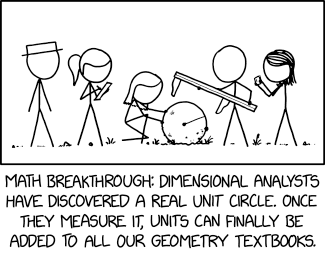
Source: https://xkcd.com/3041/
Source: https://xkcd.com/3041/
This is a new favorite story to share with students: two high school students recently figured out multiple new proofs of the Pythagorean theorem.
Professional article in the American Mathematical Monthly (requires a subscription): https://maa.tandfonline.com/doi/full/10.1080/00029890.2024.2370240
Video describing one of their five ideas:
Interview in MAA Focus: http://digitaleditions.walsworthprintgroup.com/publication/?i=836749&p=14&view=issueViewer
Interview by 60 Minutes:
https://www.youtube.com/watch?v=VHeWndnHuQs
Praise from Michelle Obama: https://www.facebook.com/michelleobama/posts/i-just-love-this-story-about-two-high-school-students-calcea-johnson-and-nekiya-/750580956432311/
This is one of my all-time favorite stories to share with students: how a couple of ninth graders in 1995 played with Geometer’s Sketchpad and stumbled upon a brand-new way of using only a straightedge and compass to divide a line segment into any number of equal-sized parts. This article was published in 1997 and made quite a media sensation at the time.
Let me take a one-day break from my current series of posts to wish everyone a Happy Pythagoras Day! Today is 7/24/25 (or 24/7/25 in other parts of the world), and 
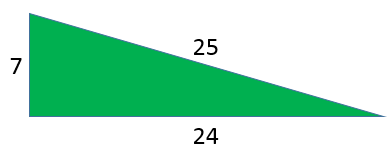 Bonus points if you can figure out (without Googling) when the next Pythagoras Days will be. Hint: It’s going to be a while.
I’m doing something that I should have done a long time ago: collecting a series of posts into one single post. The links below show the mathematical magic show that I’ll perform from time to time.
Part 1: Introduction.
Part 2a, Part 2b, and Part 2c: The 1089 trick.
Part 3a, Part 3b, and Part 3c: A geometric magic trick.
Part 4a: Part 4b, Part 4c, and Part 4d: A trick using binary numbers.
Part 5a, Part 5b, Part 5c, and Part 5d: A trick using the rule for checking if a number is a multiple of 9.
Part 7: The Fitch-Cheney card trick, which is perhaps the slickest mathematical card trick ever devised.
Part 8a, Part 8b, and Part 8c: A trick using Pascal’s triangle.
Part 9: Mentally computing 


Part 10: A mathematical optical illusion.
Part 11: The 27-card trick, which requires representing numbers in base 3.
Part 6: The Grand Finale.
And, for the sake of completeness, here’s a picture of me just before I performed an abbreviated version of this show for UNT’s Preview Day for high school students thinking about enrolling at my university.

Let me take a break from my current series of posts to wish everyone an early Happy Pythagoras Day! Tomorrow will be 10/26/24 (or 26/10/24 in other parts of the world), and 

Bonus points if you can figure out (without Googling) when the next Pythagoras Day will be.
This magic trick is an optical illusion instead of a pure magic trick, but it definitely is a crowd-pleaser. This illusion is called Sugihara’s Impossible Cylinder:
This is actually a mathematical magic trick. As detailed by David Richeson in Math Horizons, there is a fair amount of math that goes into creating this unique shape. He also provided this interacted Geogebra applet as well as a printable pdf file for creating this illusion.
I’m posting one day early this week to wish everyone a Happy Pythagoras Day! Today is 7/25/24 (or 25/7/24 in other parts of the world), and 

Bonus points if you can figure out (without Googling) when the next Pythagoras Day will be.
While re-reading the wonderful parallel biography Team of Rivals: The Political Genius of Abraham Lincoln by Doris Kearns Goodwin, I was reminded of this passage from Lincoln’s time on the Illinois traveling law circuit in the 1850s, the interlude between his term in the House of Representatives and his ascent to the presidency:
Life on the circuit provided Lincoln the time and space he needed to remedy the “want of education” he regretted all his life. During his nights and weekends on the circuit, in the absence of domestic interruptions, he taught himself geometry, carefully working out propositions and theorems until he could proudly claim that he had “nearly mastered the Six-books of Euclid.” His first law partner, John Stuart, recalled that “he read hard works — was philosophical — logical —mathematical — never read generally.”
[Law partner William] Herndon describes finding him one day “so deeply absorbed in study he scarcely looked up when I entered.” Surrounded by “a quantity of blank paper, large heavy sheets, a compass, a rule, numerous pencils, several bottles of ink of various colors, and a profusion of stationery,” Lincoln was apparently “struggling with a calculation of some magnitude, for scattered about were sheet after sheet of paper covered with an unusual array of figures.” When Herndon inquired what he was doing, he announced “that he was trying to solve the difficult problem of squaring the circle.” To this insoluble task posed by the ancients over four thousand years earlier, he devoted “the better part of the succeeding two days… almost to the point of exhaustion.”
Doris Kearns Goodwin, Team of Rivals: The Political Genius of Abraham Lincoln, pages 152-153
I have two thoughts on this: one mathematical, and one political (albeit the politics of the 19th century).
I must admit that I’m charmed by the mental image of Lincoln, like so many amateur (and professional) mathematicians before and after him, deeply engrossed after a hard day’s work by the classical problem of squaring the circle, described by Wikipedia as “the challenge of constructing a square with the area of a circle by using only a finite number of steps with a compass and straightedge.”
A subtle historical detail was left out of the above account, one that I would not expect a popular history book to include. While it’s known today that squaring the circle is impossible, this was not a settled question during Lincoln’s lifetime. Indeed, the impossibility of squaring the circle was settled in 1882, seventeen years after Lincoln’s death, when Ferdinand von Lindemann proved the transcendence of 
(As a personal aside: I still remember the triumph I felt a student many, many years ago when I read through this proof in Field Theory and Its Classical Problems and understood it well enough to stand at the chalkboard for the better part of an hour to present it to my teacher.)
Politically, I was reminded of the wonderful book Abraham Lincoln and The Structure of Reason by David Hirsch and Dan Van Haften. Hirsch and Van Haften argue that Lincoln’s studies of geometry were not merely for idle leisure or personal satisfaction, in the same way that people recreationally solve crossword puzzles today. Instead, they argue that Lincoln’s penchant for persuasive rhetoric was shaped (pardon the pun) by his study of geometry, and that Lincoln’s speeches tended to follow the same six-part outline that Euclid employed when writing geometric proofs in The Elements.
I recently read the delightful blog post ChatGPT Is Not Ready to Teach Geometry (Yet), with the wonderful sub-headline “The viral chatbot is often wrong, but never in doubt. Educators need to tread carefully.” Many thanks to the article AI Bot ChatGPT Needs Some Help With Math Assignments in the Wall Street Journal for directing me to this post. Both of these articles are cited at length below; I recommend both.
In case you’ve been on the moon for the past few months, much digital ink has been spilled in the past few months about how ChatGPT will affect education. From the blog post:
On HITC, Ellissa Bain described how ChatGPT could “Write Your Papers in Seconds,” explaining that this is “great for students” and “examiners will never know.” It’s not at all great for student learning, but it can definitely fool examiners; a team at the New YorkTimes Upshot confirmed that a small group of experts—including a teacher, a professor, a tutor, and a famous children’s author—often failed to distinguish between ChatGPT’s output and the writing of actual fourth and eighth graders in response to essay prompts from the National Assessment of Education Progress. In The Atlantic, teacher Daniel Herman pronounced “The end of high-school English,” explaining that “what GPT can produce right now is better than the large majority of [student] writing.” ChatGPT could compare Hamlet to Beloved, illustrate Buddhist ideas using a pet hamster, and write a convincing essay describing how its (fabricated) experience volunteering at a pet shelter had prepared it for success at Stanford. The bot’s ability to fabricate an admissions essay raises the question of whether colleges that no longer require standardized tests will need to drop the essay requirement as well.
Unfortunately, as Paul von Hipple, an associate professor at the University of Texas, discovered, ChatGPT isn’t so great at the Pythagorean theorem. From the blog post:
What are some common misunderstandings of Pythagoras’ theorem?
ChatGPT responded with four examples, which I’ll take just slightly out of order. The first three were howlers:
Some common misunderstandings about Pythagoras’ theorem include:
- Believing that it only works for right triangles. While Pythagoras’ theorem is most commonly used to find the length of a missing side in a right triangle, it can also be used to determine whether a triangle is a right triangle. If the lengths of the sides of a triangle satisfy the formula of Pythagoras’ theorem (i.e., if the square of the length of the hypotenuse is equal to the sum of the squares of the other two sides), then the triangle is a right triangle.
- Believing that it only works for right triangles with a 90 degree angle: Pythagoras’ theorem is specifically designed for right triangles, which have one 90 degree angle. However, it is possible for a triangle to have two acute angles (angles less than 90 degrees) and still be a right triangle.
- Believing that it only works for right triangles with legs that are perpendicular to each other: In a right triangle, the sides that are not the hypotenuse are called the legs. While it is true that the legs of a right triangle are typically perpendicular to each other, this is not a requirement for the theorem to be applicable. As long as a triangle has one 90 degree angle, Pythagoras’ theorem can be used to find the length of a missing side.
It gets better. Dr. von Hipple then asked the following:
Suppose the hypotenuse of a right triangle is 7.1 miles long, and one of the legs is 3.85 miles long. How long is the other leg?
ChatGPT returned a wrong answer: 5.93 miles. (See the blog post for more on this error.)
Dr. von Hipple then, with a simple typo, inadvertently asked ChatGPT to solve a triangle that can’t be solved:
I wondered if it would recognize a right triangle if I described it indirectly. So I started my next question:
Suppose a triangle has three sides called A, B, and C. A is 7 inches long and B is 7 inches long. The angle between A and C is 45 degrees, and so is the angle between A and B. What is the length of side C?
This was a typo; the 45-degree angle was placed between the wrong two sides. Nevertheless ChatGPT gave an answer:
Since the angle between A and B is 45 degrees, and the angle between A and C is also 45 degrees, the triangle is an isosceles right triangle, where A and B are the legs and C is the hypotenuse….
Dr. von Hipple’s conclusion:
This doesn’t make sense. If A and B are the legs of a right triangle, the angle between them can’t be 45 degrees; it has to be 90. ChatGPT went ahead and calculated the length of C using Pythagoras’ theorem, but it had revealed something important: it didn’t have a coherent internal representation of the triangle that we were talking about. It couldn’t visualize the triangle as you or I can, and it didn’t have any equivalent way to catch errors in verbal descriptions of visual objects.
In short, ChatGPT doesn’t really “get” basic geometry. It can crank out reams of text that use geometric terminology, but it literally doesn’t know what it is talking about. It doesn’t have an internal representation of geometric shapes, and it occasionally makes basic calculation errors…
What is ChatGPT doing? It is bloviating, filling the screen with text that is fluent, persuasive, and sometimes accurate—but it isn’t reliable at all. ChatGPT is often wrong but never in doubt.
The Wall Street Journal article cited above provided some more howlers. Here are a couple:
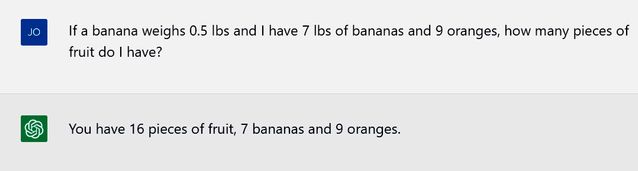
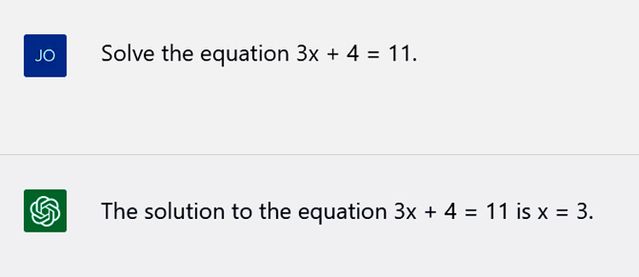
So what to make of all this? I like this conclusion from the Wall Street Journal:
Another reason that math instructors are less fussed by this innovation it that they have been here before. The field was upended for the first time decades ago with the general availability of computers and calculators.
Whereas English teachers are only now worrying about computers doing their students’ homework, math teachers have long wrestled with making sure students were actually learning and not just using a calculator. It’s why students have to show their work and take tests on paper.
The broader lesson is that AI, computers and calculators aren’t simply a shortcut. Math tools require math knowledge. A calculator can’t do calculus unless you know what you’re trying to solve. If you don’t know any math, Excel is just a tool for formatting tables with a lot of extra buttons.
Eventually, artificial intelligence will probably get to the point where its mathematics answers are not only confident but correct. A pure large language model might not be up for the job, but the technology will improve. The next generation of AI could combine the language skills of ChatGPT with the math skills of Wolfram Alpha.
In general, however, AI, like calculators and computers, will likely ultimately be most useful for those who already know a field well: They know the questions to ask, how to identify the shortcomings and what to do with the answer. A tool, in other words, for those who know the most math, not the least.
 Mean Green Math