Reminding students about Taylor series: Index

I’m doing something that I should have done a long time ago: collect past series of posts into a single, easy-to-reference post. The following posts formed my series on how I remind students about Taylor series. I often use this series in a class like Differential Equations, when Taylor series are needed but my class has simply forgotten about what a Taylor series is and why it’s important.

Part 1: Introduction – Why a Taylor series is important, and different applications of Taylor series.

Part 2: How I get students to understand the finite Taylor polynomial by solving a simple initial-value problem.

Part 3: Making the jump to an infinite series, and issues about tests of convergence.

Part 4: Application to f(x) = e^x, and a numerical investigation of speed of convergence.

Part 5: Application to f(x) = \displaystyle \frac{1}{1-x} and other related functions, including f(x) = \ln(1+x) and f(x) = \tan^{-1} x.

Part 6: Application to f(x) = \sin x and f(x) = \cos x, and Euler’s formula.


Area of a Circle: Index

I’m using the Twelve Days of Christmas (with a week-long head start) to do something that I should have done a long time ago: collect past series of posts into a single, easy-to-reference post. The following posts formed my series on the formula for the area of a circle.

Part 1: Why the circumference function C(r) = 2 \pi r is the derivative of the area function A(r) = \pi r^2.

Part 2: Finding the area of a circle via integration by trigonometric substitution.

Part 3: Finding the area of a circle via a double integral.

Part 4: Justifying the formula A(r) = \pi r^2 to geometry students by slicing a circle into pieces and rearranging the pieces as a parallelogram (approximately).


Inverse Functions: Arcsecant (Part 29)

We now turn to a little-taught and perhaps controversial inverse function: arcsecant. As we’ve seen throughout this series, the domain of this inverse function must be chosen so that the graph of y = \sec x satisfies the horizontal line test. It turns out that the choice of domain has surprising consequences that are almost unforeseeable using only the tools of Precalculus.

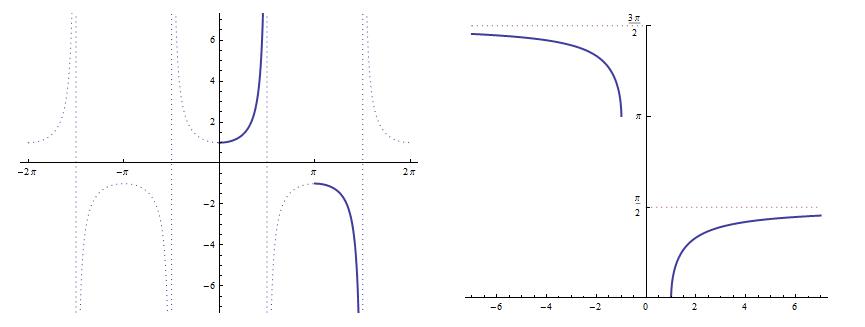
The standard definition of y = \sec^{-1} x uses the interval [0,\pi] — or, more precisely, [0,\pi/2) \cup (\pi/2, \pi] to avoid the vertical asymptote at x = \pi/2 — in order to approximately match the range of \cos^{-1} x. However, when I was a student, I distinctly remember that my textbook chose [0,\pi/2) \cup [\pi,3\pi/2) as the range for \sec^{-1} x.

I believe that this definition has fallen out of favor today. However, for the purpose of today’s post, let’s just run with this definition and see what happens. This portion of the graph of y = \sec x is perhaps unorthodox, but it satisfies the horizontal line test so that the inverse function can be defined.

arcsec3

Let’s fast-forward a couple of semesters and use implicit differentiation (see also https://meangreenmath.com/2014/08/08/different-definitions-of-logarithm-part-8/ for how this same logic is used for other inverse functions) to find the derivative of y = \sec^{-1} x:

x = \sec y

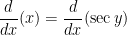
\displaystyle \frac{d}{dx} (x) = \displaystyle \frac{d}{dx} (\sec y)

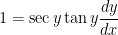
1 = \sec y \tan y \displaystyle \frac{dy}{dx}

\displaystyle \frac{1}{\sec y \tan y} = \displaystyle \frac{dy}{dx}

 At this point, the object is to convert the left-hand side to something involving only x. Clearly, we can replace \sec y with x. As it turns out, the replacement of \tan y is a lot simpler than we saw in yesterday’s post. Once again, we begin with one of the Pythagorean identities:

1 + \tan^2 y = \sec^2 y

\tan^2 y = \sec^2 y - 1

\tan^2 y = x^2 - 1

\tan y = \sqrt{x^2 - 1} \qquad \hbox{or} \tan y = -\sqrt{x^2 - 1}

So which is it, the positive answer or the negative answer? In yesterday’s post, the answer depended on whether x was positive or negative. However, with the current definition of \sec^{-1} x, we know for certain that the answer is the positive one! How can we be certain? The angle y must lie in either the interval [0,\pi/2) or else the interval [\pi,3\pi/2). In either interval, \tan y is positive. So, using this definition of \sec^{-1} x, we can simply say that

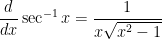
\displaystyle \frac{d}{dx} \sec^{-1} x = \displaystyle \frac{1}{x \sqrt{x^2-1}},

and we don’t have to worry about |x| that appeared in yesterday’s post.

green line

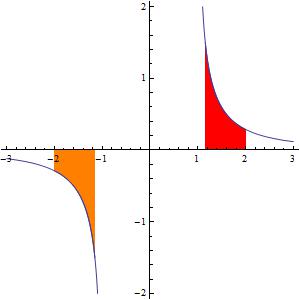
arcsec2Turning to integration, we now have the simple formula

\displaystyle \int \frac{dx}{x \sqrt{x^2 -1}} = \sec^{-1} x + C

that works whether x is positive or negative. For example, the orange area can now be calculated correctly:

\displaystyle \int_{-2}^{-2\sqrt{3}/3} \frac{dx}{x \sqrt{x^2 -1}} = \sec^{-1} \left( - \displaystyle \frac{2\sqrt{3}}{3} \right) - \sec^{-1} (-2)

= \displaystyle \frac{7\pi}{6} - \frac{4\pi}{3}

= \displaystyle -\frac{\pi}{6}

So, unlike yesterday’s post, this definition of \sec^{-1} x produces a simple integration formula.

green line

So why isn’t this the standard definition for \sec^{-1} x? I’m afraid the answer is simple: with this definition, the equation

\sec^{-1} x = \cos^{-1} \left( \displaystyle \frac{1}{x} \right)

is no longer correct if x < -1. Indeed, I distinctly remember thinking, back when I was a student taking trigonometry, that the definition of \sec^{-1} x seemed really odd, and it seemed to me that it would be better if it matched that of \cos^{-1} x. Of course, at that time in my mathematical development, it would have been almost hopeless to explain that the range [0,\pi/2) \cup [\pi,3\pi/2) had been chosen to simplify certain integrals from calculus.

So I suppose that The Powers That Be have decided that it’s more important for this identity to hold than to have a simple integration formula for \displaystyle \int \frac{dx}{x \sqrt{x^2 -1}}

Inverse Functions: Arcsecant (Part 28)

We now turn to a little-taught and perhaps controversial inverse function: arcsecant. As we’ve seen throughout this series, the domain of this inverse function must be chosen so that the graph of y = \sec x satisfies the horizontal line test. It turns out that the choice of domain has surprising consequences that are almost unforeseeable using only the tools of Precalculus.

The standard definition of y = \sec^{-1} x uses the interval [0,\pi], so that

\sec^{-1} x = \cos^{-1} \left( \displaystyle \frac{1}{x} \right)

Why would this be controversial? Yesterday, we saw that \tan x is both positive and negative on the interval [0,\pi], and so great care has to be used to calculate the integral:

\displaystyle \int \frac{dx}{x \sqrt{x^2 -1}}

Here’s another example: let’s use trigonometric substitution to calculate

\displaystyle \int_{-6}^{-3} \frac{ \sqrt{x^2-9} }{x} dx

The standard trick is to use the substitution x = 3 \sec \theta. With this substitution:

  • x^2 - 9 = 9 \sec^2 \theta - 9 = 9 \tan^2 \theta, and
  • dx = 3 \sec \theta \tan \theta \, d\theta
  • x = -3 \quad \Longrightarrow \quad \sec \theta = -1 \quad \Longrightarrow \quad \theta = \sec^{-1} (-1) = \pi
  • x = -6 \quad \Longrightarrow \quad \sec \theta = -2 \quad \Longrightarrow \quad \theta = \sec^{-1} (-2) = \displaystyle \frac{2\pi}{3}

Therefore,

\displaystyle \int_{-6}^{-3} \frac{ \sqrt{x^2-9} }{x} dx = \displaystyle \int_{2\pi/3}^{\pi} \frac{ \sqrt{9 \tan^2 \theta}} { 3 \sec \theta} 3 \sec \theta \tan \theta \, d\theta

At this point, the common mistake would be to replace \sqrt{9 \tan^2 \theta} with 3 \tan \theta. This is a mistake because

\sqrt{9 \tan^2 \theta} = |3 \tan \theta|

Furthermore, for this particular problem, \tan \theta is negative on the interval [2\pi/3,\pi]. Therefore, for this problem, we should replace \sqrt{9 \tan^2 \theta} with -3 \tan \theta.

Continuing the calculation,

\displaystyle \int_{-6}^{-3} \frac{ \sqrt{x^2-9} }{x} dx = \displaystyle \int_{2\pi/3}^{\pi} \frac{ -3 \tan \theta} { 3 \sec \theta} 3 \sec \theta \tan \theta

= \displaystyle \int_{2\pi/3}^{\pi} -3\tan^2 \theta \, d\theta

= \displaystyle \int_{2\pi/3}^{\pi} -3(\sec^2 \theta-1) \, d\theta

= \displaystyle \int_{2\pi/3}^{\pi} (3-3 \sec^2 \theta) \, d\theta

= \displaystyle \bigg[ 3 \theta - 3 \tan \theta \bigg]_{2\pi/3}^{\pi}

= \displaystyle \left[ 3 \pi - 3 \tan \pi \right] - \left[ 3 \left( \frac{2\pi}{3} \right) - 3 \tan \left( \frac{2\pi}{3} \right) \right]

= \displaystyle 3\pi - 0 - 2\pi + 3(-\sqrt{3})

= \pi - 3\sqrt{3}

So if great care wasn’t used to correctly simplify \sqrt{9 \tan^2 \theta}, one would instead obtain the incorrect answer 3\sqrt{3} - \pi.

Inverse Functions: Arcsecant (Part 27)

We now turn to a little-taught and perhaps controversial inverse function: arcsecant. As we’ve seen throughout this series, the domain of this inverse function must be chosen so that the graph of y = \sec x satisfies the horizontal line test. It turns out that the choice of domain has surprising consequences that are almost unforeseeable using only the tools of Precalculus.

The standard definition of y = \sec^{-1} x uses the interval [0,\pi], so that

\sec^{-1} x = \cos^{-1} \left( \displaystyle \frac{1}{x} \right)

Why would this be controversial? Let’s fast-forward a couple of semesters and use implicit differentiation (see also https://meangreenmath.com/2014/08/08/different-definitions-of-logarithm-part-8/ for how this same logic is used for other inverse functions) to find the derivative of y = \sec^{-1} x:

x = \sec y

\displaystyle \frac{d}{dx} (x) = \displaystyle \frac{d}{dx} (\sec y)

1 = \sec y \tan y \displaystyle \frac{dy}{dx}

\displaystyle \frac{1}{\sec y \tan y} = \displaystyle \frac{dy}{dx}

 At this point, the object is to convert the left-hand side to something involving only x. Clearly, we can replace \sec y with x. However, doing the same with \tan y is trickier. We begin with one of the Pythagorean identities:

1 + \tan^2 y = \sec^2 y

\tan^2 y = \sec^2 y - 1

\tan^2 y = x^2 - 1

\tan y = \sqrt{x^2 - 1} \qquad \hbox{or} \tan y = -\sqrt{x^2 - 1}

So which is it, the positive answer or the negative answer? The answer is, without additional information, we don’t know!

  • If 0 \le y < \pi/2 (so that x = \sec y \ge 1), then \tan y is positive, and so \tan y = \sqrt{\sec^2 y - 1}.
  • If \pi/2 < y \le \pi (so that x = \sec y \le 1), then \tan y is negative, and so \tan y = -\sqrt{\sec^2 y - 1}.

We therefore have two formulas for the derivative of y = \sec^{-1} x:

\displaystyle \frac{d}{dx} sec^{-1} x = \displaystyle \frac{1}{x \sqrt{x^2-1}} \qquad \hbox{if} \qquad x > 1

\displaystyle \frac{d}{dx} sec^{-1} x = \displaystyle -\frac{1}{x \sqrt{x^2-1}} \qquad \hbox{if} \qquad x < 1

These may then be combined into the single formula

\displaystyle \frac{d}{dx} sec^{-1} x = \displaystyle \frac{1}{|x| \sqrt{x^2-1}}

green lineIt gets better. Let’s now find the integral

\displaystyle \int \frac{dx}{x \sqrt{x^2 -1}}

arcsec2

Several calculus textbooks that I’ve seen will lazily give the answer

\displaystyle \int \frac{dx}{x \sqrt{x^2 -1}} = \sec^{-1} x + C

This answer works as long as x > 1, so that |x| reduces to simply x. For example, the red signed area in the above picture on the interval [2\sqrt{3}/3,2] may be correctly computed as

\displaystyle \int_{2\sqrt{3}/3}^2 \frac{dx}{x \sqrt{x^2 -1}} = \sec^{-1} 2 - \sec^{-1} \displaystyle \frac{2\sqrt{3}}{3}

= \cos^{-1} \left( \displaystyle \frac{1}{2} \right) - \cos^{-1} \left( \displaystyle \frac{\sqrt{3}}{2} \right)

= \displaystyle \frac{\pi}{3} - \frac{\pi}{6}

= \displaystyle \frac{\pi}{6}

However, the orange signed area on the interval [-2,-2\sqrt{3}/3]  is incorrectly computed using this formula!

\displaystyle \int_{-2}^{-2\sqrt{3}/3} \frac{dx}{x \sqrt{x^2 -1}} = \sec^{-1} \left( - \displaystyle \frac{2\sqrt{3}}{3} \right) - \sec^{-1} (-2)

= \cos^{-1} \left( -\displaystyle \frac{\sqrt{3}}{2} \right) -\cos^{-1} \left( \displaystyle \frac{1}{2} \right)

= \displaystyle \frac{5\pi}{6} - \frac{2\pi}{3}

= \displaystyle \frac{\pi}{6}

This is patently false, as the picture clearly indicates that the above integral has to be negative. For this reason, careful calculus textbooks will often ask students to solve a problem like

\displaystyle \int \frac{dx}{x \sqrt{x^2 -1}}, \qquad x > 1

and the caveat x > 1 is needed to ensure that the correct antiderivative is used. Indeed, a calculus textbook that doesn’t include such caveats are worthy of any scorn that an instructor cares to heap upon it.

Inverse Functions: Arcsecant (Part 26)

We now turn to a little-taught and perhaps controversial inverse function: arcsecant. As we’ve seen throughout this series, the domain of this inverse function must be chosen so that the graph of y = \sec x satisfies the horizontal line test. It turns out that the choice of domain has surprising consequences that are almost unforeseeable using only the tools of Precalculus.

The standard definition of y = \sec^{-1} x uses the interval [0,\pi] — or, more precisely, [0,\pi/2) \cup (\pi/2, \pi] to avoid the vertical asymptote at x = \pi/2. This portion of the graph of y = \sec x satisfies the horizontal line test and, conveniently, matches almost perfectly the domain of y = \cos^{-1} x. This is perhaps not surprising since, when both are defined, \cos x and \sec x are reciprocals.

arcsec1


Since this range of \sec^{-1} x matches that of \cos^{-1} x, we have the convenient identity

\sec^{-1} x = \cos^{-1} \left( \displaystyle \frac{1}{x} \right)

To see why this works, let’s examine the right triangle below. Notice that

\cos \theta = \displaystyle \frac{x}{1} \qquad \Longrightarrow \qquad \theta = \cos^{-1} x.

Also,

\sec\theta = \displaystyle \frac{1}{x} \qquad \Longrightarrow \qquad \theta = \cos^{-1} \left( \displaystyle \frac{1}{x} \right).

This argument provides the justification for 0 < \theta < \pi/2 — that is, for x > 1 — but it still works for x = 1 and x \le -1.

So this seems like the most natural definition in the world for \sec^{-1} x. Unfortunately, there are consequences for this choice in calculus, as we’ll see in tomorrow’s post.

A probability problem involving two cards: Index

I’m doing something that I should have done a long time ago: collect past series of posts into a single, easy-to-reference post. The following posts formed my series on different ways (correct and incorrect) to solve a two-part probability problem.

Part 1: Two different and correct ways of solving the following problem: “Two cards are dealt from a well-shuffled deck. Find the probability that the first is an ace or the second is a ace.”

Part 2: Two different ways — one correct, one incorrect — of solving the following problem: “Two cards are dealt from a well-shuffled deck. Find the probability that the first is an ace or the second is a jack.”

Part 3: Explaining the incorrect solution, and salvaging the solution to obtain the correct answer.


Classroom Voting Patterns in Differential Calculus

Every so often, I’ll publicize through this blog an interesting article that I’ve found in the mathematics or mathematics education literature that can be freely distributed to the general public. Today, I’d like to highlight Kelly Cline , Holly Zullo & Lahna VonEpps (2012) Classroom Voting Patterns in Differential Calculus, PRIMUS: Problems,Resources, and Issues in Mathematics Undergraduate Studies, 22:1, 43-59, DOI: 10.1080/10511970.2010.491521

Here’s the abstract:

We study how different sections voted on the same set of classroom voting questions in differential calculus, finding that voting patterns can be used to identify some of the questions that have the most pedagogic value. We use statistics to identify three types of especially useful questions: 1. To identify good discussion questions, we look for those that produce the greatest diversity of responses, indicating that several answers are regularly plausible to students. 2. We identify questions that consistently provoke a common misconception, causing a majority of students to vote for one particular incorrect answer. When this is revealed to the students, they are usually quite surprised that the majority is wrong, and they are very curious to learn what they missed, resulting in a powerfully teachable moment. 3. By looking for questions where the percentage of correct votes varies the most between classes, we can find checkpoint questions that provide effective formative assessment as to whether a class has mastered a particular concept.

The full article can be found here: http://dx.doi.org/10.1080/10511970.2010.491521

Exponential growth and decay: Index

I’m doing something that I should have done a long time ago: collect past series of posts into a single, easy-to-reference post. The following posts formed my recently completed series on various applications of exponential growth and decay.

Part 1: Introduction: continuous compound interest and the phrasing of homework questions

Paying off credit-card debt

Part 2: Solution using a differential equation.

Part 3: Teaching basic principles of financial literacy.

Part 4: More on financial literacy.

Part 5: Solution using a difference equation.

Part 6: Comparison of the two solutions (difference equation vs. differential equation).

Part 7: An alternative solution of the difference equation that can be derived by Precalculus students.

Part 8: Verifying the solution of the difference equation using a spreadsheet.

Part 9: Amortization tables.

Half-life

Part 10: Derivation of the formula for exponential decay using a differential equation.

Part 11: Rewriting the solution of the differential equation into the half-life formula.

Newton’s Law of Cooling

Part 12: Derivation of the formula using a differential equation.

Part 13: Classroom demonstrations of Newton’s Law of Cooling.

Logistic Growth Model

Part 14: A simple classroom demonstration of the logistic growth model.

Part 15: The governing differential equation for the logistic growth model.

Part 16: Tips on graphing the logistic growth function.


Exponential growth and decay (Part 16): Logistic growth model

In this series of posts, I provide a deeper look at common applications of exponential functions that arise in an Algebra II or Precalculus class. In the previous posts in this series, I considered financial applications, radioactive decay, and Newton’s Law of Cooling.

Today, I discuss the logistic growth model, which describes how an infection (like a disease, a rumor, or advertise) spreads in a population. In yesterday’s post, I described an in-class demonstration that engages students while also making the following formula believable:

A(t) = \displaystyle \frac{Ly_0}{y_0+ (L-y_0)e^{-rt}}.

I’d like to discuss some observations about this somewhat complicated function that will make producing its graph easier. The first two observations are within reach of Precalculus students.

1. Let’s figure out the y-intercept:

A(0) = \displaystyle \frac{Ly_0}{y_0+ (L-y_0)e^{-r \cdot 0}} = \displaystyle \frac{Ly_0}{y_0+ L-y_0} = y_0.

In other words, the number y_0 represents the initial number of people who have the infection.

2. Let’s figure out the limiting value as t gets large:

\displaystyle \lim_{t \to \infty} A(t) = \displaystyle \frac{Ly_0}{y_0+ (L-y_0) \cdot 0} = \displaystyle \frac{Ly_0}{y_0} = L.

As expected, all L people will get the infection eventually. (Of course, Precalculus students won’t be familiar with the $\displaystyle \lim$ notation, but they should understand that e^{-rt} decays to zero as t gets large.

3. Let’s now figure out the point of inflection. Ordinarily, points of inflection are found by setting the second derivative equal to zero. Though this can be done for the function A(t) above, it would be a somewhat daunting exercise!

The good news is that the points of inflection can be found quite simply using the governing differential equation, which is

A' = r A [ L - A] = r L A - r A^2

Let’s take the derivative of both sides, remembering that r and L are constants:

A'' = r L A' - 2 r A A'

A'' = A' (r L - 2 r A)

So the second derivative is equal to zero when either A' = 0 or else r L - 2 r A = 0. The first case corresponds to the trivial cases A(t) \equiv 0 and A(t) \equiv L; these constants are called the equilibrium solutions. The second case is the more interesting one:

r L - 2 r A = 0

r L = 2 r A

\displaystyle \frac{L}{2} = A

This suggests that, as the infection spreads throughout a population, the curve changes concavity at the time that half of the population becomes infected. In other words, the infection spreads fastest throughout the population at the time when half of the population has been infected.

The time at which the point of inflection occurs can be found by setting A(t) = \displaystyle \frac{L}{2} and solving for t:

\displaystyle \frac{L}{2} = \displaystyle \frac{Ly_0}{y_0+ (L-y_0)e^{-rt}}.

\displaystyle \frac{1}{2} = \displaystyle \frac{y_0}{y_0+ (L-y_0)e^{-rt}}.

y_0 + (L-y_0) e^{-rt} = 2y_0

(L-y_0) e^{-rt} = y_0

e^{-rt} = \displaystyle \frac{y_0}{L-y_0}

-rt = \displaystyle \ln \left( \frac{y_0}{L-y_0} \right)

t = \displaystyle - \frac{1}{r} \ln \left( \frac{y_0}{L-y_0} \right)

This technique for finding the points of inflection directly from the differential equation is possible whenever the differential equation is autonomous, which loosely means that the independent variable does not appear on the right-hand side.