My Mathematical Magic Show: Index

I’m doing something that I should have done a long time ago: collecting a series of posts into one single post. The links below show the mathematical magic show that I’ll perform from time to time.

Part 1: Introduction.

Part 2a, Part 2b, and Part 2c: The 1089 trick.

Part 3a, Part 3b, and Part 3c: A geometric magic trick.

Part 4a: Part 4b, Part 4c, and Part 4d: A trick using binary numbers.

Part 5a, Part 5b, Part 5c, and Part 5d: A trick using the rule for checking if a number is a multiple of 9.

Part 7: The Fitch-Cheney card trick, which is perhaps the slickest mathematical card trick ever devised.

Part 8a, Part 8b, and Part 8c: A trick using Pascal’s triangle.

Part 6: The Grand Finale.

And, for the sake of completeness, here’s a recent picture of me just before I performed an abbreviated version of this show for UNT’s Preview Day for high school students thinking about enrolling at my university.

magician


My Mathematical Magic Show: Part 5d

Last March, on Pi Day (March 14, 2015), I put together a mathematical magic show for the Pi Day festivities at our local library, compiling various tricks that I teach to our future secondary teachers. I was expecting an audience of junior-high and high school students but ended up with an audience of elementary school students (and their parents). Still, I thought that this might be of general interest, and so I’ll present these tricks as well as the explanations for these tricks in this series. From start to finish, this mathematical magic show took me about 50-55 minutes to complete. None of the tricks in this routine are original to me; I learned each of these tricks from somebody else.

green line

Though this wasn’t part of my Pi Day magic show, I recently read an interesting variant on my fourth trick. The next time I do a mathematical show, I’ll do this trick next — not to amaze and stun my audience, but to see if my audience can figure out why it works. Each member of the audience will need to have a calculator (a basic four-function calculator will suffice). Here’s the patter:

I want you to take out your calculator. Using only the digits 1 through 9, there are three rows, three columns, and two diagonals. I want you to pick either a row, a column, or a diagonal. Then I want you to enter a three digit number using those numbers. For example, if you chose the first row, you can enter 123 or 312 or 231 or any three-digit number using each digit once.

calculator

Now, I want you to multiply this number by another three-digit number. So hit the times button.

(pause)

Now, choose another row, column, or diagonal and type in another three-digit number, using each of the three digits once.

(pause)

Now hit the equals button to multiply those two numbers together.

(pause)

Is everyone done? The product you just computed should have either five or six digits. I want you to concentrate on one of those digits. Just make sure that you concentrate on a digit other than zero, because zero is boring. So concentrate on a nonzero digit.

(pause)

(I point to someone.) Without telling me the digit you chose, please tell me the other digits in your product.

The audience member will say something like, “3, 7, 9, and 2.” To which I’ll reply in three seconds or less, “The number you chose was 6.”

Then I’ll turn to someone else and ask which numbers were not scratched out. She’ll say something like, “1, 1, 9, 7, and 2.” I’ll answer, “The number you chose was 7.”

And then I’ll repeat this a few times, and everyone’s amazed that I knew the different numbers that were chosen.

green line

Clearly this works using the same logic as my fourth magic trick: the product is always a multiple of 9, and so I can add the digits to figure out the missing digit. The more interesting question is: Why is the product always a multiple of 9?

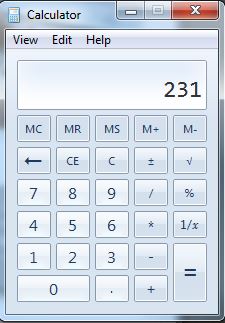
This works because each of the factors of the product is a multiple of 3. Let’s take another look at the calculator.

calculatorIf the first row is chosen, the sum of the digits is 1+2+3 = 6, a multiple of 3. And it doesn’t matter if the number is 123 or 312 or 231… the order of the digits is unimportant.

If the second row is chosen, the sum of the digits is 4+5+6 = 15, a multiple of 3.

If the third row is chosen, the sum of the digits is 7+8+9 = 24, a multiple of 3.

If the first column is chosen the sum of the digits is 1+4+7=12, a multiple of 3.

If the second column is chosen, the sum of the digits is 2+5+8 = 15, a multiple of 3.

If the third column is chosen, the sum of the digits is 3+6+9 = 18, a multiple of 3.

If one diagonal is chosen, the sum of the digits is 1+5+9 = 15, a multiple of 3.

If the other diagonal is chosen, the sum of the digits is 3+5+7 = 15, a multiple of 3.

This can be stated more succinctly using algebra. The digits in each row, column, and diagonal form an arithmetic sequence. For each row, the common difference is 1. For each column, the common difference is 3. And for a diagonal, the common difference is either 2 or 4. If I let a be the first term in the sequence and let d be the common difference, then the three digits are a, a + d, and a + 2d, and their sum is

a + (a+d) + (a+ 2d) = 3a + 3d = 3(a+d),

which is a multiple of 3. (Indeed, the sum is 3 times the middle number.)

green line

So each factor is a multiple of 3. That means the product has to be a multiple of 9. In other words, if the first factor is 3m and the second factor is 3n, where m and n are integers, their product is equal to

(3m)(3n) = 9(mn),

which is clearly a multiple of 9. Therefore, I can use the same adding-the-digits trick to identify the missing digit.

My Mathematical Magic Show: Part 5c

Last March, on Pi Day (March 14, 2015), I put together a mathematical magic show for the Pi Day festivities at our local library, compiling various tricks that I teach to our future secondary teachers. I was expecting an audience of junior-high and high school students but ended up with an audience of elementary school students (and their parents). Still, I thought that this might be of general interest, and so I’ll present these tricks as well as the explanations for these tricks in this series. From start to finish, this mathematical magic show took me about 50-55 minutes to complete. None of the tricks in this routine are original to me; I learned each of these tricks from somebody else.

green line

Though this wasn’t part of my Pi Day magic show, I recently read an interesting variant on my fourth trick. The next time I do a mathematical show, I’ll do this trick next — not to amaze and stun my audience, but to see if my audience can figure out why it works. Each member of the audience will need to have a calculator (a basic four-function calculator will suffice). Here’s the patter:

I want you to take out your calculator. Using only the digits 1 through 9, there are three rows, three columns, and two diagonals. I want you to pick either a row, a column, or a diagonal. Then I want you to enter a three digit number using those numbers. For example, if you chose the first row, you can enter 123 or 312 or 231 or any three-digit number using each digit once.

calculator

Now, I want you to multiply this number by another three-digit number. So hit the times button.

(pause)

Now, choose another row, column, or diagonal and type in another three-digit number, using each of the three digits once.

(pause)

Now hit the equals button to multiply those two numbers together.

(pause)

Is everyone done? The product you just computed should have either five or six digits. I want you to concentrate on one of those digits. Just make sure that you concentrate on a digit other than zero, because zero is boring. So concentrate on a nonzero digit.

(pause)

(I point to someone.) Without telling me the digit you chose, please tell me the other digits in your product.

The audience member will say something like, “3, 7, 9, and 2.” To which I’ll reply in three seconds or less, “The number you chose was 6.”

Then I’ll turn to someone else and ask which numbers were not scratched out. She’ll say something like, “1, 1, 9, 7, and 2.” I’ll answer, “The number you chose was 7.”

And then I’ll repeat this a few times, and everyone’s amazed that I knew the different numbers that were chosen.

green line

Clearly this works using the same logic as yesterday’s post: the product is always a multiple of 9, and so I can add the digits to figure out the missing digit. The more interesting question is: Why is the product always a multiple of 9? I’ll address this in tomorrow’s post.


My Mathematical Magic Show: Part 5b

Last March, on Pi Day (March 14, 2015), I put together a mathematical magic show for the Pi Day festivities at our local library, compiling various tricks that I teach to our future secondary teachers. I was expecting an audience of junior-high and high school students but ended up with an audience of elementary school students (and their parents). Still, I thought that this might be of general interest, and so I’ll present these tricks as well as the explanations for these tricks in this series. From start to finish, this mathematical magic show took me about 50-55 minutes to complete. None of the tricks in this routine are original to me; I learned each of these tricks from somebody else.

green line

Here’s the patter for my fourth and most impressive trick. As before, my audience has a sheet of paper and a pen or pencil; quite a few of them have calculators.

Write down any five-digit number you want. Just make sure that the same digit repeated (not something like 88,888).

(pause)

Now scramble the digits of your number, and write down the new number. Just be sure that any repeated digits appear the same number of times. (For example, if your first number was 14,232, your second number could be 24,231 or 13,422.)

(pause)

Is everyone done? Now subtract the smaller of the two numbers from the bigger, and write down the difference. Use a calculator if you wish.

(pause)

Has everyone written down the difference. Good. Now, pick any nonzero digit in the difference, and scratch it out.

(pause)

(I point to someone.) Which numbers did you not scratch out?

The audience member will say something like, “8, 2, 9, and 6.” To which I’ll reply in three seconds or less, “The number you scratched out was a 2.”

Then I’ll turn to someone else and ask which numbers were not scratched out. She’ll say something like, “3, 2, 0, and 7.” I’ll answer, “You scratched out a 6.”

green lineAfter performing this trick, I’ll explain how it works. I gave a very mathematical explanation in a previous post for why this trick works, but the following explanation seems to go over well with even elementary-school students. I’ll ask an audience member for the two five-digit numbers that they subtracted. Suppose that she tells me that hers were

43,125-24,513

I’ll now tell the audience that, ordinarily, we would plug this into a calculator or else start by subtracting the ones digits. However, I tell the audience, I’m now going to write this in a very unusual way:

(40,000 + 3,000 + 100 + 20 + 5) - (20,000 + 4,000 + 500 + 10 + 3)

I tell the audience, “For now, I’m not saying why I did this. But does everyone agree that I can do this?” Once I get agreement, then I proceed to the next step by grouping like digits together:

(40,000 - 4,000) + (3,000 - 3) + (100 - 10) + (20 - 20,000) + (5 - 500)

Again, I tell the audience, “For now, I’m not saying why I did this. But does everyone agree that I can do this?” Once I get agreement, then I proceed to the next step by reversing the signs of any negative differences:

(40,000 - 4,000) + (3,000 - 3) + (100 - 10) - (20,000 - 20) - (500 - 5)

Next, I factor each common difference. Notice that in each parenthesis, the second number is a factor of the first number:

4,000(10-1) + 3(1,000 - 1) + 10(10 - 1) - 20(1,000 - 1) - 5(100 - 1),

or

4,000(9) + 3(999) + 10(9) - 20(999) - 5(99).

Notice that the number in each pair of parentheses is a multiple of 9. Therefore, no matter what, the difference must be a multiple of 9.

This is the key observation that makes the trick work. Now, I go back to my audience member and ask what the difference actually was:

43,125-24,513 = 18,612

This difference must be a multiple of 9. Therefore, by one of the standard divisibility tricks, the digits of this number must add to a multiple of 9:

1 + 8 + 6 + 1 + 2 = 18.

Then I’ll ask the audience member, “Which number did you scratch out?” Suppose she answers 6. Then I’ll add up the remaining numbers:

1 + 8 + 1 + 2 = 12.

So I ask the audience, “So these four numbers add up to 12, but I know that all five numbers have to add up to a multiple of 9. What’s the next multiple of 9 after 12?” They’ll answer, “18”. I ask, “So what does the missing number have to be?” They’ll answer “18-12, or 6.”

Then I’ll repeat with someone else. If an audience member answers “8, 2, 9, and 6,” I’ll ask the audience for the sum of these four numbers. (It’s 25.) So they can figure out that the scratched-out number was 2, since 25+2 = 27 is the next multiple of 9 after 25.

green lineI’m often asked why I made people choose a five-digit number at the start of the routine. The answer is, I could have chosen any size number I wanted as long as I’m comfortable with quickly adding the digits at the end of the magic trick. In other words, if I had permitted nine-digit numbers, I might need to add 8 numbers at the end of the routine to get the missing number. I could do it, but I wouldn’t get the answer as quickly as the five-digit numbers.

Also, I’m often asked why it was important that I told the audience to scratch out a nonzero number. Well, suppose that I came to end of the routine and the audience member told me her remaining digits were 4, 3, and 2. These numbers have a sum of 9, and so the missing number hypothetically could be 0 or 9. So by instructing the audience to not scratch out a 0, that eliminates the ambiguity from this special case.

After showing the audience how the trick works, I’ll then ask an audience member to come forward and repeat the trick that I just performed. Then I’ll move on to the final act of my routine, which I’ll present in tomorrow’s post.

My Mathematical Magic Show: Part 5a

Last March, on Pi Day (March 14, 2015), I put together a mathematical magic show for the Pi Day festivities at our local library, compiling various tricks that I teach to our future secondary teachers. I was expecting an audience of junior-high and high school students but ended up with an audience of elementary school students (and their parents). Still, I thought that this might be of general interest, and so I’ll present these tricks as well as the explanations for these tricks in this series. From start to finish, this mathematical magic show took me about 50-55 minutes to complete. None of the tricks in this routine are original to me; I learned each of these tricks from somebody else.

green line

Here’s the patter for my fourth and most impressive trick. As before, my audience has a sheet of paper and a pen or pencil; quite a few of them have calculators.

Write down any five-digit number you want. Just make sure that the same digit repeated (not something like 88,888).

(pause)

Now scramble the digits of your number, and write down the new number. Just be sure that any repeated digits appear the same number of times. (For example, if your first number was 14,232, your second number could be 24,231 or 13,422.)

(pause)

Is everyone done? Now subtract the smaller of the two numbers from the bigger, and write down the difference. Use a calculator if you wish.

(pause)

Has everyone written down the difference. Good. Now, pick any nonzero digit in the difference, and scratch it out.

(pause)

(I point to someone.) Which numbers did you not scratch out?

The audience member will say something like, “8, 2, 9, and 6.” To which I’ll reply in three seconds or less, “The number you scratched out was a 2.”

Then I’ll turn to someone else and ask which numbers were not scratched out. She’ll say something like, “3, 2, 0, and 7.” I’ll answer, “You scratched out a 6.”

And then I’ll repeat this a few times, and everyone’s amazed that I knew the different numbers that were scratched out.

Then I explain how this trick works, which I’ll do in tomorrow’s post.


My Mathematical Magic Show: Part 4d

Last March, on Pi Day (March 14, 2015), I put together a mathematical magic show for the Pi Day festivities at our local library, compiling various tricks that I teach to our future secondary teachers. I was expecting an audience of junior-high and high school students but ended up with an audience of elementary school students (and their parents). Still, I thought that this might be of general interest, and so I’ll present these tricks as well as the explanations for these tricks in this series. From start to finish, this mathematical magic show took me about 50-55 minutes to complete. None of the tricks in this routine are original to me; I learned each of these tricks from somebody else.

green line

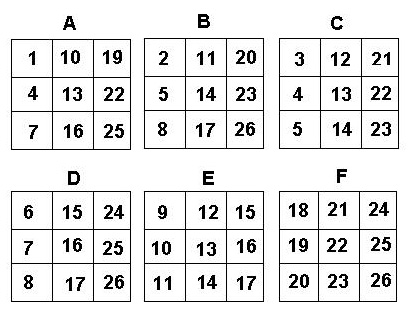
For my third trick, I’ll present something that I first saw when pulling Christmas crackers with my family. I’ll give everyone a piece of paper with six cards printed. I’ll also have a large version of this paper shown at the front of the room (taken from http://diaryofagrumpyteacher.blogspot.com/2014/04/freebie-friday-magic-number-cards.html; see also this Google search if this link somehow goes down):

Here’s the patter:

Think of a number from 0 to 63. Then, on your piece of paper, circle the cards that contain your number. For example, if your number is 15, you’ll need to circle the card in the upper-left because 15 is on that card. You’d have to circle all the cards that contain 15.

(pause)

Is everyone done? (Points to someone) Which cards did you circle?

At this point, the audience member will say something like “Top left, top middle, and bottom right.” Then I will add the smallest numbers on each card (in this case, 1, 2, and 32) and answer in five seconds or less, “Your number was 35 (or whatever the sum is).” It turns out that the number is always the sum of the smallest numbers on the selected cards.As shown in yesterday’s post, this is a consequence of the binary representation of whole numbers (as opposed to the ordinary decimal representation).

green line

Though I don’t do this in my magic routine for the sake of time, I have challenged my future high school math teachers to develop a similar magic trick for some other base, like base 3, just to make sure that they really understand the concept behind the above magic trick. Here are the cards that work for base 3 (taken from http://www.mathman.biz/html/sherimagic.html).

I encourage the reader to develop another set of cards for base 5. It will require 10 cards for numbers from 1 to 24.

With tomorrow’s post, I’ll continue my description of my magic routine.

My Mathematical Magic Show: Part 4c

Last March, on Pi Day (March 14, 2015), I put together a mathematical magic show for the Pi Day festivities at our local library, compiling various tricks that I teach to our future secondary teachers. I was expecting an audience of junior-high and high school students but ended up with an audience of elementary school students (and their parents). Still, I thought that this might be of general interest, and so I’ll present these tricks as well as the explanations for these tricks in this series. From start to finish, this mathematical magic show took me about 50-55 minutes to complete. None of the tricks in this routine are original to me; I learned each of these tricks from somebody else.

green line

For my third trick, I’ll present something that I first saw when pulling Christmas crackers with my family. I’ll give everyone a piece of paper with six cards printed. I’ll also have a large version of this paper shown at the front of the room (taken from http://diaryofagrumpyteacher.blogspot.com/2014/04/freebie-friday-magic-number-cards.html; see also this Google search if this link somehow goes down):

Here’s the patter:

Think of a number from 0 to 63. Then, on your piece of paper, circle the cards that contain your number. For example, if your number is 15, you’ll need to circle the card in the upper-left because 15 is on that card. You’d have to circle all the cards that contain 15.

(pause)

Is everyone done? (Points to someone) Which cards did you circle?

At this point, the audience member will say something like “Top left, top middle, and bottom right.” Then I will add the smallest numbers on each card (in this case, 1, 2, and 32) and answer in five seconds or less, “Your number was 35 (or whatever the sum is).” It turns out that the number is always the sum of the smallest numbers on the selected cards.

In yesterday’s post, I gave a similar but utterly unimpressive trick; the trick was unimpressive because it was obvious that the trick used our ordinary base-10 representation of whole numbers. The trick above is much more impressive because it uses binary (base-2) instead of base-10.

The cards above are carefully rigged using binary arithmetic, so that all numbers are written as sums of powers of 2. For example, on the card in the upper left, the first few numbers are

1 = 1

3 = 2 + 1

5 = 4 + 1

7 = 4 + 2 + 1

9 = 8 + 1

11 = 8 + 2 + 1,

and so on. On the right-hand side, I’ve written each number as the sum of powers of 2 (for the numbers at hand, that means 1, 2, 4, 8, 16, and 32). Notice that each expansion on the right hand side contains a 1. So, if the audience member tells me that her number is on the upper-left card, that tells me that there’s a 1 in the binary representation of her number.

Let’s now take a look at the first few number in the upper-middle card:

2 = 2

3 = 2+1

6 = 4+2

7 = 4+2+1

10 = 8+2

11 = 8+2+1,

and so on. Notice that each expansion on the right hand side contains a 2. So, if the audience member tells me that her number is on the upper-middle card, that tells me that there’s a 2 in the binary representation of her number.

Similarly, the upper-right card has numbers which contain 4 in its binary representation. The lower-left card has numbers containing 8. The lower-middle card has numbers containing 16. And the lower-right card has numbers containing 32. Happily for the magician, each of these numbers is also the smallest number on the card.

So, if the audience member will says “Top left, top middle, and bottom right,” then I know that the binary representation of her number contains 1, 2, and 32. Adding up those numbers, therefore, gives me the original number!

green lineAfter explaining how the trick works, I’ll call up an audience member to play the magician and repeat the trick that I just performed. Then I’ll move on to the next magic trick in the routine.


My Mathematical Magic Show: Part 4b

Last March, on Pi Day (March 14, 2015), I put together a mathematical magic show for the Pi Day festivities at our local library, compiling various tricks that I teach to our future secondary teachers. I was expecting an audience of junior-high and high school students but ended up with an audience of elementary school students (and their parents). Still, I thought that this might be of general interest, and so I’ll present these tricks as well as the explanations for these tricks in this series. From start to finish, this mathematical magic show took me about 50-55 minutes to complete. None of the tricks in this routine are original to me; I learned each of these tricks from somebody else.

green line

For my third trick, I’ll present something that I first saw when pulling Christmas crackers with my family. I’ll give everyone a piece of paper with six cards printed. I’ll also have a large version of this paper shown at the front of the room (taken from http://diaryofagrumpyteacher.blogspot.com/2014/04/freebie-friday-magic-number-cards.html; see also this Google search if this link somehow goes down):

Here’s the patter:

Think of a number from 1 to 63. Then, on your piece of paper, circle the cards that contain your number. For example, if your number is 15, you’ll need to circle the card in the upper-left because 15 is on that card. You’d have to circle all the cards that contain 15.

(pause)

Is everyone done? (Points to someone) Which cards did you circle?

At this point, the audience member will say something like “Top left, top middle, and bottom right.” Then I will add the smallest numbers on each card (in this case, 1, 2, and 32) and answer in five seconds or less, “Your number was 35 (or whatever the sum is).” It turns out that the number is always the sum of the smallest number on the given cards.

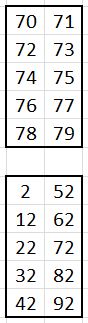
To explain this trick to my audience, I’ll present the following conceptually similar trick using 20 cards. I’ll ask the audience to pick a number between 0 and 99 and then find the cards that contain that number.

decimal magic trickSuppose that the audience member tells me that her number appears on these two cards:

decimal magic trick2The first card tells me that the number is in the 70s; the last card tells me that the ones digit is 2. So the answer must be 72. Stated another way, I can add the smallest number on each card (70 + 2) to get the answer.

This magic trick looks utterly unimpressive because the trick is so obvious because base-10 arithmetic has been so utterly drilled into our heads since elementary school. So my audience is usually surprised to learn that the first magic trick, with the six cards with numbers from 1 to 63, is conceptually the same as this 0-99 trick. I’ll explain this in the next post.

My Mathematical Magic Show: Part 4a

Last March, on Pi Day (March 14, 2015), I put together a mathematical magic show for the Pi Day festivities at our local library, compiling various tricks that I teach to our future secondary teachers. I was expecting an audience of junior-high and high school students but ended up with an audience of elementary school students (and their parents). Still, I thought that this might be of general interest, and so I’ll present these tricks as well as the explanations for these tricks in this series. From start to finish, this mathematical magic show took me about 50-55 minutes to complete. None of the tricks in this routine are original to me; I learned each of these tricks from somebody else.

green line

For my third trick, I’ll present something that I first saw when pulling Christmas crackers with my family. I’ll give everyone a piece of paper with six cards printed. I’ll also have a large version of this paper shown at the front of the room (taken from http://diaryofagrumpyteacher.blogspot.com/2014/04/freebie-friday-magic-number-cards.html; see also this Google search if this link somehow goes down):

Here’s the patter:

Think of a number from 0 to 63. Then, on your piece of paper, circle the cards that contain your number. For example, if your number is 15, you’ll need to circle the card in the upper-left because 15 is on that card. You’d have to circle all the cards that contain 15.

(pause)

Is everyone done? (Points to someone) Which cards did you circle?

At this point, the audience member will say something like “Top left, top middle, and bottom right.” Then I will add the smallest numbers on each card (in this case, 1, 2, and 32) and answer in five seconds or less, “Your number was 35 (or whatever the sum is).”

Then I’ll ask someone else which cards they circled, and then tell him/her the number that he/she chose (by quietly and quickly adding the smallest numbers on the selected cards.) Then I’ll do this for a couple more people until everyone is convinced that I’m a genius.

Then I’ll start explaining why the trick works… which I’ll begin with tomorrow’s post.