I'm a Professor of Mathematics and a University Distinguished Teaching Professor at the University of North Texas. For eight years, I was co-director of Teach North Texas, UNT's program for preparing secondary teachers of mathematics and science.
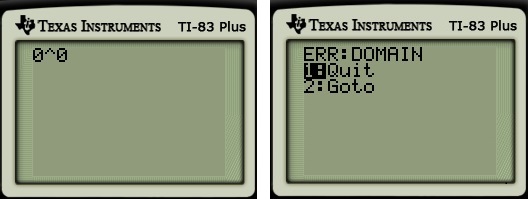
So as the base gets closer to , the answer remains . So, from this perspective, it looks like ought to be equal to .
In conclusion: looking at it one way, should be defined to be . From another perspective, should be defined to be .
Of course, we can’t define a number to be two different things! So we’ll just say that is undefined — just like dividing by is undefined — rather than pretend that switches between two different values.
Here’s a more technical explanation about why is an indeterminate form, using calculus.
Part 1. As before,
.
The first equality is true because, inside of the limit, is permitted to get close to but cannot actually equal , and there’s no ambiguity about if . (Naturally, is undefined if .)
The second equality is true because the limit of a constant is the constant.
Part 2. As before,
.
Once again, the first equality is true because, inside of the limit, is permitted to get close to but cannot actually equal , and there’s no ambiguity about if .
As before, the answers from Parts 1 and 2 are different. But wait, there’s more…
Part 3. Here’s another way that can be considered, just to give us a headache. Let’s evaluate
Clearly, the base tends to as . Also, as , so that as . In other words, this limit has the indeterminate form .
To evaluate this limit, let’s take a logarithm under the limit:
Therefore, without the extra logarithm,
Part 4. It gets even better. Let be any positive real number. By the same logic as above,
So, for any , we can find a function of the indeterminate form so that .
In other words, we could justify defining to be any nonnegative number. Clearly, it’s better instead to simply say that is undefined.
P.S. I don’t know if it’s possible to have an indeterminate form of where the answer is either negative or infinite. I tend to doubt it, but I’m not sure.
In my capstone class for future secondary math teachers, I ask my students to come up with ideas for engaging their students with different topics in the secondary mathematics curriculum. In other words, the point of the assignment was not to devise a full-blown lesson plan on this topic. Instead, I asked my students to think about three different ways of getting their students interested in the topic in the first place.
I plan to share some of the best of these ideas on this blog (after asking my students’ permission, of course).
This student submission comes from my former student Angel Pacheco. His topic, from Algebra II: solving linear systems of equations by either substitution or graphing.
How has this topic appeared in pop culture (movies, TV, current music, video games, etc.)?
Westerville South High School (WSHS) is located in Westerville, Ohio. In 2010, the math department of WSHS worked together with their students to create parodies of popular rap songs about particular mathematical topics. They have made a Facebook page as well as their own account for YouTube. This is a great idea because it uses websites that are popular among the students. In one of their recent videos, it is called All I Do is Solve, which is the parody of ‘All I Do is Win’ by DJ Khaled. This video has been constructed really well. It contains three ways to solve systems of equations, which are graphing, substitution, and elimination.
This video will be a great tool for an Engagement as well as right before the Evaluation. The sound of it being a famous rap song will certainly grab the interest of all students. I, personally, am not a big fan of rap but when I saw this video I could not stop watching it. It was really entertaining. A lot of teachers can gain a lot of ideas from this type of teaching.
What interesting things can you say about the people who contributed to the discovery and/or the development of this topic?
There are a lot things to say. There are a lot of different cultures that had their own procedure or different perspective to this topic. I found a website called History of Math. In early 200 BC, there are sections in an ancient China text called the ‘Jiuzhang suanshu’ that contains examples of linear equations. This is a selection from the text:
One pint of good wine costs 50 gold pieces, while one pint of poor wine costs 10. Two pints of wine are bought for 30 gold pieces. How much of each kind of wine was bought?
The solution of this problem is used by using systems of linear equations. I can use this example as well as other examples from the different cultures. I will primarily use this as an Engagement. I will begin to ask the class, “Do any of you know how long solving systems of equations has been around?” “Do you know who discovered this concept?” Using these questions to get them interested, I will use the website to inform the different contributions that each culture made.
How could you as a teacher create an activity or project that involves your topic?
I will create a project based activity that requires the students to work in groups of 3-4. The students will each have their own role: Gate Keeper, Focus Keeper, Analyst, and Encourager. The link below will be to the website that describes the same roles and the same project. Each students will have to learn the material to complete the project on their own, but they will not do it by themselves. The group complete it by itself.
The project consists of the real life scenario that their parent(s) have decided not to pay for their cell phone bill so they have a $50 limit per month so they must research the different options they have with different service providers. They will create a system of linear equations and they must be able to solve the systems of linear equations by the three methods: graphing, substitution, and elimination. This will allow for students to work together as well by themselves on an activity that is exciting. The students will be required to present their results at the end of the project. The project will turn to be an interdisciplinary lesson with systems of equations.
Source(s): The image below is a copy of the layout of the roles and project.
In my capstone class for future secondary math teachers, I ask my students to come up with ideas for engaging their students with different topics in the secondary mathematics curriculum. In other words, the point of the assignment was not to devise a full-blown lesson plan on this topic. Instead, I asked my students to think about three different ways of getting their students interested in the topic in the first place.
I plan to share some of the best of these ideas on this blog (after asking my students’ permission, of course).
This student submission comes from my former student Roderick Motes. His topic, from Pre-Algebra: finding prime factorizations.
A) How could you as a teacher create an activity or project that involves your topic?
“The magic words are squeamish ossifage”
-Plaintext decode of the RSA-196 challenge in the 1994 issue of Scientific American
Prime factorizations are an interesting topic. Being that prime factorization was a part of number theory which was, for several hundred years, considered the “last bastion of pure mathematics” we can often find it a struggle to relate the problem to students. But prime factorizations have found a use very recently.
In 1977 a paper was published submitting a possible encryption algorithm for computers that takes two very large prime numbers, multiplies them, and uses this to generate a key-value pair to make your information more secure. This encryption algorithm is currently the backbone of internet data exchange.
For students you can craft an activity around this ideas, framing them as being secret agents trying to hide data, that uses a naïve version of the RSA algorithm in order to generate keys. Even if you didn’t want the RSA algorithm you could use the idea of multiplying primes to generate some kind of cipher scheme which is not complex, and then use that. Students could be put into groups for the project and given a message which is encoded, and then they need to try and break it.
Clearly it would be untenable to give the students exceedingly large numbers but as a consequence of the fundamental theorem of arithmetic you can use smaller primes and still have unique cipher keys (2*5 is a perfectly valid key in RSA, as is 5*7, you can extend things to be 2*3*2 even.) You don’t have to use RSA cryptography, but it’s a good talking point. This could be an excellent project I think, but you as a teacher would need to take much time carefully building up everything to make sure students can do it.
B)How can this topic be used in your student’s future math and science courses?
This is a pretty difficult question for anything involving number theory but prime factorizations, as discussed above, are of particular interest to students who plan to take computer science. Understanding how things become cryptographically secure and implementation of the RSA algorithm and various cracking algorithms would not be out of place in an upper level high school comp. sci. course.
C) What interesting things can you say about the people who contributed to the discovery and/or development of this topic over time?
Number theory is hugely important to the history of mathematics as one of the oldest and most accessible areas of mathematical study. To look into the history of number theory is to look into the history of math itself. Prime factorization is an interesting part of number theory because primes are an interesting part of number theory.
In 300 BCE Euclid wrote Elements, largely considered to be one of in not the most important math book ever published. In Elements Euclid compiled what he knew to be the modern understanding of geometry, but he went a bit further as well. He discusses at length and eventually gives formal proof of, the fundamental theorem of arithmetic. The whole basis of the fundamental theorem is that numbers are either prime or composite, and if a number is composite we can break it down into primes (through Prime Factorization!)
For thousands of years number theory was considered a lofty subject, and finding prime factorizations would have been a mental workout akin to our doing Sudoku or Crossword puzzles. It wasn’t until we started creating machines that could count (and eventually machines that could connect us to countless videos of small, fluffy animals sneezing) that we found a practical use for prime factorization.
We noted that factoring big primes takes a while, students should have cursory familiarity with this idea, and created RSA cryptography based on this. Every now and again the RSA foundation would offer prize money for people to attempt to factorize some really big numbers. Prime factorization is even worth money (the RSA challenge in 1997 offered a $200k prize for factoring something around RSA-380.)
In my capstone class for future secondary math teachers, I ask my students to come up with ideas for engaging their students with different topics in the secondary mathematics curriculum. In other words, the point of the assignment was not to devise a full-blown lesson plan on this topic. Instead, I asked my students to think about three different ways of getting their students interested in the topic in the first place.
I plan to share some of the best of these ideas on this blog (after asking my students’ permission, of course).
This student submission comes from my former student Claire McMahon. Her topic, from Pre-Algebra: the Laws of Exponents (with integer exponents)
These laws are essential not only in math classes but in science classes as well. The laws of exponents are essential when learning scientific notation and important facts like Avogadro’s constant. This is just one of the important facts that students will encounter as they enter the world of exponents. There is a really awesome lesson plan devoted to finding this enormous number at the following website here. I implemented this in a classroom that called for an interdisciplinary lesson plan and had great success with it.
There are some really cool videos that deal with the laws of exponents and I love to incorporate music wherever I can in my math classes. This is one of my favorite videos that I came across as I was trying to reach for things to help engage my students in the middle of math class. Watch this YouTube video and see if you think you would enjoy showing this to your class. Even better for your class would be to create a video like this in a project.
I love to also find some great online activities that I can give to my students that are not too intensive but give them some great confidence in understanding. There are a few different websites that I have found to be very useful and somewhat cute!! I do want my students to have a basic understanding on how the laws of exponents work but we all get better at math by DOING math. This website gives you some great practice on laws of exponents with the same base and has a cute little monster to cheer you on along the activity! I am also a big fan of foldables and have found a great one on the internet to utilize for your class. It’s always fun to create something in math class that you would normally do in kindergarten!! Cutting and folding and making something your own is an awesome way to drive a topic and even to make a homework assignment fun. A foldable for the laws of exponents can be found here.
Here’s a simple probability problem that should be accessible to high school students who have learned the Multiplication Rule:
Suppose that you play the lottery every day for about 20 years. Each time you play, the chance that you win is chance in . What is the probability that, after playing times, you never win?
This is a straightforward application of the Multiplication Rule from probability. The chance of not winning on any one play is . Therefore, the chance of not winning consecutive times is , which we can approximate with a calculator.
Well, that was easy enough. Now, just for the fun of it, let’s find the reciprocal of this answer.
Hmmm. Two point seven one. Where have I seen that before? Hmmm… Nah, it couldn’t be that.
What if we changed the number in the above problem to ? Then the probability would be .
There’s no denying it now… it looks like the reciprocal is approximately , so that the probability of never winning for both problems is approximately .
Why is this happening? I offer a thought bubble if you’d like to think about this before proceeding to the answer.
The above calculations are numerical examples that demonstrate the limit
In particular, for the special case when , we find
The first limit can be proved using L’Hopital’s Rule. By continuity of the function , we have
The right-hand side has the form as , and so we may use L’Hopital’s rule, differentiating both the numerator and the denominator with respect to .
Applying the exponential function to both sides, we conclude that
The above calculation also justifies (in Algebra II and Precalculus) how the formula for continuous compound interest can be derived from the formula for discrete compound interest
All this to say, Euler knew what he was doing when he decided that was so important that it deserved to be named.
I received the following e-mail last week, and I thought it deserved a larger audience. For what it’s worth, I have added this to my list of resources.
Hello,
Sally Ride Science’s STEM Central™—home of the best STEM resources on the web—is now open… and it’s free, too!
We have reviewed thousands upon thousands of web resources for STEM instruction, and picked thousands of those that are especially suited to the needs of educators and students.
That’s what makes STEM Central special. Every resource has been vetted—reviewed and rated by educators, and ready for use in the classroom. You can search by topic, grade level, rating, or by the type of resources you need.
Visit STEM Central and find the best STEM resources for educators and students. It’s live now, so you can start using it today.
And if you think we missed something, then YOU can add it! Because starting November 1, 2013, you can:
Submit your favorite links from the web
Rate and review existing resources on STEM Central
In my capstone class for future secondary math teachers, I ask my students to come up with ideas for engaging their students with different topics in the secondary mathematics curriculum. In other words, the point of the assignment was not to devise a full-blown lesson plan on this topic. Instead, I asked my students to think about three different ways of getting their students interested in the topic in the first place.
I plan to share some of the best of these ideas on this blog (after asking my students’ permission, of course).
This student submission comes from my former student Roderick Motes. His topic, from Algebra II: polynomials and non-linear functions.
How can this topic be used in your students future math and science courses?
Polynomials are used extensively throughout math and science, and nonlinear functions have a place in math, science, and even business.
Consider a problem that is fundamental in both physics and calculus. How can we effectively model motion? To talk about motion we have to have a basic understanding of linear functions (these model constant acceleration problems well,) but we also need an understanding of polynomials if we are to gain a real appreciation for how acceleration is related to position; even the simplest kinematic problems will often require us to deal with polynomials.
Within business consider investing money at a bank. Your returns on investments made aren’t linear, they’re a function of the total amount you have at any given moment. The basic formula:
has a very funny setup, that is actually related in rather interesting ways to some fundamental concepts you will discuss in courses that have nonlinear functions as a topic.
The website http://zebu.uoregon.edu/~probs/mech.html has a great deal of physics problems, most of which are not novel, that demonstrate the need for nonlinear functions even within basic mechanics.
How does this topic extend what your students have learned in previous courses?
Linear change is often among the first topics we discuss in algebra. We use the same concept in geometry when talking about slope. It’s very easy to see applications of this. Weight as a function of a person’s height, and the very accessible choice of which cell phone plan is best for your family both use linear functions to model the real world.
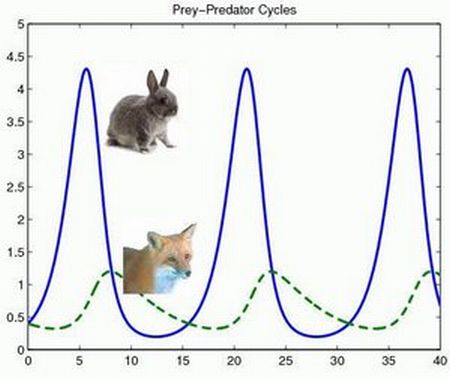
But, as discussed above, what happens when things don’t quite work out in a linear fashion? Animal populations in the wild are bound by some particularly interesting equations. Bacterial growth is modeled by exponential increase. Motion in physics is generally described with polynomials of degree at least two. Supply and Demand, while easy to understand as linear functions, are rarely so easily described in the real world.
At a more basic level nonlinear functions are tied to concepts of multiplication, division, and graphs. All of these are concepts students should be familiar with by late primary school. We describe multiplication, in one way, as repeated addition. So what happens when we repeat multiplication? Exponentiation. Exponents are at the heart of the study of nonlinear equations. Questions like this which students may have thought at some point or another are finally discussed and implemented within the context of nonlinear equations.
How can technology be used to effectively engage students?
Technology and modeling of functions go hand in hand, and any topic you can think of can be approached using technology.
To grab student attention you might discuss this wonderful Vi Hart video
The video discusses how frequency and pitch are related, and you’ll notice that sound is simply sine waves (a type of nonlinear function!) You can discuss this idea with students who are particularly engaged by music, and discuss how mathematics and nonlinear functions can, as Ms. Hart points out in the video, be used to explain why cultures so different still developed similar musical structures.
For students who are more into computers and programming you might be able to capture their attention with game design. As outlined at http://www.ehow.com/how-does_5296037_math-involved-designing-video-games.html, math and physics are used in the creation of physics engines like the Source Engine, or the Quake Engine for video games. To effectively model real situations you have to be able to understand nonlinear equations and be able to create convincing models for the computer to display. At my high school the computer science teacher was trying to make a great push to have computer science students and math students’ team up to actually create interesting things, while learning new material in an engaging way. Depending on your school, this could be an interesting approach that is also multidisciplinary.
In my capstone class for future secondary math teachers, I ask my students to come up with ideas for engaging their students with different topics in the secondary mathematics curriculum. In other words, the point of the assignment was not to devise a full-blown lesson plan on this topic. Instead, I asked my students to think about three different ways of getting their students interested in the topic in the first place.
I plan to share some of the best of these ideas on this blog (after asking my students’ permission, of course).
This student submission comes from my former student Claire McMahon. Her topic, from Algebra I: multiplying binomials like .
I personally have had the pleasure of teaching this part of Algebra 1 to a freshman high school class. The greatest part about the lesson was how the students were able to work together to really figure all of them out and better yet, they knew why! You can use several different versions of BINGO for practically anything in math. And who doesn’t love to win prizes. This website in particular has led me to some really great lesson plans and I credit a lot of this blog to a lot of the lesson plans I have personally implemented. Almost every one of them worked with almost little to no tweaking. I’m not exactly a huge fan of the FOIL concept so I used BINO instead of Bingo!! Just like singing the song and insert joke here. So here is the lesson on Distributive Bingo and how it works. The basic rundown is you give the students either the polynomial or the already factored binomials and have them solve it one way or the other. For example, if you are trying to focus more on the factoring and zeros making them go from a polynomial to factoring is good practice. The other really great thing is you can build scaffolds into the game itself by passing out hint cards or key concepts to help them figure out what they are looking for, similar to a formula sheet.
One of the great things about the Internet is there is so much information constantly flowing in and out at all times. YouTube is a great asset when trying to reinforce good study habits and good metacognition. Most students are very visual and it gives step-by-step instructions on how to do almost anything. The other key thing is they can pause rewind and replay if necessary. If you prefer to have a safer environment for your students to browse then you can lean them toward teacher tube, which has all the same resources without the junk videos. Here is one of the many multiplying videos that show a method similar to a Punnet Square, which is in line with learning genetics and heredity. They might have already learned this in biology but if not then it’s a great visual representation of a multiplication table and they will learn it again in science. It’s easy for the students to check their work and for you to see where any misconceptions can arise.
Algebra tiles are an amazing tool for teaching area models and multiplying binomials. There are virtual algebra tiles found on the Internet and also many different websites that you can buy a classroom set. I recommend your students to get used to because they show the value of negative and positive and how multiplying, adding, subtracting or dividing positive and negative integers affects the outcome. This concept is very important when you are learning to multiply binomials and is often lost or was never present in many student’s previous studies. You need to make sure that these basic skill benchmarks are met before embarking on an algebra tiles journey. If you teach the basic rules to play with algebra tiles then you will be set in teaching them multiplication and factoring of binomials and polynomials. We all love a journey of understanding and this is one of the most awesome tools that students can use to “do math.”


? Of course, it’s
.
? Again,
? Again,
, or
? Again,
, or
? In other words, what number, when cubed, is
, or
? In other words, what number, when raised to the 10th power, is
. Of course, it’s
.
. Again,
. Again,
? Again,
. Again,
? Again,










 . What is the probability that, after playing
  . Therefore, the chance of not winning
  , which we can approximate with a calculator.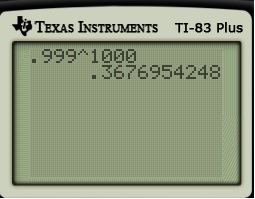

 ? Then the probability would be
  .
.
 , so that the probability of never winning for both problems is approximately
  .
.
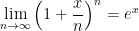
 , we find
 , we have
![\ln \left[ \displaystyle \lim_{n \to \infty} \left(1 + \frac{x}{n}\right)^n \right] = \displaystyle \lim_{n \to \infty} \ln \left[ \left(1 + \frac{x}{n}\right)^n \right]](https://s0.wp.com/latex.php?latex=%5Cln+%5Cleft%5B+%5Cdisplaystyle+%5Clim_%7Bn+%5Cto+%5Cinfty%7D+%5Cleft%281+%2B+%5Cfrac%7Bx%7D%7Bn%7D%5Cright%29%5En+%5Cright%5D+%3D+%5Cdisplaystyle+%5Clim_%7Bn+%5Cto+%5Cinfty%7D+%5Cln+%5Cleft%5B+%5Cleft%281+%2B+%5Cfrac%7Bx%7D%7Bn%7D%5Cright%29%5En+%5Cright%5D&bg=ffffff&fg=000000&s=0&c=20201002)
![\ln \left[ \displaystyle \lim_{n \to \infty} \left(1 + \frac{x}{n}\right)^n \right] = \displaystyle \lim_{n \to \infty} n \ln \left(1 + \frac{x}{n}\right)](https://s0.wp.com/latex.php?latex=%5Cln+%5Cleft%5B+%5Cdisplaystyle+%5Clim_%7Bn+%5Cto+%5Cinfty%7D+%5Cleft%281+%2B+%5Cfrac%7Bx%7D%7Bn%7D%5Cright%29%5En+%5Cright%5D+%3D+%5Cdisplaystyle+%5Clim_%7Bn+%5Cto+%5Cinfty%7D+n+%5Cln+%5Cleft%281+%2B+%5Cfrac%7Bx%7D%7Bn%7D%5Cright%29&bg=ffffff&fg=000000&s=0&c=20201002)
![\ln \left[ \displaystyle \lim_{n \to \infty} \left(1 + \frac{x}{n}\right)^n \right] = \displaystyle \lim_{n \to \infty} \frac{ \displaystyle \ln \left(1 + \frac{x}{n}\right)}{\displaystyle \frac{1}{n}}](https://s0.wp.com/latex.php?latex=%5Cln+%5Cleft%5B+%5Cdisplaystyle+%5Clim_%7Bn+%5Cto+%5Cinfty%7D+%5Cleft%281+%2B+%5Cfrac%7Bx%7D%7Bn%7D%5Cright%29%5En+%5Cright%5D+%3D+%5Cdisplaystyle+%5Clim_%7Bn+%5Cto+%5Cinfty%7D+%5Cfrac%7B+%5Cdisplaystyle+%5Cln+%5Cleft%281+%2B+%5Cfrac%7Bx%7D%7Bn%7D%5Cright%29%7D%7B%5Cdisplaystyle+%5Cfrac%7B1%7D%7Bn%7D%7D&bg=ffffff&fg=000000&s=0&c=20201002)
 as
as  , and so we may use L’Hopital’s rule, differentiating both the numerator and the denominator with respect to
  .
.![\ln \left[ \displaystyle \lim_{n \to \infty} \left(1 + \frac{x}{n}\right)^n \right] = \displaystyle \lim_{n \to \infty} \frac{ \displaystyle \frac{1}{1 + \frac{x}{n}} \cdot \frac{-x}{n^2} }{\displaystyle \frac{-1}{n^2}}](https://s0.wp.com/latex.php?latex=%5Cln+%5Cleft%5B+%5Cdisplaystyle+%5Clim_%7Bn+%5Cto+%5Cinfty%7D+%5Cleft%281+%2B+%5Cfrac%7Bx%7D%7Bn%7D%5Cright%29%5En+%5Cright%5D+%3D+%5Cdisplaystyle+%5Clim_%7Bn+%5Cto+%5Cinfty%7D+%5Cfrac%7B+%5Cdisplaystyle+%5Cfrac%7B1%7D%7B1+%2B+%5Cfrac%7Bx%7D%7Bn%7D%7D+%5Ccdot+%5Cfrac%7B-x%7D%7Bn%5E2%7D+%7D%7B%5Cdisplaystyle+%5Cfrac%7B-1%7D%7Bn%5E2%7D%7D&bg=ffffff&fg=000000&s=0&c=20201002)
![\ln \left[ \displaystyle \lim_{n \to \infty} \left(1 + \frac{x}{n}\right)^n \right] = \displaystyle \lim_{n \to \infty} \displaystyle \frac{x}{1 + \frac{x}{n}}](https://s0.wp.com/latex.php?latex=%5Cln+%5Cleft%5B+%5Cdisplaystyle+%5Clim_%7Bn+%5Cto+%5Cinfty%7D+%5Cleft%281+%2B+%5Cfrac%7Bx%7D%7Bn%7D%5Cright%29%5En+%5Cright%5D+%3D+%5Cdisplaystyle+%5Clim_%7Bn+%5Cto+%5Cinfty%7D+%5Cdisplaystyle+%5Cfrac%7Bx%7D%7B1+%2B+%5Cfrac%7Bx%7D%7Bn%7D%7D&bg=ffffff&fg=000000&s=0&c=20201002)
![\ln \left[ \displaystyle \lim_{n \to \infty} \left(1 + \frac{x}{n}\right)^n \right] = \displaystyle \frac{x}{1 + 0}](https://s0.wp.com/latex.php?latex=%5Cln+%5Cleft%5B+%5Cdisplaystyle+%5Clim_%7Bn+%5Cto+%5Cinfty%7D+%5Cleft%281+%2B+%5Cfrac%7Bx%7D%7Bn%7D%5Cright%29%5En+%5Cright%5D+%3D+%5Cdisplaystyle+%5Cfrac%7Bx%7D%7B1+%2B+0%7D&bg=ffffff&fg=000000&s=0&c=20201002)
![\ln \left[ \displaystyle \lim_{n \to \infty} \left(1 + \frac{x}{n}\right)^n \right] = x](https://s0.wp.com/latex.php?latex=%5Cln+%5Cleft%5B+%5Cdisplaystyle+%5Clim_%7Bn+%5Cto+%5Cinfty%7D+%5Cleft%281+%2B+%5Cfrac%7Bx%7D%7Bn%7D%5Cright%29%5En+%5Cright%5D+%3D+x&bg=ffffff&fg=000000&s=0&c=20201002)
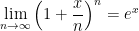
 can be derived from the formula for discrete compound interest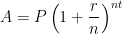


 .
.
